Why bother with Aargau when everyone heads for the mountains
Aargau and Solothurn do not show up on most Lucerne itineraries, and it is easy to see why: neither has a lake steamer, a cable car, or a peak with a view of the Alps. What they have instead is two of the best-preserved old towns in German-speaking Switzerland, a castle that has been lived in continuously since the 11th century, and a stretch of the Aare valley that quietly runs the country’s railways, its power stations and one of its dynastic founding stories all in the same 40 kilometres.
This guide covers two separate half-cantons that sit next to each other along the Aare: Aargau, with Aarau as its capital, and the canton of Solothurn, with its city of the same name. Both are reachable from Lucerne on the same Olten-anchored rail line, which makes it practical to treat them as one route rather than two separate trips.
Getting there from Lucerne
Both towns sit on the SBB network’s Mittelland corridor, and Olten is the hinge for nearly every connection.
| From Lucerne to | Journey time | Change | Frequency |
|---|---|---|---|
| Aarau | ~55 min | Olten (some direct) | Every 30 min |
| Solothurn | ~1 hr 15 min | Olten | Every 30 min |
| Olten | ~35 min | Direct | Every 15–30 min |
| Brugg | ~1 hr 5 min | Olten or Aarau | Every 30 min |
| Lenzburg | ~1 hr | Olten or Aarau | Every 30 min |
A standard second-class return from Lucerne to Aarau costs around CHF 60–70 without a discount card; Solothurn is a little more. A Half Fare Card cuts that roughly in half and is worth having if you are making more than one day trip like this one. See swiss-trains-explained if the fare and pass system is new to you, and the Swiss Travel Pass guide before deciding whether a multi-day pass makes sense for your trip as a whole.
Aarau: a town with painted roofs
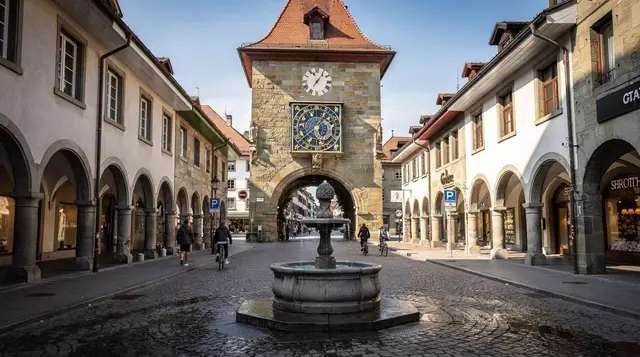
Aarau’s old town is small enough to cover on foot in two or three hours, and its single distinguishing feature is worth planning around: the Dachtraufen, painted eaves that run under the roofline of houses on streets like Pelzgasse, Rathausgasse and Kirchgasse. Around a hundred of them survive, dating mostly from the 18th and 19th centuries, painted with floral scrolls, ribbons and geometric bands that were a genuine local craft rather than a modern tourist addition. Nowhere else in Switzerland has this concentration of painted eaves, and it is the one thing that makes Aarau worth the detour rather than just a stop on the way to somewhere else.
Below the eaves, the town is built from grey-green sandstone quarried locally, giving the old town a more muted palette than the pastel fronts common elsewhere in Switzerland. The Rathaus (town hall) anchors the main square, and the Stadtturm marks the old town’s edge. Aarau has been the capital of canton Aargau since 1803 and briefly served as capital of the short-lived Helvetic Republic in 1798, which explains a scattering of administrative buildings slightly larger than the town’s size would otherwise suggest.
Walking the old town costs nothing beyond a coffee. If you want the history explained rather than guessed at, a local guide covers the eaves, the sandstone building tradition and the town’s brief spell as a national capital in a couple of hours.
a private walking tour of Aarau’s old town with a local guideFor context on how much a day like this costs against a typical Lucerne base budget, see lucerne-on-a-budget and lucerne-travel-costs.
Solothurn: the town built on eleven
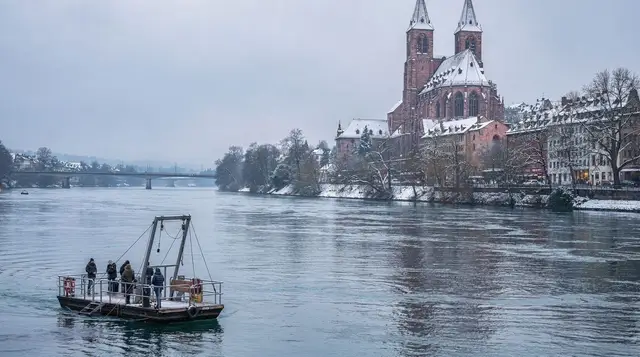
Solothurn sits on the Aare about 20 minutes further from Lucerne than Aarau, and it plays a different game: baroque grandeur rather than painted domestic charm. The town’s Catholic history as seat of French ambassadors to the Swiss Confederacy in the 17th and 18th centuries brought Italian and French architects north, and the result is a baroque old town that looks more like it belongs south of the Alps than in the Swiss Mittelland.
The centrepiece is St Ursen Cathedral, an 18th-century Baroque Classicist building with a broad flight of steps and eleven bells — a number that recurs across the town almost obsessively. Local tradition counts eleven churches and chapels, eleven towers and gates, eleven fountains, eleven historic guild houses and an old town wall with eleven corners. Not every count holds up to a literal audit, and guides differ on some of the specifics, but the pattern is old and genuine rather than an invented marketing hook, and it gives the town a running joke that locals clearly enjoy repeating.
Beyond the number games, Solothurn’s Baseltor gate, the Zeitglockenturm clock tower and the riverside promenade along the Aare are worth the walk on their own. The town is compact enough to see in half a day, and the cafés along the river are a legitimate reason to linger rather than a tourist trap — prices are close to Lucerne’s, not inflated.
a guided walking tour through Solothurn’s baroque old townIf you would rather set your own pace and just want the highlights pointed out efficiently, a shorter private option covers the cathedral, the gates and the old town core without committing to a full guided walk.
Lenzburg Castle: nine centuries under one roof
Lenzburg Castle sits on a hill above the town of the same name, roughly midway between Aarau and Zurich, and it has been continuously inhabited since it was first built around 1036. That continuity is the point: the interior spans furnished rooms from the medieval period through to the 19th century, including a well-preserved knight’s hall and a tower with views over the Aargau countryside rather than mountains.
Entry runs around CHF 12–16 for adults with reductions for children, and the castle is open seasonally with reduced winter hours — check before travelling in the shoulder months, since several Swiss castles close entirely for a stretch in January and February. The grounds and gardens are worth the entry fee on their own if the weather is good; the furnished interior is worth it on a wet day when the alternative is standing under an awning in the old town.
Lenzburg also sits near Europa Park’s transport corridor, which is why the local tour operators bundle transfers together rather than selling the castle alone.
a Lenzburg transfer bundled with Europa Park entryFamilies weighing this against other day options from Lucerne should also look at family-day-trips-from-lucerne and lucerne-with-kids before committing a full day to the Aargau side of the country.
Olten and the Aare valley: the practical middle
Olten is the town every train from Lucerne to Aargau or Solothurn passes through, and it is honest to say most visitors should stay on the train. It is a working railway junction — historically the hub of the Swiss federal rail network — with five bridges across the Aare and a modest old town that is pleasant for a coffee during a long connection but not a destination in its own right. If your connection gives you 40 minutes or more, the old town by the river is a reasonable way to spend it; if it gives you 15, do not try.
The wider Aare valley between Aarau and Brugg carries more weight than its flat, unglamorous landscape suggests. It is genuinely a valley between two worlds: medieval castle ruins on one side of the river, and on the other some of Switzerland’s working infrastructure, including nuclear power stations at Beznau and Gösgen that most tourist material quietly skips over. It is not a scenic contradiction anyone needs to seek out deliberately, but it explains why the valley reads as more functional and less photogenic than the postcard version of Switzerland — and why locals treat it as ordinary rather than remarkable.
Brugg and the cradle of the Habsburgs
Brugg, a small town at the confluence of the Aare, Reuss and Limmat rivers, is easy to underrate. Just outside town stand the ruins of Habsburg Castle, the ancestral seat from which the House of Habsburg took its name before the family’s centre of power shifted to Austria and, eventually, to the Habsburg Empire that shaped much of European history for six centuries. The ruins themselves are modest — a keep and fragments of walls rather than a restored fairy-tale castle — but the historical weight of the site is real, and it costs nothing to visit.
Brugg is also close to Vindonissa, once a major Roman legionary camp, with a small museum covering the Roman period of the region. For a more structured way to see the town and its surroundings, including corners most day-trippers miss entirely, a longer guided outing works better than trying to piece the sites together on foot without local knowledge.
a six-hour guided outing through Brugg and Aargau’s less-visited cornersWhere this fits against other Lucerne day trips
Aargau and Solothurn compete for the same day-trip slot as Bern, Basel and Zurich, and they lose on drama but can win on quiet. There are no crowds to speak of outside a handful of festival weekends, admission to the old towns themselves is free, and the trains are some of the least crowded on the network compared with the Interlaken or Zurich lines.
| Destination | Train from Lucerne | What you get | What you don’t |
|---|---|---|---|
| Aarau | ~55 min | Unique painted old town, low crowds | Nightlife, big museums |
| Solothurn | ~1 hr 15 min | Baroque architecture, riverside cafés | Mountain or lake views |
| Basel | ~1 hr 15 min | Major museums, Rhine, three-country point | Higher prices, more crowds |
| Bern | ~1 hr | Capital city, UNESCO old town | Fewer surprises for repeat Swiss visitors |
| Zurich | ~45 min–1 hr | Biggest city, best shopping and transit links | Least “small-town Switzerland” feel |
For a broader comparison of how a day here stacks up against Lucerne’s more obvious alternatives, see the day-trips section and day-trips-from-lucerne. If you are building a longer stay around Lucerne rather than a single day out, a five-day itinerary has room to fit one Aargau or Solothurn day without crowding out the mountain excursions most people come for.
Practical notes before you go
Both Aarau’s and Solothurn’s old towns are flat and fully walkable, with no significant hills — a contrast with Lucerne’s own old town, which is manageable but has more slope. Public toilets, water fountains (mostly drinkable, as in the rest of Switzerland) and benches are plentiful in both. Neither town has significant queues at any time of year, so there is little benefit to arriving at opening time the way there is at Chapel Bridge or the Lion Monument.
Shops in both towns follow standard Swiss hours: closed Sundays, and many close for a lunch break between roughly noon and 2pm on weekdays, a habit that has mostly disappeared in Lucerne and Zurich but persists in smaller cantonal capitals. If you are travelling on a Sunday, plan around cafés and museums rather than shopping.
Combine a day here with a Half Fare Card if you are making more than one such trip during your stay, and check getting-around-lucerne for how to connect your first and last legs to the main station efficiently. For currency and budgeting context specific to smaller Swiss towns, where prices run slightly below Lucerne and Zurich but not dramatically so, see the budget tool and lucerne-travel-costs.
Questions about visiting Aargau and Solothurn from Lucerne
How do I get from Lucerne to Aarau and Solothurn?
Both are reached by direct or one-change SBB trains through Olten. Aarau takes about 55 minutes, Solothurn about 1 hour 15 minutes. Trains run roughly twice an hour on both routes, so there is no need to plan around a fixed timetable slot.
Can I visit Aarau and Solothurn in one day?
You can, but it is a full day with limited time in each town. Aarau and Solothurn are on different lines and the cross-connection via Olten adds transfer time, so most visitors get more out of picking one town and adding Lenzburg Castle or Brugg instead.
What are the painted eaves in Aarau?
Dachtraufen are the painted undersides of roof eaves along Aarau’s old-town houses, decorated from the 18th century onward with floral and geometric motifs. Around a hundred survive, concentrated on streets like Pelzgasse and Rathausgasse, and they are unique to Aarau within Switzerland.
Why is Solothurn called the town of eleven?
Local tradition ties the town to the number eleven: eleven churches and chapels, eleven towers and gates, eleven fountains, eleven bells on St Ursen Cathedral, and an eleven-sided old town wall. Not every count survives close inspection, but the pattern is genuine and guides lean on it heavily.
Is Lenzburg Castle worth the entry fee?
For a family or a rainy afternoon, yes: it is one of Switzerland’s oldest inhabited castles, with furnished rooms spanning nine centuries and a genuinely good children’s programme. As a standalone reason to travel from Lucerne, it is a moderate detour rather than a headline sight.
Is the Swiss Travel Pass worth it for this trip?
If you already hold one for a longer Swiss itinerary, it covers the trains to Aarau and Solothurn at no extra cost. Buying one purely for a single day trip from Lucerne to Aargau or Solothurn is not worth it; a Saver Day Pass or a regular point-to-point ticket works out cheaper.
Is Olten worth stopping in?
Only if you have a long connection to fill. Olten is a functional railway junction with five bridges over the Aare and a compact old town, honest but modest compared with Aarau or Solothurn. Most visitors are better off staying on the train.