Getting around Lucerne: walking, buses, boats and bikes
What's the best way to get around Lucerne?
Lucerne's old town and lakefront are compact enough to walk almost everywhere in 15-20 minutes, so most visitors barely need transport inside the city. VBL buses cover the rest for CHF 2.60-4.40 a ride, the free Visitor Card issued by most hotels covers city buses for the length of your stay, and the lake boats double as a genuine way to reach villages like Weggis without a car.
Lucerne is a walking city first
Before working out buses or boats, it’s worth knowing that most of what visitors come for in Lucerne sits inside a 20-minute walk. The station (Luzern Bahnhof) and the main boat pier share the same forecourt on the lake, and from there it’s five minutes to the Kapellbrücke, eight to the Old Town’s main squares, and fifteen along the water to the Lion Monument. Very little in the centre genuinely needs a bus, and the cobbled lanes of the old town are more pleasant on foot than from a bus window anyway.
That said, the flat centre is deceptive. Lucerne climbs quickly once you head away from the water: the Musegg Wall towers sit on a hillside, and several hotels in the Hirschmattquartier or up towards Sonnenberg involve a genuine slope with luggage. If your accommodation is more than about a kilometre from the station, or up a hill, factor in a bus or a taxi for the arrival day with bags, even if you’d happily walk it empty-handed.
VBL buses: the practical backbone
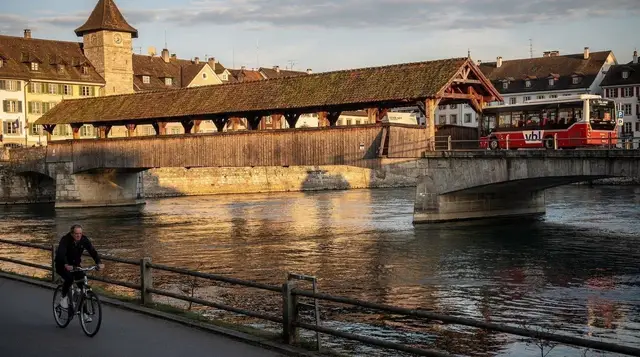
VBL (Verkehrsbetriebe Luzern) runs the city and near-suburban bus network, and it’s genuinely useful once you’re staying somewhere outside the old town or heading to the Swiss Museum of Transport, the KKL, or a residential neighbourhood. Buses are frequent (every 7-10 minutes on core routes during the day), clean, and reliably on time in the way Swiss public transport generally is.
Tickets are bought from the yellow machines at every stop, not from the driver, and you must validate before boarding — there’s no conductor check on entry but inspectors do fine without a valid ticket (CHF 100 on the spot). Pricing works on a zone system:
| Ticket | Price | Covers |
|---|---|---|
| Short-hop (Kurzstrecke) | CHF 2.60 | Up to 4 stops, no transfers |
| Single, 1 zone | CHF 4.20 | Most single crossings of the centre |
| Single, 2 zones | CHF 4.40 | Slightly further trips, e.g. to Kriens |
| Day pass, zones 10-11 | CHF 9.60 | Unlimited city travel for the day |
Zones 10 through 13 cover the city and immediate suburbs, which is what matters for a typical stay. If you’re also taking a train that day — say, out to Weggis or Vitznau by bus and back by boat — check whether a Swiss Travel Pass or Tell-Pass already covers VBL buses before buying a separate ticket, because both do.
The Visitor Card: free transport most people forget to collect
Almost every hotel, guesthouse, hostel and campsite in Lucerne issues a free Visitor Card (sometimes called a guest card) once you’ve paid the local overnight tax, which is usually already built into your room rate or added at check-in. Ask for it explicitly — it isn’t always offered — because it covers VBL city buses in zones 10-13 for every day of your stay, at no extra cost.
For a short city stay this alone can replace most bus tickets you’d otherwise buy individually. It does not cover boats, trains, or the mountain railways, and it’s tied to your specific dates, so it’s worth checking it hasn’t expired if you extend a stay. Day-trippers without overnight accommodation in Lucerne don’t get one, which is one more reason a short stay in the city itself, rather than a pure day trip, tends to pay for itself.
Boats as transport, not just as cruises
This is the part visitors most often miss: Lucerne’s lake boats are scheduled public transport with a timetable, not only sightseeing tours. The regular services (not the paddle steamers specifically, though they run the same routes) connect the city to lakeside villages including Weggis, Vitznau, Küssnacht, and the base of the Bürgenstock funicular, and they’re covered by the Swiss Travel Pass and the regional Tell-Pass.
For a genuinely pleasant alternative to a bus, taking the 35-40 minute boat to Weggis to start a walk or catch the cable car up Rigi is both more scenic and no more expensive than the road option once you already hold a pass. Full timetables and how the point-to-point pricing works without a pass are covered separately in the boat timetable guide, and the five historic paddle steamers that share the routes are worth knowing about even if you’re travelling functionally rather than for the occasion.
If you’d rather not manage timetables and connections at all, a private option covers the water without any of the logistics:
a private luxury boat cruise on Lake Lucerne puts you on your own schedule rather than the public timetable.
Cycling and e-bikes along the lakeshore
The path running north-east from the city towards Weggis is flat, largely separated from traffic, and one of the more rewarding short rides available from a Swiss town centre — figure roughly 90 minutes at an easy pace one-way, less on an e-bike. It’s a genuinely practical way to reach the lower Rigi villages without waiting on a bus or boat timetable.
Inside the old town itself, cycling is more hassle than help: the lanes are narrow, cobbled, often pedestrianised, and bikes are not permitted on the covered bridges, so you’ll be walking the bike more than riding it. Rental points cluster near the station, and e-bikes are widely available and worth the small premium given how the terrain around the lake tends to climb the moment you leave the shoreline. For a guided version that also takes in some of the lake by boat afterwards:
a private e-bike tour around four lakes finishing with a Lake Lucerne cruise covers more ground than most visitors manage solo in a day, and a slower version built for the evening light is available as a private sunset cycling tour with a guide.
Full rental locations, prices and route notes are in the dedicated cycling and e-bike guide if you’re planning a longer ride than a lakeside afternoon.
Getting oriented without walking cold
If you’d rather have someone explain the layout on your first afternoon than work it out from a map, a short guided introduction covers more ground than wandering does and tends to save time later in the trip. Two options worth knowing about:
an e-tuktuk city tour of Lucerne covers the centre and a wider loop in under an hour without any walking, which suits a short layover or a first afternoon with tired legs from travel. A more traditional option on foot is a private walking tour of Lucerne, which is a reasonable way to learn the old town’s layout properly before navigating it alone.
Arriving in Lucerne and connecting onward
Most visitors arrive by train. Zürich Airport (ZRH) is roughly an hour away on a direct train, and the connection is simple enough that a taxi or transfer rarely makes sense — the full route and timings are in the Zürich airport to Lucerne guide. Basel-Mulhouse (BSL) is about 90 minutes by train. Domestically, Swiss trains run on a clockface timetable and are punctual enough that a five-minute connection at Zürich Hauptbahnhof is a normal, reliable transfer rather than a risk.
If you’re arriving with a lot of luggage and don’t want to carry it through the station and across town, left-luggage lockers and porter services at Luzern Bahnhof are covered in the luggage and left-luggage guide. Renting a car is rarely worth it for the city stay itself — parking runs CHF 3-5 an hour in the centre, and public transport plus the odd taxi covers everything most itineraries need — though it becomes more sensible for certain day trips into rural valleys with sparser train coverage; that trade-off is weighed properly in the car rental in Switzerland guide.
Putting it together for a short stay
For a stay of one to three nights, the practical pattern most visitors settle into looks like this: walk everywhere inside the old town and along the lakefront, use the free Visitor Card for any bus trip outside that radius, and treat the boats as a normal way to reach a lakeside village rather than saving them for a special cruise. Buy a Swiss Travel Pass or Tell-Pass before arrival if you’re also doing mountain excursions or day trips, since it quietly folds VBL buses and the regular boats into the same ticket — details on which pass suits which itinerary are in the Swiss Travel Pass guide.
None of this changes much whether you’re planning a single night or a longer stay — see the how many days in Lucerne guide for that decision, and the one-day itinerary for how the walking distances above map onto an actual schedule. What does change with a longer stay is how much the free Visitor Card and a Swiss Travel Pass end up paying for themselves; on a single night, VBL’s pay-as-you-go single tickets are usually simpler, and the running costs of getting around are broken down properly in the Lucerne travel costs guide.
None of the transport options above are expensive by Swiss standards, but they add up on a longer trip, and a bus ticket bought out of habit rather than necessity is one of the easiest places to overspend without noticing. Working out which of the free or already-covered options apply to your specific stay before you arrive is the difference between a transport budget of a few francs and one that creeps past what a taxi would have cost.
Transport passes & transfers on GetYourGuide
Verified deep-linked GetYourGuide tours. Book through these links and we earn a small commission at no cost to you.
GetYourGuide does not provide a product photo for this activity — the image shows the meeting point, photographed by us.