Why the lake has four arms, not one shape
Lake Lucerne looks simple on a postcard and confusing on an actual map. It is not one long body of water but four distinct arms meeting at a central point off Lucerne, each pointing into a different canton. That is also why the German name, Vierwaldstättersee, translates roughly as “lake of the four forest cantons” rather than anything about its shape.
The city bay, where every visitor starts, sits in the canton of Lucerne and is the smallest and calmest of the four. West of it, past Kussnacht, the Küssnachter See pushes into the canton of Schwyz. South-west, the Alpnachersee narrows toward Mount Pilatus and the canton of Obwalden. South-east, past Weggis and Vitznau, the lake opens again and then squeezes into its longest and most dramatic arm, the Urnersee, running down through the canton of Uri to Flüelen. Four arms, four cantons, one name that covers all of it.
This matters for planning because a “Lake Lucerne cruise” sold at the pier could mean any of these. A one-hour loop stays inside the city bay and shows you Lucerne from the water, nothing more. A trip toward the Rigi side means Weggis and Vitznau. A trip toward Pilatus means Alpnachstad. And the trip that shows the lake at its most alpine, cliffs dropping straight into the water, is the long run down the Urnersee to Flüelen and Brunnen - a different outing altogether from a short city loop, in length, cost and scenery.
The five paddle steamers, and why they are worth seeking out
Five historic paddle steamers still work the lake on the standard timetable, alongside a larger fleet of modern motor vessels. All five date from between 1901 and 1928 and are still coal- or oil-fired, still visibly working their side-mounted paddle wheels rather than a hidden propeller. They are DS Stadt Luzern, DS Schiller, DS Unterwalden, DS Uri and DS Gallia, run by the Lake Lucerne Navigation Company (SGV).
None of them run every departure. The Navigation Company publishes which vessel serves which crossing on a given day, and it changes with maintenance schedules, so if riding a genuine paddle steamer rather than a modern boat matters to you, check the vessel assigned to your specific sailing before buying a ticket, not after. A first-class ticket on a paddle steamer buys access to the restaurant saloon and, on some routes, the engine room viewing area, where the connecting rods are visibly turning a few feet from the rail.
Boarding is at Lucerne’s Bahnhofquai, directly outside the railway station, or at any of the lakeside piers the route serves - there is no need to start every journey from the city.
The piers that actually matter
The lake has more than 30 stops, and most visitors only need a handful of them:
| Pier | What it connects to |
|---|---|
| Lucerne (Bahnhofquai) | Starting point for every route; train station is adjacent |
| Vitznau | Cog railway up the Rigi |
| Weggis | Cable car up the Rigi, quieter alternative to Vitznau |
| Alpnachstad | Cog railway up Pilatus, the steepest in the world |
| Kehrsiten-Bürgenstock | Funicular up to Bürgenstock and the Hammetschwand lift |
| Brunnen | Gateway to canton Schwyz and the Swiss Path |
| Flüelen | End of the line, connecting trains toward Andermatt and the Gotthard |
Vitznau, Alpnachstad and Kehrsiten-Bürgenstock are the three piers built around a boat-plus-mountain connection, and they are the ones worth planning a day around rather than treating as a scenery stop.
Boat and mountain combinations that work
Pairing a boat leg with a mountain railway is the single best way to use the lake, because it turns a photo opportunity into an actual itinerary. The three combinations that consistently work:
Lucerne to Vitznau, then the Rigi cog railway. The oldest mountain railway in Europe, running since 1871, climbs from the pier itself. Weggis, one stop further, offers the cable-car alternative if the queue at Vitznau is long, which it often is in July and August.
Lucerne to Alpnachstad, then Pilatus. The Alpnachstad cog railway is the steepest in the world, at a gradient of up to 48%, and only runs from late spring to autumn depending on snow. Outside that window, the only way up is the cable car from Kriens, which does not connect to the boat pier.
Lucerne to Kehrsiten-Bürgenstock, then the funicular. The shortest crossing of the three, and the only one that ends at a hotel and viewing terrace rather than an open summit, plus the Hammetschwand lift, Europe’s highest exterior lift, bolted onto the cliff face above.
a private day trip that pairs the Pilatus cog railway with a lake crossing removes the timetable-matching from this, which is worth the premium if your schedule is tight and a missed connection would cost you the afternoon.
Cable cars and cog railways on all three mountains close for scheduled maintenance in spring and again in autumn, on dates that shift year to year. This is the detail that ruins the most days on the lake: arriving at a pier timed perfectly for a mountain railway that turns out to be shut for revision. Check the specific railway’s operating dates before building a day around it, not the general “boats run April to October” rule, which applies to the lake and not to any one summit.
A short cruise versus the crossing to Flüelen
The difference in scale here catches people out. A standard round-trip loop out of Lucerne, the kind sold as a scenic hour on the water, stays inside the city bay and takes roughly an hour. It is a reasonable way to see Lucerne’s old town from the water and nothing more ambitious than that.
The full length of the lake, Lucerne to Flüelen, is a different undertaking: just over three hours one way on the direct boat, longer with stops. It passes through all four arms, past Vitznau and Weggis, through the narrows below Bürgenstock, and down the Urnersee, where the mountains close in and the water turns from lake-blue to a colder, darker shade. This is the crossing people mean when they say Lake Lucerne is dramatic - the city bay, on its own, is pleasant but not dramatic.
the round trip from Brunnen down to Flüelen and back is the practical way to see this stretch without committing to the full six-hour there-and-back from Lucerne itself: catch a train to Brunnen (about 40 minutes from Lucerne), then join the boat there.
Flüelen also connects onward by train toward Andermatt and the Gotthard, so a one-way boat down and a train back is a genuine itinerary, not just a there-and-back cruise.
What a day on the water actually costs
None of this is cheap, and pretending otherwise does not help anyone budget for it. A single one-hour city-bay loop runs roughly CHF 30-40 second class. The half-day run out to Vitznau or Alpnachstad, one way, is closer to CHF 40-50 before adding the mountain railway on top, which on Pilatus or the Rigi will add another CHF 70-90 for the round trip up and down.
| Route | Approx. one-way fare (2nd class) | Approx. duration |
|---|---|---|
| Lucerne city loop | CHF 30-40 | ~1 hour |
| Lucerne to Vitznau | CHF 30 | ~1 hour |
| Lucerne to Alpnachstad | CHF 28 | ~1 hour 15 |
| Lucerne to Brunnen | CHF 36 | ~1 hour 40 |
| Lucerne to Flüelen | CHF 46 | ~3 hours 10 |
The Swiss Travel Pass covers scheduled boat services on Lake Lucerne at no extra charge, which changes the maths considerably if you are already holding one for the trains. The regional Tell-Pass does the same for central Switzerland specifically, boats and several of the mountain railways included, and is worth comparing against the national pass if the lake and its surrounding peaks are the whole point of the trip rather than one stop on a wider Swiss itinerary. See our guide to the unlimited train, bus and boat pass for how the coverage breaks down.
First class, where it is offered, typically adds 60-80% to the second-class fare and buys a quieter upper deck and, on the paddle steamers, the restaurant saloon.
Seeing the lake without a scheduled boat
Scheduled sailings are not the only way onto the water, and for a lower-key, self-paced view of the shoreline, an e-bike route that follows the lake and finishes with a cruise back is a genuine alternative to the timetabled piers. a guided e-bike route around four of the region’s lakes, ending on a Lake Lucerne cruise covers more shoreline in a morning than any single boat route manages, at the cost of doing some of the work yourself.
For a smaller group wanting the water without a fixed timetable at all, a chartered option removes the schedule entirely: a private boat charter on Lake Lucerne sets its own route and stops, which is the only way to linger at a single bay, such as the cliffs below Bürgenstock, for longer than a scheduled stop allows.
When to go
The full five-boat, full-timetable season runs roughly May to September. Outside that, from October, the timetable thins noticeably, and by December it drops to a skeleton winter service on the core routes only - Lucerne to Vitznau and a handful of others keep running, but not the full network, and not the paddle steamers, which are largely a fair-weather fleet. If a specific mountain combination or the full Flüelen run is the goal, the shoulder months of May, June and September give the full timetable with noticeably shorter queues at Vitznau and Alpnachstad than July and August bring.
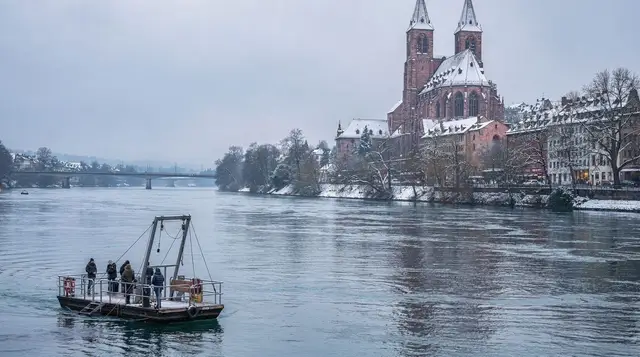
Winter is not without its appeal - the lake in low cloud with snow on the shoreline peaks is a genuinely different sight from the summer view - but go in expecting a reduced network and no paddle steamers, not the full experience at a quieter time.
Lake Lucerne FAQ: boats, piers and timing
How many arms does Lake Lucerne actually have?
Four: the city bay by Lucerne itself, the Küssnachter See toward Schwyz, the Alpnachersee toward Pilatus and Obwalden, and the Urnersee, the long southern arm running down to Flüelen in Uri. The German name Vierwaldstättersee, “lake of the four forest cantons”, refers to this shape.
What are the five paddle steamers called?
DS Stadt Luzern, DS Schiller, DS Unterwalden, DS Uri and DS Gallia, all built between 1901 and 1928 and still in scheduled service alongside the modern motor vessel fleet.
Does the Swiss Travel Pass cover Lake Lucerne boats?
Yes. Scheduled sailings on Lake Lucerne are included with a Swiss Travel Pass at no supplement. The regional Tell-Pass covers the same routes plus several connecting mountain railways, and is worth comparing if the lake and its peaks are the main focus of the trip.
How long does the crossing to Flüelen take?
Just over three hours one way on the direct boat from Lucerne, longer with intermediate stops. Many visitors instead join the boat partway, at Brunnen, cutting the one-way time to under an hour and a half.
Which pier should I use for Mount Pilatus or the Rigi?
Alpnachstad for the Pilatus cog railway, which only operates from late spring to autumn depending on snow. Vitznau for the Rigi’s Vitznau-Rigi cog railway, or Weggis, one stop further, for the Rigi cable car as an alternative when Vitznau is busy.
Do the boats run all year?
A reduced winter timetable runs on the core routes, but the full network and the paddle steamers largely stop from around October through spring. Check the current timetable before planning a winter visit around a specific route.
Is a one-hour lake cruise worth doing from Lucerne?
For a first view of the city from the water, yes, but treat it as exactly that: a city-bay loop, not a tour of the lake. It shows none of the Urnersee’s cliffs or the mountain-railway piers further out.
Can I do a mountain and a boat in the same day?
Yes, and it is the best way to use the lake. Vitznau-Rigi, Alpnachstad-Pilatus and Kehrsiten-Bürgenstock are all built around exactly this pairing, with the mountain railway or funicular departing from the pier itself. Just confirm the specific railway is not closed for its spring or autumn maintenance window before you go.