Lucerne old town walking guide
How long does the Lucerne old town walking route take?
The core loop, from Chapel Bridge to Weinmarkt, Hirschenplatz, the Spreuer Bridge and back, takes about 90 minutes at an unhurried pace with no stops. Add the Musegg Wall towers and you're looking at 2.5 to 3 hours in total, longer if the towers are open and you climb more than one or two.
Lucerne’s old town is small enough to see in an afternoon and dense enough that most visitors miss half of it because they stop at the bridge photo and turn back. This route covers the parts worth the detour: the two wooden bridges, the two squares with the best painted façades, and the medieval wall above the rooftops that almost nobody who’s only in town for a day bothers to climb. None of it requires a car, a bus ticket or a booking. It does require comfortable shoes for the last stretch, which is uphill on cobbles.
Before you start: the route at a glance
The whole loop is under 3 km and gains about 70 metres of elevation, all of it on the climb to the Musegg Wall. You can walk it in either direction; this guide goes anticlockwise from the station, which puts the steepest part near the end when you’ve already seen the flat highlights.
| Stop | Walking time to next stop | Cost |
|---|---|---|
| Lucerne station to Chapel Bridge | 3 min | Free |
| Chapel Bridge (crossing + Water Tower exterior) | 10-15 min | Free |
| Rathaus quay to Weinmarkt | 5 min | Free |
| Weinmarkt to Hirschenplatz | 3 min | Free |
| Hirschenplatz to Spreuer Bridge | 8 min | Free |
| Spreuer Bridge crossing | 10 min | Free |
| Spreuer Bridge to Musegg Wall (first tower) | 12-15 min, uphill | Free if towers are open |
| Musegg Wall walk (rampart, all open towers) | 45-60 min | Free |
| Wall back down into town | 15 min | Free |
Total moving time is around 90 minutes; with photo stops, a coffee and one or two open towers, budget half a day.
Chapel Bridge and the Water Tower
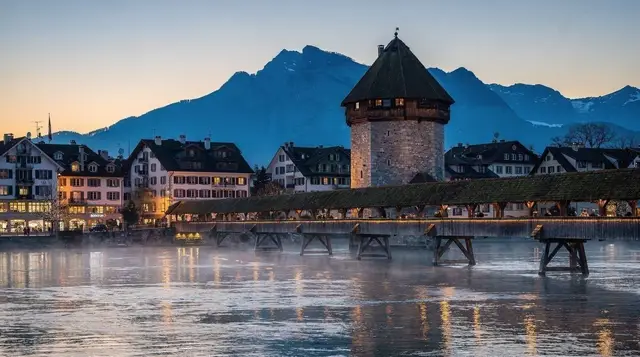
Start at Lucerne station, which sits directly across the Reuss from the old town, and walk the short distance to Chapel Bridge, known locally as Kapellbrücke. It’s the covered wooden footbridge that appears on every postcard of the city, and it’s still a working pedestrian crossing rather than a museum piece, so expect commuters weaving between the tourists.
The bridge dates back to 1333, though what you’re walking across today is largely a reconstruction. A fire in August 1993, started by a discarded cigarette on a moored boat, destroyed roughly two thirds of the structure and most of its 17th-century roof panels depicting scenes from Lucerne’s history and the lives of the city’s patron saints. Restoration was fast, about a year, and used salvaged timber where possible, but only around 30 of the original panels survived; the rest are gone or exist as blackened fragments displayed near the Historisches Museum. It’s worth knowing this before you cross, because otherwise the panels look older than they are.
The octagonal stone tower rising from the water partway along the bridge is the Wasserturm, the Water Tower. It predates the bridge by decades and has served as a prison, a treasury and a watchtower over the centuries. It’s not open to the public and there’s no ticket to buy here; you look at it from the bridge or the quay, which is what everyone does. For a closer, unhurried read of the panels and the tower’s history, the dedicated Chapel Bridge and Water Tower guide goes deeper than this walk has room for.
Cross the bridge fully rather than turning back halfway; the far end drops you at the Rathaus quay, on the edge of the old town proper, which is where the second half of the walk begins.
If you’d rather have someone point out what to look for rather than reading panel captions yourself, a guided photography walk through this stretch is timed around the light on the water and covers the bridge, the squares and the riverside in around two hours.
Weinmarkt and Hirschenplatz: the painted façades
From the Rathaus quay, head inland a few minutes to Weinmarkt, the wine market square. This is the best-preserved medieval square in Lucerne, and it looks it: guild houses on three sides carry frescoed façades, some restored, some faded, showing coats of arms, biblical scenes and trompe-l’œil architectural details painted directly onto the plaster. The square’s fountain, dedicated to Saint Maurice, sits at the centre and is one of several painted fountains scattered through the old town.
Weinmarkt has no entry fee and no set viewing route; walk the perimeter slowly and look up, since most of the detail is above ground-floor shopfront height. Restaurants and cafés occupy the ground floors now, so this is also a sensible place to plan a coffee stop, though prices sit at the upper end of what you’ll pay in Lucerne, roughly CHF 5 to 6 for a cappuccino at a square-front terrace versus CHF 4 to 4.50 a few streets back.
A short walk from Weinmarkt is Hirschenplatz, Deer Square, smaller and quieter, with its own run of painted buildings including the Hirschen guild house that gives the square its name. It’s less photographed than Weinmarkt and correspondingly less crowded, which makes it a better spot to actually stand still and look rather than dodge tour groups. Neither square requires more than 15 to 20 minutes unless you’re stopping to eat.
For a wider survey of façades and painted buildings across the old town beyond these two squares, the Lucerne viewpoints guide covers a few additional angles, including a couple of upper-floor terraces that overlook the rooftops.
The Spreuer Bridge and the Dance of Death
From Hirschenplatz, walk west and slightly south to reach the Spreuer Bridge, Spreuerbrücke, the old town’s second covered wooden bridge and, in most respects, the more interesting of the two. It’s older in character than Chapel Bridge in that its painted panels are genuinely original, having survived the 1993 fire because that fire never reached this end of the river.
The bridge’s roof trusses hold a cycle of 45 panels painted in the 1620s by Kaspar Meglinger, collectively known as the Totentanz, the Dance of Death. The theme was common across late-medieval and early-modern Europe, particularly after successive waves of plague: skeletal figures, each representing death, lead away people from every level of society, popes, emperors, merchants, mothers, infants, as a reminder that death comes for everyone regardless of rank. It’s darker and more striking than anything on Chapel Bridge, and far fewer visitors make it this far, so you can generally take your time reading the panels without being jostled.
The bridge is free to cross and open at all hours; there’s no ticket booth and no gate. Give it a genuine 10 minutes rather than the 90-second walk-through most people give it on the way to somewhere else.
Below and beside the bridge is the old town’s flour mill site, which now houses a small chocolate museum operated by a Swiss producer. If chocolate is more your interest than frescoes, a walking route through this part of town can be paired with a stop there, or with a dedicated chocolate-making session elsewhere in the city.
Climbing to the Musegg Wall
This is the part of the walk most day-trippers skip, and it’s the part that rewards the effort. From the Spreuer Bridge, head north and start climbing; the path up to the Musegg Wall is cobbled, unshaded and genuinely uphill for 10 to 15 minutes. It is not stroller or wheelchair friendly, and in summer heat it’s worth carrying water.
The wall itself dates to the 14th century and once ran the full length of the city’s northern defences. Nine towers survive along its length, roofed and largely intact, making it one of the better-preserved medieval town walls in Switzerland. Not all nine are open to visitors; typically around five are, on a seasonal schedule that runs roughly from April to November depending on weather and staffing, and admission to the open towers is free. The schedule shifts from year to year and towers occasionally close for maintenance mid-season, so treat “open April to November” as a general rule rather than a guarantee on the day you visit.
Among the towers usually open:
- Zytturm, the clock tower, whose clock has run since the 16th century and by long-standing local custom is allowed to strike the hour a full minute before every other clock in the city.
- Männliturm, with rampart access and some of the better rooftop views back over the old town.
- Wachtturm, the watch tower, one of the taller climbs.
- Schirmerturm and Luegisland, both with narrow internal stairs and small platform views.
Climbing a tower means a tight spiral or ladder-style stone staircase with low headroom in places; it’s not difficult, but it’s not accessible, and it’s a poor choice with young children who won’t stay still on a narrow platform. Between the open towers, a walkable rampart section connects several of them directly, so you don’t always need to descend to street level and climb again.
Budget 45 minutes to an hour for the wall if you want to go inside two or three towers and walk the connecting rampart; 20 minutes is enough for a look from outside if the towers happen to be closed or you’re short on time. The dedicated Musegg Wall and towers guide has the tower-by-tower detail, including which platforms have the best photo angle over the old town roofs, if you want to plan the climb more precisely before you go.
From the wall, a path leads back down into town, arriving a few streets from where the loop began near Weinmarkt, which closes the circuit.
What to skip if you’re short on time
If you only have an hour, do Chapel Bridge and the Spreuer Bridge and skip the wall; both bridges are flat, close together and give you the bridge photograph and the Dance of Death panels without the climb. If you have two hours, add Weinmarkt and Hirschenplatz. The wall is the first thing to cut for a short visit and the first thing to add back if you have half a day, since it’s the one part of this route that most visitors never see.
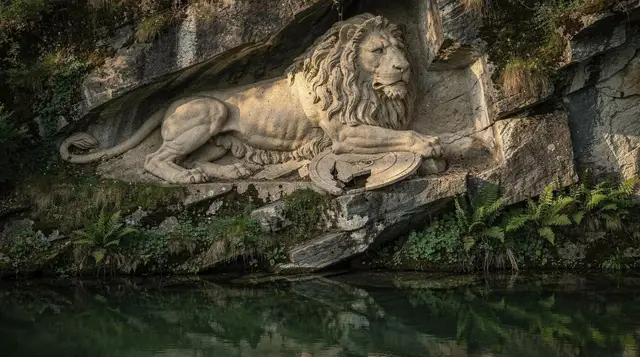
If you’re trying to fit this walk around other Lucerne sights in a single day, the Lucerne in one day guide sequences it against the Lion Monument and a lake cruise, and how many days in Lucerne is worth a look if you’re still deciding how much time to give the city overall.
Extending the walk: museums nearby
Three museums sit close enough to this route to fold in without much extra walking. The Rosengart Collection, a short walk south of the station, holds a large private collection of Picasso and Klee works and typically charges in the region of CHF 18 to 20 for adult entry; the full Rosengart Collection guide has current hours. The Glacier Garden, up near the Lion Monument, combines glacial potholes carved into the rock with a mirror maze and a small museum, and generally runs CHF 18 to 22; see the Glacier Garden guide.
The Bourbaki Panorama, a 360-degree painted panorama depicting a Franco-Prussian War episode, sits near the old town’s western edge and is usually CHF 12 to 15; details in the Bourbaki Panorama guide. None of these are free, and none are essential to the walking route itself, but any one of them turns a 90-minute walk into a genuine half day.
For a fuller list of what costs nothing at all in Lucerne, including several stops not on this specific route, the Lucerne free things to do guide is the wider reference. And if you’d rather not plan the sequencing yourself, a private guided walking tour covers most of this ground with a guide setting the pace, which is a reasonable option for a first visit or if mobility makes the wall climb impractical without local advice on where to stop.
Getting there and getting around
Everything on this route starts and ends within walking distance of Lucerne station, so there’s no need for the VBL city buses unless you’re staying outside the centre. If you’re arriving from Zurich, the train into Lucerne station takes 45 minutes to an hour; from Basel it’s around 1 hour 15, and from Bern about an hour, all direct or with a single easy change. Anyone combining the old town with a boat trip afterwards should note that the main lake embarcadere sits directly beside the station too, so the walk described here connects easily into an afternoon cruise; see the Lucerne boat trips guide for timetables and which paddle steamers run which days.
For visitors staying several nights and weighing up a wider loop of the lake, a walking tour paired with a lake cruise is a way to combine this old town route with time on the water without organising the logistics yourself.
Practical notes before you go
Wear real shoes, not sandals, for the wall climb; the cobbles are uneven and the tower stairs are stone and worn smooth in places. Carry water in summer, since there’s no café directly on the wall itself, only back down in town. Photography is unrestricted throughout, including inside the open towers, though the platforms are small and can feel crowded if a tour group arrives at the same time you do.
None of this route needs advance booking. The one thing worth checking the morning of your visit, if the wall is a priority, is whether the towers are open that day; a quick look at the current schedule saves the climb turning into a view of locked doors. Otherwise, this is a walk you can start on a whim straight off the train, finish in an afternoon, and leave having seen a side of Lucerne that the bridge photograph alone doesn’t show.
City sightseeing tours on GetYourGuide
Verified deep-linked GetYourGuide tours. Book through these links and we earn a small commission at no cost to you.
GetYourGuide does not provide a product photo for this activity — the image shows the meeting point, photographed by us.