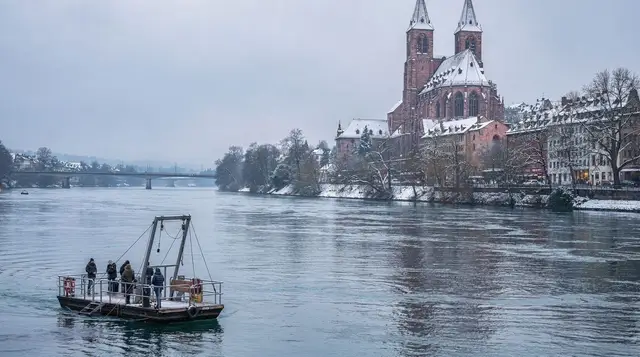
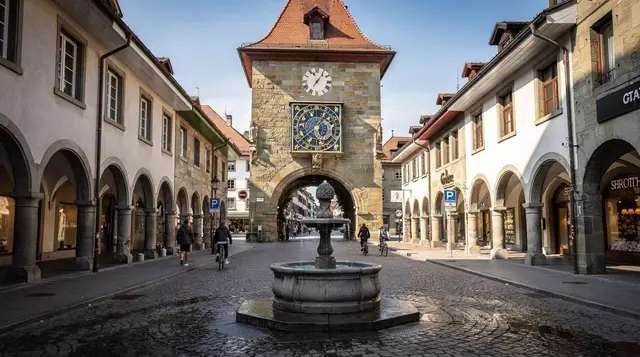
Lucerne’s old town sits on both banks of the River Reuss where it leaves Lake Lucerne, and almost everything described here is within a 20-minute walk of the station. That matters, because it’s easy to spend an entire trip riding cable cars up the surrounding peaks and never actually look at the city that gives them their name. It deserves a proper day.
The Kapellbrücke and its water tower
The Kapellbrücke (Chapel Bridge) is the wooden covered bridge that appears on every postcard of Lucerne, crossing the Reuss diagonally near where it flows out of the lake. It dates from the 14th century, making it one of the oldest surviving truss bridges in Europe — but “surviving” needs a caveat. A fire in August 1993, started by a dropped cigarette on a moored boat, destroyed roughly two-thirds of the wooden structure and most of the painted panels lining its roof. The city rebuilt it within a year using the burned bridge as a template. Around 30 of the original 17th-century panels, painted by Heinrich Wägmann and depicting scenes from Swiss and local history, survived and are back in their places; the rest are careful reproductions.
The octagonal stone water tower (Wasserturm) standing beside the bridge predates it by decades and was never actually part of the bridge structure — it’s a free-standing 13th-century tower that has served over the centuries as a prison, a treasury, and an archive. It’s not open to the public inside, but it’s the single most photographed object in Lucerne, and for good reason: the combination of dark timber, red masonry, and the lake behind it is genuinely striking, fire damage notwithstanding.
Walking the bridge itself takes five minutes if you don’t stop. Budget twenty if you want to actually look at the panels overhead, which most visitors don’t.
a private boat cruise on Lake Lucerne gives you the reverse view — the bridge and water tower from the water, which is how they were meant to be seen before the quay existed.
The Spreuerbrücke and its dance of death
Less photographed and less crowded, the Spreuerbrücke sits about 500 metres downstream, closer to the old town’s western edge. It’s shorter than the Kapellbrücke and considerably older in spirit: it survived the 1993 fire untouched and still carries its original roof paintings, a cycle of 67 panels painted by Kaspar Meglinger between 1616 and 1637 known as the Totentanz, or dance of death. Each panel shows Death — depicted as a skeleton — interrupting people from every rung of society, from popes to peasants, a theme that spread across post-plague Europe as a reminder that death made no distinctions of rank. It’s grim subject matter rendered with a fair amount of dark humour, and it rewards slowing down rather than walking straight across.
The bridge’s name comes from “Spreu” (chaff), since it was historically the only place millers were permitted to dump grain husks into the river. There’s no entry fee and no set opening hours — it’s a public river crossing, open around the clock, though the panels are easiest to appreciate in daylight.
The Musegg wall and its nine towers
Above the old town’s northern edge runs the Museggmauer, a stretch of medieval fortification built mostly between 1350 and 1408, with nine towers still standing along roughly 870 metres of wall. It’s one of the better-preserved town fortifications in Switzerland, and the walk along the top of the wall — where it’s open — gives the clearest rooftop view over the old town’s terracotta roofs to the lake and mountains beyond.
Access to the walkway and a handful of the towers is free, but it’s seasonal: the towers typically open from spring through autumn (roughly April to November, weather dependent) and close for winter, since the walkways aren’t heated or lit. The Zytturm (clock tower) is the most recognisable, its clock permitted — by old civic privilege — to strike the hour one minute before every other clock in the city. The Männliturm usually has public access too. Check which towers are open before you go; showing up in January to find the gate locked is a common disappointment.
Getting up to the wall involves a short, moderately steep climb from the old town streets — nothing technical, but worth knowing if mobility is a concern. There’s no lift.
A good way to sequence the two bridges is to cross the Kapellbrücke first, while you still have energy for the crowds, then drift downstream along the river to the Spreuerbrücke once the pace of the day has settled. The contrast is the point: one bridge is a monument that has been polished for visitors, the other still feels like a piece of the working town. If you only have time to give one of them real attention, give it to the panels, because they are what turns a pretty crossing into a story.
The Lion Monument
A ten-minute walk northeast of the old town, set into a former sandstone quarry, the Lion Monument (Löwendenkmal) is a large relief of a dying lion carved directly into the rock face. Designed by Bertel Thorvaldsen and cut in 1820–21, it commemorates the roughly 760 Swiss Guards killed defending King Louis XVI during the storming of the Tuileries Palace in Paris in 1792 — mercenary soldiers who died fulfilling a contract after the French royal family had already fled. Mark Twain called it “the most mournful and moving piece of stone in the world,” a line the local tourism board has never stopped quoting.
It’s free, unguarded, and small — the carving itself takes only a few minutes to see properly, so it’s worth combining with the Glacier Garden next door rather than treating it as a destination on its own.
The old town’s painted facades
Wander the streets around Kornmarkt, Weinmarkt, and Hirschenplatz and the thing that stands out isn’t any single building but the density of painted house fronts — oriel windows, frescoed guild houses, and trompe-l’œil architectural details on buildings dating mostly from the 16th and 17th centuries. Weinmarkt in particular retains its fountain and a tight cluster of painted facades that once belonged to guild houses and inns. None of this requires a ticket; it rewards simply walking slowly with your head up, which is not the natural pace of a group tour.
Rathausplatz, home to the Renaissance-style town hall (Rathaus, completed 1606), is the other square worth lingering in, especially on Tuesday and Saturday mornings when it hosts a fruit, vegetable, and flower market.
Reading the old town: a way to pace the walk
Lucerne rewards a loose plan better than a strict one. The old town is small enough that you can criss-cross it without ever feeling lost, and the river acts as a constant reference point: if the Reuss is on your left, you are heading away from the lake, and if the mountains appear at the end of a street, you are heading back towards it. Start with the bridges while the light is soft, spend the middle of the day among the squares and facades, and keep the Musegg wall for a moment when you want height and a long view rather than another street scene.
Weather is the other variable. On a clear day the lake and the quay are the obvious draw; on a grey or wet one, the covered bridges, the arcaded streets and the museums make the city work just as well. That flexibility is one reason Lucerne suits a short stay, and why it pairs so easily with a mountain day when the forecast is good. Our Lucerne weather month by month and best time to visit Lucerne pages help you choose which day to spend where.
Eating is part of the rhythm too. The old town is full of places that suit a long, unhurried lunch, and the squares fill with terrace tables as soon as the weather allows. For ideas beyond the obvious, the Lucerne food tour guide and Lucerne coffee and bakeries are good companions to this page, and eating well in Lucerne without going broke is a candid read on keeping the bill reasonable.
The KKL and the lake quay
At the lake end of the station square stands the KKL (Kultur- und Kongresszentrum Luzern), Jean Nouvel’s 2000 concert hall and convention centre, distinguished by an oversized flat roof that cantilevers out over the water. The lobby and the lakeside terrace beneath that overhanging roof are open to the public without a ticket, and the terrace is one of the better free spots to sit with a coffee and watch the paddle steamers dock. The concert hall itself is used by the Lucerne Symphony Orchestra and the Lucerne Festival each August, and requires a ticket to a performance to get inside. On the top floor, the Kunstmuseum Luzern has its own separate admission (around CHF 15–20).
From the KKL, the quay runs along the lakefront through Schwanenplatz — the old town’s main lakeside square, named for a defunct swan fountain — where the historic paddle steamers and regular lake boats dock. This stretch is the practical spine of a Lucerne visit: the train station, the boat piers, and the old town all sit within a few hundred metres of each other, so there’s rarely a reason to take a taxi within the city itself.
The Glacier Garden
Tucked beside the Lion Monument, the Glacier Garden (Gletschergarten) preserves a set of giant potholes gouged into the rock by glacial meltwater roughly 20 million years ago, discovered by accident in 1872 during construction work. Above ground, the same site includes a mirror maze built in 1896 in a Moorish-revival style and a small museum on the region’s glacial and geological history, plus a viewing platform over the old town. Entry runs around CHF 17 for adults; it’s a reasonable hour-long stop, best combined with the Lion Monument since they’re a two-minute walk apart.
Who this city suits best
Lucerne works for almost every kind of traveller, but in different ways. First-time visitors get a compact, legible introduction to Switzerland: lake, mountains, medieval wood and stone, and a station that connects to everything. Families find that the short distances and the boats keep children interested without long transfers; see Lucerne with kids for ideas. Travellers with limited mobility should read accessibility in Lucerne before planning, since the Musegg climb and cobbled streets are not equally easy for everyone. And if you are watching your budget, Lucerne on a budget shows how much of the city costs nothing at all.
Practical basics
| What | Cost / detail |
|---|---|
| Kapellbrücke, Spreuerbrücke, Musegg wall, Lion Monument | Free |
| Glacier Garden | Around CHF 17 |
| Kunstmuseum Luzern (inside the KKL) | Around CHF 15–20 |
| Lake boat trip, Schwanenplatz to Weggis | Around CHF 30 return (covered by the Swiss Travel Pass) |
| VBL city bus, single ticket | Around CHF 3–4 for a short hop |
| Coffee on the quay | CHF 5–6 |
| Two-course lunch, old town restaurant | CHF 25–40 |
Lucerne is walkable enough that the VBL city buses are optional for anyone staying in or near the old town — most sights above are within 20 minutes on foot of the station. A private sunset cycling tour is a good alternative for covering the lakefront and old town’s edges faster than walking, without needing a car.
Given how much of the city is free, the main variable cost is food and the odd museum ticket. Franc for franc, this is one of the cheaper days you’ll have in Switzerland — save the budget for the mountain excursions.
Where this fits with the rest of a Lucerne trip
The old town works as a single, self-contained day, but it also sits at the centre of everything else covered on this site: the lake it borders, the mountains visible from its bridges, and the day trips that all start from the same station. For orientation, how many days in Lucerne and where to stay in Lucerne are worth reading before booking anything. If you’re arriving from the airport, getting from Zurich Airport to Lucerne covers the train connection, and getting around Lucerne explains the VBL bus network and boat piers in more detail than fits here.
For the old town itself, the Lucerne old town walking guide lays out a route connecting everything above in order, and Lucerne viewpoints covers the best angles beyond the standard quay shot of the Kapellbrücke. The chapel bridge and water tower guide and the Musegg wall and towers guide go into more depth on those two sights specifically, including current tower opening seasons. For the carving itself, see the Lion Monument guide, and for the site next to it, the Glacier Garden guide.
If a single day feels tight, Lucerne in one day and the one-day itinerary both sequence the old town against a lake cruise or a mountain trip, and free things to do in Lucerne rounds up what’s covered here alongside a few sights that didn’t fit this page. For a broader sense of what’s collected under one roof, the Lucerne museums guide and the Rosengart Collection guide cover the city’s art holdings, and the Bourbaki Panorama guide covers the 19th-century circular painting a short tram ride from the old town.
Once the city itself is covered, the lake is the natural next step — Lake Lucerne as a destination page, or the Lucerne boat trips guide and Lake Lucerne paddle steamers guide for the historic vessels docking at Schwanenplatz. From there, most visitors move on to the surrounding peaks or a day trip further afield — the day trips from Lucerne hub is the place to plan that next.
For something sweeter than a fortification wall, a chocolate-making tour from Lucerne fills an afternoon well if the museums have run their course.