Lake Lucerne's five paddle steamers: engine rooms, timetables and first class
Which paddle steamers sail on Lake Lucerne and when?
Five coal- or oil-fired paddle steamers operate on Lake Lucerne: Uri, Unterwalden, Schiller, Gallia and Stadt Luzern. All five run a reduced winter timetable and a full daily timetable from roughly April to October; exact sailings and which ship covers which route change by date, so check the timetable on the day rather than assuming.
Five ships, one lake, and why they’re still running
Lake Lucerne (Vierwaldstättersee) has the largest surviving fleet of historic paddle steamers in Switzerland: five ships, all more than ninety years old, all still doing scheduled passenger work rather than sitting as museum pieces. They belong to SGV, the shipping company that also runs the lake’s modern diesel-electric motor vessels, and they share the same timetable, the same jetties and largely the same fares as the rest of the fleet. The difference is what happens below deck, and it is worth knowing which ship you are getting on before you buy the ticket, because not every sailing on the board is a steamer.
This guide covers the five ships by name, when each one is realistically on the water, what the first class supplement actually buys you, what you can see of the engine room, and where the steamers fit against everything else you can do on the lake, from a short catamaran hop to a private charter.
The five ships
| Ship | Built | Notes |
|---|---|---|
| DS Uri | 1901 | Oldest of the five, smallest tonnage |
| DS Unterwalden | 1902 | Near-identical build to Uri |
| DS Schiller | 1906 | Named for the playwright, mid-size |
| DS Gallia | 1913 | Built for the busiest pre-war routes |
| DS Stadt Luzern | 1928 | Youngest and largest, most capacity |
All five are coal- or oil-fired, all five still turn their original or rebuilt compound engines, and all five are maintained by SGV’s own workshop in Lucerne, which is one reason the fleet has survived rather than being scrapped like most of Europe’s lake steamers. None of the five sails every day of the year: they rotate through dry dock for boiler and hull work, usually one at a time, and in winter it is common for only one or two to be in service at all, with motor vessels covering the rest of the routes. If you want a specific ship rather than “a paddle steamer,” check the day’s timetable, which names the vessel on each sailing, rather than assuming.
When they actually sail
The practical pattern, rather than the marketing one, is this: a full daily timetable with multiple steamers running roughly from April to October, and a thinner winter timetable the rest of the year where you may see none, one, or two on the water depending on maintenance and demand. Summer weekends are when you are most likely to catch several steamers out at once, including on the long Lucerne–Flüelen run past Brunnen and Lake Uri. Shoulder season (April, May, October) is a reasonable compromise: steamers are running but crowds are thinner than July and August.
If your trip depends on a particular ship being in service, do not book transport, lunch or a return train around it without checking SGV’s daily schedule first. Ships get swapped for mechanical reasons at short notice, and a steamer sailing can quietly become a motor vessel sailing with no announcement beyond the timetable itself. For general timing across the whole lake network, our boat timetables explained guide covers how to read the board at the jetty.
What the engine room actually shows you
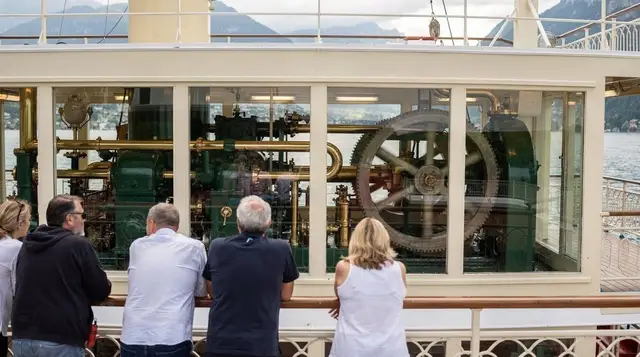
This is the part that makes a steamer worth choosing over a motor vessel, and it costs nothing extra. On all five ships, the engine room sits below the main deck, roughly midships, and is open for viewing through glass panels or a railed opening rather than sealed off. While the ship is under way you can watch the crank, connecting rods and crosshead of the compound engine turning in full view, along with the crew tending it.
There is no separate booking, no extra ticket and no fixed viewing slot: you walk down, watch for as long as you like, and walk back up. It is one of the few places in Switzerland where you can watch nineteenth-century engineering doing actual work rather than sitting static behind rope in a museum, and it is the single best reason to check which ship is on your sailing before you board.
Bring earplugs if you are sensitive to noise; the engine room is loud at close range, more so than the passenger decks. Photography is generally fine but the space is tight and gets crowded on short, busy summer crossings such as Lucerne–Weggis, so early or late in the day gives you more room to actually see the mechanism rather than a wall of other passengers’ phones.
First class: what it buys and what it doesn’t
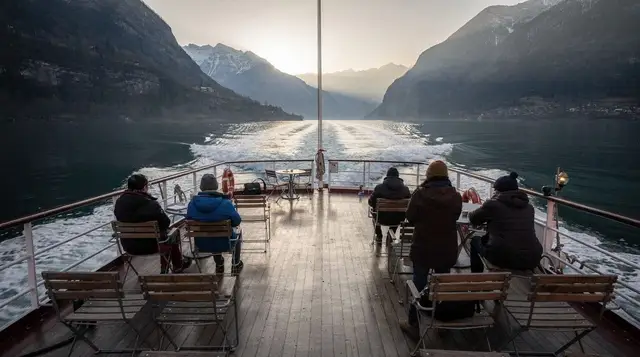
Second class puts you on the main deck and lower saloon, first class on the upper deck and stern saloon, generally quieter, less crowded, and with better unobstructed views for photos of the lake and the mountains around Weggis and Vitznau or Bürgenstock. It does not change the engine room access, which is open to both classes, and it does not speed up the crossing.
The supplement scales with distance rather than being a flat fee. On a short hop such as Lucerne to Vitznau it typically adds a few francs to the second class fare; on the full Lucerne–Flüelen run, the longest scheduled route on the lake at around three and a half hours, it runs closer to CHF 20. The Swiss Travel Pass and Half Fare Card cover second class; if you are travelling on either and want first class, you pay only the supplement rather than the full first class fare, which makes it a reasonable upgrade on longer routes and a skippable one on short crossings where second class is already uncrowded outside peak summer weekends.
Fares, passes and where the steamers fit
Scheduled sailings on Lake Lucerne, steamers and motor vessels alike, are covered in second class by the Swiss Travel Pass and by the regional Tell-Pass, which bundles boats and mountain transport across central Switzerland. Point-to-point tickets are also available at any jetty or through SBB if you would rather not commit to a pass. Our Swiss Travel Pass guide and Tell-Pass guide go through which one actually pays off depending on how many days you are in the region and what else you plan to ride.
If scheduled sailings don’t fit your day, a couple of the bookable options cover similar ground on your own timetable. A one-hour catamaran cruise on the lake is the fast, no-timetable alternative if you want the scenery without committing to a fixed departure, though it is a modern catamaran rather than a steamer and skips the engine room entirely.
For a private group wanting the lake to themselves, a private luxury boat cruise on Lake Lucerne runs on your schedule rather than SGV’s. And if you’d rather pair the water with something to drink, a wine tasting cruise around the Lake Lucerne region turns the crossing into an afternoon rather than a point-to-point trip.
Practical routes worth knowing
Lucerne to Weggis or Vitznau (roughly 50–70 minutes) is the standard short hop and the one most likely to be a steamer on a summer day, with connections at Vitznau for the Rigi rack railway; see our Mount Rigi guide for what to do once you’re up there. Lucerne to Kehrsiten-Bürgenstock connects with the funicular up to Bürgenstock and the Hammetschwand lift, covered in the Bürgenstock and Hammetschwand guide. Lucerne to Flüelen, the full-length run past Küssnacht and Brunnen, is the one where the first class supplement is most worth paying, simply because you’re on board for over three hours.
None of these routes require booking ahead in the way a mountain railway sometimes does; you buy at the jetty or on board, and steamers and motor vessels share the same ticket. Where booking does help is on the busiest summer weekends, when boats can genuinely fill up on the Lucerne–Weggis leg around midday.
Is it worth building a day around
For most first-time visitors doing a single day in Lucerne or working through a broader Lucerne itinerary, a short return crossing to Weggis or Vitznau is enough to get the lake, the mountain backdrop and, if you land a steamer, the engine room, without eating the whole afternoon.
Committing to the full Flüelen run or a first class ticket makes more sense if boats and lake scenery are the point of your day rather than a stop on the way to something else, or if you’re already spending a slower, quieter kind of day on the water, the kind described in the quiet shore of Lake Lucerne. Either way, check which ship is actually on your sailing before you decide how much time to give it: a steamer with an open engine room is a different couple of hours from a modern motor vessel doing the same route, even at the same fare.
If you’re travelling with children, the engine room is usually the highlight of the crossing rather than a detour for them; see Lucerne with kids for how it fits alongside the rest of a family day. And if cost is the deciding factor between a steamer crossing and one of the bookable cruise options above, our Lucerne travel costs guide has the wider context on what a day on and around the lake tends to actually cost.
Lake cruises & boat tours on GetYourGuide
Verified deep-linked GetYourGuide tours. Book through these links and we earn a small commission at no cost to you.
GetYourGuide does not provide a product photo for this activity — the image shows the meeting point, photographed by us.