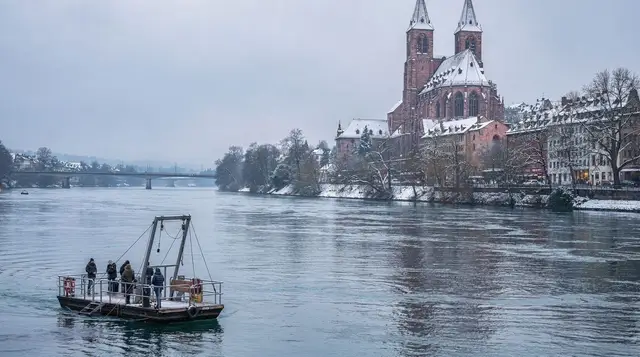
Switzerland’s fjord, one stop past the postcards
Most visitors to Lake Lucerne never get past Weggis and Vitznau. That is a shame, because the lake keeps narrowing south of there, and by the time it reaches Brunnen it has stopped looking like a lake at all. The Mythen peaks stand almost vertically above the water, the shoreline pinches to a few hundred metres wide, and the stretch running on to Flüelen is officially a separate body of water, Lake Uri (Vierwaldstättersee’s Urnersee arm). Tourist brochures reach for “fjord” and, unusually for tourist brochures, the comparison holds up: steep rock walls, deep cold water, and weather that changes faster than the scenery suggests it should.
Brunnen itself is a small resort town of around 7,000 people at the point where Lake Lucerne’s main basin gives way to Lake Uri. It has none of the Chapel Bridge name recognition of Lucerne’s old town, and that is largely the point. What it has instead is direct access, by a five-minute walk from the station, to the water’s edge, a lakeside promenade with unobstructed views down the fjord, and a boat landing that puts the Rütli meadow, Tell’s Chapel, Flüelen and Altdorf all within an hour or two.
This guide treats Brunnen as a base for exploring Lake Uri rather than as an attraction in its own right, because that is what it functions as for almost everyone who comes here.
Getting to Brunnen
Trains from Lucerne to Brunnen run roughly twice an hour, taking 40–55 minutes depending on whether you catch a direct service or one changing at Arth-Goldau. A second-class single costs around CHF 20–24; both the Swiss Travel Pass and Half Fare Card apply. Driving takes about 35 minutes via the A2 motorway, with parking at the station and along the lakefront running CHF 1.50–2 per hour.
The boat is slower and more expensive but is the actual point of the trip for most people: Lucerne to Brunnen by lake takes roughly two hours and stops at Weggis and Vitznau on the way, giving you the mountain panorama from water level before the fjord narrows. A second-class single is around CHF 35–40; it is free with a valid Swiss Travel Pass, which is the more sensible way to do this leg if you are already touring the region by rail and boat.
If you would rather book the crossing on its own terms, the round-trip cruise from Brunnen to Flüelen and back covers the whole fjord stretch in about ninety minutes without committing you to a rail pass.
A practical compromise many visitors miss: take the train down to Brunnen, then the boat back to Lucerne (or the reverse), so you get the fast connection one way and the scenery the other. See how to read the paddle steamer timetable before you commit to a schedule, since not every sailing is a historic paddle steamer and not every one stops at every jetty.
The Rütli meadow: Switzerland’s founding field
The Rütli (Rütliwiese) is a sloping meadow on the southern shore of Lake Uri, reachable only by boat or on foot along the lakeside path — there is no road. According to the founding legend commemorated here, representatives of Uri, Schwyz and Unterwalden swore an oath of mutual defence on this meadow in 1291, the event traditionally dated as the birth of the Swiss Confederation. Whatever the historical accuracy of the specific date and location (serious historians treat it as legend layered onto a real alliance), the Rütli has functioned as a national symbol for centuries and is treated with a solemnity that can surprise visitors expecting a generic viewpoint.
There is not much infrastructure: a small chapel, an inn (Rütli-Haus) serving simple food, and a flagpole with the cantonal banners of the founding cantons. The meadow itself is free to walk and open year-round, but the boat that gets you there runs a reduced timetable outside May–October, and on some Föhn days is cancelled altogether — check the current schedule rather than assuming a sailing will be running.
Budget an hour on the meadow if you disembark, including the short uphill walk from the jetty. Combine it with a stop at Tell’s Chapel below and you have a natural half-day boat itinerary out of Brunnen.
Tell’s Chapel and the Axenstrasse
A few hundred metres north of the Rütli, on the eastern shore, a small white chapel sits directly at the waterline, accessible only from the lake. This is the Tellskapelle, built on the spot where legend says William Tell leapt from the boat taking him to prison in Küssnacht, escaping his guards during a Föhn-driven storm. It is decorated with 19th-century frescoes depicting the Tell story and is genuinely tiny — most boats slow down or pass close by rather than mooring, and seeing it properly from the deck takes a couple of minutes.
Above the chapel runs the Axenstrasse, a road cut into the cliff face in the 1860s that was, for its time, a genuine feat of engineering connecting Brunnen to Flüelen along terrain too steep for a conventional route. Much of today’s through-traffic now uses the parallel Axen tunnel, which has quietened the old road considerably and made it a pleasant, if narrow, drive or cycle for anyone wanting the cliffside views at eye level rather than from a boat deck. Sections have closed periodically for rockfall protection work; if you are planning to drive or cycle it specifically for the scenery, check current conditions before setting off, since a closure here means a long diversion rather than a short one.
Walkers get the same views without the traffic on the lakeside path and the Waldstätterweg long-distance trail, which threads along this shore in sections. It is not a casual afternoon stroll in its entirety — treat any stretch beyond Brunnen’s own promenade as a proper hike with suitable footwear.
Flüelen and Altdorf, at the head of the lake
Flüelen sits at the very southern tip of Lake Uri, roughly 45 minutes from Brunnen by boat or 15 minutes by train, and marks the point where the lake ends and the Reuss valley begins its climb toward the Gotthard. It is a working transport hub more than a destination — this is where road and rail traffic heading toward the Gotthard route and on to Ticino funnel through — but the boat landing gives a clean view back up the fjord toward Brunnen and the Mythen, which is worth the round trip on a clear day.
Altdorf, a ten-minute bus or short walk inland from Flüelen, is the capital of canton Uri and, by tradition, William Tell’s hometown — the town where he is said to have shot the apple from his son’s head under Gessler’s orders. A large bronze Tell monument by Richard Kissling dominates the main square, and there is a modest theatre where an open-air Tell play has been performed periodically since the 19th century. Altdorf itself is an unpretentious Swiss administrative town rather than a polished tourist set piece; 30–45 minutes covers the monument, the square and a coffee, and it is worth doing only if you are already passing through rather than as a special trip from Lucerne.
Anyone continuing south from here toward Andermatt and the Gotthard, or connecting to the Gotthard Panorama Express route that pairs a boat leg on this lake with a scenic train onward, will pass through Flüelen as a matter of course.
The Föhn wind and why it changes everything here
The Föhn is a warm, dry, often powerful wind that funnels north through the Alps and down into the Reuss and Lake Uri corridor, and it matters more here than almost anywhere else on Lake Lucerne. Geographically, Lake Uri is a narrow trench between steep mountainsides, which means wind gets channelled and accelerated rather than dispersed — a moderate Föhn event elsewhere can produce sudden, sharp gusts and short, steep waves on this stretch of water that catch out boat operators and swimmers alike.
Three practical effects follow from this:
- Boat cancellations. Lake Uri sailings, particularly to the Rütli and along the Flüelen route, are the first services suspended on a strong Föhn day, even in July. Lucerne–Weggis–Vitznau services on the calmer main basin often continue running when the Brunnen–Flüelen leg does not.
- Visibility swings. A Föhn wind clears the air dramatically, and the classic photographs of the Mythen peaks razor-sharp against a deep blue sky are almost always taken on or just after a Föhn day. The trade-off is the wind itself, which can make the open sections of the promenade genuinely unpleasant to walk.
- Historical weight. The Tell legend’s storm-crossing episode is explicitly a Föhn storm, and locals still talk about the wind with a degree of respect that visitors sometimes mistake for folklore. It is not; the Föhn on this lake has capsized boats within living memory, and the region’s emergency services take Föhn warnings seriously.
Practically, this means treating any Lake Uri boat departure on a windy day as provisional. Check the operator’s live status before walking to the jetty, and do not assume that a booked crossing will run simply because it appears on the printed timetable.
What to do in Brunnen itself
Brunnen’s own centre is compact and does not need more than an hour or two beyond the lakefront walk. The Seequai promenade runs along the water with unobstructed views down the fjord toward the Mythen and across to the Axenstrasse cliffs, and is the best free thing to do in town — a slow half-hour walk covers most of it. Brunnen’s public lake access points let you swim directly from stone platforms, and the water, fed by glacier melt further up the valley system, stays cold even in August; expect low-to-mid teens Celsius rather than anything resembling a warm sea.
For a longer outing, the Fronalpstock cable car climbs from Morschach, a short bus ride above Brunnen, to a ridge with views across both Lake Uri and Lake Lucerne’s main basin simultaneously — a genuinely useful vantage point for understanding how the two lake sections relate to each other geographically, and one that gets far fewer visitors than Rigi or Pilatus. Combine it, weather permitting, with the Stoos funicular a short distance further along the valley, which holds the record for the steepest funicular gradient in the world.
If your appetite runs to mountains rather than lakeshore, the classic Rigi round trip is bookable directly out of Lucerne and reachable from Brunnen via Arth-Goldau: the Rigi round trip combining cogwheel train and cable car is the standard way to do it, or the guided walk up Rigi from Goldau with a barbecue lunch included for a more active, guided version of the same mountain. Full detail on routes, prices and which side to approach from is in the Rigi guide.
Where to eat and where to stay
Brunnen’s waterfront restaurants trade heavily on the view, and prices reflect that: a main course at a lakeside terrace runs CHF 28–45, with fish from the lake (Felchen, a whitefish, is the local speciality) typically at the higher end. A short walk back from the water, ordinary Swiss restaurants serving rösti and schnitzel drop to CHF 22–32, which is the more sensible choice if the view is not the point of the meal. Bakeries and the Coop and Migros supermarkets near the station are the usual budget fallback, as they are across the rest of the region — see the budget guide for the wider destination for the same logic applied to Lucerne itself.
Accommodation in Brunnen skews toward mid-range lakeside hotels rather than budget hostels; expect CHF 150–260 for a double room with a lake view in summer, dropping meaningfully outside July–August. Staying here rather than in Lucerne makes sense mainly for people prioritising quiet and direct lake access over nightlife and museum density — Brunnen has neither the former’s crowds nor the latter’s culture, which some visitors will count as a plus and others as a reason to stay a single night at most.
Planning your visit: costs and timing at a glance
| Item | Approximate cost | Notes |
|---|---|---|
| Train, Lucerne–Brunnen (one way) | CHF 20–24 | 40–55 min; covered by Swiss Travel Pass |
| Boat, Lucerne–Brunnen (one way) | CHF 35–40 | ~2 hours; free with Swiss Travel Pass |
| Rütli boat stop, from Brunnen | CHF 15–20 return | May–October main timetable |
| Lakeside restaurant main course | CHF 28–45 | Non-lakeside options run CHF 22–32 |
| Double room, lakeside hotel | CHF 150–260/night | Summer peak; lower off-season |
| Fronalpstock cable car (return) | CHF 40–45 from Morschach | Free/discounted with Swiss Travel Pass |
For a short list of what a whole day here should reasonably cost, see the region-wide travel costs guide, which uses the same methodology across every destination in this guide.
A realistic day plan
A single day from Lucerne works well as: morning train to Brunnen (45 minutes), an hour on the lakeside promenade, the midday boat down to the Rütli and on to Flüelen with the Tellskapelle passed en route, a short stop in Altdorf if the connections line up, then the return boat or train to Lucerne by early evening.
Anyone wanting to add a mountain should split this across two days rather than trying to fit Rigi or Fronalpstock into the same afternoon — the connections exist on paper but leave no slack for a delayed boat, which on this lake is a real possibility rather than a hypothetical one. For a longer stay in the wider region, the 3-day Lucerne itinerary slots a Brunnen and Lake Uri day in alongside the old town and one mountain excursion, which is roughly the right proportion of time to give it.
If you would rather see the fjord from a boat under your own control than a scheduled service, the private luxury boat cruise on Lake Lucerne can be routed to include this stretch, at a price that only makes sense for a small group splitting the cost. For everyone else, the scheduled boats and trains covered above do the same job for a fraction of the price — see the comparison of the Swiss Travel Pass against the regional Tell-Pass if you are trying to work out which covers this route more cheaply for your specific trip.
For general orientation on how the wider Lake Lucerne region fits together, including Weggis and Vitznau further north and Schwyz inland, those destination pages cover the rest of the shoreline this guide does not.