Switzerland’s best-preserved medieval square
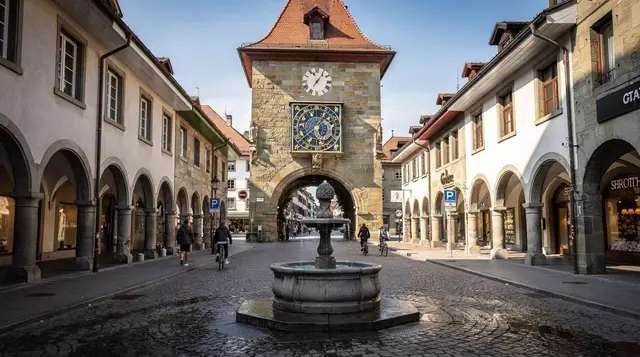
Rathausplatz in Stein am Rhein is small, easy to see in twenty minutes, and still the reason to come. Every building on it is painted: allegorical figures, saints, guild emblems, and trompe-l’oeil architecture that fools the eye into thinking flat facades have carved reliefs. The Haus zur Sonne, the Weisser Adler and the Rathaus itself carry the best of it, and the oriel windows jutting out over the cobbles are original rather than restorations dressed up for tourists. Bern’s arcades and Zurich’s Niederdorf have their own charm, but nothing else in Switzerland concentrates this much intact late-medieval and Renaissance painting into one square this size.
The town itself is tiny, around 3,500 people, which is part of the appeal and part of the problem. In July and August, tour buses arrive between roughly 11am and 3pm and the square fills up quickly, since there is only so much space to stand in front of a facade and photograph it. Arriving before 10am, or after 4pm when the day-trip buses have moved on, gets you the town closer to how it looks the rest of the year: quiet, a few locals on bicycles, cafés with tables half empty.
Stein am Rhein’s position explains the good preservation. It sat on the Rhine trade route between Lake Constance and Schaffhausen, wealthy enough in the late Middle Ages to build well, then bypassed by later industrial growth that reshaped larger towns nearby. The result is a town centre that was never demolished and rebuilt in the 19th or 20th centuries, simply because there was no pressing need to.
Getting there from Lucerne
There is no direct train, and the routing is the main reason Stein am Rhein is a considered day trip from Lucerne rather than an easy add-on. The standard route runs Lucerne to Zurich HB, a change onto a regional service towards Winterthur, and a second change onto the branch line that follows the Rhine through Etzwilen to Stein am Rhein. Total journey time is around two hours each way, so four hours of the day go to trains before you have seen anything. Check how Swiss regional connections work before you go, since the final leg runs less frequently than the main lines and a missed connection can cost thirty minutes or more.
The alternative is water rather than rail. Seasonal passenger boats run the Rhine between Schaffhausen and Stein am Rhein, continuing on to Konstanz on Lake Constance, typically from April to October. It is slower than the train but scenic, and pairs naturally with a stop at Rhine Falls, which sits on the same stretch of river closer to Schaffhausen. A guided day trip from Zurich covering Stein am Rhein, Rhine Falls and a lake boat crossing covers this route in one booking and removes the connection-timing worry, which for a lot of visitors is worth the premium over doing it independently.
If your Swiss Travel Pass or Half Fare Card covers the trains, the only extra costs are the boat, if you take one, and Kloster St. Georgen’s entry fee. The Swiss Travel Pass also covers standard-route boats on the Rhine and Lake Constance, though not every seasonal excursion boat is included, so check before boarding.
For visitors based in Zurich rather than Lucerne, the trip shrinks to roughly an hour and a quarter each way, which changes the arithmetic considerably: it becomes a realistic half-day out rather than a full day committed almost entirely to travel.
Kloster St. Georgen: the better sight, less of the queue
Most visitors photograph the square and move on, which is a mistake, because the former Benedictine abbey just off it, Kloster St. Georgen, is the more substantial thing to see. Founded in the 11th century and dissolved during the Reformation, the abbey buildings survive largely intact, with painted rooms from the 16th century that were never stripped out or overpainted. The Sommerhaus, a small painted timber structure in the abbey garden, and the Fürstenzimmer, the prince’s rooms with their original decorated ceilings, are the standout interiors.
Entry costs around CHF 8, it rarely has a queue even when the square outside is busy, and a proper visit takes 45 minutes to an hour. It is one of the more convincing arguments for treating Stein am Rhein as more than a photo stop: the abbey rewards the kind of slow, unhurried look that the crowded square doesn’t really allow for in high season.
The Rhine before Lake Constance
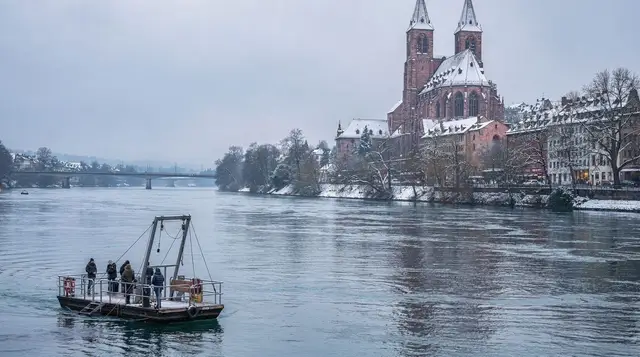
Stein am Rhein sits at a specific and slightly unusual point on the river: this is where the Rhine leaves Lake Constance (Bodensee to German speakers, though English guidebooks generally stick with Lake Constance) and narrows back into a proper river before its long run west towards Basel. The riverside promenade below the old town gives a clear view of that transition, wide and lake-like upstream, channelled and faster-flowing as it heads towards Rhine Falls further downriver.
The covered wooden bridge across the Rhine, rebuilt after wartime damage but on its original medieval alignment, is worth crossing on foot simply to see the town from the opposite bank, where the painted facades read as a single composition rather than a row of individual buildings. From the far bank, a short walk leads to better, less crowded views back towards the square than anything available from the square itself.
Boat traffic on this stretch is a mix of the scheduled Rhine passenger services and private craft, since the river here is calm enough for casual boating in a way it isn’t lower down towards the falls. A short excursion on the river, whether as part of a longer private day trip combining Rhine Falls and Stein am Rhein or independently, is the easiest way to see both the old town and the wider lake-to-river landscape without walking the whole shoreline.
For a shorter, more targeted introduction to the town itself rather than the wider region, a 60-minute guided walk with a local covers the square, the abbey exterior and the bridge in the time most visitors actually have, which for a lot of day-trippers arriving from Zurich or further afield is closer to the real constraint than interest.
Arenenberg and the Thurgau shore
Across the water and slightly upriver, on the Thurgau shore rather than the Schaffhausen side the old town sits on, is Arenenberg, a castle with a genuinely odd history for a small Swiss estate. It was the exile home of Hortense de Beauharnais, Napoleon’s stepdaughter, and the childhood home of her son, later Napoleon III of France. The castle is now the Napoleonmuseum Thurgau, with period rooms, French Empire furniture, and gardens laid out with views back over Lake Constance towards the German shore.
Reaching Arenenberg from Stein am Rhein means either a car or bus journey of thirty to forty minutes along the shore road through Steckborn and Mannenbach, or a seasonal boat connection when the Lake Constance services are running. Neither is instant, which is why it functions as an extra rather than a given: worth it for visitors with a genuine interest in the period or in seeing the quieter Thurgau shore, skippable for anyone whose day is already full with the old town and the abbey.
The Thurgau shore itself, beyond Arenenberg, is orchard and vineyard country running along Lake Constance, considerably less visited than the Schaffhausen side and correspondingly quieter. It isn’t a destination in its own right for most Lucerne-based visitors, but it explains why Stein am Rhein feels like an edge of the country rather than a stop along a well-worn route: it genuinely is one, with Germany a short distance across the water.
Where to eat and what it costs
Stein am Rhein is not a cheap detour once the travel time is accounted for, and restaurant prices in the old town sit at typical small-town Swiss levels rather than city prices, which is a mild relief after Zurich or Lucerne. A sit-down lunch, a Rösti or a lake fish dish with a drink, runs CHF 25 to 35. Café stops with coffee and cake are CHF 8 to 12. A full day including the abbey entry, a coffee, lunch and a short Rhine boat ride comes to roughly CHF 60 to 90 per person, before the cost of getting there.
| Item | Typical cost |
|---|---|
| Kloster St. Georgen entry | CHF 8 |
| Lunch, sit-down | CHF 25–35 |
| Coffee and cake | CHF 8–12 |
| Short Rhine boat excursion | CHF 20–30 |
| Guided day trip from Zurich (transport, guide, boat included) | CHF 90–150 |
A guided option such as the Zurich city tour combining the Lindt chocolate factory, Rhine Falls and Stein am Rhein costs more than doing it independently, but it removes the connection planning entirely and packs three stops into one day, which for visitors without much spare time in Switzerland is often the more sensible trade.
Planning the day
Stein am Rhein does not work well as a rushed stop bolted onto a bigger itinerary; the travel time from Lucerne is too long for that. It works best as one of two things: a considered day trip in its own right for visitors with a week or more in the region, taken alongside Rhine Falls to justify the journey, or an easy half-day for anyone already based in or passing through Zurich.
| From | Journey time | Suggested pairing |
|---|---|---|
| Lucerne | ~2h each way | Rhine Falls, full day |
| Zurich | ~1h15 each way | Half day, or add Lindt factory |
| Schaffhausen | ~20–30 min, train or boat | Easy half day |
For Lucerne-based visitors, check the full list of day trips from Lucerne before committing to this one, since closer options exist for anyone with only a single spare day and no particular pull towards the Rhine or Lake Constance. Those with several days to spend, following something like the seven-day Lucerne itinerary, are better placed to give Stein am Rhein the half or full day it needs without feeling it has eaten into time meant for closer sights.
Visitors arriving via Zurich rather than starting from Lucerne, including anyone connecting from Zurich Airport, should note that Stein am Rhein sits almost as conveniently for a stopover before continuing on to Lucerne as it does for a dedicated day trip once settled there. The town of St Gallen, with its own Unesco library, lies on a different line further east and is not naturally combined with Stein am Rhein in a single day without an early start.
Boat timetables, both on the Rhine and on Lake Constance, run a reduced or suspended winter schedule, typically from November to March. Visiting outside that window still works for the old town and the abbey, both open year-round, but rules out the river approach and makes Arenenberg harder to reach without a car.
Check the region’s scenic train and boat routes and the interactive map when sequencing this alongside other stops, and see the wider day trips from the region for how it compares against Rhine Falls, St Gallen or the Thurgau shore on their own. General planning notes, including seasonal closures that affect this corner of the country, are covered in the region’s travel tips.
Questions about visiting Stein am Rhein
How do I get from Lucerne to Stein am Rhein by train?
There is no direct connection. Take the train to Zurich HB (45 minutes to an hour), change onto a regional service towards Winterthur, then change again for the branch line that follows the Rhine to Stein am Rhein. Budget around two hours each way and check the connection before you leave, since the final leg is a regional train that does not run every few minutes.
Is Stein am Rhein a day trip from Zurich or from Lucerne?
Both work, but Zurich is the easier base: it is around an hour and a quarter away by train and closer still by the seasonal Rhine boat. From Lucerne it is a longer day, closer to four hours of travel in total, so it suits travellers who already have several days in the region rather than a first, short stay.
What is there to see in Stein am Rhein besides the old town square?
The Rathausplatz and its painted houses are the reason most people come, but Kloster St. Georgen, the former Benedictine abbey just off the square, is arguably the better sight: its late-medieval rooms and painted interiors are largely original and rarely crowded. The Rhine promenade, the hilltop ruin of Hohenklingen, and the Arenenberg estate across the water are worth the extra time if you have it.
Can I combine Stein am Rhein with Rhine Falls in one day?
Yes, and most visitors do. Rhine Falls is roughly 30 minutes away by train or boat, and several guided day trips from Zurich pair the two, sometimes with the Lindt chocolate factory added on. Doing both properly, with time to walk around Stein am Rhein rather than rush it, makes for a full day rather than a half day.
Is Arenenberg worth the extra detour?
If you have an interest in the Napoleonic period or simply want to see the Thurgau shore rather than double back the way you came, yes. Arenenberg castle and its museum, once home to Hortense de Beauharnais and the future Napoleon III, sit above the lake with gardens open to the public. It adds an hour or two, reached by road along the shore or by seasonal boat.
What does a day in Stein am Rhein cost?
Excluding the train fare from your base, budget CHF 60 to 90 per person: CHF 8 for Kloster St. Georgen, CHF 20 to 30 for a Rhine boat trip if you take one, and CHF 25 to 35 for lunch. It is not a cheap detour once travel time and fares are added up, which is the main argument for combining it with Rhine Falls or another stop rather than visiting on its own.