The Rhine Falls (Rheinfall) at Neuhausen is the largest waterfall in Europe by volume, not by height. At 23 metres tall and 150 metres wide, it is short compared with mountain cascades elsewhere in Switzerland, but the sheer amount of water moving over the rock shelf — an average of 373 cubic metres per second, more in early summer snowmelt — makes it loud and physically impressive at close range. It sits on the Rhine between the towns of Neuhausen am Rheinfall and Laufen-Uhwiesen, a short train ride from Zurich and a longer one from Lucerne.
This isn’t a wilderness spot. There’s a train station a few minutes’ walk from the main viewpoint, coach parking, gift shops, and in high season, a lot of people. What makes it worth the trip is choosing the right vantage point and the right hour, and pairing it with something else — Schaffhausen’s old town is a 10-minute train ride away and worth more of your time than the falls alone.
Neuhausen and the platform at Laufen Castle
The falls straddle two banks, and each side gives a different view.
Laufen Castle (Schloss Laufen), on the southern bank, sits directly above the falls and has been used as a viewing point since the 19th century, when it operated as a hotel for exactly that purpose. A lift and a set of stairs take you down through the rock to the Känzeli platform, bolted onto the cliff face at water level, close enough that spray reaches you on a still day. It’s the single best vantage point at the falls, and it isn’t free — expect a small platform fee, paid at the castle.
Neuhausen, on the northern bank, gives the wide view most photographs of the falls are taken from, and it’s free. This is also where the boat docks are and where the Neuhausen Rheinfall train station sits. If you’re arriving by public transport from Zurich or Lucerne, you’ll land on this side first.
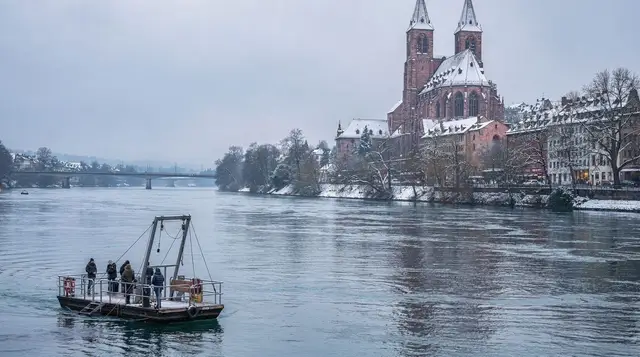
Walking between the two banks means either crossing at the nearby road bridge or taking one of the small ferries that shuttle across just below the falls — a short, slightly damp crossing that’s part of the experience rather than an inconvenience.
Getting onto the water: boats to the rock
The falls have a rock pillar standing in the middle of the flow, and small boats run out to it and back, docking briefly so passengers can climb the steps bolted into the rock for a view straight down into the water on both sides. It’s the closest most visitors get to the falls, and it’s genuinely loud up there.
A short 15-20 minute boat runs from the Neuhausen side without landing on the rock, and a slightly longer version stops at the rock itself. Both run from spring to autumn and are weather-dependent — they don’t operate in high water or strong current, which occasionally happens after heavy rain, so don’t plan a trip around the boat alone if you’re visiting outside the main season.
a short boat trip out to the rock in the middle of the falls covers the basics in half an hour and is the simplest way to get on the water without arranging your own transport there.
For a longer day that takes in more of the region by boat and rail, a combined Rhine cruise linking Stein am Rhein and the falls covers a stretch of river most day-trippers skip, running past half-timbered riverside villages before reaching Neuhausen.
Schaffhausen’s old town and the Munot fortress
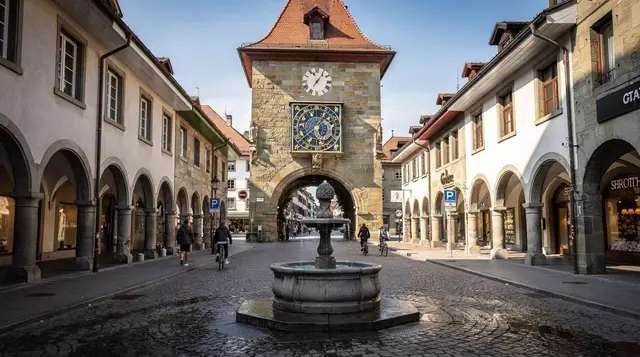
Schaffhausen is a five-minute train ride from Neuhausen Rheinfall, or a longer walk along the riverbank, and it’s worth more time than most people give it. The old town has one of the best-preserved collections of oriel windows (Erker) in Switzerland — carved stone bay windows projecting from the fronts of merchant houses along Vordergasse — and a pedestrianised centre that’s easy to cover on foot in an hour or two.
Above the old town, the Munot is a 16th-century circular fortress with grass growing over its thick ramparts, built partly with forced labour and, according to local tradition, to a design influenced by Albrecht Dürer. It’s free to enter, the climb up is a genuine climb (steep, cobbled, no lift), and the view from the top takes in the old town roofs and the Rhine below. If you only do one thing in Schaffhausen beyond the falls, make it this rather than the museums, which are modest.
The town also makes a reasonable base if you want to see the falls at both quiet hours — early and late — without a long train connection each way, though most visitors from Lucerne treat it as a stop rather than an overnight.
a half-day trip that combines the falls with Schaffhausen’s historic centre is the straightforward way to see both without working out train connections yourself.
When to go: the quiet hour
The Rhine Falls gets busy in a predictable pattern, and knowing it is the single most useful piece of planning information here. Coach tours from Zurich and Lucerne arrive mid-morning and cluster through early afternoon, roughly 10am to 4pm from May to September. Outside that window, the platforms thin out considerably.
| Time | What to expect |
|---|---|
| Before 9am | Quiet, good light for photos, some platforms may still be opening |
| 10am-4pm (May-Sep) | Busiest; coach groups, queues for the Känzeli platform and boats |
| Evening (after 5pm) | Quiet again, boats often stop running by early evening in shoulder season |
| November-March | Consistently quiet, boats mostly not running, falls run clear and low |
Water volume follows the season rather than the crowds. The falls carry the most water in May and June, fed by Alpine snowmelt, and the least in winter, when the flow is clearer and more turquoise but visibly smaller. Photographers who want the loudest, fullest falls should aim for early summer; anyone who wants a quieter visit with fewer people in every photograph should go in autumn or winter, and arrive before mid-morning either way.
Getting there from Lucerne
There’s no direct train; the standard route runs via Zurich.
| Leg | Approximate time |
|---|---|
| Lucerne to Zurich HB | 45 min-1 hr |
| Change at Zurich HB | 10-20 min depending on connection |
| Zurich HB to Neuhausen Rheinfall | 35-40 min |
| Total, door to platform | Around 1 hr 45 min |
Trains run at least hourly on both legs, and the Swiss Travel Pass covers the entire route if you already hold one for a wider trip. If you’re coming specifically for the falls rather than passing through, it’s a long round trip for a short stop — pairing it with Zurich itself, Stein am Rhein, or Winterthur makes better use of the day.
For those who’d rather not manage the connection themselves, a full-day tour from Zurich covering the falls and Stein am Rhein handles the transport and timing, including the crowd-heavy midday window when self-guided visitors are often queuing.
What it costs
Switzerland doesn’t get cheaper the further you get from the cities, and the Rhine Falls area is no exception once you add up train fares, platform fees and a meal.
| Item | Approximate cost (CHF) |
|---|---|
| Return train, Lucerne-Neuhausen (no pass) | 70-90 |
| Laufen Castle platform + lift | 5-6 |
| Short boat to the rock | 8-10 |
| Lunch near the falls or in Schaffhausen | 20-30 |
| Total for one person | 100-135 |
Holders of a Half Fare Card or a Swiss Travel Pass cut the rail portion substantially, and in the case of the Travel Pass, the regional trains are included outright. Food at the falls itself is the standard tourist-site mark-up; walking five minutes into Neuhausen or taking the extra ten to Schaffhausen gets you ordinary Swiss prices instead.
Practical notes
The paths on both banks are paved and manageable for most visitors, though the Laufen Castle platform involves stairs beyond the lift, and the Munot climb in Schaffhausen is steep cobblestone with no accessible route to the top. Bring a layer that can get wet if you’re heading down to the Känzeli platform or taking a boat near the rock — the spray carries further than it looks from above.
There’s no need to book the falls themselves in advance; the platforms and paths don’t sell out. Boats can form short queues in peak summer hours, which is one more reason to aim for the early or late window rather than midday. Left luggage is available at Zurich HB if you’re day-tripping from Lucerne and don’t want to carry bags for the whole loop — see our Lucerne luggage guide for the equivalent option nearer home.
If you’re building this into a longer eastern Switzerland loop, St Gallen and Walensee both connect reasonably well from Schaffhausen or Zurich, and Basel is a viable alternative base if you’re arriving from France or already routing through it. For those without a full day to spare, our day trips from Lucerne guide ranks the falls against the other common options, including Zurich and Bern, and our Swiss trains explained guide covers how the connections and passes fit together for a trip like this one.
Frequently asked questions about the Rhine Falls
How long does it take to see the Rhine Falls?
An hour covers the viewing platforms and a walk along both banks. Add 30 minutes if you take a boat out to the rock, and half a day if you continue into Schaffhausen’s old town.
Which side of the Rhine Falls is better, Neuhausen or Schloss Laufen?
Schloss Laufen (Laufen Castle), on the southern bank, has the closer viewing platforms, including one bolted directly above the water. The Neuhausen side, on the north bank, gives the classic wide-angle view and is where most boats depart from.
Can you swim at the Rhine Falls?
Not at the falls themselves; the current is dangerous close to the drop. Swimmers use the calmer river well downstream, near Schaffhausen, where the current is still fast but manageable in the marked areas.
Is the Rhine Falls free to visit?
The riverside paths and most viewpoints are free. The lower platform at Laufen Castle and the lift down to it charge a small entry fee, and boat trips out to the rock are paid separately, typically 20-30 CHF.
How do you get from Lucerne to the Rhine Falls by train?
Take the train to Zurich Hauptbahnhof, then a connecting regional train towards Schaffhausen, alighting at Neuhausen Rheinfall station. The whole journey runs to roughly 1 hr 45 minutes with a typical connection.
What is the Munot in Schaffhausen?
A 16th-century circular fortress on a hill above Schaffhausen’s old town, built using forced labour on a design attributed to Albrecht Dürer’s circle. Its grass-roofed ramparts are free to climb and give a wide view over the town and the Rhine.
When is the Rhine Falls least crowded?
Before 9am and after 5pm in summer, and any time on a weekday between November and March. Coach tours cluster in the late morning and early afternoon from May to September.