Zurich Airport to Lucerne: trains, tickets and the taxi price
What is the best way to get from Zurich Airport to Lucerne?
The SBB train is the best option for almost everyone: it leaves from directly beneath the terminal, runs roughly hourly with some added connections through the day, and covers the roughly 65 km to Lucerne in about an hour. A taxi is faster door to door on a good traffic day but costs several times more and gains you little once you factor in the walk from the terminal to a rank.
The fastest way in: SBB’s direct train
Zurich Airport (ZRH) has its own railway station built directly under the terminal, and that single fact makes the whole journey to Lucerne simpler than the transfer at most European airports. There’s no shuttle bus to a separate station and no tram ride to a hub. You come down the escalator from arrivals, buy a ticket at a machine or on the SBB app, and you’re on a platform.
Several IR (InterRegio) trains a day run straight from Zurich Airport to Lucerne without a change, taking around 55 to 60 minutes. Outside those direct slots, the fastest option is usually a short hop to Zurich Hauptbahnhof followed by a connecting train to Lucerne — the change is a few platforms apart, not a walk across the city, and the total journey time is close to an hour either way. In practice, if you check departures on arrival rather than trying to memorise a fixed pattern, you’ll rarely wait more than 30 minutes for the next usable connection.
This is one of the clearer illustrations of why Swiss trains run on the reputation they have: the airport-to-city rail link isn’t an afterthought bolted onto the network, it’s built into it. If you want the general logic of how the country’s train system fits together before your trip, the Swiss trains explained guide covers ticket classes, the concept of a Fahrplan (timetable), and how connections are timed to the minute.
Buying the right ticket
For a single one-way trip, the simplest approach is a point-to-point ticket bought at the airport station. A standard second-class fare is roughly CHF 27; first class runs close to double that. These numbers move with ordinary SBB pricing, so treat them as a planning figure rather than a quote, and check the machine or app for the fare on the day.
A few discount cards change the maths if you’re staying in Switzerland for more than a couple of days:
| Option | What it does | Worth it if |
|---|---|---|
| Half Fare Card | Roughly halves point-to-point fares for a month | You’ll take three or more paid train journeys during your stay |
| Swiss Travel Pass | Unlimited trains, most buses and boats, many museums | You’re covering multiple regions or doing several day trips from Lucerne |
| Saver Day Pass | One discounted day of unlimited travel, bought in advance | You have one specific long day planned, like a return trip to Zermatt or Interlaken |
| Single airport ticket | Pay once for the one journey | You’re only making this one trip and staying local afterwards |
If you already know you’ll want a Swiss Travel Pass for excursions to places like Mount Pilatus or Mount Rigi, it’s worth activating it from the airport rather than buying a separate ticket first — the pass covers this leg too. The Swiss Travel Pass guide breaks down validity periods and what it does and doesn’t include; central Switzerland also has its own regional Tell-Pass, though that one only starts paying off once you’re doing lake and mountain excursions from Lucerne itself, not on the airport leg.
No seat reservation is needed or possible on this route — you board with a valid ticket, full stop. Trains can fill up at weekday evening peak times and on Friday and Sunday afternoons when Swiss commuters and returning weekenders overlap with airport traffic, so arriving on the platform a few minutes before departure is worth doing if you’d rather sit than stand.
a pre-booked private transfer from Zurich Airport straight to your Lucerne hotel is the alternative if you’d rather not deal with tickets and platforms after a long flight, though it costs noticeably more than the train for the same door-to-door result.
Train vs taxi vs shuttle: what it actually costs
| Method | Time | Approx. cost (2026) | Notes |
|---|---|---|---|
| Direct train | 55–60 min | ~CHF 27 (2nd class, full fare) | Leaves from directly under the terminal |
| Train via Zurich HB | ~60–70 min | ~CHF 27 | Short, well-timed platform change |
| Taxi | 50–65 min | CHF 180–220 | Price depends on traffic on the A14/A2 |
| Private transfer (pre-booked) | 50–65 min | Fixed rate, similar to taxi | Fixed price agreed in advance, no meter |
| Rental car | 50–70 min | Rental cost + Swiss motorway vignette | Only worth it if you need the car in Lucerne anyway |
The taxi rank is well signposted outside arrivals, and there’s rarely a long queue outside the very busiest afternoon hours. The honest case for a taxi is a group of four splitting the fare, a very early or very late arrival when trains are sparse, or simply wanting one less decision to make after an overnight flight. For a solo traveller or a couple, the train wins on cost by a wide margin and loses very little on time. If you’d rather drive yourself for the whole trip, the car rental in Switzerland guide covers where pick-up desks are at the airport and what the motorway vignette costs.
Arriving late at night
This is where the maths shifts. Direct trains thin out after the early evening, and the last realistic connection to Lucerne is usually shortly after midnight — typically involving a change at Zurich Hauptbahnhof rather than a through service. If your flight is scheduled to land after 11pm, don’t assume a train will still be running by the time you clear passport control and baggage claim; check the actual connection before you fly, not after you land.
If your arrival genuinely falls outside train hours, a taxi or a pre-booked airport transfer to Lucerne is the sensible choice rather than an uncertain wait for a first morning train. It costs more, but arriving at your hotel at 1am beats sitting in a mostly closed airport until 5am to save the difference. This is a small version of a bigger pattern worth knowing before any Swiss trip: the first-time mistakes in Lucerne guide covers other places where assuming Swiss infrastructure runs 24 hours costs people an evening.
Luggage and lockers
Both stations have coin- or card-operated lockers rather than a staffed left-luggage counter. Zurich Airport’s lockers are in the underground railway station itself, easy to find on the way to the platforms. Lucerne’s are near the main station hall, a short walk from where the trains and the lake boats meet. Neither is large enough for oversized ski or golf bags without checking sizes first. The luggage and left luggage in Lucerne guide has current locker sizes and prices if you need to drop bags for a few hours between arriving and checking in, which is common if your flight lands early and your room isn’t ready yet.
Where you actually arrive
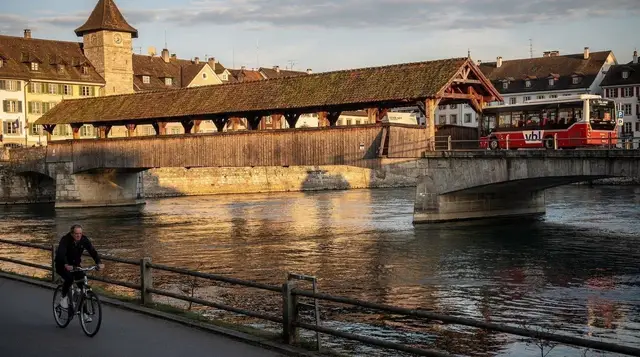
The train pulls into Luzern Bahnhof, which sits right on the lakefront next to the main boat docks — this is the practical centre of the city, not a station you then need a taxi from. Most hotels in the Lucerne old town or along the lake are a 10 to 20 minute walk, and city buses run by VBL cover the rest if you’re staying further out. The getting around Lucerne guide covers the bus network, the Lucerne guest card that many hotels include, and when walking simply beats waiting for a bus in a city this compact.
If you’re wondering where to base yourself for the first night after a flight, the where to stay in Lucerne guide is a better starting point than picking a hotel purely on airport-transfer convenience, since almost everywhere in central Lucerne is within easy reach of the station regardless.
Connecting onward from Lucerne
Because the airport train and the rest of the Swiss network share the same timetable logic, a Zurich Airport arrival often connects the same day to onward destinations if you’d rather not stop in Lucerne first. Interlaken is about two hours further via the scenic Brünig line, Bern around an hour past Lucerne, and Basel roughly an hour and 15 minutes. Most travellers do stop in Lucerne, though — it’s the more useful base for the lake and mountain excursions the region is actually known for, covered in the best mountain excursions from Lucerne guide and the day trips from Lucerne guide.
For a first full day, the private Pilatus and Lake Lucerne tour that starts from Zurich is worth knowing about even if you’re staying in Lucerne itself, since it’s built around exactly this transfer route and can save you working out the cogwheel railway and boat timetables on your own. If chocolate rather than mountains is the priority, there’s also a combined Lucerne and Bürgenstock day trip departing Zurich that covers the cliff-top viewpoint above the lake in the same outing.
Planning the rest of the trip
Before you land, it’s worth having a rough shape for the days ahead rather than deciding everything on arrival. The how many days in Lucerne guide and the Lucerne in one day guide are useful starting points, and the Lucerne, 3 days itinerary pairs a realistic pace with the mountain and lake excursions most first-time visitors actually want. If your trip includes Switzerland’s visa or entry requirements, check the Switzerland visa and ETIAS guide well before travel rather than at the gate, since it’s Schengen but not EU and the paperwork isn’t always what people assume.
For a broader sense of what things cost once you’re here — restaurants, museum tickets, the mountain railways — the Lucerne travel costs guide sets realistic expectations for a notoriously expensive country, and pairs well with this page’s honest numbers on the airport transfer itself.
Zurich Airport to Lucerne: frequently asked questions
Is there a direct train from Zurich Airport to Lucerne?
Yes, several IR trains a day run without a change of train, taking around 55 to 60 minutes. Outside those direct departures, the fastest connection changes once at Zurich Hauptbahnhof, which usually costs only a few extra minutes because the connecting platform is close by.
How much does the train from Zurich Airport to Lucerne cost?
A standard second-class one-way fare is roughly CHF 27, with a Half Fare Card bringing that down to about CHF 13.50. First class runs close to double the second-class price. Fares move with SBB’s ordinary pricing, so treat these as a planning figure and check the current price when you book.
Is a taxi from Zurich Airport to Lucerne worth it?
Only for a very early or very late arrival with no reasonable train, or for a group of four splitting the cost. Expect CHF 180 to 220 and 50 to 65 minutes depending on traffic on the A14 and A2, against roughly CHF 27 and an hour by train that starts right under the terminal.
What time does the last train from Zurich Airport to Lucerne leave?
The last realistic connection is usually shortly after midnight, but it typically involves a change at Zurich Hauptbahnhof rather than a direct service. If your flight lands after 11pm, check the exact connection before you fly rather than assuming a train will still be running.
Do I need to reserve a seat on the Zurich Airport to Lucerne train?
No. Seat reservations aren’t used on this route; you simply board with a valid ticket. The trains can be busy at weekday peak times and on Friday and Sunday afternoons, so arriving on the platform a few minutes early gets you a seat rather than the aisle.
Can I buy the ticket at the airport or should I book ahead?
Buy it at the airport. Ticket machines and the SBB app sell point-to-point fares for the next available train, and there’s no discount for booking days in advance the way there is with some European rail operators. Booking ahead only matters if you’re buying a Swiss Travel Pass or Half Fare Card, which are worth arranging before you land if you’ll use them elsewhere too.
Is left luggage available at Zurich Airport or Lucerne station?
Both stations have lockers. Zurich Airport’s are in the underground railway station itself; Lucerne’s are near the main hall. Neither location offers a staffed left-luggage counter with the flexibility of, say, a hotel concierge, so lockers are the practical option if you need to drop bags for a few hours.
Transport passes & transfers on GetYourGuide
Verified deep-linked GetYourGuide tours. Book through these links and we earn a small commission at no cost to you.
GetYourGuide does not provide a product photo for this activity — the image shows the meeting point, photographed by us.