Bad Ragaz and the Tamina Gorge
What makes Bad Ragaz worth a day trip from Lucerne?
Bad Ragaz sits on a thermal spring that emerges at a constant 36.5°C inside the Tamina Gorge, first used by monks in 1242. The water now feeds the public Tamina Therme and the Grand Resort's spa pools in the village, while the original stone bathhouse cut into the gorge, Altes Bad Pfäfers, can still be reached on foot. The trip from Lucerne takes roughly 1 hour 45 minutes to 2 hours by train.
A spring the monks found in 1242
Bad Ragaz is a small town in the canton of St. Gallen built almost entirely around one fact: a thermal spring rises inside the nearby Tamina Gorge at a steady 36.5°C, all year, regardless of the weather outside. Monks from the Benedictine abbey at Pfäfers are recorded finding the source in 1242, and for roughly six centuries the only way to use it was to be lowered into the gorge itself. Bathers were carried down by rope and basket to sit in the rock cleft where the water emerged, which sounds dramatic and, by most accounts, was.
That changed in 1840, when a pipeline was finally built to carry the water down from the gorge to the valley floor, and the modern spa town of Bad Ragaz grew up around the pipe’s endpoint. The water still comes from the same source and still arrives at close to the same temperature. What has changed is that nobody has to be lowered into a canyon on a rope to use it.
This guide covers both halves of the story: the gorge where the water is found, and the town where it is now used, plus how to get to either one from Lucerne without a car.
The Tamina Gorge and the old bathhouse
The Tamina Gorge (Taminaschlucht) is a narrow limestone canyon cut by the Tamina river between Valens and Pfäfers, a short distance above Bad Ragaz. It is where the spring actually surfaces, and it is where bathing at this spot began. The 17th-century stone building known as Altes Bad Pfäfers sits wedged into the gorge itself, built directly over and around the spring outlet, replacing the rope-and-basket arrangement with proper rooms and a permanent bathhouse.
Altes Bad Pfäfers is open to visitors from roughly May to October (exact dates shift year to year and it’s worth checking before planning around it) as a small museum with a restaurant. It is reached on foot, either down into the gorge from the village of Valens on a maintained trail with steps and handrails, or via a path from the Pfäfers side. It is not accessible directly from Bad Ragaz train station without a walk or a local bus connection first, so it works better as a half-day add-on than as the sole reason for the trip unless hiking is the point.
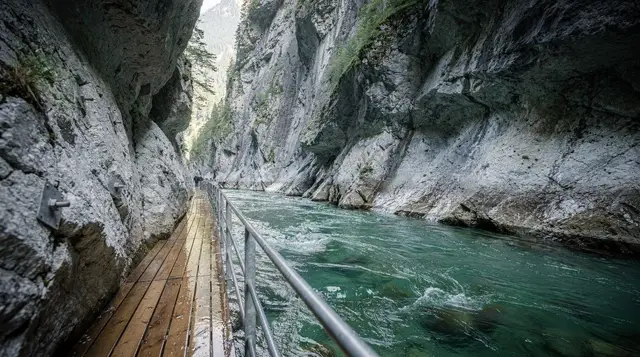
The gorge trail itself is short but genuinely dramatic: sheer rock walls close in overhead, the river runs turquoise-green below, and the temperature inside the canyon noticeably drops even in summer. It is not a difficult walk by Swiss standards, but it is not a stroller route either, and wet rock after rain makes the steps worth taking slowly.
For a broader look at gorge walks and cave tours in the wider Walensee and Appenzell area, see best hikes near Lucerne and Seealpsee and Appenzell hikes, though neither substitutes for the Tamina Gorge trail itself, which is its own separate walk.
a guided day trip by train from Zurich that combines the Höllgrotten caves with the Tamina Gorge is the simplest way to see the gorge without organising the connections yourself, and it removes the guesswork around bus timings on the Valens side.
What Bad Ragaz village looks like today
Down in the valley, Bad Ragaz is a compact, orderly town built around two main uses of the thermal water: the public Tamina Therme and the private pools of the Grand Resort Bad Ragaz, a five-star hotel and spa complex that has grown into one of the larger wellness operations in German-speaking Switzerland. The two are next to each other and share the same water source, but they are separate businesses with separate admission.
Tamina Therme is open to any visitor, no hotel stay required. It has indoor and outdoor thermal pools, saunas, and a separate area for children, and it is the version of Bad Ragaz that makes sense as a day trip. Expect to pay somewhere in the region of CHF 29–35 for a standard multi-hour ticket on a weekday, rising towards CHF 40 or more at weekends and for full-day access; saunas are usually a separate supplement. Prices and exact tariffs shift, so check the current list before travelling rather than relying on any figure printed here.
The Grand Resort’s own pools are reserved for hotel guests and spa-package bookings, and cost considerably more, reflecting the five-star positioning. Day spa packages exist but need to be booked ahead and are a different budget bracket entirely from the public therme next door.
Both draw on water that starts in the same gorge a few kilometres away, at the same 36.5°C, so the practical difference is really about crowd levels, facilities, and price, not water quality.
Getting from Lucerne to Bad Ragaz
There’s no direct train between Lucerne and Bad Ragaz. The realistic journey takes around 1 hour 45 minutes to 2 hours, usually with one change, either at Zurich HB or at Sargans, depending on which connection the timetable offers when you check. Bad Ragaz station itself is a short, flat walk (under 10 minutes) from both the Tamina Therme and the Grand Resort, so there’s no local transfer needed once you arrive.
| From Lucerne | Typical journey time | Change |
|---|---|---|
| Bad Ragaz (via Zurich) | ~1 h 50 | Zurich HB |
| Bad Ragaz (via Sargans) | ~1 h 45–2 h | Sargans |
| Sargans to Bad Ragaz | ~5 min | — |
| Bad Ragaz to Valens (bus, for the gorge) | ~10–15 min | local PostBus |
A Swiss Travel Pass covers the train legs, which matters here more than on most day trips since there’s no way to shorten the journey with a faster direct route. Anyone building a wider itinerary around Swiss trains in general should read Swiss trains explained first; the Lucerne–Bad Ragaz run is a fairly standard example of a two-leg regional connection rather than anything unusual.
Because the round trip alone eats close to four hours, Bad Ragaz works better as a full day than a half-day, especially if the gorge walk is part of the plan. Anyone tight on time should treat this as one of the longer entries on a day trips from Lucerne list, not a quick add-on to something else.
Combining Bad Ragaz with the wider region
Bad Ragaz sits at the edge of the Heidiland tourism region, close to Walensee, the village of Maienfeld associated with the Heidi stories, and within reach of Chur and the Liechtenstein border. Because the train journey from Lucerne is already fairly long, several operators run tours that bundle Bad Ragaz or the Tamina Gorge with one of these neighbours rather than treating the spa as a stand-alone stop, which can be a reasonable way to make the travel time pay off.
a day trip from Chur that takes in Flumserberg and a boat ride on Walensee covers the lake side of the region if the gorge and spa aren’t the only draw.
a private day itinerary starting in Bad Ragaz and continuing on to Chur, Davos and St. Moritz suits travellers who want the spring as one stop on a longer alpine loop rather than the whole day.
For the gorge specifically, without the wider loop, a public tour from St. Gallen focused on the gorge and its bathing ponds is a lower-cost way in if Bad Ragaz itself isn’t the priority.
Anyone weighing this against Liechtenstein, which is a similarly awkward train connection from Lucerne in roughly the same direction, should compare against Liechtenstein day trip before committing a full day to either.
What actually gets missed
A few things trip people up here more than anywhere else on a Lucerne itinerary that touches this region.
The gorge and the therme are not the same visit. Altes Bad Pfäfers, the old bathhouse in the Tamina Gorge, and the Tamina Therme in Bad Ragaz village are about 20–30 minutes apart by bus and foot, and they are two separate things: one is a historical site with limited opening months, the other is a modern spa open year-round. Assuming a Bad Ragaz train ticket gets you straight to the gorge is a common and avoidable mistake.
The old bathhouse closes for winter. Altes Bad Pfäfers is a seasonal opening, roughly May to October. Anyone visiting Bad Ragaz outside that window will find the modern Tamina Therme fully open but the gorge bathhouse itself closed, with only the outdoor gorge trail (weather permitting) still accessible.
Booking the therme matters more than it looks. Tamina Therme caps visitor numbers, and weekends fill. Turning up without a reservation on a Saturday in high season is a realistic way to be told to come back later or to wait considerably longer than expected.
The travel time is real. Just under two hours each way from Lucerne means a genuine six-to-seven-hour round trip once the spa or gorge visit is added. This is not a two-hour detour; budget the whole day, or pair it with an overnight stay if the plan includes the gorge trail on top of the spa.
Cost overview
| Item | Typical cost (CHF) |
|---|---|
| Lucerne–Bad Ragaz return train | 60–90 (without a rail pass) |
| Tamina Therme, weekday multi-hour ticket | 29–35 |
| Tamina Therme, weekend/full day | 35–45 |
| Sauna supplement | 15–20 |
| Grand Resort day spa package | from ~150, varies by package |
| Local bus Bad Ragaz–Valens | 5–8 |
| Altes Bad Pfäfers museum entry | 8–12 |
These are indicative ranges, not fixed tariffs; check current prices before travelling, particularly for the Grand Resort’s day packages, which change with season and demand.
Bad Ragaz and the Tamina Gorge: the questions people actually ask
How hot is the Bad Ragaz thermal water?
The spring rises inside the Tamina Gorge at a constant 36.5°C year-round. It is piped down to Bad Ragaz village, where it feeds the public Tamina Therme and the private pools of the Grand Resort Bad Ragaz, cooling only slightly on the way.
How do I get from Lucerne to Bad Ragaz by train?
There is no direct train. The typical journey involves changing at Zurich HB or Sargans and takes around 1 hour 45 minutes to 2 hours, depending on the connection. Bad Ragaz station is a short walk from the Tamina Therme and the Grand Resort.
Can I still visit the old bathhouse in the gorge?
Yes. Altes Bad Pfäfers, the stone bathhouse built into the Tamina Gorge in the 17th century, is open as a museum and restaurant from around May to October. It is reached on foot from Valens or by a signed gorge trail, not directly from Bad Ragaz village.
Is the Tamina Gorge walk difficult?
The main gorge trail from Valens down to Altes Bad Pfäfers is a well-maintained path with steps and railings, manageable for anyone with reasonable fitness, but it is not stroller- or wheelchair-friendly. Sturdy shoes are worth it even though the walk itself is short.
Do I need to book the Tamina Therme in advance?
Advance booking is recommended, especially at weekends and in winter, since the thermal baths cap the number of visitors. Walk-ins are often possible on quiet weekdays, but arriving without a reservation on a Saturday risks being turned away or facing a long wait.
Is Bad Ragaz worth it as a day trip, or better with an overnight stay?
A day trip works well if the spa is the main goal: train there, a few hours in the Tamina Therme, and a train back leaves a full afternoon. An overnight stay only pays off if it is combined with the gorge walk to Valens, a night at the Grand Resort, or a wider loop through Heidiland and Walensee.
What else is nearby if I’m making the trip from Lucerne?
Bad Ragaz sits at the edge of the Heidiland region, close to Walensee, the Liechtenstein border, and Chur. Several tours combine the thermal water with a boat ride on Walensee, a look at Heidi’s home village, or a private itinerary that continues to Chur, Davos or St. Moritz.
Hiking & nature tours on GetYourGuide
Verified deep-linked GetYourGuide tours. Book through these links and we earn a small commission at no cost to you.
GetYourGuide does not provide a product photo for this activity — the image shows the meeting point, photographed by us.