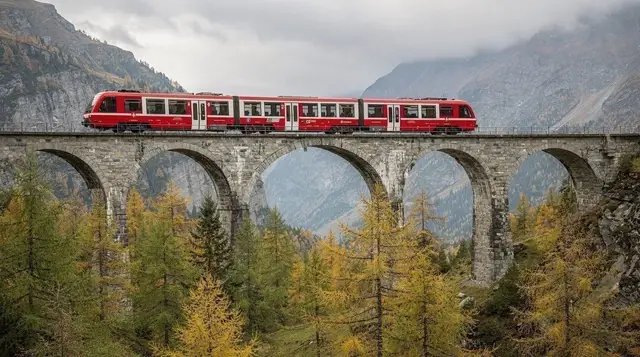
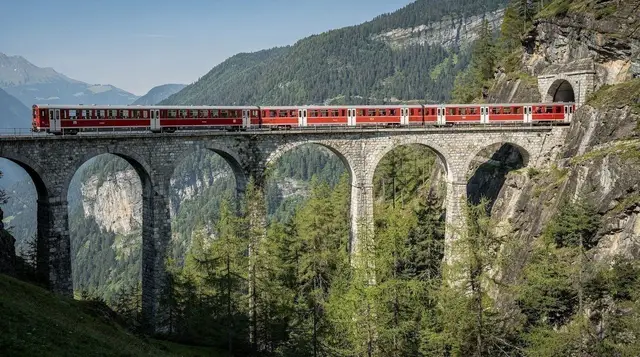
The Bernina Express: UNESCO line, Brusio viaduct and the 2,253m pass
What exactly is the Bernina Express and do you need to book?
It's a regular Rhaetian Railway line between Chur or St. Moritz and Tirano, Italy, run with panoramic carriages and open to any valid rail ticket. Seat reservations (around CHF 15-33 depending on season) are compulsory in the panoramic cars and sell out days ahead in summer, so book them separately from your travel pass.
What the Bernina Express actually is
The Bernina Express is not a special one-off service like the Glacier Express. It’s the Rhaetian Railway’s ordinary line between Chur (or St. Moritz) and Tirano, on the Italian side of the border, run with panoramic rolling stock and marketed under a brand name. Any train on that line counts, and most of them carry the same wide-windowed carriages whether or not the timetable calls them “Bernina Express”. The route was added to the UNESCO World Heritage list in 2008, jointly with the Albula line, as the Rhaetian Railway in the Albula/Bernina Landscapes — one of very few railways anywhere with that status, and the only one crossing an open Alpine pass on standard-gauge-free narrow track without a single tunnel over the summit.
That matters practically: because it’s a regular line, a Swiss Travel Pass or Half Fare Card covers the fare, and you can break the journey at Pontresina, Poschiavo or anywhere else the train stops. What you pay extra for is the seat reservation in the panoramic carriages, not the trip itself.
The route from Lucerne
There’s no single train from Lucerne to Tirano; you build the day in two or three legs.
| Leg | Journey time | Notes |
|---|---|---|
| Lucerne to Chur | ~1 h 40 | Direct IR train, hourly |
| Chur to St. Moritz | ~2 h | Albula line, also UNESCO-listed, scenic in its own right |
| St. Moritz to Tirano | ~2 h 15 | The core Bernina Express section |
| Chur to Tirano direct | ~4 h | Same train continues past St. Moritz |
| Tirano to Lugano (bus) | ~2 h 30 | Postbus connection, separate reservation |
Most people from Lucerne join at Chur and ride straight through to Tirano, rather than backtracking via St. Moritz. If the goal is the Bernina Pass itself and the Brusio viaduct rather than the full run, boarding at St. Moritz shortens the day by nearly two hours and still covers every scenic highlight — the Chur-to-St. Moritz stretch on the Albula line is dramatic too, but it’s a different set of viaducts and spiral tunnels, not the Bernina Pass.
A same-day return from Lucerne to Tirano and back is roughly 12 hours of travel once you add the connections, most of it on trains that are themselves worth watching out the window, but it leaves under an hour in Tirano itself. Anyone tempted by that should read how many days in Lucerne first — it’s the kind of day trip that works better as one night away.
What you see on the way
Northbound or southbound, the sequence is roughly the same. Leaving St. Moritz, the line climbs past Pontresina and the Morteratsch glacier, visible on the right-hand side heading towards Tirano — it has retreated visibly even in the last decade, and there’s a marked trail from Morteratsch station if you want to walk closer on a different day. The train then reaches the Bernina Pass itself at 2,253 metres, the highest point any Rhaetian Railway line crosses without a tunnel, running alongside Lago Bianco, a turquoise reservoir lake that in winter is one of the coldest, starkest stretches of the whole trip.
From there the line drops fast towards Poschiavo, an Italian-speaking Swiss village worth a stop if time allows, and then into the Val Poschiavo proper. The last set-piece before Tirano is the Brusio spiral viaduct: a nine-arch stone bridge where the track curls through a full 360-degree loop to lose altitude on a gradient the train couldn’t otherwise manage. It’s a few minutes before the Tirano terminus and visible from both sides, marginally better from the right heading downhill. Photographers who want the classic shot from outside the train, rather than through a window, get off at Brusio station and walk down to the viaduct itself — it’s a short walk and there’s usually another train back within the hour.
Tirano is an ordinary Italian border town rather than a destination in itself. The Rhaetian Railway station sits almost next to the Italian Trenord one, and most visitors either turn straight around for the return train or catch the connecting postbus onward to Lugano. For a fuller comparison of this line against the country’s other headline routes, see the Gotthard Panorama Express guide and the Glacier Express guide.
Reservations, cost and timing
The train itself runs on normal Rhaetian Railway fares, so a Swiss Travel Pass, Half Fare Card, or point-to-point ticket all work exactly as they would on any other Swiss train — see the Swiss Travel Pass guide for what each covers. What’s compulsory is a seat reservation for the panoramic carriages, booked separately through the Rhaetian Railway. Reservation fees run roughly CHF 15-33 depending on the season and how far you’re travelling, cheaper in winter, more expensive in the July-August peak.
Reservations open months ahead and the busiest summer departures — the late-morning trains from St. Moritz, which fit best with a day trip — sell out one to two weeks in advance. Booking as soon as travel dates are fixed avoids being pushed onto an earlier or later departure that doesn’t match the rest of the day’s connections. Ordinary regional trains on the same line, without the panoramic carriages, don’t require a reservation and run the identical route at the identical fare, just with standard windows and no at-seat commentary — a reasonable fallback if reservations for the panoramic service are gone.
For travel further afield in the region, a private guided option covering St. Moritz, Chur and Davos in one day removes the reservation logistics entirely; details are under a private day tour through Bad Ragaz, Davos, St. Moritz and Chur.
Booking it as a packaged day trip instead
For visitors based further south, in Milan rather than Lucerne, the Bernina Express is usually sold as a bundled day trip that handles the border crossing, seat reservations and connections in one booking. That’s a different starting point to a Lucerne-based visit, but worth knowing about if the itinerary includes both cities: a day trip from Milan on the Bernina Express to St. Moritz covers the classic run northbound, while a guided Bernina train journey from Tirano to St. Moritz with a private guide is a smaller-group version starting from the Italian side.
From Lucerne, the practical version of the same idea is to base a night in St. Moritz and treat the Bernina Express as one leg of a longer loop through St. Moritz and Chur, rather than a single packaged excursion — the region rewards more than a few hours, and the Lugano and Ticino day trip guide covers what’s on the other side once the postbus reaches Italian-speaking Switzerland.
Where to break the journey
Poschiavo and Pontresina are the two obvious stops, for different reasons. Poschiavo sits in the warmer, Italian-speaking valley south of the pass, with a village centre that feels distinctly different from German-speaking central Switzerland — a good lunch stop if the timetable allows an hour or two between trains. Pontresina, just outside St. Moritz, is the base for wildlife watching in the surrounding valleys; a guided outing there covers marmots and ibex on the slopes above the village, sold as a photo tour to see marmots and ibex near Pontresina, and works well tacked onto either end of a Bernina Express day.
St. Moritz itself is expensive by Swiss standards even for Swiss standards, and a coffee or lunch there costs noticeably more than the same order in Lucerne or Chur — worth budgeting for rather than being caught out by. The Swiss trains explained guide covers how reservations, passes and regional trains fit together more generally, which is useful background before tackling a route with as many moving pieces as this one.
Alternatives and how it compares
Three other named panoramic routes get mentioned in the same breath as the Bernina Express, and they’re not interchangeable:
| Route | Length | Character |
|---|---|---|
| Bernina Express | ~4 h (Chur-Tirano) | Open Alpine pass, no summit tunnel, glacier views |
| Glacier Express | ~7 h 45 (Zermatt-St. Moritz) | Longest single journey, at-seat dining, mostly valleys and tunnels |
| Gotthard Panorama Express | ~5 h (Lucerne-Lugano) | Boat plus train, historic Gotthard route, starts in Lucerne itself |
| GoldenPass Line | ~5 h 30 (Lucerne-Montreux via Interlaken/Zweisimmen) | Three connecting trains, lake and Alpine foothill scenery |
Of the four, the Gotthard Panorama Express is the only one that starts and ends in Lucerne without a connection, which makes it the simplest to fit into a short visit; details are in the Gotthard Panorama Express guide. The Bernina Express asks for more commitment — a connection to Chur or St. Moritz first — but its open, glacial high pass is a genuinely different landscape from anything the Gotthard or GoldenPass routes cross, and it’s the one most likely to be combined with a stay in St. Moritz or a crossing into Italy rather than a there-and-back day.
For travellers weighing the Bernina Express specifically against the Glacier Express, the short version is that the Glacier Express is the longer, more scenic-dining-focused experience through the Alps’ interior, while the Bernina Express is shorter, cheaper, and crosses genuinely open high country rather than running through it in tunnels. Either can be paired with the other on a longer Swiss itinerary without feeling repetitive, since the landscapes and pace are different enough to justify both.
Practical notes before booking
Reservations for the panoramic carriages should be made as early as travel dates allow, particularly for a July or August morning departure from St. Moritz. A Swiss Travel Pass or Half Fare Card covers the underlying fare; the reservation fee is separate and non-negotiable in peak season. Winter travel is possible and the pass in snow is one of the more striking versions of the route, but postbus connections on to Lugano run less frequently between November and April, so check the current timetable rather than assuming a summer frequency.
Anyone building this into a longer central-Switzerland trip rather than a single excursion should look at Andermatt and the Gotthard region and Lugano as the other ends of a rail loop, and at the day trips from Lucerne guide for how this compares in effort and payoff to shorter options closer to the city, and the Zermatt day trip guide for the other major rail-based excursion in the same general direction.
Bernina Express, St. Moritz and the Engadine
For questions specific to the Bernina Express as a piece of railway rather than a day-trip logistics problem — reservations, seasons, and the difference between the panoramic and standard carriages — the FAQ below covers what comes up most.
Is the Bernina Express a separate train you have to pay extra for?
No. It runs on normal Rhaetian Railway track between Chur/St. Moritz and Tirano, and Swiss Travel Pass or Half Fare Card holders travel on the standard fare. What costs extra is the seat reservation for the panoramic carriages, not the journey itself.
How long does the full Bernina Express route take?
Chur to Tirano is about 4 hours; St. Moritz to Tirano is roughly 2 hours 15 minutes. Add the bus connection from Tirano to Lugano (about 2.5 hours) if you’re continuing that way rather than taking the return train.
Do I need to reserve a seat, and how far ahead?
Reservations are compulsory in the panoramic carriages and go on sale months in advance through the Rhaetian Railway’s own booking system. In July and August, popular departures sell out one to two weeks ahead, so book as soon as your dates are fixed.
Can the Bernina Express be done as a day trip from Lucerne?
It’s a very long day: Lucerne to Chur is about 1 hour 40, then 4 hours each way on the Bernina line, which leaves almost no time in Tirano or St. Moritz before the last connection home. An overnight in St. Moritz, Tirano or Poschiavo makes the trip far less rushed.
What is the Brusio spiral viaduct and where do you see it?
It’s a nine-arch stone viaduct near Brusio, a few minutes before Tirano, where the track loops back over itself in a full circle to lose height on the steep descent. It’s visible from both sides of the train, and better from the right-hand side heading downhill towards Tirano.
Which side of the train has the best views?
Heading from St. Moritz towards Tirano, the right-hand side gets the Morteratsch glacier and Lago Bianco; the left-hand side gets the Brusio viaduct loop near the end. There’s no seat that has everything, and the carriages are narrow enough that most passengers end up standing at both windows anyway.
Is the Bernina Express worth it if I’ve already done the Glacier Express?
They’re different trips. The Glacier Express is a single scheduled panoramic service with at-seat dining over nearly 8 hours; the Bernina Express is a regular line you can hop on and off, shorter, and crosses an open, glacial high pass rather than mostly tunnels and valleys. Doing both is common and they don’t feel repetitive.
Does the Bernina Express run in winter?
Yes, year-round, and the Bernina Pass section in snow is one of the most striking stretches of railway in the Alps. Winter departures are less frequent and reservations still apply; check the current timetable before travelling between November and April, when some connecting postbuses reduce service.
Scenic train tours on GetYourGuide
Verified deep-linked GetYourGuide tours. Book through these links and we earn a small commission at no cost to you.
GetYourGuide does not provide a product photo for this activity — the image shows the meeting point, photographed by us.