The Gotthard Panorama Express: boat and train from Lucerne to Lugano
What exactly is the Gotthard Panorama Express?
It is a single-ticket journey combining a paddle steamer from Lucerne to Flüelen with a panoramic train over the historic Gotthard mountain line to Lugano. The whole trip takes around five to five and a half hours, runs roughly April to October, and needs a compulsory seat reservation on top of a normal ticket or rail pass.
Boat, then train, in one bookable journey
The Gotthard Panorama Express is not a single vehicle. It is a joined-up itinerary: a paddle steamer across Lake Lucerne from the Lucerne pier to Flüelen, followed by a dedicated panoramic train that climbs over the old Gotthard pass railway to Bellinzona and on to Lugano. It is run by SBB and sold as one product with through reservations, but you physically change vehicles at Flüelen, walking a few minutes from the boat landing to the station platform.
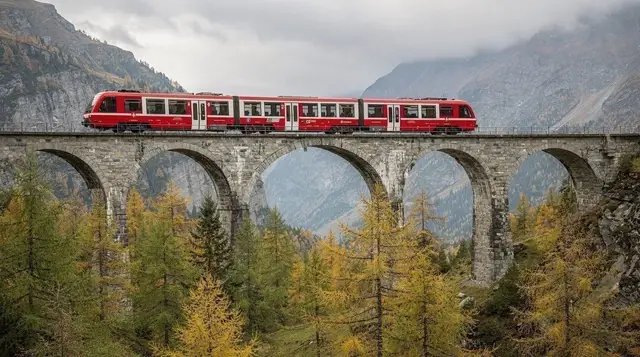
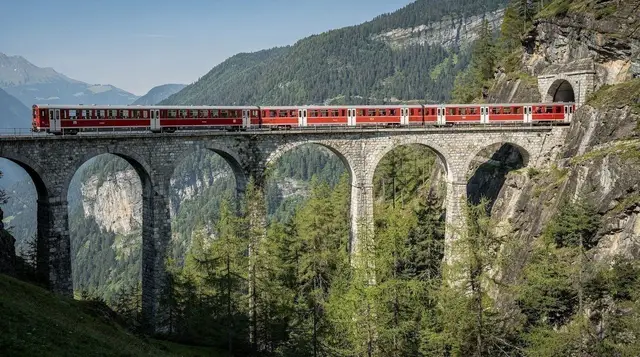
The appeal is the combination. The boat leg gives you the length of Lake Lucerne, past Weggis and Vitznau, Brunnen and the Lake Uri basin, with the Rütli meadow and the steep shoreline below Mount Pilatus and Mount Rigi on either side. The train leg then does something the fast trains through the Gotthard Base Tunnel cannot: it takes the historic mountain route, climbing in full view of the valley through a sequence of loops and spirals before crossing into Ticino.
If you only have time for one of the two legs, the boat alone is covered in our Lake Lucerne paddle steamer guide and general Lucerne boat trips guide. This page is about doing both together, as the through service.
The boat: Lucerne to Flüelen
The paddle steamer departs from the pier next to Lucerne station — the same jetty used for the shorter lake cruises described in our boat timetables guide. The Gotthard Panorama Express uses a faster, more direct sailing than the leisurely round-the-lake cruises: budget close to two hours to Flüelen rather than the three-plus hours of a full scenic loop with many stops.
On a clear day this is worth doing for its own sake. The lake narrows and the shores steepen as you head south past Brunnen, and the last stretch into Flüelen runs under cliffs with almost no flat shoreline left, a genuinely different landscape from the open water near Lucerne. In poor weather, or if the boat is cancelled for high water or ice (it happens most winters, which is one reason the whole service is seasonal), the alternative is a direct train from Lucerne to Flüelen in well under an hour — worth knowing if you are trying to salvage a booked train reservation on a day the boat isn’t running.
The train: Flüelen to Lugano over the old Gotthard line
From Flüelen the panoramic train follows the historic Gotthard railway, the line that predates the Gotthard Base Tunnel by more than a century. It climbs through Erstfeld and Amsteg, then tackles the steepest section of the ascent around Wassen using a sequence of spiral tunnels and loops cut into the mountainside to gain height without an impossibly steep gradient. It is genuinely one of the more dramatic pieces of railway engineering in the Alps, and it is the reason to choose this route over the faster, mostly underground trains through the base tunnel.
After the loops the train reaches Göschenen and enters the original Gotthard summit tunnel — 15 kilometres of tunnel dating from 1882, still in everyday use for regional and panoramic services even though the base tunnel below now carries the fast through-trains. It emerges in Airolo on the southern, Italian-speaking side, then descends through Faido and Biasca to Bellinzona, capital of Ticino, before the final short run to Lugano.
The carriages used are dedicated panoramic stock with unusually large windows, run specifically for this seasonal service rather than everyday regional trains. Expect a noticeably slower, more sightseeing-paced journey than the modern Gotthard base line — that is the entire point of choosing it.
The Wassen loops, explained
The section between Erstfeld and Göschenen is the one people ask about. To climb roughly 600 metres in a short horizontal distance, the railway builders spiralled the line back on itself three times in helical tunnels, so the train passes both above and below the village of Wassen and its church several times over, at different heights, in the space of about twenty minutes. It is disorienting the first time — you will see the same church tower from three different angles and heights — and it is genuinely one of the best short stretches of railway watching in Switzerland. Sit on the right-hand side heading south for the best views of the loops and the church.
Booking, seat reservations and price
A seat reservation is compulsory on the panoramic train section, whether you are travelling on a point-to-point ticket, a Half Fare Card fare, or a Swiss Travel Pass. The pass and most rail tickets cover the underlying transport; the reservation is a separate paid supplement layered on top, generally in the region of CHF 30 to 40 per person depending on class and how far in advance you book. Fares are reviewed at each timetable change, so treat that figure as a planning estimate and check the current price when you book rather than assuming last season’s number still applies.
The boat leg on the Gotthard Panorama Express itself does not usually require its own reservation, but during July and August the through service can sell out days in advance, particularly for first class and window seats through the Wassen loops. Booking two to three weeks ahead is sensible in high summer; a few days’ notice is normally enough in shoulder season.
Regional rail travellers in Central Switzerland sometimes cover part of the boat leg with a Tell-Pass instead of the Swiss Travel Pass — worth comparing if you are staying mainly around Lucerne, Weggis and Vitznau, or Brunnen and only doing this one longer excursion south.
Class, seating and what’s on board
Both first and second class are available on the panoramic train, with first class buying wider seats and slightly better sightlines but the same windows and the same route — the difference matters less here than on some scenic trains, because the view is the product either way. There is an onboard catering trolley on most departures rather than a full dining car; it is not the same at-seat meal service you get on the Glacier Express or Bernina Express, so eat before boarding or bring something if you want more than a snack.
Luggage space is standard train racks rather than dedicated luggage vans, which is fine for a day bag but worth planning around if you are travelling on with suitcases — Lucerne has left-luggage facilities at the station if you want to travel light for the day and collect bags afterwards.
| Element | Approximate detail |
|---|---|
| Boat leg | Lucerne to Flüelen, about 2 hours |
| Train leg | Flüelen to Lugano, about 2 hours 40 minutes to 3 hours |
| Total journey | Around 5 to 5.5 hours one way |
| Season | Roughly early April to mid-October |
| Reservation | Compulsory on the train, CHF 30–40 supplement (indicative) |
| Frequency | Once daily each direction in season |
Season and timetable
This is strictly a seasonal service, running from roughly early April through mid-October, with a single departure a day in each direction. It does not operate in winter — the boat timetable on Lake Lucerne thins out considerably from November, and the historic panoramic carriages go into off-season maintenance. If you are visiting in winter and still want the Gotthard mountain line experience, regular regional trains still run the Erstfeld–Wassen–Göschenen–Airolo section year-round, just without the dedicated panoramic carriages or the connecting boat.
Because there is only one departure a day, this is a fixed-commitment excursion rather than something you can casually decide on over breakfast — check the current-year timetable and lock in a reservation before you plan the rest of the day around it.
One-way, return, or a stopover in Lugano
Most visitors do this one way and fly or train back separately, rather than turning around immediately. Lugano is a genuine destination in its own right — lakeside, palm-lined, distinctly Italian-feeling despite being Swiss — and a same-day return would leave barely any time there once you account for the outbound five and a half hours. A short walking tour on arrival is a reasonable way to use a couple of hours before catching a fast train back north through the base tunnel, which takes a fraction of the time the panoramic route does.
a guided walk through Lugano’s old town with a funicular ride included is a sensible way to fill the hours after arrival if you don’t want to plan the stopover yourself. Coming back, most people take the direct train through the Gotthard Base Tunnel, which covers Lugano to Lucerne (via Zurich or Arth-Goldau, depending on connection) in well under three hours — useful context for how much slower, and how much more scenic, the panorama route actually is.
If Uri itself interests you rather than just passing through it on the boat, the Flüelen area sits at the base of some serious hiking and canyon country; a guided hiking and wild-camping trip into the Uri mountains is a way to use the region as more than a transfer point. And if the appeal of this route for you is really the mountain railway engineering more than the boat, a private day trip covering Andermatt, Interlaken and Grindelwald reaches the same Gotthard corridor from a different angle, without the fixed daily departure time of the panoramic service.
How it compares to the Glacier Express and Bernina Express
Switzerland’s better-known panoramic trains, the Glacier Express and the Bernina Express, both run longer routes with full at-seat dining and larger panoramic windows built for the whole journey, not just one leg. The Gotthard Panorama Express is shorter, cheaper, and arguably more interesting for the specific stretch through the Wassen loops, but it is a half-day excursion rather than a full-day set piece, and only the train half is purpose-built panoramic stock — the boat is a standard (if historic) lake steamer.
If you are choosing between scenic rail routes and only have time for one, our comparison of the main panoramic lines and the dedicated Glacier Express guide are worth reading alongside this page before you commit a full day to any of them.
For a broader look at how this fits into a Central Switzerland itinerary, see day trips from Lucerne, best mountain excursions from Lucerne, and — if Ticino is the real draw — our Lugano and Ticino day trip guide. For a longer stay that could absorb a day like this without feeling rushed, look at the 4-day itineraries or 5-day itineraries from Lucerne, and general Swiss trains explained if reservation systems and rail passes are new to you.
Mistakes to avoid
Booking a reservation but forgetting the boat can be cancelled independently is the most common one — check the sailing status the day before in shoulder season, and know that the fallback direct train from Lucerne to Flüelen takes under an hour if the boat doesn’t run. Second, don’t assume the Swiss Travel Pass makes this free: it covers the transport, not the compulsory train reservation, and people occasionally arrive at the platform surprised by an extra charge. Third, remember there is only one departure a day — missing it means waiting until the next day, not the next train.
Questions about the Gotthard Panorama Express
What is the Gotthard Panorama Express exactly?
It pairs a paddle steamer from Lucerne to Flüelen with a panoramic train from Flüelen to Lugano over the historic Gotthard mountain railway, sold as one connecting itinerary with through reservations, even though you change vehicles at Flüelen.
How long does the journey from Lucerne to Lugano take?
Around five to five and a half hours in total: roughly two hours by boat, then close to three hours by train, including the climb through the Wassen loops and the old Gotthard summit tunnel.
Do I need a seat reservation?
Yes, a seat reservation on the panoramic train is compulsory, even for Swiss Travel Pass holders. The boat does not usually need one, though booking ahead in July and August is wise.
How much does the Gotthard Panorama Express cost?
The reservation supplement is roughly CHF 30 to 40 per person depending on class, on top of the underlying ticket or pass — confirm the current fare when booking, as it is reviewed each season.
Is the Gotthard Panorama Express covered by the Swiss Travel Pass?
The pass covers the boat and train transport itself, but not the compulsory seat reservation supplement on the panoramic carriages.
When does the Gotthard Panorama Express run?
Seasonally, from roughly early April to mid-October, with one departure a day in each direction. There is no winter service.
Can I do the journey from Lugano to Lucerne instead?
Yes, the same service runs in reverse — train from Lugano to Flüelen, then boat to Lucerne — with a similar total journey time.
Scenic train tours on GetYourGuide
Verified deep-linked GetYourGuide tours. Book through these links and we earn a small commission at no cost to you.
GetYourGuide does not provide a product photo for this activity — the image shows the meeting point, photographed by us.