The Glacier Express from Lucerne: is the eight-hour ride worth it?
Can you board the Glacier Express from Lucerne?
Not directly — Lucerne isn't a Glacier Express station. Most central Switzerland travellers connect at Andermatt (via the Gotthard Panorama Express or a regular train) or ride further round to Chur or Brig. Budget CHF 150-300 per person once the compulsory seat reservation is added to the rail fare, and reserve at least 2-4 weeks ahead in July and August.
The Glacier Express is the train everyone’s seen a photo of — red carriage, glass roof, a viaduct somewhere above a valley nobody can quite place. It’s also not a train you catch from Lucerne itself, which surprises a fair number of people planning a trip around this city. Here’s what it actually costs, where central Switzerland travellers realistically join it, and whether eight hours on a train — most of it at walking pace — earns its reputation.
Where to actually board it from central Switzerland
The Glacier Express runs between Zermatt and St Moritz, full stop. It never comes near Lucerne, and there’s no version of the route that starts here. If you’re based in Lucerne, you have three realistic ways onto it.
Via Andermatt. This is the connection most Lucerne-based travellers use. You take a regular SBB train from Lucerne through the Gotthard base tunnel towards Göschenen, then change onto the older mountain line up to Andermatt — about 1 hour 30 minutes to 1 hour 45 minutes door to door depending on connections.
Andermatt is a scheduled Glacier Express stop, so you simply board there. Alternatively, the Gotthard Panorama Express — a combined boat-and-train product that starts in Lucerne itself — also passes through Andermatt on its way south, and some travellers use its morning boat leg as a scenic warm-up before switching to the Glacier Express instead of continuing on to Lugano.
Via Chur. If you’re coming from Zurich or already heading east, Chur is the other major joining point, roughly 1 hour from Zurich by train and about 2 hours from Lucerne with one change. Chur to St Moritz on the Glacier Express also overlaps almost entirely with the separate Bernina Express route as far as Chur, so if you’re chasing red panoramic trains generally, it’s worth comparing both rather than assuming Glacier Express is the only option.
Via Brig. Coming from Bern or over the Lötschberg, Brig is the western end near Zermatt where the line starts. This only makes sense if you’re already in the Valais or approaching from Geneva rather than Lucerne.
None of these connections are covered “for free” by the Glacier Express ticket itself — you’re paying for the approach leg separately, on top of the Glacier Express fare and its reservation, unless you’re travelling on a Swiss Travel Pass that already covers the connecting trains.
What it actually costs, in CHF, not marketing numbers
Two separate charges make up a Glacier Express fare: the underlying rail fare (covered by a Swiss Travel Pass, a Half Fare Card at 50%, or paid at full price) and a compulsory seat reservation that nothing waives.
| Item | Standard class (peak, Jul-Aug) | Excellence Class |
|---|---|---|
| Seat reservation, per person | CHF 33-53 | CHF 490-650 (includes meal) |
| Base fare, Zermatt–St Moritz, full price 2nd class | ~CHF 152 | ~CHF 152 + upgrade |
| Base fare with Half Fare Card | ~CHF 76 | ~CHF 76 + upgrade |
| Base fare with Swiss Travel Pass | CHF 0 | CHF 0 + upgrade |
| Onboard lunch (standard class, optional) | CHF 28-38 | included |
So a realistic one-way total for someone travelling on a Half Fare Card, in standard class, in July, is around CHF 110-130 in reservation and fare alone — before whatever it costs to reach Andermatt or Chur from Lucerne, and before lunch. Reservation prices vary by season and by exactly which departure and route segment you book; shoulder-season reservations (May, June, September, October) run at the lower end of that range, and winter fares drop further still.
The bit that catches people out: the reservation fee is per direction, and it’s the same whether you ride the full 8-hour route or just one short segment between two intermediate stations. There’s no discount for boarding partway through.
a Glacier Express day tour from Basel or the equivalent packaged trip from Zurich bundles the connecting transport, the seat reservation, and sometimes lunch into one price — worth comparing against booking each leg yourself, since the DIY route from Lucerne involves at least one extra change that a packaged tour handles for you.
Booking the seat reservation without getting shut out
Reservations open roughly 3-4 months ahead through SBB or the Glacier Express website, and they need to be locked in earlier than most people expect:
- July-August: book 2-4 weeks ahead minimum. Panoramic-car window seats and any Excellence Class slots often sell out further in advance than that.
- May-June and September-October: a week’s notice is usually fine, though weekends still fill.
- November-April: departures run less frequently — often once daily rather than several — so check the current timetable before assuming a same-week booking will work.
You’ll be asked to pick a specific date, direction, and departure time, and the reservation ties you to that exact train — there’s no flexible “any train today” version. If you’re travelling with a rail pass, you still complete the reservation as a separate transaction; the pass only exempts you from the base fare, not the seat charge.
The mountain sections of this line, particularly around the Oberalp Pass, close for scheduled maintenance and are weather-dependent outside the main season — the same pattern that closes Pilatus and other high routes each spring and autumn. If you’re planning a shoulder-season trip, confirm the current operating dates before booking connecting trains you can’t easily refund.
What eight hours actually buys you
The full route covers about 291 km, 291 bridges, and 91 tunnels between Zermatt and St Moritz. The named highlights, roughly west to east:
- Matter Valley and the approach to Brig — vineyard terraces and the Rhône valley floor, the least dramatic stretch of the ride.
- Furka-Oberalp line to the Oberalp Pass — the journey’s high point at 2,033 m, usually the section people photograph most, snow-capped even in summer.
- Andermatt to Disentis — the connection point for central Switzerland travellers, then a drop through forested valleys.
- The Rhine Gorge (“Swiss Grand Canyon”) near Ilanz — a genuinely dramatic stretch of pale limestone cliffs the train winds through at low speed.
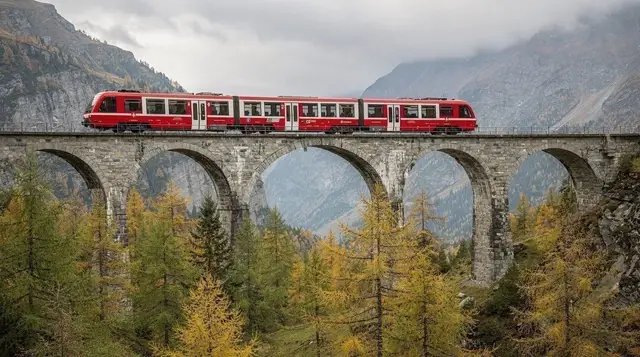
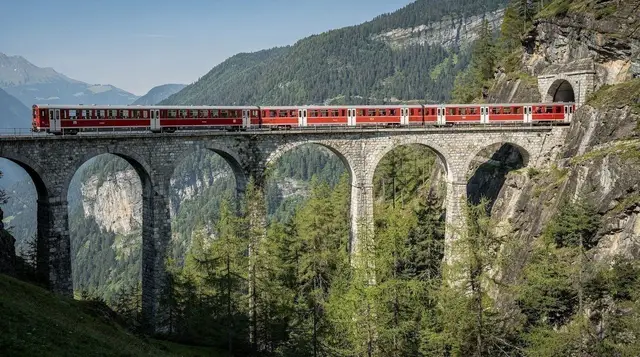
- Landwasser Viaduct, near Filisur — the six-arch stone bridge that appears on most of the marketing material, curving directly into a tunnel mouth.
- Albula Pass approach into the Engadin — spiral tunnels gaining altitude before the final run into St Moritz.
Is it worth eight hours? Depends what you’re comparing it to. As pure scenery-per-hour, the Rhine Gorge and Landwasser Viaduct sections are genuinely worth seeing and photograph better than they’re often given credit for. But roughly half the route runs through ordinary valley towns and agricultural land at a pace that a faster regional train would cover in a third of the time — the “express” in the name refers to the panoramic experience, not the speed; average speed across the whole line is under 40 km/h.
Cheaper and faster alternatives from Lucerne
If the appeal is panoramic Alpine rail rather than the Glacier Express brand specifically, three other routes are worth weighing, all more directly accessible from Lucerne:
| Route | Starts in Lucerne? | Duration | Reservation required? |
|---|---|---|---|
| Gotthard Panorama Express | Yes, boat + train | ~5.5 hours to Lugano | No compulsory reservation |
| Luzern-Interlaken Express | Yes, direct | ~2 hours | No |
| GoldenPass Line | No, joins near Interlaken or Montreux | Varies by segment | Panoramic cars only |
| Glacier Express | No, via Andermatt or Chur | ~7h40-8h | Yes, compulsory |
For a single central Switzerland day trip, the Gotthard Panorama Express is the better-value comparison: it departs Lucerne directly, costs meaningfully less because there’s no compulsory reservation fee stacked on top, and its lake cruise leg through Lake Uri adds a different kind of scenery the Glacier Express doesn’t have. The Glacier Express wins on altitude and on the specific Rhine Gorge and Landwasser sections — but you’re paying a premium, in both money and connecting time from Lucerne, for terrain that’s a genuine step up rather than a modest one.
If Zermatt itself, rather than the train ride there, is the real goal, it’s also worth comparing a private transfer option: a private day tour to Zermatt and the Matterhorn Glacier Paradise from Zurich gets you to the Matterhorn viewpoints in a single day without needing an overnight stop, which the Glacier Express’s own schedule effectively forces on you if you’re starting that far from either end of the line.
Practical notes for the day
Luggage: normal suitcase allowance, stored at the end of each carriage — there’s no separate luggage van, so oversized bags are awkward on a train this narrow.
Food: standard class has at-seat food and drink service you pay for as you go (CHF 28-38 for a hot lunch); Excellence Class includes a multi-course meal in the fare. Bringing your own snacks is normal and nobody minds.
Seats: window seats on the north/uphill side generally get better light for the Rhine Gorge and Landwasser Viaduct sections, though which side faces the view flips depending on direction of travel — ask when booking if it matters to you.
Once you’re at Zermatt or St Moritz: neither town is a quick add-on. Zermatt is car-free and reached only by train or cable car from Täsch, so factor in arriving with enough daylight left to do anything once you’re there. A same-day return from Lucerne is not realistic — this is a trip that needs an overnight, or a very early start paired with a late one.
If you’d rather see the Matterhorn without the full line: the Gornergrat cogwheel railway ticket gets you to a 3,089 m viewpoint over the Matterhorn once you’re in Zermatt, and doesn’t require booking weeks ahead the way the Glacier Express reservation does.
For most people building an itinerary around Lucerne, the honest framing is this: the Glacier Express is a worthwhile once-per-trip splurge if Alpine scenic rail is specifically what you’re after and you’re prepared to treat the connection to Andermatt or Chur, and the overnight at either end, as part of the cost.
If what you actually want is “a scenic train from Lucerne, today, without a CHF 50 add-on fee,” the Gotthard Panorama Express or the Luzern-Interlaken Express solve that more directly. See day trips from Lucerne for how either fits into a shorter stay, or a longer 4-day itinerary if you want to build the Glacier Express in properly with a night in Zermatt or St Moritz either side.
Scenic train tours on GetYourGuide
Verified deep-linked GetYourGuide tours. Book through these links and we earn a small commission at no cost to you.
GetYourGuide does not provide a product photo for this activity — the image shows the meeting point, photographed by us.