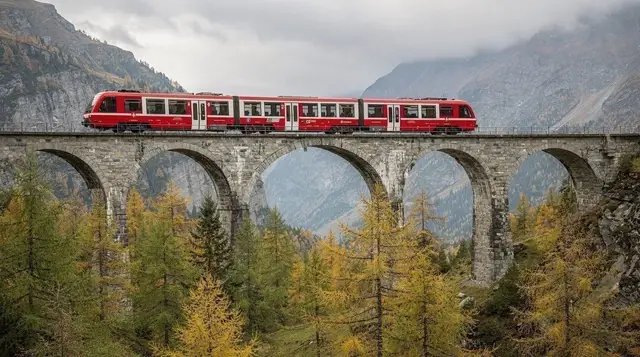
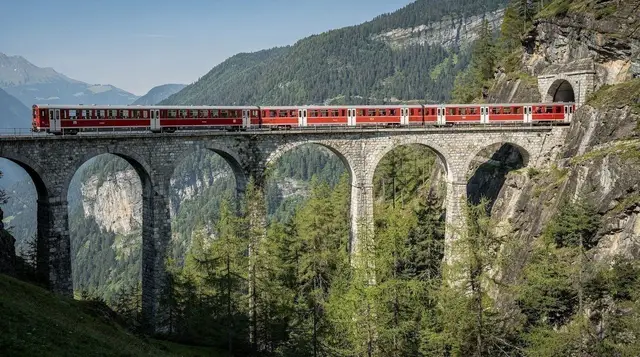
The GoldenPass line: Lucerne to Montreux by panoramic train
What is the GoldenPass line and does it run all the way from Lucerne to Montreux?
The GoldenPass line links Lucerne to Montreux via Interlaken, using the Brünig railway for the first leg and the GoldenPass Express for the second. Since December 2022 the Express uses variable-gauge trains that swap bogies automatically at Zweisimmen, so you no longer change trains there. Reservations are compulsory on the Express leg and cost extra on top of your ticket or pass.
What the GoldenPass line actually is
“GoldenPass” is a marketing name for a corridor, not a single train company. It covers roughly 190 km of track between Lucerne and Montreux, split between three different railways that historically didn’t talk to each other well: Zentralbahn on the Brünig section (Lucerne to Interlaken), the MOB (Montreux-Oberland Bernois) on the metre-gauge stretch from Zweisimmen to Montreux, and BLS on the standard-gauge middle section between Interlaken and Zweisimmen. For decades this meant two changes of train and, worse, a change of gauge at Zweisimmen that forced everyone off one train and onto another on a different platform, luggage and all.
That second change disappeared in December 2022 with the launch of the GoldenPass Express, which uses trains built with variable-gauge bogies - more on that below. What’s left is a single change, at Interlaken Ost, and a journey that runs from Lucerne’s lakeside station to Lake Geneva in one continuous ticketed corridor, even if it’s still technically three railways cooperating.
If you’re coming from Lucerne and only have a day to spare, treat this less as “riding the GoldenPass” and more as “getting to Montreux the scenic way” - the practical version of this trip is covered separately in our day trips from Lucerne guide. This page is about the train itself: how the segments fit together, what the new rolling stock changed, where to sit, and what it costs.
The route in three segments
| Segment | Operator | Duration | Reservation |
|---|---|---|---|
| Lucerne → Interlaken Ost (Brünig line) | Zentralbahn | about 1h50 | not compulsory, recommended in summer |
| Interlaken Ost → Zweisimmen | BLS (part of GoldenPass Express) | about 55 min | compulsory, through-ticketed |
| Zweisimmen → Montreux | MOB (part of GoldenPass Express) | about 2h20 | compulsory, through-ticketed |
In practice you buy and think of the last two rows as one train: the GoldenPass Express runs Interlaken Ost to Montreux without you getting off, even though the track gauge changes underneath you partway through. Total Lucerne to Montreux, door to door on the platform, runs to roughly five hours including the connection time at Interlaken Ost. That is slower than driving the same distance, and slower than the direct SBB route via Bern (about three hours), which is the honest comparison to make before booking: you are paying in time and reservation fees for scenery, not for the fastest way to Lake Geneva.
The Brünig line out of Lucerne climbs quickly - it’s a rack railway on the steepest section near Giswil - past Lake Sarnen and through Brienz before dropping into Interlaken. It’s a working regional line as much as a tourist one, so trains are ordinary Zentralbahn rolling stock, not panoramic carriages; the views are still good, just not the main event of the trip.
The variable-gauge trains that changed everything
The detail worth understanding, because it’s the whole reason this is a “new” GoldenPass rather than the same route that’s existed for a century: Swiss main lines run on standard gauge (1435 mm between rails), but the MOB network from Zweisimmen to Montreux was built to metre gauge, like a narrow mountain railway. For most of the 20th century that meant a hard stop at Zweisimmen - everyone off, luggage across the platform, onto a different train.
The GoldenPass Express carriages, delivered by Swiss manufacturer Stadler, solve this with bogies (the wheel-and-axle units under each carriage) that can physically widen or narrow their track gauge. At Zweisimmen the train passes slowly through a gauge-changing facility - a short, deliberate crawl, not a stop you’d notice as dramatic - and the wheelsets adjust themselves while passengers stay in their seats. It’s a genuinely unusual piece of railway engineering for a scheduled passenger service, and it’s the single biggest change to this route in decades: what used to be two separate scenic trains stitched together by a transfer is now one seamless run.
It isn’t flawless. The service still depends on three different infrastructure owners coordinating, and delays on one section can ripple into the next. But for a traveller starting from Lucerne, the practical upshot is simple: one change, at Interlaken Ost, and nothing to carry across a platform after that.
Seat reservations, panoramic seats and what they cost
Reservation is compulsory on the Interlaken Ost-Montreux GoldenPass Express leg, for everyone, regardless of ticket type - a Swiss Travel Pass, a Half Fare Card fare, a point-to-point ticket, or the regional Tell-Pass if you’ve combined it with onward travel. The reservation fee is a flat charge on top of the fare, typically in the CHF 20-30 range depending on class and how far ahead you book - it has changed more than once since the Express launched, so check the current figure on the MOB or SBB site before you travel rather than trusting a number printed here.
Two classes run on the Express: standard second class, and a “prestige” first-class carriage with wider individual seats, a dedicated attendant and a small at-seat food and drink service. The panoramic windows - the tall glass that curves up into the roofline - are standard across both classes on the newer sets, so paying for prestige buys comfort and service rather than a materially different view.
A smaller number of departures still run with the older Belle Époque carriages: 1930s-style wood-panelled compartments with a period feel, kept in service alongside the newer panoramic trains rather than replaced by them. These need their own reservation category and don’t run every day, so if the vintage carriages matter to you, check the specific departure before booking rather than assuming.
The Brünig leg from Lucerne to Interlaken Ost does not require a reservation on a standard Zentralbahn service. In July and August, when the whole corridor gets busy with connecting Glacier Express and GoldenPass traffic through Interlaken, it’s still worth reserving a seat for a few francs for peace of mind, especially with luggage.
If you’d rather have someone else handle the connections, tickets and reservations, a guided version of the route is bookable as a day trip that rides the GoldenPass Express and stops in Gruyères - useful if the idea of coordinating a compulsory reservation on a foreign railway’s booking system puts you off doing it yourself.
What you’ll see out of the window
| Section | What to expect |
|---|---|
| Lucerne–Brienz | Lake Sarnen, forested hillsides, the Brünig rack section |
| Interlaken–Zweisimmen | The Simmental valley, dairy farms, timber chalet villages |
| Zweisimmen–Gstaad | Wide alpine meadows, the Saanenland, Gstaad’s chalet architecture |
| Château-d’Oex–Montbovon | The Pays-d’Enhaut, narrower valley, more forest |
| Montbovon–Gruyères | First views of Gruyères castle on its hilltop |
| Gruyères–Montreux | Vineyard terraces above Lake Geneva, then the descent into Montreux |
None of this is high-alpine scenery in the way the Glacier Express delivers glaciers and the Oberalp Pass, or the Bernina Express delivers its 2253 m summit and switchback viaducts. The GoldenPass corridor is gentler: dairy country, chalet villages, and a long, steady descent that ends at vineyards and a lake more associated with the Riviera than the high mountains. If you’ve already done a proper high-alpine panoramic train and are wondering whether this one adds something different, it does - it’s the closest thing on this corridor to rural, workaday Switzerland rather than postcard peaks, right up until Gruyères comes into view.
Doing it as a day trip from Lucerne
A same-day return is arithmetically possible and practically tight. Figure five hours each way including the Interlaken Ost connection, which means an early departure (the first realistic GoldenPass Express connection from Lucerne gets you into Montreux around midday) and a last train back that leaves you two to three hours in Montreux - enough to walk the lakefront promenade and see Chillon Castle from outside, not enough to do it justice along with Gruyères.
Two more realistic ways to use the line from Lucerne:
- One-way, then fly home or continue by another route. If Montreux, Lausanne or Geneva is your next stop rather than a day trip back to Lucerne, the GoldenPass Express is simply the scenic way to make that journey instead of the faster route via Bern.
- Overnight in Gruyères or Montreux. Breaking the journey lets you actually walk Gruyères’ old town and visit the castle - covered in our Gruyères and chocolate day trip guide - rather than watching it go past the window, then continue to Montreux the next morning.
For travellers who want the GoldenPass experience without managing the Lucerne end of the journey at all, tours running from the Montreux side cover the Gruyères connection directly, including a day trip from Lausanne or Montreux up to Col du Pillon and Glacier 3000, which pairs a different scenic ride with a high-altitude viewpoint above the Pays-d’Enhaut section the train passes through lower down.
How it compares to Switzerland’s other panoramic trains
| Train | Route | Approx. duration | Reservation fee band |
|---|---|---|---|
| GoldenPass Express | Lucerne–Interlaken–Montreux | ~5h from Lucerne | lower |
| Glacier Express | Zermatt–St Moritz | ~8h | higher |
| Bernina Express | Chur–Tirano | ~4h | mid |
| GoldenPass Panoramic / Luzern-Interlaken Express | Lucerne–Interlaken only | ~2h | lower still |
If your budget or time only stretches to one panoramic train and you’re weighing this against the Glacier Express, the honest trade-off is: GoldenPass costs less, takes less of your day, and shows you green pre-Alpine valleys rather than glaciers. It’s not a lesser version of the Glacier Express, it’s a different kind of scenery for a different kind of traveller.
Which side to sit on
On the Interlaken Ost-Montreux leg, sit on the right-hand side of the train (facing the direction of travel) for the Simmental valley views and, later, the descent towards Lake Geneva and the vineyard terraces above Montreux - this is the side that faces open valley rather than the hillside. On the Lucerne-Interlaken Brünig leg, the left-hand side gives the better lake views over Lake Sarnen and towards the Bernese Oberland as the train climbs.
Seat reservations on the Express let you choose a side when booking online or through a ticket office; if you’re booking close to departure in high season, the choice may already be limited, so book a few days ahead if the view matters more than the schedule.
Tickets, passes and what’s included
A Swiss Travel Pass covers the train fare on both legs of this journey - you do not pay again for the ride itself. What it does not cover is the compulsory GoldenPass Express seat reservation fee, which everyone pays regardless of pass. A Half Fare Card gets you 50% off point-to-point tickets but, again, not off the reservation fee. If you’re travelling without a national pass at all, point-to-point tickets are sold the normal SBB way and can be combined with the reservation in one booking on the MOB or SBB website.
For a wider view of how this fits into a multi-region pass strategy - including whether the regional Tell-Pass is worth adding for Lucerne’s own lake and mountains before or after this trip - see our Swiss Travel Pass guide and Tell-Pass guide.
Travellers assembling a longer central-Switzerland itinerary around one flexible pass, rather than pricing out each scenic train separately, sometimes book a customisable private-guide itinerary built around a travel pass instead, which folds the GoldenPass leg into a broader plan with a guide handling the connections.
Mistakes that ruin the day
- Not booking the reservation ahead in July-August. The compulsory seats sell out on popular departures; turning up with a valid pass and no reservation means you can’t board that specific train.
- Assuming Zweisimmen is still a change. Older guidebooks and some trip-planning habits still route people off at Zweisimmen out of caution. Since December 2022 you stay seated through the gauge change - don’t get off unless you’re actually stopping there.
- Treating it as a same-day round trip without checking the last connection back. Five hours each way plus a short stop leaves little room for a delay; check the last realistic return connection through Interlaken Ost before committing to a same-day plan.
- Booking prestige class expecting a different view. The windows are the same on both classes on the newer sets - prestige buys seat width and service, not scenery.
- Skipping Gruyères because it’s “on the way.” The train passes close to Gruyères without stopping long enough to see the castle properly; if the town matters to you, plan a stop rather than watching it from the window.
Chocolate and cheese sit either side of the Gruyères section of this line, and both are easy to fold into the same day: a private van tour from Montreux covering the castle, cheese dairy and chocolate factory around Gruyères is a way to see all three without working out local bus connections on top of the train journey itself.
The GoldenPass line, honestly assessed
This is not the most dramatic scenic train in Switzerland, and it doesn’t try to be. What it offers is a genuinely useful, now much simpler, rail link between Lucerne and Lake Geneva through some of the country’s least-touristed pre-Alpine valleys, at a lower reservation cost than the Glacier Express or Bernina Express. The variable-gauge engineering at Zweisimmen is a real point of interest if you like trains for their own sake, not just marketing copy - it solved an actual, decades-old inconvenience rather than being a cosmetic upgrade. Go in expecting green valleys and dairy country rather than glaciers, budget the full day it actually takes, and book the compulsory reservation ahead of time in summer.
Questions people ask about the GoldenPass line
Do I need to change trains between Lucerne and Montreux?
Yes, once: at Interlaken Ost, where you switch from the Brünig line to the GoldenPass Express. The connection is usually a same-platform or short walk transfer with 10-20 minutes to spare. The old second change, at Zweisimmen, was eliminated in December 2022 when the variable-gauge trains started running through.
What are the variable-gauge trains and why do they matter?
Swiss Travel System trains normally run on standard gauge, but the MOB line between Zweisimmen and Montreux is metre gauge. The GoldenPass Express carriages have bogies that widen or narrow automatically while the train passes slowly through a technical stop, so passengers stay seated instead of changing trains. It replaced a cross-platform transfer that used to break the journey in two.
Is seat reservation compulsory on the GoldenPass Express?
Yes, on the Interlaken Ost-Montreux leg reservation is compulsory even with a Swiss Travel Pass or Half Fare Card, and it costs extra. The Brünig leg from Lucerne to Interlaken does not require a reservation, though it is worth booking ahead in July and August.
Does the Swiss Travel Pass cover the GoldenPass line?
The Swiss Travel Pass covers the train fare for both legs. It does not cover the compulsory seat reservation fee on the GoldenPass Express, which you pay separately regardless of which pass or ticket you are travelling on.
Which side should I sit on for the best views?
Travelling from Interlaken to Montreux, the right-hand side gives the better views of the Simmental valley and the descent towards Lake Geneva and the Alpes vaudoises. On the Brünig leg from Lucerne to Interlaken, the left-hand side faces Lake Lucerne and Lake Sarnen as you climb out of the city.
Can I do Lucerne to Montreux and back in a day?
It is possible but tiring: the one-way journey takes around five hours, so a same-day return leaves barely two hours in Montreux before the last connection back. Most people either stop overnight in Montreux or Gruyères, or treat the GoldenPass as a scenic way to relocate rather than a day trip.
Is the GoldenPass line as scenic as the Glacier Express or Bernina Express?
It covers gentler, greener scenery than either - rolling pre-Alpine hills, dairy country and vineyards rather than glaciers and high passes - and it costs less because the reservation fee is lower than on those two trains. It suits travellers who want panoramic rail without the full-day commitment or price of the Glacier Express.
What are the Belle Époque carriages?
A small number of GoldenPass departures still use restored 1930s-style carriages with wood panelling and traditional compartments, run alongside the newer panoramic sets. They are a nostalgic option rather than the faster or more comfortable one, and seats need to be reserved specifically for them.
Scenic train tours on GetYourGuide
Verified deep-linked GetYourGuide tours. Book through these links and we earn a small commission at no cost to you.
GetYourGuide does not provide a product photo for this activity — the image shows the meeting point, photographed by us.