Jungfraujoch day trip from Lucerne: the full itinerary and price
Can you do Jungfraujoch as a day trip from Lucerne?
Yes, but it is a long day: roughly 2 hours 30 minutes each way by train, plus 1.5 to 2 hours at the top. Leave Lucerne by 6:30-7:00am, expect to be back around 8-9pm, and budget CHF 200-260 per adult for train and lift tickets alone before food.
Jungfraujoch is the excursion people plan their whole Swiss trip around, and it is also the one most likely to disappoint someone who did not read the fine print. From Lucerne it is not a half-day outing - it is close to five hours of travel for two hours at the top, and the ticket price rivals a night’s hotel stay in the city. None of that means skip it. It means go in knowing the real schedule, the real cost in CHF, and the point at which the Schilthorn becomes the smarter booking.
Why this is a long day, not a half day
The number that catches people out is the transfer time, not the altitude. Lucerne to Interlaken is about 1 hour 50 minutes by the Brünig line, then Interlaken Ost to Kleine Scheidegg is another 1 hour 10-30 minutes depending on the connection, and the final Jungfraubahn cogwheel section to the summit adds 35-50 minutes more. Door to door, Lucerne station to the Sphinx terrace is a solid 2 hours 45 minutes to 3 hours 15 minutes each way, and the return trip is the same again. That leaves roughly 1.5-2 hours at the top if you want to be back in Lucerne before 9-10pm.
If you would rather not manage four separate connections yourself, an organised option such as the day trip to Jungfraujoch from Interlaken handles the timing for you, though from Lucerne you would still need to reach Interlaken first on your own.
Route and timings from Lucerne
| Leg | Typical duration | Notes |
|---|---|---|
| Lucerne to Interlaken Ost | 1h 50min | Via the Brünig line, scenic but not fast; sit on the right heading south |
| Interlaken Ost to Grindelwald or Lauterbrunnen | 35-50min | Two valleys, two routes - see below |
| Grindelwald/Lauterbrunnen to Kleine Scheidegg | 35-50min | Change trains again, often a tight but scheduled connection |
| Kleine Scheidegg to Jungfraujoch | 35-50min | The final cogwheel section, mostly through a tunnel in the Eiger and Mönch |
| Time at the summit | 1.5-2h realistic | Less in peak season queues for the lifts inside the station |
You reach Kleine Scheidegg via one of two valleys: through Grindelwald on the east side, or through Lauterbrunnen and Wengen on the west side. Neither is faster in any meaningful way; the Lauterbrunnen route passes the valley’s waterfalls, the Grindelwald route gives you the closest look at the Eiger’s north face. Many day-trippers go up one way and down the other, which costs no extra time since both converge at Kleine Scheidegg anyway.
What the ticket actually costs
This is where Jungfraujoch earns its reputation as expensive, and the number genuinely surprises first-timers.
| Fare type | Adult return, Lucerne to Jungfraujoch | Notes |
|---|---|---|
| Standard fare, no discount | CHF 210-230 | Full price train plus full price cogwheel section |
| With Half Fare Card | CHF 150-170 | Half Fare Card itself costs CHF 120 for a month, worth it on two or more excursions |
| Swiss Travel Pass holder | CHF 150-175 | Pass covers the base journey; the Jungfraujoch excursion segment gets 25% off, not free |
| Winter promotional fare (roughly Nov-Apr, excluding peak weeks) | CHF 140-160 | Jungfraubahn runs a lower “Good Morning” fare for early departures in the shoulder season |
On top of the ticket, budget CHF 25-40 per person for food at the summit restaurants, which are the only option once you are up there and priced accordingly. A packed lunch from Lucerne saves real money here. For a family of four without any discount card, transport and lift tickets alone can reach CHF 800-900 for the day - worth stacking against a Swiss Travel Pass or checking whether the Tell-Pass offers any regional benefit if you are basing your trip in central Switzerland rather than Lucerne itself.
Hour-by-hour itinerary
6:09am or 6:39am - Depart Lucerne station on the Brünig line towards Interlaken Ost. Buy coffee and something to eat before boarding; there is no reliable buffet car on this route.
8:00-8:30am - Arrive Interlaken Ost, change onto the Berner Oberland Bahn towards Lauterbrunnen or Grindelwald depending on which valley you have chosen.
9:00-9:30am - Arrive Kleine Scheidegg after the second change. This is a genuine mountain pass with views in both directions - if your connection has a gap of 15-20 minutes, it is not wasted time.
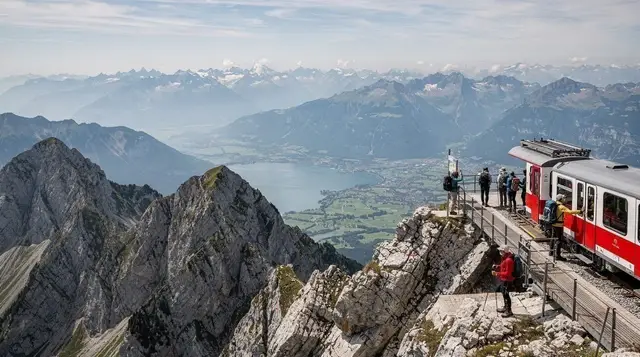
9:30-10:15am - Board the Jungfraubahn for the final ascent through the tunnel bored into the Eiger and Mönch. Two brief stops inside the rock, Eigerwand and Eismeer, let you look out through windows cut into the mountain face.
10:15am-12:00pm - At the summit: the Sphinx Observation Deck at 3,466 metres, the Ice Palace carved into the glacier, and (weather permitting) a short walk out onto the Aletsch Glacier plateau. This is genuinely the highest railway station in Europe, and on a clear day the Aletsch - the longest glacier in the Alps - stretches out below you in a way photographs undersell.
12:00-1:00pm - Lunch at the summit, or save money and eat on the way down at Kleine Scheidegg, where prices are noticeably lower than at the top.
1:00-4:30pm - Descend and retrace the route, or descend via the opposite valley from the one you came up through.
7:00-8:30pm - Back in Lucerne, depending on which afternoon connection you catch.
What you’re actually paying for
The Sphinx terrace is the headline, and it delivers on a clear day: an uninterrupted 360-degree view that includes the Aletsch Glacier’s full length, a sight genuinely unlike anything else reachable by train in the region. The Ice Palace is a lower ceiling attraction carved into the glacier itself, worth 15-20 minutes but not the main event. What catches people out is altitude - 3,466 metres is enough for mild breathlessness or a headache in some visitors, and the summit is cold and windy even in August, so bring a proper layer regardless of the season.
The honest caveat: cloud cover at this altitude is common and unpredictable, and the railway does not refund tickets for weather. Check the Jungfraujoch webcam the morning of your trip before boarding the first train - if the summit is socked in, you are better off swapping the day for something at lower altitude and trying again, or reconsidering the Schilthorn instead, which sits nearly 900 metres lower and clears more often.
The Schilthorn alternative when the budget doesn’t stretch
If CHF 210-230 per adult is more than the day is worth to you, the Schilthorn is the honest downgrade, not a consolation prize. Reached via Lauterbrunnen and the mountain village of Mürren, it trades the glacier ice palace and the highest-in-Europe claim for a panorama over the Eiger, Mönch and Jungfrau trio from the opposite side - arguably a better angle for photographing the three peaks together than Jungfraujoch itself, since you’re looking at them rather than standing among them.
| Jungfraujoch | Schilthorn | |
|---|---|---|
| Adult return from Lucerne | CHF 210-230 | CHF 140-170 |
| Total travel time each way | 2h 45min-3h 15min | 2h 15min-2h 45min |
| Altitude | 3,466m | 2,970m |
| Signature feature | Sphinx terrace, Aletsch Glacier, Ice Palace | 360° revolving restaurant, Eiger-Mönch-Jungfrau panorama |
| Weather reliability | More exposed to cloud at altitude | Slightly better cloud clearance, still exposed to wind closures |
| Good for | First-timers, glacier interest, bragging rights | Budget-conscious, photographers, second visit to the region |
For a closer side-by-side, the dedicated Jungfraujoch versus Schilthorn comparison walks through both routes in more detail. If you’re coming from further afield than Lucerne, a bundled option like the roundtrip train and Jungfraujoch ticket from Lauterbrunnen can simplify the booking, or for a fully organised day including both valleys, the private day trip covering Grindelwald and Lauterbrunnen takes the connection-planning off your hands entirely.
When the lifts don’t run
Both routes are affected by the maintenance closures that catch out travellers who assume Swiss infrastructure never stops. The Jungfraubahn itself runs year-round since it is largely a tunnel railway, but connecting cable cars and some Kleine Scheidegg-area lifts close for scheduled maintenance in spring (typically April) and again in autumn (typically November), and heavy snowfall or high wind can close sections at short notice at any time of year. The Schilthorn cable car is more exposed and more likely to suspend service in high wind than the Jungfraujoch tunnel railway. Check the operator status page the evening before, not the morning of, so you still have time to switch plans.
Practical tips for the day
- Book Jungfraujoch tickets in advance in July, August, and over the Christmas/New Year period - daily visitor caps mean midday slots sell out, and same-day tickets in peak season sometimes mean a several-hour wait for the next available train.
- Bring a proper jacket regardless of season. The summit sits well below freezing outside summer and is windy even in August; Lucerne’s own weather tells you nothing about conditions at 3,466 metres.
- Sit on the correct side of the train for the best views - right-hand side heading from Lucerne towards Interlaken, and check current guidance for the Kleine Scheidegg to Jungfraujoch leg since the best views vary with the tunnel sections.
- Pack food for the ascent and descent. Summit prices are steep even by Swiss standards; a sandwich bought in Lucerne costs a fraction of the same thing at 3,466 metres.
- Don’t skip Kleine Scheidegg on the way down. It has its own restaurants at lower prices and, on a clear day, closer views of the Eiger’s north face than you get from the summit itself.
- If mobility or breathlessness at altitude is a concern, note that the change of pressure and thinner air at 3,466 metres genuinely affects some visitors, more so than at the Schilthorn’s 2,970 metres.
Should you go from Lucerne, or base yourself closer?
If Jungfraujoch is the single excursion your trip is built around, staying a night in Interlaken, Grindelwald or Wengen cuts the round-trip travel time roughly in half and gives you a buffer day for bad weather - genuinely useful given how weather-dependent the summit experience is. If Lucerne is your base for the wider trip and Jungfraujoch is one excursion among several, it remains doable as a long day, just one that needs an early alarm and a realistic idea of how much time is actually spent at the top versus on trains.
For comparing this trip against Lucerne’s other big excursions on price and duration, the best mountain excursions from Lucerne guide lines them up side by side, and the broader day trips from Lucerne overview covers where else that early start could take you instead. For getting to the station itself and general fare logistics, see getting around Lucerne and what a trip like this adds to your overall Lucerne travel costs.
For those who’d rather not manage the changes solo, the private day trip to Harder Kulm and Grindelwald covers the Grindelwald valley with a driver and guide, useful if you’re combining the excursion with other stops on the same day rather than making a single dedicated run to the summit.
Jungfraujoch day trip from Lucerne: the FAQ
What time does the first train to Jungfraujoch leave Lucerne?
The earliest realistic connection leaves Lucerne around 6:09am or 6:39am via Interlaken, reaching Kleine Scheidegg by roughly 9:00-9:30am. Later departures exist, but leaving after 8am cuts your time at the summit short if you want to be back in Lucerne the same evening.
How much does the Jungfraujoch day trip from Lucerne actually cost?
A standard adult return from Lucerne to Jungfraujoch (train plus the final cogwheel section) runs about CHF 210-230 without a discount card, and CHF 150-170 with a Half Fare Card or the Jungfraujoch excursion price on a Swiss Travel Pass. Add roughly CHF 25-40 for food at the summit.
Is the Jungfraujoch trip worth the price?
It depends on the weather and your budget. On a clear day, the Sphinx Observation Deck at 3,466 metres and the Aletsch Glacier view are genuinely unmatched in the region. On a cloudy or foggy day you are paying full price to stand inside a cloud, which is why checking the webcam before you commit matters more here than at almost any other Swiss attraction.
What is the cheaper alternative to Jungfraujoch from Lucerne?
The Schilthorn, reached via Lauterbrunnen and Mürren, costs roughly CHF 60-90 less per adult on a return ticket and takes about 45 minutes less each way from Lucerne. You lose the glacier ice palace and the highest-in-Europe altitude claim, but you gain a 360-degree panorama over the Eiger, Mönch and Jungfrau that many visitors rate just as highly.
Do I need to book Jungfraujoch tickets in advance?
In July, August and over Christmas/New Year, yes - the railway caps daily visitor numbers and midday slots sell out. Outside peak season you can usually buy on the day at Interlaken Ost or Grindelwald, but booking ahead online avoids queuing at the ticket counter.
Can I use the Swiss Travel Pass for Jungfraujoch?
The Swiss Travel Pass covers the journey as far as Kleine Scheidegg (or Grindelwald/Wengen) and gives 25% off the final Kleine Scheidegg to Jungfraujoch cogwheel section, known as the Jungfraujoch excursion fare. It does not make the summit section free.
Do the Jungfraujoch and Schilthorn lifts run all year?
Jungfraujoch runs year-round, weather permitting, since it is a train through a tunnel rather than an open cable car. The Schilthorn cable car also runs year-round but is more exposed to high wind closures. Both routes can still be disrupted by heavy snow or storms, so always check the status page the night before you go.
Mountain excursions on GetYourGuide
Verified deep-linked GetYourGuide tours. Book through these links and we earn a small commission at no cost to you.
GetYourGuide does not provide a product photo for this activity — the image shows the meeting point, photographed by us.