Jungfraujoch vs Schilthorn: which one is worth it from Lucerne
Jungfraujoch or Schilthorn: which is worth it from Lucerne?
Jungfraujoch is higher, more famous and costs roughly double Schilthorn's ticket, but it is also more likely to disappear into cloud and eats a full 11-12 hour day from Lucerne. Schilthorn is cheaper, faster to reach from Lauterbrunnen and gives an arguably better panoramic view of the Eiger, Mönch and Jungfrau, since you are looking at the massif rather than standing inside it.
The two most expensive days you can buy from Lucerne
Jungfraujoch and Schilthorn get compared constantly because they solve the same problem — a big Alpine view from the Bernese Oberland reached via Interlaken — for two very different prices. Book the wrong one and you either overpay for a summit you can’t see through cloud, or you save money and later wonder if you should have gone higher. Neither is a bad choice. They are different trips with different maths, and from Lucerne the maths matters more than usual, because both start with the same 1 hour 50 minute ride to Interlaken Ost on the Brünig line before either excursion even begins.
This page sets the two side by side on the things that actually change your day: price, altitude, how long you are away from Lucerne, and what you’re likely to see when you get there.
Jungfraujoch and Schilthorn, side by side
| Jungfraujoch | Schilthorn | |
|---|---|---|
| Altitude | 3,454 m — highest railway station in Europe | 2,970 m |
| Getting up | Cogwheel train via Kleine Scheidegg (or Eiger Express gondola) | Cable car via Mürren or Gimmelwald |
| Full-price return from Interlaken | Roughly CHF 220-240 | Roughly CHF 110-120 |
| With Swiss Travel Pass / Half Fare (25% off) | Roughly CHF 170-185 | Roughly CHF 85-95 |
| Time at altitude before you need to head back | 2.5-4 hours to see it properly | 1-1.5 hours is usually enough |
| Round trip from Lucerne, door to door | 11-12 hours | 9-10 hours |
| Cloud risk | High — you’re inside the massif’s saddle | Moderate — open summit, still weather-dependent |
| Known for | Ice Palace, Sphinx Observatory, Alpine Sensation, glacier views | Piz Gloria revolving restaurant, 360° panorama, James Bond film history |
The prices above are approximate and change with season and currency movement — check the current fare before you travel, but the roughly 2:1 ratio between the two tickets has held for years and is the number to plan around.
What each trip actually costs
Jungfraujoch is not just expensive by Swiss standards, it’s expensive by any standard: a full-price adult return from Interlaken Ost sits around CHF 220-240, on top of whatever it cost you to reach Interlaken. The railway company runs occasional early-departure discounts and a “Good Morning Ticket” for the first trains of the day, so it’s worth checking timetables before you commit to full fare. A Swiss Travel Pass or Half Fare Card cuts roughly a quarter off, which on a CHF 230 ticket is a genuine saving rather than a rounding error.
Schilthorn runs at roughly half that: a full-price return from Stechelberg or Lauterbrunnen is in the region of CHF 110-120, with the same 25% pass discount applying. If you’re travelling as a family, the gap compounds fast — two adults and two children at Jungfraujoch prices can tip past CHF 600 for the mountain section alone, before rail fares from Lucerne, food, or the Swiss Travel Pass that gets you there in the first place.
Neither ticket includes lunch at altitude, and both restaurants at the top charge resort prices — expect CHF 25-35 for a simple pasta or rösti at either summit. Pack something to eat on the way up if the budget is already stretched by the ticket itself.
Altitude and what you actually see
Jungfraujoch’s number is the one everyone quotes: 3,454 metres, the highest railway station in Europe, reached by tunnelling through the Eiger and Mönch. That altitude buys glacier views over the Aletsch Glacier, the Sphinx Observatory terrace, and — on a genuinely clear day — a horizon that stretches toward the Black Forest and the Vosges. It also means you spend the final stretch of the journey inside a mountain, and the viewing platforms at the top, while dramatic, are smaller and more crowded than the open panorama at Schilthorn.
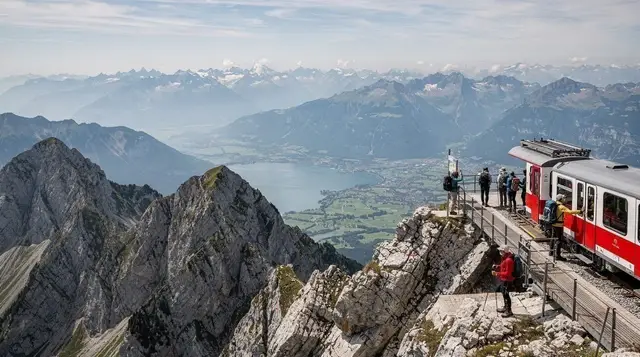
Schilthorn sits nearly 500 metres lower at 2,970 metres, but the summit is open rather than tunnelled, and the revolving restaurant at Piz Gloria turns a full 360 degrees so you see the Eiger, Mönch and Jungfrau from outside the massif rather than from within it. For many travellers this is the more satisfying view precisely because you can see the three famous peaks as a skyline, not just the glacier between them. Piz Gloria is also the filming location for the 1969 Bond film “On Her Majesty’s Secret Service,” and the small exhibit dedicated to it is a genuinely fun half hour that Jungfraujoch has no equivalent for.
Neither summit is a hiking base in the way Mount Pilatus or Rigi are from Lucerne — both are built around the view and the building at the top, not a network of trails, though Schilthorn does connect to walking routes down through Mürren and Gimmelwald for those with the legs and time for it.
How long the round trip takes from Lucerne
This is the part visitors underestimate most. From Lucerne, the train to Interlaken Ost takes roughly 1 hour 50 minutes via the Brünig line. From there, Jungfraujoch is another 2 hours or so up via Grindelwald or Lauterbrunnen and Kleine Scheidegg, and the same coming down — call it 4 hours of travel above Interlaken on top of the journey from Lucerne. Add 2.5-4 hours at the summit to actually see the Ice Palace, the Sphinx Observatory and the glacier terraces, and a realistic Jungfraujoch day from Lucerne runs 11-12 hours door to door. Leave Lucerne on a 7am train and expect to be back around 7-8pm.
Schilthorn is a shorter add-on: roughly 1 hour up from Lauterbrunnen via Mürren, similar coming down, and 1-1.5 hours at the top is usually enough unless you’re eating a full meal at Piz Gloria. A realistic day from Lucerne runs 9-10 hours, which still means leaving early but gives more slack for delays, weather waits, or a stop in Interlaken or Lauterbrunnen on the way back.
Either way, this is not a casual half-day out. If your itinerary has room for it, an overnight in Wengen or Lauterbrunnen turns both excursions from an exhausting single day into two relaxed half-days, with the added benefit of a second morning to wait for better weather if the first one is cloudy. See the day trips from Lucerne guide for how this compares with Lucerne’s closer options.
Getting there from Lucerne
Both trips start the same way: Lucerne to Interlaken Ost, roughly 1 hour 50 minutes on the scenic Brünig line, with a change at Meiringen on some services. From Interlaken Ost:
- For Jungfraujoch: continue by train to Grindelwald or Lauterbrunnen, then up to Kleine Scheidegg and the final cogwheel stretch to the top, or take the newer Eiger Express gondola from Grindelwald Grund, which cuts around 30-45 minutes off the old route.
- For Schilthorn: continue to Lauterbrunnen, then up through Mürren or via the Stechelberg cable car base station to the Schilthorn summit.
If you’re combining either excursion with other stops in the region, the Interlaken day trip guide and the Grindelwald destination page cover what else fits into the same day without extending it further. Rail passes bought for this trip are also worth checking against the Tell-Pass, which covers Central Switzerland’s boats and mountains but not this Bernese Oberland leg — the Swiss Travel Pass is the relevant one here, not the regional pass.
Weather risk and cloud cover
This is where the two trips diverge most sharply in practice, not just on paper. Jungfraujoch’s saddle position between the Mönch and the Jungfrau means cloud collects there even on days that look clear from the valley — visitors regularly pay full fare and reach the top to a whiteout with visibility under 20 metres. The railway doesn’t cancel or discount for this; the train runs, the ticket is used, and the weather is entirely your risk.
Schilthorn’s exposed summit is also weather-dependent, and high wind can suspend the cable car, but because the peak sits outside the main massif rather than tunnelled into it, a partially cloudy day is more likely to still deliver a partial view than at Jungfraujoch, where cloud in the saddle blocks everything.
Neither ticket is refundable for weather. Check the operator’s live webcams the morning you’re planning to go — both Jungfrau Railways and the Schilthorn cable car publish these — and if the forecast for the specific summit is poor, it is almost always better to postpone a day than to spend CHF 200+ on a walk through fog. This is the single most common regret reported by visitors doing either trip as a rushed day excursion from Lucerne rather than from a closer base.
Crowds and how the day feels
Jungfraujoch is one of the most visited attractions in Switzerland, and it feels like it: queues for the train up at Kleine Scheidegg, queues for the lift to the Sphinx Observatory, and a summit building that can feel more like an airport terminal than a mountain peak during peak season (July-August, and Chinese New Year). The Ice Palace and Alpine Sensation exhibits help fill the 3-4 hours most visitors spend there, but solitude is not part of the experience.
Schilthorn draws a fraction of the numbers. The queues are shorter, the Piz Gloria terrace rarely feels packed even in summer, and the walk out to the viewing platform is unhurried. If part of what you want from a mountain excursion is a bit of quiet, Schilthorn delivers it far more reliably than Jungfraujoch does.
Which one for which traveller
Choose Jungfraujoch if the “Top of Europe” name matters to you specifically, if you want the glacier views from the Sphinx Observatory, or if this is a once-only trip to Switzerland and budget is not the deciding factor. Build in a full day and don’t schedule anything else around it.
Choose Schilthorn if you’re travelling on a tighter budget, want a shorter and less crowded day, or actually prefer an outward-facing panorama of the Eiger-Mönch-Jungfrau skyline to standing inside it. It also pairs more easily with a stop in Lauterbrunnen or Mürren on the same day without pushing your return to Lucerne past 8pm.
If you’re still undecided between the wider set of Bernese Oberland options, the best mountain excursions from Lucerne guide and the Jungfraujoch vs Schilthorn context aside on Lucerne’s own closer peaks are worth reading before you commit a full day to either.
Making the day work as a guided trip
Both excursions are straightforward to do independently by train and cable car, but a guided day trip removes the timetable-juggling — useful if you’d rather not plan the Interlaken changeovers yourself, or if you want commentary on the route through the valley.
A private scenic train tour through Grindelwald covers the approach route shared by both excursions and works well if you want a driver-guide who knows the current cloud forecast before you commit to the summit ticket. For travellers wanting to see both valleys in one organised day, the Interlaken, Grindelwald, Lauterbrunnen and Mürren tour takes in the base villages for both Jungfraujoch and Schilthorn without committing you to either summit ticket in advance.
If Schilthorn is the one you’ve settled on, the Bern to Lauterbrunnen, Mürren and Schilthorn private trip handles the full route from a starting point further out, useful if you’re combining the excursion with a stop in Bern on the way.
Booking and timing tips
Book Jungfraujoch tickets a few days ahead in July and August — the railway does sell out on peak dates, and walk-up tickets on a clear-forecast morning are not guaranteed. Schilthorn rarely sells out, though the first cable car of the day is worth catching regardless, since afternoon cloud is more common than morning cloud in the Bernese Oberland through summer.
Both mountain railways close sections for scheduled maintenance outside peak season, typically in shoulder periods in spring and late autumn — check the operator’s site for your travel dates before building a whole day around either excursion, since a maintenance closure with no advance notice is the fastest way to lose a full day from Lucerne for nothing.
For the practicalities of buying tickets and passes before you go, see Swiss trains explained and getting around Lucerne, and for planning a longer stay that includes one of these excursions without rushing it, the 5-day summer Alps itinerary builds in the extra half-day both trips really deserve.
Mountain excursions on GetYourGuide
Verified deep-linked GetYourGuide tours. Book through these links and we earn a small commission at no cost to you.
GetYourGuide does not provide a product photo for this activity — the image shows the meeting point, photographed by us.