Schilthorn and Piz Gloria: the Bond mountain, honestly assessed
Is the Schilthorn worth visiting, and how does it compare to the Jungfraujoch?
The Schilthorn (2,970 m) gives a wider 360-degree panorama for roughly two-thirds the price of the Jungfraujoch, plus the Thrill Walk and the Piz Gloria revolving restaurant from the James Bond film. It has no glacier or ice palace, so pick it for the view and the Bond history, not for standing on a glacier.
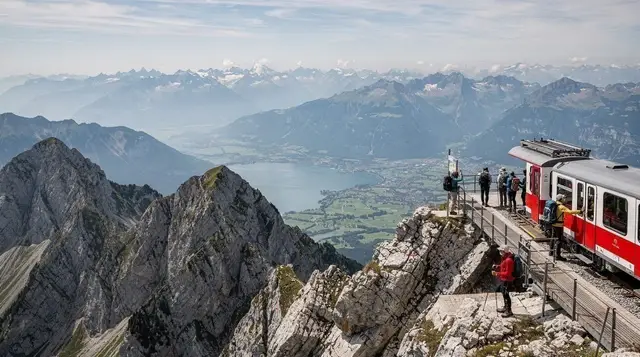
The Schilthorn is the mountain that got famous for the wrong reason, in the right way. In 1969 a half-built revolving restaurant at 2,970 metres became Piz Gloria, Blofeld’s lair in On Her Majesty’s Secret Service, and the film’s helicopter chases and ski pursuit are still the reason half the visitors on the summit are there. The other half are there for what was always the real draw: an uninterrupted 360-degree view that runs from Mont Blanc in the west to the Säntis in the east, with the Eiger, Mönch and Jungfrau lined up close enough to feel like scenery rather than a postcard.
None of that makes it a straightforward day trip from Lucerne. It takes longer to reach than Mount Pilatus or Mount Rigi, the cableway is expensive, and the last leg from Mürren depends on weather that the Bernese Oberland does not always deliver. This guide covers what you are actually paying for, how the Thrill Walk at Birg works, whether Piz Gloria’s rotating restaurant is worth the markup, and — because it comes up on every planning thread — how the Schilthorn stacks up against the Jungfraujoch.
Getting to the Schilthorn from Lucerne
There is no direct route; you are threading together three or four train and cable car legs. The standard path from Lucerne runs: train to Interlaken Ost (about 50 minutes), the Bernese Oberland Railway to Lauterbrunnen (around 20 minutes), then either a connecting train down the valley to Stechelberg or the cable car up to Mürren via Grütschalp.
Two cable car systems reach the summit, and which one you take changes the journey noticeably:
| Route | From | Via | Approx. one-way time |
|---|---|---|---|
| Valley cable car | Stechelberg | Gimmelwald, Mürren, Birg | 32 minutes |
| Mountain railway + cable car | Lauterbrunnen | Grütschalp, Mürren | 45 minutes |
Both converge at Mürren before the final Birg–Schilthorn stage. If you are driving or coming via a car-free valley town, Stechelberg is the more direct start; if you are already routed through Lauterbrunnen by train, the Grütschalp line saves a change. Either way, factor in roughly 2 hours 45 minutes from Lucerne to the summit, door to door, and the same coming back. That is a full day commitment, which is why most visitors treat the Schilthorn as a stop within a wider Bernese Oberland day trip rather than a quick outing.
Drivers should note that Stechelberg’s car park fills early in summer; arriving before 9am avoids circling for a space. Everyone else is on Swiss rail timetables, which run reliably enough that a 5-minute connection window at Lauterbrunnen is normal, not risky — see our Swiss trains explained guide if the transfer choreography feels unfamiliar.
The cable car journey and what it costs
Prices below are approximate high-season figures in Swiss francs; they shift a little by month and are worth checking before you commit a full day to the trip.
| Ticket | Approx. price (return) | Notes |
|---|---|---|
| Stechelberg → Schilthorn | CHF 108 | Full round trip, all stages |
| Mürren → Schilthorn | CHF 88 | If already in Mürren overnight |
| Lauterbrunnen → Schilthorn | CHF 98 | Via Grütschalp and Mürren |
| Half Fare Card | ~50% off above | Standard nationwide discount |
| Swiss Travel Pass | 25% off | Not full inclusion on this route |
That 25% Swiss Travel Pass discount catches people out, because the pass gives full free travel on many regional lines and only a partial discount here. If your itinerary is built around the Swiss Travel Pass, the Schilthorn still costs real money on top; it is not a “free” excursion day the way some lower-altitude routes are.
The cabins themselves are unremarkable modern gondolas — no glass floors, no rotation — until you reach Birg, one stage below the summit, where the Thrill Walk is bolted onto the outside of the station.
The Thrill Walk at Birg
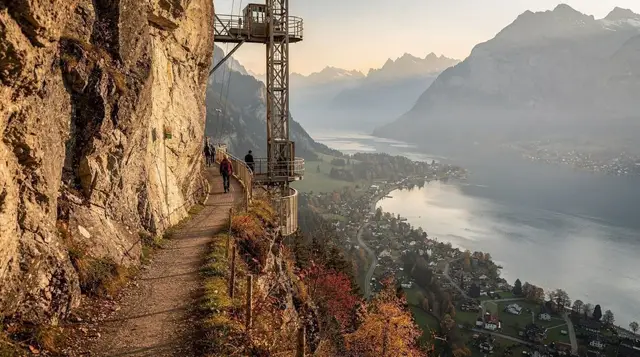
This is the best free addition on the whole route: a steel walkway fixed to the cliff face at Birg, included in your cableway ticket, with sections of glass flooring and a net-covered gap you cross above a 200-metre drop. It takes 10-15 minutes end to end and needs no booking or extra fee — you simply walk out of the Birg station and follow the signed route.
It is genuinely vertiginous rather than gimmicky; the glass panels show real exposure, not a painted illusion, and the rope-net crossing gives slightly under your feet. Anyone uneasy with heights should treat “included in the ticket” as informational, not an obligation — there is a standard indoor route past the Thrill Walk for those who’d rather skip it. Families with children old enough to follow safety instructions generally manage it fine; toddlers in carriers are a judgement call given the net section.
Piz Gloria and the revolving restaurant
Piz Gloria completes a full rotation roughly every 45 minutes, slow enough that a coffee gives you most of the horizon without feeling like a gimmick. The Bond connection is played up appropriately rather than excessively: a small exhibition covers the film’s production, including the real 1968 ski chase footage, and a “Bond World 007” installation with props and photo points sits just off the main restaurant floor.
Food is standard high-altitude Swiss fare — rösti, schnitzel, a few pasta options — at standard high-altitude prices: mains run CHF 28-42, a coffee is around CHF 6, and a beer is CHF 7-8. It is not bad food, but nobody visits the Schilthorn for the cooking. Booking a table by the window for the rotation is worth doing if you want to actually watch the peaks move past rather than just glimpse them between other diners; walk-in seating away from the glass loses most of the effect.
Outside, the 360° View Platform is free to access and open longer hours than the restaurant, so if the sit-down meal doesn’t appeal, the platform alone delivers the panorama.
a private day trip from Bern that covers Lauterbrunnen, Mürren and the Schilthorn cable car in one booked itinerary removes the transfer-planning entirely if you’d rather not chain four separate tickets together yourself.
Schilthorn vs Jungfraujoch: the comparison everyone asks about
Both summits are reachable from Lucerne in a similar timeframe and both get pitched as “the” Bernese Oberland excursion, which makes the choice genuinely confusing. Here is the honest breakdown.
| Schilthorn | Jungfraujoch | |
|---|---|---|
| Altitude | 2,970 m | 3,466 m |
| Approx. return cost from Lucerne | CHF 180-210 | CHF 260-290 |
| Panorama | Wider, 360° open view | Narrower, framed by higher peaks |
| Glacier access | None | Aletsch Glacier viewing platform |
| Standout feature | Thrill Walk, Piz Gloria/Bond | Ice Palace, Sphinx Observatory |
| Crowds | Moderate | Heavy, especially midday |
| Journey time from Lucerne (one way) | ~2h 45m | ~2h 30m |
The Jungfraujoch is the more famous name and, on a clear day, the more dramatic altitude experience — you are standing at the foot of a real glacier, not just looking at one from a distance. It is also considerably busier: the train up regularly runs at capacity in July and August, and the summit halls can feel more like an airport terminal than a mountain station at peak times.
The Schilthorn is quieter, cheaper, and arguably gives the better all-round view precisely because it is not hemmed in by taller neighbours the way the Jungfraujoch is. If you only have time or budget for one Bernese Oberland summit, choose the Jungfraujoch for glacier ice and bragging rights, or the Schilthorn for panorama, the Thrill Walk, and roughly a third off the price. We cover this trade-off in more depth in Jungfraujoch vs Schilthorn, and the glacier side of the comparison in the Jungfraujoch guide and our piece on what nobody tells you about Jungfraujoch.
Weather, closures and when to go
Cloud is the single biggest risk to a Schilthorn day, more so than most Lucerne-area mountains, because the summit sits exposed above the Lauterbrunnen valley with nothing to block incoming Atlantic weather. Check the live webcam the morning of your trip rather than trusting a forecast from the night before; a clear Lucerne morning says nothing about visibility 2,970 metres up in Mürren.
Like the region’s other cable systems, the Schilthorn line closes for scheduled maintenance, typically for short windows in spring and late autumn — check current dates before booking a specific day, especially outside the June-September and December-March peak windows. Winter brings good skiing on the Schilthorn’s slopes and a snow-dusted version of the Bond scenery, but also more frequent weather-related delays than summer.
a private day trip from Interlaken that builds in flexibility around cable car timings is a reasonable hedge if you’re nervous about the weather gamble and would rather not manage the connections solo. For a small-group version departing the same base, a small-group day trip from Interlaken runs at a lower price point than the private options.
Combining the Schilthorn with the rest of the valley
Because the approach runs directly through Lauterbrunnen and Mürren, most visitors don’t treat the Schilthorn as an isolated trip. Lauterbrunnen’s waterfalls, including Trümmelbach and Staubbach, sit a short walk from the valley floor station and cost nothing extra to see on the way through — our Lauterbrunnen waterfalls guide covers the short detours worth the time. Mürren itself is car-free and worth an hour beyond the cable car interchange, with a genuinely quiet main street that empties out once the day-trip crowds move on to the summit.
Travellers based in Interlaken rather than Lucerne have a shorter run at the whole route and sometimes pair it with Grindelwald or Wengen in the same trip; from Lucerne, that kind of double-summit day stretches the journey past what’s comfortable, so picking one focus — Schilthorn or Jungfraujoch, not both — is the more realistic plan.
If you want a guided version that threads Lauterbrunnen, Mürren and the wider valley together without building the itinerary yourself, a private tour from Zurich covering Mürren, Lauterbrunnen and Grindelwald covers the fuller loop in one day.
For active travellers, the hike down from Birg or the Schilthorn into the Lauterbrunnen valley is a well-marked, several-hour route rather than a technical climb, and pairs the panorama with genuine trail time instead of just cable car windows. It sits alongside our broader roundup of mountain excursions from Lucerne if you’re weighing the Schilthorn against Pilatus, Rigi or Titlis before committing a full day to any one of them.
Practical notes before you go
Pack for altitude regardless of the season: the summit runs 15-20°C colder than Lucerne and wind chill on the View Platform is significant even on a mild day. Sunglasses and sun cream matter more than most first-time visitors expect — UV exposure at 2,970 metres on snow or bright rock is stronger than it feels.
If your onward plans include the Swiss Travel Pass for the rest of a Bernese Oberland or wider Switzerland trip, buy it before this excursion so the 25% discount applies automatically rather than requiring a separate claim. Toilets and a small shop are available at both Birg and the Schilthorn summit station, but there is no lodging up top — everyone descends the same day, which keeps the mountain considerably quieter after 4pm than the Jungfraujoch tends to be at any hour.
Finally, for hikers or paragliders wanting a more active version of the same valley, a Mürren hike-and-paragliding experience replaces the cable car descent with a flight down over the valley — a genuinely different way to end the day for anyone who wants the view without the ride back down.
Frequently asked questions about the Schilthorn and Piz Gloria
How do you get to the Schilthorn from Lucerne?
Train to Interlaken Ost (about 50 minutes from Lucerne), then the Bernese Oberland Railway to Lauterbrunnen, a connecting train or the Stechelberg valley road to Stechelberg, and the cable car via Mürren to the Schilthorn summit. Allow around 2 hours 45 minutes door to door each way if you go via Mürren, or budget a full day round trip.
How much does the Schilthorn cableway cost?
A return ticket from Stechelberg to the Schilthorn summit costs roughly CHF 108 in high season; from Mürren it is around CHF 88 return. Half Fare Card holders pay about half, and the Swiss Travel Pass gives a 25% discount rather than free travel.
Is the Schilthorn or the Jungfraujoch worth visiting?
The Schilthorn wins on panorama and price, showing peaks from Mont Blanc to the Säntis from a single summit platform. The Jungfraujoch wins if you specifically want glacier ice, the Aletsch Glacier view, and the novelty of Europe’s highest railway station, for around 50% more money.
What is the Thrill Walk at Birg?
A free steel walkway bolted to the cliff face at the Birg cable car station, one stage below the Schilthorn summit, with glass floor sections and a rope net over a 200-metre drop. It is included in the cableway ticket and takes 10-15 minutes to walk.
Does the Swiss Travel Pass cover the Schilthorn?
No. The Swiss Travel Pass covers the train and cable car legs up to Mürren but gives only a 25% discount on the final Mürren-Birg-Schilthorn stretch, unlike some other Bernese Oberland summits where the pass gives full inclusion on lower sections.
How long does the full round trip take?
Budget 6-8 hours door to door from Lucerne if you want unhurried time at the top, including the Thrill Walk, lunch, and the return journey. It is doable as a long day trip but a tight one if you also want to linger in Mürren.
Is Piz Gloria restaurant expensive?
Yes, in line with every summit restaurant in the Bernese Oberland. A main course runs CHF 28-42 and coffee is around CHF 6. The 360-degree rotating dining room is the reason to eat there, not the cooking, which is competent but unremarkable.
When is the best time to visit the Schilthorn?
Late June to September gives the best odds of a clear panorama and functioning summer hiking trails around Mürren. Winter (December-March) adds skiing and a snow-covered Bond backdrop, but cloud and closures are more common; the cableway runs year-round bar occasional maintenance days.
Mountain excursions on GetYourGuide
Verified deep-linked GetYourGuide tours. Book through these links and we earn a small commission at no cost to you.
GetYourGuide does not provide a product photo for this activity — the image shows the meeting point, photographed by us.