Appenzell is not on the way to anywhere from Lucerne. There’s no direct train, no shared valley, no lake in common — you go there deliberately, for a cluster of things that don’t exist around Lake Lucerne: painted timber façades on the main street, a cliff-face inn you can only reach on foot, a cantonal assembly that still votes by raised hand, and cheese made in front of you rather than sold in a shop. It’s a full day from Lucerne door to door, closer to a day and a half if you want to do it properly, and it rewards people who like their Switzerland rural and specific rather than postcard-alpine.
Getting from Lucerne to Appenzell
There is no direct connection. The standard route is Lucerne to Zurich (45 minutes to 1 hour on the fast trains), then a change onto a St. Gallen or Gossau-bound service, then a final change at Gossau onto the narrow-gauge Appenzellerbahnen line, which climbs through Herisau and Urnäsch into the village of Appenzell itself. Total journey time runs about 2 hours 15 minutes to 2 hours 45 minutes depending on connections, with two changes. If you’re continuing to Wasserauen for the Ebenalp cable car, add another 12–15 minutes on the same line.
A one-way second-class fare from Lucerne to Appenzell without a discount card is roughly CHF 45–55; the Half Fare Card roughly halves that, and Swiss Travel Pass holders travel the train legs free (the Ebenalp and Säntis cable cars are separate, discounted rather than included). Because the outward and return legs alone eat 4.5–5.5 hours, this is a long day trip — worth planning as your one eastern Switzerland excursion rather than combining casually with somewhere else, though St. Gallen sits on the same line and can be tacked onto either end in 45 minutes if you’re not also doing Ebenalp.
| Leg | Approx. time | Notes |
|---|---|---|
| Lucerne → Zurich HB | 45 min–1 h | Fast trains, frequent |
| Zurich HB → Gossau or St. Gallen | 45 min–1 h | Change for Appenzellerbahnen |
| Gossau/St. Gallen → Appenzell | 35–50 min | Narrow-gauge, scenic through Herisau |
| Appenzell → Wasserauen (for Ebenalp) | 12–15 min | Same line, terminus |
The painted village
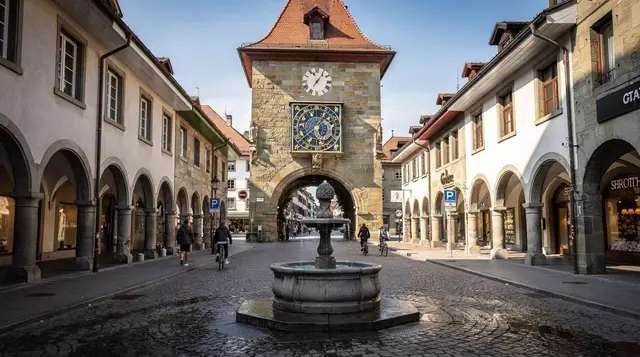
Appenzell village (around 780 metres, canton Appenzell Innerrhoden) is small enough to see on foot in under an hour, which is exactly why people underestimate how long to give it — the Hauptgasse’s painted gable-end houses reward slow walking rather than a quick pass-through. Façades along the main street carry murals of cows, alpine scenes and folk figures rather than plain paint, a tradition specific to this canton and largely absent even a valley over.
The Landsgemeindeplatz, the main square, is unremarkable most of the year but becomes the literal seat of direct democracy every last Sunday of April, when Appenzell Innerrhoden holds its Landsgemeinde — citizens with cantonal voting rights gather outdoors and vote by raised hand. It’s one of only two Swiss cantons (with Glarus) that still does this rather than voting by ballot, and visitors can watch from the square’s edges even though they can’t vote.
The village is walkable, cheap to just wander (unlike most of what follows), and worth 60–90 minutes even on a tight schedule. Shops along the Hauptgasse sell Appenzeller cheese, Biberli (spiced honey biscuits) and the region’s embroidered textiles, historically a major local industry. If you’re staying overnight rather than day-tripping, this is also where the guesthouses are — there’s little reason to base yourself at Wasserauen or Schwägalp instead.
Ebenalp and the Äscher cliff inn
This is the single most-photographed thing in the canton, and it earns the reputation. From Wasserauen station, a cable car climbs to Ebenalp (1,640 metres) in about six minutes. From the top station, a level path leads in 15–20 minutes to the Wildkirchli caves, inhabited on and off since the Palaeolithic and used as a hermitage into the 19th century, then continues — with a section of chain handrail along an exposed rock ledge — to the Gasthaus Äscher, built directly against the cliff face at around 1,454 metres. Allow 30–40 minutes total from the top of the cable car to the inn, longer if you stop in the caves.
The inn itself is small, seasonal (closed in winter), and often full on clear summer weekends — this is the image used to sell alpine Switzerland on every second postcard rack, so it draws crowds accordingly. Go on the first cable car of the day or on a weekday if you want the terrace without a queue. From the Äscher, the path continues down to Seealpsee, so most visitors do Ebenalp, the caves, the inn and the lake as one loop rather than an out-and-back — reasonable, since it’s downhill the whole way after the inn.
watch Appenzeller cheese being made and taste the results yourself is the easiest way to pair the hike with the region’s other main draw, since the demonstration dairy sits just outside the village on the way back from Wasserauen.
Seealpsee
Seealpsee sits at around 1,141 metres, a genuinely cold alpine lake ringed by pasture and cliff, reached either by descending from the Äscher inn (about 40–50 minutes, steep in places) or by walking up directly from Wasserauen (roughly 1 hour, gentler). Doing the full loop — cable car up, caves, Äscher, down to the lake, back to Wasserauen — takes most people 3–4 hours including stops, not counting the cable car ride itself.
Swimming is normal here in July and August despite the cold; there are no lifeguards and no facilities beyond a couple of mountain restaurants at the lakeshore. Photographers favour early morning for the lake — mist over the water and no crowds — but that means starting the Ebenalp cable car before the inn even opens, which works better on an overnight in the village than a Lucerne day trip.
Säntis: the region’s high point
Säntis (2,502 metres) is the highest peak in the Alpstein range and gives a 360-degree view that, on a clear day, reaches into Germany, Austria, France and Italy — genuinely one of the best payoff-to-effort viewpoints in Switzerland, comparable in scale to Rigi but considerably further from Lucerne. It’s reached by a separate cable car from Schwägalp, not from Appenzell village or Wasserauen, so combining Säntis with Ebenalp in the same day from Lucerne is a long, train-heavy day best reserved for people who really want both.
The summit is exposed and frequently in cloud even when the valley floor is clear — check a live webcam before committing to the trip out to Schwägalp, since a return ticket wasted on whiteout is a genuinely expensive mistake. For visitors based in Zurich or St. Gallen rather than Lucerne, a guided option removes the routing headache: a guided day trip from Zurich covering both the Säntis summit and St. Gallen’s old town, or a private day trip built specifically around the Säntis cable car for those who’d rather not manage the connections themselves.
Alpine dairies and cheese culture
Appenzeller cheese — the pungent, brine-washed hard cheese that gives the canton its best-known export — is made both in village dairies and on higher alpine pastures during the summer grazing season (roughly June to September), when herds are moved up and cheese is made fresh at altitude in small Alpine huts (Alpkäse). The Appenzeller Schaukäserei, a demonstration dairy a short walk from Appenzell village, runs live production most mornings with a viewing gallery and a tasting room, and is the practical way to see the process without arranging access to a working alp.
For a broader dairy-and-culture day that doesn’t require driving yourself, a guided day combining St. Gallen’s old town with Appenzell’s cheese culture and the scenic railway between them covers both towns without the logistics of working out connections on the day.
| Stop | What it is | Typical cost |
|---|---|---|
| Appenzeller Schaukäserei | Live cheese production + tastings | CHF 0 entry to viewing gallery; tastings/shop extra |
| Ebenalp cable car | Wasserauen ↔ Ebenalp | Approx. CHF 36 return |
| Säntis cable car | Schwägalp ↔ summit | Approx. CHF 46 return |
| Gasthaus Äscher | Meal/drink at the cliff inn | CHF 20–35 for a simple lunch |
Where to eat and what to buy
Appenzeller Biberli (a spiced honey biscuit, often filled) and Mostbröckli (air-dried beef) are the two local foods worth seeking out beyond the cheese itself; both are sold in Hauptgasse shops and easy to pack home. At the Äscher inn, expect simple mountain fare — Rösti, soup, cheese platters — at prices that reflect everything being carried up by cable car and on foot; a full meal runs CHF 25–40. In the village, restaurants along the Hauptgasse are moderately priced by Swiss standards, closer to CHF 25–35 for a main course than the CHF 40+ you’ll see in central Lucerne or Zurich.
Closures and timing to plan around
The Ebenalp cable car and the Wildkirchli–Äscher path are a summer proposition: the cable car typically runs May to October, occasionally into early November depending on snow, and both the caves and the inn close for winter. Like the lake-mountain cable cars around Lucerne, Ebenalp and Säntis also close for scheduled maintenance in shoulder seasons — check operating dates before building a spring or late-autumn day around them, since a closed cable car with no back-up plan is the single most common way this trip goes wrong. Outside the cable-car season, the village, the cheese shops and the Schaukäserei still operate normally, so a winter visit can still work as a shorter, village-and-cheese-only day.
Should you stay overnight, or combine with St. Gallen?
A day trip from Lucerne is realistic but tight: figure 4.5–5.5 hours of travel against 8–10 hours of total daylight, leaving perhaps 4–5 hours on the ground for the village, Ebenalp, the caves, the inn and Seealpsee — enough for the loop, not much slack for delays or a long lunch. An overnight in Appenzell village turns this into a relaxed two-day trip: village and dairy on arrival afternoon, an early Ebenalp start the next morning before the crowds reach the inn.
Alternatively, since the train route already passes through it, St. Gallen — with its UNESCO-listed abbey library — makes a natural add-on at either end of the day, adding 45 minutes each way rather than a separate trip. Travellers based in Zurich rather than Lucerne have an easier version of this same day: a full day out of Zurich combining train, cable car and a Walensee boat trip covers similar Alpstein-region scenery with a shorter return leg.
Planning the rest of your eastern Switzerland time
If Appenzell is your reason for heading east from Lucerne, it’s worth building a short loop rather than a single there-and-back: Walensee and the Rhine Falls sit on plausible variations of the same route through Zurich, and the Swiss Travel Pass or Tell-Pass can make a two- or three-stop eastern swing cheaper than several separate day trips from Lucerne.
For hikers, our Seealpsee and Appenzell hikes guide breaks down route options and timings in more depth than fits here, and our best hikes near Lucerne piece is the place to compare this trip against closer alternatives like Pilatus or Rigi — our Pilatus vs Rigi vs Titlis comparison covers those two directly if Appenzell turns out to be more travel than you want to commit to.
For general trip-length planning, see how many days in Lucerne and the wider day trips from Lucerne roundup, or check the best time to visit tool before locking in dates against the cable cars’ seasonal closures.
Common questions about visiting Appenzell and Säntis
How do I get from Lucerne to Appenzell?
Take the train to Zurich (45 minutes to 1 hour), change for Gossau or St. Gallen, then change again onto the narrow-gauge Appenzellerbahnen to Appenzell. Door to door it is roughly 2 hours 15 minutes to 2 hours 45 minutes, with two changes. There is no direct train from Lucerne.
What does the Ebenalp cable car cost and where does it leave from?
The cable car leaves from Wasserauen, the last stop on the Appenzellerbahnen line, about 15 minutes past Appenzell village. A return ticket costs roughly CHF 36 for an adult; it is not covered by the Swiss Travel Pass, though pass holders usually get a discount.
Is the Äscher inn worth the hike?
Yes, but it is a real hike, not a stroll: from the top of the Ebenalp cable car it is around 30–40 minutes on a rocky path with sections of chain handrail to reach the inn, which is built directly into the cliff face. It gets very busy on clear summer weekends, so aim for a weekday or an early cable car.
Can I swim in Seealpsee?
Yes, in summer. Seealpsee sits below Ebenalp at around 1,141 metres and the water is cold even in July and August, but swimming is normal for visitors who do the loop past the inn. There are no lifeguards.
What is the Landsgemeinde and can visitors watch it?
The Landsgemeinde is Appenzell Innerrhoden’s open-air cantonal assembly, held every year on the last Sunday of April in the main square, where citizens vote by show of hands. Only Appenzell Innerrhoden and the canton of Glarus still hold one. Visitors can watch from the edges of the square, but the voting itself is for those with cantonal voting rights.
Do I need to book the Säntis cable car in advance?
It is not usually necessary to pre-book, but the top of Säntis is often in cloud even when Appenzell village is sunny, so check a live webcam before the drive or train out to Schwägalp — the round trip is expensive to waste on a whiteout.
Where can I see Appenzeller cheese actually being made?
The Appenzeller Schaukäserei (demonstration dairy) just outside Appenzell village runs live cheese-making most mornings and includes tastings; it is the easiest single stop for understanding the region’s dairy culture without arranging a farm visit.
Is Appenzell worth it if I’ve already done Pilatus or Rigi from Lucerne?
Yes, for a different reason: Pilatus and Rigi are about the mountain itself, while Appenzell is as much about the village, the painted houses and the dairy culture as it is about the Ebenalp cliffs. If you only want another high viewpoint, Säntis is comparable to Rigi in altitude and view but a much longer day from Lucerne.