Mount Rigi: Vitznau, Arth-Goldau and the Kulm sunrise
What's the best way to get up Mount Rigi?
Take the boat from Lucerne to Vitznau, then the cogwheel railway to Rigi Kulm (about 30 minutes, first opened in 1871). Arth-Goldau is faster by train from Zurich and has its own cogwheel line. Combined boat-and-rail tickets from Lucerne cost around CHF 92 return; the Swiss Travel Pass covers the whole journey.
Two ways up, and they’re genuinely different trips
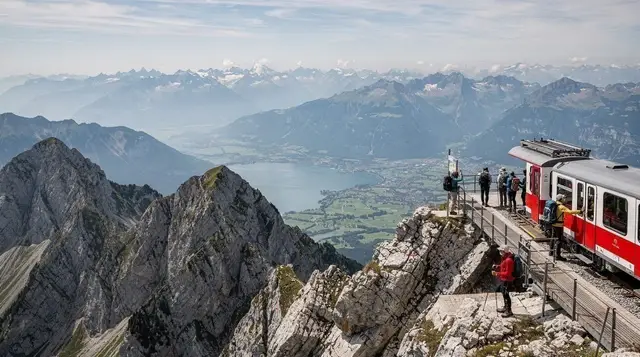
Mount Rigi sits between Lake Lucerne and Lake Zug, and it has been a package destination since 1871, when Europe’s first mountain cogwheel railway opened from Vitznau to the summit. That history is still the reason most people go: this isn’t a cable car bolted onto a peak, it’s a proper railway journey that takes about 30 minutes and climbs at a steady, unhurried pace through meadows and forest before the trees give out and the view opens up.
There are two starting points, and which one you pick changes the whole day.
Vitznau, on the lake shore below Weggis, is the route from Lucerne. You take a boat across the lake - itself one of the better ways to spend an hour in this region, see our guide to the paddle steamers on Lake Lucerne - then transfer to the Vitznau-Rigi-Bahn cogwheel train. It’s the classic approach and the one most day-trip itineraries from Lucerne are built around; see our one-day Lucerne itinerary for how it fits alongside the old town.
Arth-Goldau, on the other side of the mountain near Küssnacht and Lake Zug, is the faster route if you’re coming from Zurich or Zug rather than Lucerne - a direct train to Goldau, then the Arth-Rigi-Bahn cogwheel line. It’s less scenic on the approach (no lake crossing) but shaves real time off the journey, and Goldau is also the starting point for guided walking routes up the mountain rather than the train.
A good plan, if you have the time, is to go up one side and down the other, so you’re not retracing the same cogwheel line twice. Rigi Kulm station sits at the top and connects both lines, so this requires no extra planning beyond buying the right ticket.
The Weggis cable car: a third, less crowded option
There’s a third way up that skips both cogwheel stations: the cable car from Weggis to Rigi Kaltbad. Weggis is a short boat or bus ride from Vitznau along the lake shore, and its cable car climbs directly to Kaltbad, the mountain’s halfway station, in about ten minutes. It’s a useful option if the Vitznau train is running at capacity in peak season, or if Kaltbad rather than the summit is actually your destination for the day - which, for a meaningful number of visitors, it is.
Kaltbad: baths, hotel, and a sensible place to stop
Rigi Kaltbad, at roughly 1,450 metres, is not just a station on the way to the top. It has its own hotel, a striking modern church, walking paths in several directions, and - the main draw for a lot of people - the Mineralbad & Spa Rigi Kaltbad, an architecturally distinctive thermal bathing complex with indoor and outdoor pools looking out over the lake. Soaking in warm mineral water with that view, particularly with snow on the ground below, is one of the better cold-weather arguments for coming up here at all; our guide to alpine spas near the Bürgenstock covers a similar experience on the opposite shore of the lake.
If you want to combine the mountain with a proper spa afternoon rather than just ticking off the viewpoint, that’s a legitimate way to spend a day, and it’s worth building your ticket around Kaltbad specifically rather than pushing straight through to the Kulm. For visitors coming from further afield, a self-guided day trip from Zürich that pairs Rigi with a Lucerne spa stop packages exactly this kind of day without you having to piece together three separate tickets.
Kaltbad is also the junction for onward paths: to the Kulm on foot in about an hour, down to Weggis by the cable car or on foot, or along gentler contour paths that don’t involve much further climbing at all - a reasonable option if the train has already done the hard work and you just want a walk with a view rather than a hike.
Sunrise on the Kulm
Rigi Kulm, the actual summit at 1,798 metres, earned the nickname “Königin der Berge” - queen of the mountains - in the nineteenth century, when it became one of the first mountains in Europe developed specifically for tourists rather than climbers. The sunrise trips that made it famous are still possible, though they depend entirely on the season: the first cogwheel trains only run early enough to catch sunrise during the warmer months, roughly late spring through early autumn, when Rigi Bahnen adds special early departures from both Vitznau and Arth-Goldau timed to the actual sunrise time, which obviously shifts through the season.
Outside that window, there’s no way up in time by rail, and walking up in the dark is not something to attempt without proper winter equipment and local knowledge - the paths are exposed and can be icy long after the valley has thawed.
If you do make the sunrise train, be realistic about what’s open when you get there: at that hour, the summit hotel’s restaurant is typically the only option for a hot drink, and it can be busy with everyone who had the same idea. Bring a proper layer regardless of season - Kulm sits considerably colder and windier than lake level, and sunrise is the coldest part of the day.
For a guided alternative to doing this alone, a guided walk up from Goldau that finishes with a barbecue lunch turns the ascent into a structured half-day rather than a solo dawn mission, with the practical advantage of a guide who knows the current trail conditions.
Boat and train combination tickets
Pricing on the Rigi is straightforward but not cheap, which is fairly standard for Swiss mountain railways. Approximate 2026 fares, all in Swiss francs, one adult, return:
| Route | Approx. return price (CHF) | Notes |
|---|---|---|
| Vitznau - Rigi Kulm (cogwheel only) | 78 | Rail only, no boat |
| Arth-Goldau - Rigi Kulm (cogwheel only) | 72 | Rail only, no boat |
| Lucerne - Vitznau (boat) - Rigi Kulm (rail) | 92-100 | Depends on boat class (2nd/1st) |
| Weggis - Rigi Kaltbad (cable car) return | 36 | Fastest way to Kaltbad specifically |
| Half Fare Card holders | 50% of above | Card must be bought separately |
| Swiss Travel Pass / Tell-Pass | Included | Covers both cogwheel lines and the lake crossing |
The Rigi Queen of the Mountains Summer Day Card is worth knowing about specifically because it bundles unlimited travel on both cogwheel railways plus the Weggis cable car for a single day, which matters if you’re planning the up-one-side-down-the-other route or want the flexibility to backtrack to Kaltbad without buying a second ticket. A summer day card covering both cogwheel railways and the cable car tends to work out cheaper than point-to-point tickets the moment your day involves more than one leg on the mountain.
If your trip covers more than just the Rigi - say a broader loop through central Switzerland’s lakes and peaks - a flexible train-bus-boat pass can be the more sensible buy, and it’s worth comparing directly against the dedicated Swiss Travel Pass and the regional Tell-Pass, which both also cover Rigi travel but bundle in considerably more besides.
Whichever you choose, buy tickets before you’re at the station in peak season (July-August weekends, and any clear-sky forecast on a weekend generally): queues at Vitznau can run long enough to cost you a train.
Thirteen lakes: does the panorama live up to it?
Rigi’s marketing has claimed a view of thirteen lakes for well over a century, and on a genuinely clear day it holds up: Lake Lucerne dominates in the foreground, with Lake Zug and Lake Zurich both visible, plus a scatter of smaller lakes - Ägerisee, Baldeggersee, Hallwilersee, Sempachersee among them - picked out across the lowlands depending on exactly where you’re standing on the summit’s viewing terraces. Behind all of that, on the best days, the Bernese Alps, the peaks above Uri, and the Glarus Alps line the horizon.
The honest caveat: Swiss lowland haze is common, especially in summer, and it cuts that panorama down hard - sometimes to two or three lakes and a grey smear where the Alps should be. Late autumn and winter mornings, after a cold clear night, are consistently the most reliable conditions, which is a large part of why the sunrise trains matter so much to people chasing the full view rather than just the mountain itself.
If you’re weighing the Rigi against nearby alternatives with a similar promise, our comparison of Pilatus, Rigi and Titlis covers how the three peaks’ views actually differ in practice, and the standalone Mount Pilatus guide and Mount Titlis guide go into each in more depth.
When the railways close - the thing that ruins the most days
Both cogwheel lines run a reduced service through winter and each has a maintenance closure, typically a window in late autumn and sometimes a shorter one in spring, when the line shuts entirely for track and rolling-stock work. Exact dates move from year to year and aren’t fixed on a calendar the way, say, a museum’s opening hours are - they depend on snow, maintenance schedules and occasionally weather damage from the previous season.
This is, in practical terms, the single most common way a Rigi day gets wasted: someone builds an itinerary around the train, arrives, and finds it’s not running. Always check the current Rigi Bahnen timetable before you set out, particularly if you’re travelling in November or March-April, and have a backup plan (Pilatus and Titlis run on different schedules and are rarely closed at the same time). If you’re building a longer central-Switzerland itinerary, our guide to Lucerne in winter and the wider list of mountain excursions from Lucerne both flag which peaks are realistically open when.
Planning the day: how long it actually takes
| Plan | Time needed | Suits |
|---|---|---|
| Boat, train up, train down, same route | 4-5 hours from Lucerne | First visit, minimal walking |
| Up one side, down the other | 5-6 hours from Lucerne | No repeat scenery, more of the mountain |
| Kulm with a stop at Kaltbad (spa or lunch) | 6-7 hours from Lucerne | Slower pace, spa or long lunch |
| Sunrise train, back down by mid-morning | Early start, back by 10-11am | Clear-sky forecast, warmer months only |
| Walk up or down one leg | Add 2.5-3.5 hours to any of the above | Fit walkers, proper boots, dry trail |
Whichever combination you pick, the Rigi pairs naturally with a wider look at the region’s peaks and lakes - it’s one entry in the broader set of mountain excursions from Lucerne and a common stop on multi-day plans through the day trips from Lucerne list, alongside neighbouring shore towns like Brunnen and Lake Uri.
Questions about visiting Mount Rigi
Should I go up from Vitznau or Arth-Goldau?
From Lucerne, Vitznau is the classic route: a lake cruise followed by the original 1871 cogwheel railway. From Zurich or Zug, Arth-Goldau is quicker and also has a cogwheel line to the Kulm. Many visitors go up one side and down the other.
How much does the Rigi cogwheel railway cost?
A return ticket Vitznau-Kulm costs around CHF 78 on its own. A boat-and-train combination from Lucerne runs roughly CHF 92-100 depending on the boat class. The Swiss Travel Pass and the Tell-Pass both cover the railway; Half Fare Card holders pay half price.
Is sunrise on the Rigi Kulm worth the early start?
It is popular for a reason: on a clear morning you’re above the cloud line with the Alps lit up before the day’s boats and coach groups arrive. The first cogwheel train up runs early enough to catch it, but only in the warmer months, and the summit hotel restaurant is often the only place open for coffee afterwards.
What’s at Rigi Kaltbad?
Kaltbad is the halfway station, reachable directly from Weggis by cable car. It has thermal baths (Mineralbad & Spa Rigi Kaltbad), a hotel, a church and easy onward paths to the Kulm. It’s a sensible base if you want to split the ascent or avoid one long cogwheel ride.
Do you really see thirteen lakes from the top?
On a genuinely clear day, yes - Lake Lucerne, Lake Zug, Lake Zurich and several smaller lakes are all visible from the Kulm’s 360-degree viewpoint, along with the Bernese, Uri and Glarus Alps. Haze, which is common in summer, cuts that number down fast, so a crisp autumn or winter morning is the more reliable bet.
When does the Rigi railway close for maintenance?
Both cogwheel lines run a reduced winter timetable and each closes for a short maintenance window, usually in November and again in spring - check the current Rigi Bahnen timetable before you travel, since dates shift year to year and this is what catches out the most day trips.
Can you walk up or down the Rigi instead of taking the train?
Yes. Walking trails connect Vitznau, Weggis, Kaltbad, the Kulm and Arth-Goldau, and a common plan is to ride up and walk down, or the reverse. Allow 2.5-3.5 hours for the main descents and proper boots even in summer, since sections are steep and can be muddy.
Mountain excursions on GetYourGuide
Verified deep-linked GetYourGuide tours. Book through these links and we earn a small commission at no cost to you.
GetYourGuide does not provide a product photo for this activity — the image shows the meeting point, photographed by us.