Mount Pilatus: the complete guide
What's the best way to get up Mount Pilatus?
Most visitors ride the Alpnachstad cogwheel railway, the steepest rack railway in the world at a 48% gradient, up and take the Kriens cable car and gondola down (or the reverse) — this loop is sold as the Golden Round Trip. The cogwheel line only runs from around May to November; the Kriens cable car operates all year.
The steepest cogwheel railway in the world
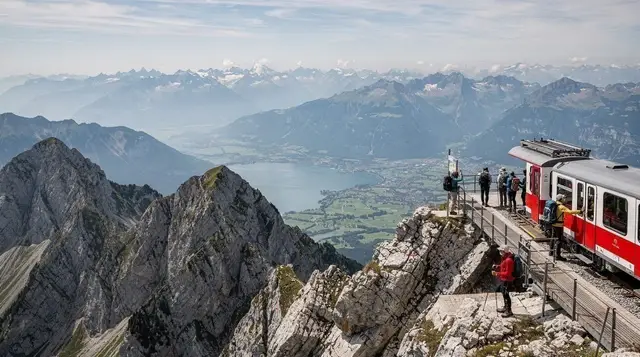
Mount Pilatus rises directly behind Lucerne, and getting to the top is as much the point as the summit itself. The mountain is served by two completely different systems that meet at Pilatus Kulm, 2,132 metres up: a cogwheel railway from Alpnachstad on one side, and a cable car and gondola combination from Kriens on the other. They were built decades apart, they feel nothing alike, and most people who visit ride one up and the other down. That loop has a name — the Golden Round Trip — and it’s the single most useful thing to understand before you go.
This guide covers the mechanics: how each line works, what it costs in CHF, when each one actually runs, what the weather does to your chances of a view, and what’s worth doing once you’re standing at Mount Pilatus itself.
The Alpnachstad cogwheel railway
The railway from Alpnachstad has held the record for the steepest rack railway in the world since it opened in 1889, with a maximum gradient of 48%. For comparison, most mountain railways in Switzerland top out around 20–25%. The carriages are built with stepped floors and forward-raked seating so passengers stay roughly upright even at the steepest section, just below the Aemsigen viaduct.
The ride from Alpnachstad to Pilatus Kulm takes about 30 minutes and climbs 1,635 metres over 4.6 km of track — a gradient that would be a genuine hiking challenge condensed into half an hour of sitting down. Alpnachstad itself is reached by regional train from Lucerne station in around 20 minutes, or by lake boat, which is slower but scenic and covered by the Swiss Travel Pass for the water portion.
The catch is the season. Alpnachstad closes for winter — typically from mid-to-late November through late April or early May, depending on snow — because the exposed rack section can’t be reliably cleared. If you’re visiting Lucerne between December and April, the cogwheel railway simply won’t be an option, whatever the weather looks like in town. Check the operator’s published dates before building a day around it; they shift by a few weeks most years.
The Kriens cable car and gondola
The second route runs from Kriens, a suburb reachable from Lucerne station by bus in about 10–15 minutes. From Kriens, a Panorama Gondola climbs to Fräkmüntegg, a mid-station with a rope park and a summer toboggan run. From there, a larger aerial cable car covers the steeper upper section to Pilatus Kulm.
This route runs all year, which makes it the only way up Pilatus in winter. It’s also faster overall than the cogwheel line — the two-stage journey from Kriens takes around 40 minutes including the change at Fräkmüntegg — and it gives a different view on the way up, looking out over the Kriens valley rather than down the Alpnachstad line.
The Golden Round Trip
The Golden Round Trip strings both systems together with the lake in between. The classic direction: boat from Lucerne to Alpnachstad, cogwheel railway up to Pilatus Kulm, cable car and gondola down to Kriens, then a short bus ride back to Lucerne station. Done the other way round, it works just as well and lets you decide on the day depending on which side has clearer weather.
Budget five to six hours for the full loop with reasonable time at the top, more if you plan to walk the Tomlishorn trail or linger over lunch. Because it only runs on the Alpnachstad side seasonally, the full Golden Round Trip is only possible when the cogwheel railway is operating — outside that window you’re limited to the Kriens cable car for both directions, which is still a good visit, just a different one.
| Route | Season | One-way time | Notes |
|---|---|---|---|
| Alpnachstad cogwheel railway | Roughly May–November | ~30 min | 48% gradient, steepest rack railway in the world |
| Kriens cable car + gondola | All year | ~40 min | Two stages, changes at Fräkmüntegg |
| Golden Round Trip (full loop) | Only when cogwheel is running | ~5–6 hours total | Boat + train up, cable car down, or reverse |
For an easy first ascent without the boat leg, a straightforward option is the Alpnachstad round-trip cogwheel ticket, which covers the train up and back on the steep line. If you’d rather organise the whole loop yourself at your own pace, the self-guided round trip from Lucerne bundles the connecting legs into one ticket.
What it costs
Prices below are approximate full-fare adult returns in CHF; expect roughly half price with a Half Fare Card, and a 50% discount with the Swiss Travel Pass, since Pilatus-Bahnen is a private operator and isn’t fully included the way SBB trains are.
| Ticket | Approx. adult return (CHF) |
|---|---|
| Alpnachstad cogwheel only | 82 |
| Kriens cable car + gondola only | 72 |
| Golden Round Trip from Lucerne (boat + both mountain legs) | 112 |
| Golden Round Trip, Half Fare Card | ~56–60 |
These are list prices and change slightly year to year — treat them as a planning figure, not a quote, and check current fares before booking if the exact number matters to your budget. For context on what else in the region costs, see Lucerne travel costs.
Weather: the thing that ruins the most days
More Pilatus trips are spoiled by cloud than by rain. The summit sits at 2,132 metres, which is often exactly the altitude where low cloud and haze from the Swiss plateau collect, even on days that look perfectly clear from Lucerne at lake level. It’s entirely possible to leave town under blue sky and arrive at Pilatus Kulm inside a white-out.
Before committing to a Pilatus day, check the operator’s live summit webcam rather than trusting the forecast for Lucerne itself. Mornings tend to have better odds than afternoons, when convective cloud tends to build over the mountains through the day, especially in summer. If the webcam shows cloud, the Kriens cable car and Rigi’s cogwheel lines are worth checking too — cloud cover at 2,000 metres doesn’t always sit evenly across every peak around the lake, and switching to Mount Rigi or postponing entirely can save the day. For a side-by-side comparison of the three big peaks, see Pilatus vs Rigi vs Titlis.
What’s actually at the top
Pilatus Kulm has two historic hotels — the Bellevue and the Kulm — dating to the 1890s, along with a restaurant, several viewing terraces, and a short network of paved and gravel paths that don’t require hiking boots. The main terrace looks north over Lucerne and the lake; on a genuinely clear day the view extends to the Black Forest.
The Dragon Trail (Drachenweg) is a short loop, around 20 minutes, that circles part of the summit ridge with information panels tied to local legends about dragons once said to live in the mountain’s caves. It’s paved and manageable for most fitness levels.
For something more demanding, the path to Tomlishorn — at 2,128 metres, effectively the true high point of the massif — takes about 45 minutes each way along a narrow but maintained trail with some exposure. It’s not technical, but it’s not for anyone uneasy with heights or drop-offs, and it should be skipped in wet or icy conditions.
Fräkmüntegg, the mid-station on the Kriens side, has its own attractions: a rope park for older kids and adults, and a summer toboggan run (the Pilatus Rodelbahn) that’s one of the better family stops on the mountain — worth combining with a broader look at Rigi and Pilatus with kids.
Hiking Pilatus instead of riding
Several marked trails climb Pilatus on foot from the valley floor, mainly from Alpnach, Hergiswil and Kriens. These are serious hikes — five to seven hours one way, with over 1,600 metres of ascent — not casual walks, and they’re firmly a summer proposition; snow lingers on the upper sections well into June most years. Almost everyone who hikes up still rides a cable car or the cogwheel back down, since the descent is long and hard on the knees after a full ascent.
If you’d rather have a guide handle the route-finding and pacing, the guided Pilatus hike with snacks and coffee included covers one of the standard ascent routes with a local guide setting the pace. For a broader look at trails in the wider area, see best hikes near Lucerne.
Mountain biking is also an option on Pilatus’s lower flanks and across the wider Obwalden canton on the Alpnachstad side; the guided Obwalden mountain bike tour is a reasonable way to see that terrain without navigating unmarked forest tracks alone.
Seasonal closures worth knowing about
Beyond the Alpnachstad railway’s full winter closure, both systems can shut for short maintenance windows in spring and autumn — typically a handful of days rather than weeks, but enough to derail a tightly planned day if you don’t check first. Autumn maintenance usually falls in November, overlapping with the start of the cogwheel’s winter closure; spring maintenance is more often a short window in April, just before the cogwheel reopens. The Kriens cable car occasionally closes for a day or two in high wind as well, since the upper cable car stage is more wind-sensitive than the gondola section below it.
None of this is published far in advance, so the practical approach is to check the operator’s current status page the day before, not rely on a schedule you saw weeks earlier — the same caution that applies to Titlis and other cable-served summits around Lucerne.
Planning the rest of the day
Pilatus works well as a half-day trip if you’re efficient, or a full day if you add a hike, the toboggan run, or a long lunch at altitude. It pairs naturally with a night in Lucerne rather than a rushed same-day return from further afield — see how many days in Lucerne for how it fits into a longer stay, or day trips from Lucerne for how it compares to the other big excursions.
If you’re deciding between mountains for a single available day, best mountain excursions from Lucerne lays out the trade-offs, and the Tell-Pass guide is worth reading if you’re planning more than one peak, since it can work out cheaper than paying for Pilatus and Rigi separately.
For getting back into town afterwards, Lucerne boat timetables explained covers the lake leg if you’re doing the Golden Round Trip in the boat-first direction, and the wider things to do: mountains and peaks category has the full list of summits around the lake if Pilatus doesn’t end up matching the weather on your day. A single-day itinerary built around Lucerne itself, Lucerne in one day, shows where a Pilatus half-day can slot in without derailing the rest of the schedule, and Lucerne viewpoints is useful if cloud rules Pilatus out and you need a lower-altitude backup.
Mount Pilatus: frequently asked questions
Is Mount Pilatus open all year?
The summit and the Kriens cable car and gondola run all year, weather permitting. The Alpnachstad cogwheel railway is seasonal, roughly early May to late November, and closes for maintenance and snow in winter.
How much does the Pilatus cogwheel railway cost?
A standard return from Alpnachstad to Pilatus Kulm costs around 82 CHF for an adult at full price. Half Fare Card holders pay roughly half, and the Swiss Travel Pass gives a 50% discount rather than free travel, since the line is privately operated.
What is the Golden Round Trip?
It’s the classic Pilatus loop: boat from Lucerne to Alpnachstad, the cogwheel railway up to Pilatus Kulm, then the cable car and Panorama Gondola down to Kriens, finishing with a bus back to Lucerne station (or the same route in reverse). Budget five to six hours door to door.
Is Mount Pilatus covered by the Swiss Travel Pass?
The lake cruise and the local bus legs are fully covered. The cogwheel railway and the Kriens cable car are only discounted 50% for pass holders, because both are run by the private Pilatus-Bahnen company rather than the SBB network.
How steep is the Pilatus railway really?
The maximum gradient is 48%, meaning the track rises 48 metres for every 100 metres travelled. It has held the record for the steepest rack railway in the world since it opened in 1889, and the carriages are built with stepped floors so seats stay roughly level.
Can I hike up Mount Pilatus instead of taking the train?
Yes, several marked trails climb from Alpnach, Hergiswil and Kriens, typically taking five to seven hours one way with over 1,600 metres of ascent. Most people who hike up still ride a cable car or the cogwheel down, since the descent trails are steep and hard on the knees.
Which is better, Pilatus or Rigi?
Pilatus has the more dramatic engineering — the steep cogwheel and the big cable car — and slightly better views over Lucerne itself. Rigi is gentler, has more walking trails across a rounded summit plateau, and is easier for families and anyone unsteady on their feet.
What’s the weather like on top of Pilatus?
Cloud cover is the main risk, not rain — Pilatus sits high enough to poke into low cloud even on days that look clear from Lucerne. Check the live webcam before setting out; early morning ascents have the best odds of a clear summit.
Mountain excursions on GetYourGuide
Verified deep-linked GetYourGuide tours. Book through these links and we earn a small commission at no cost to you.
GetYourGuide does not provide a product photo for this activity — the image shows the meeting point, photographed by us.