Basel day trip: museums, old town and the Rhine
Is Basel worth a day trip from Lucerne?
Yes, if you care about museums or the Rhine. The direct train takes roughly 1 hour 15 minutes each way, leaving a full day in Basel. Skip it if art and architecture aren't your thing — Basel's old town is pleasant but smaller than Lucerne's, and it doesn't have mountain scenery.
Basel doesn’t get the same billing as Zurich or Bern on a first Switzerland itinerary, and that’s partly fair — it has no mountain backdrop and its old town is a fraction of the size of Lucerne’s. What it has instead is one of the strongest concentrations of art museums in Europe, a working river running straight through the middle of the city, and a border with France and Germany you can walk to in twenty minutes. For anyone based in Lucerne who wants a day that isn’t about lakes and cable cars, it’s a solid trade.
Getting from Lucerne to Basel
The direct IC train from Lucerne Bahnhof to Basel SBB takes about 1 hour 15 minutes and runs roughly every 30 minutes through the day, so there’s no need to plan around a fixed departure. A second-class return with the Half Fare Card runs around CHF 45-50; without it, expect close to CHF 90 return. The Swiss Travel Pass covers the journey outright, along with Basel’s tram network once you arrive, which matters because the old town, the museums and the river are spread out enough to want public transport at least once during the day.
Basel SBB station sits a short walk or one tram stop from the old town — this is the main-line station, not to be confused with Basel Badischer Bahnhof, which serves German trains. If you’re coming from Zurich instead, that connection takes about an hour; see the Zurich day trip guide for how the two compare as bases.
| From Lucerne | Journey time | Typical return fare (Half Fare) |
|---|---|---|
| Basel | ~1h15 | CHF 45-50 |
| Zurich | 45min-1h | CHF 35-40 |
| Bern | ~1h | CHF 40-45 |
| Rhine Falls (via Zurich) | ~2h | CHF 55-65 |
The old town on foot
Basel’s Altstadt is compact enough to cover in two to three hours without rushing. Start at the Münster, the red-sandstone cathedral overlooking the Rhine — the terrace behind it, the Pfalz, gives a free view over the river and the industrial skyline beyond, which is a more honest picture of Basel than the postcard version. From there, the streets running down to Marktplatz and the ornate red town hall (Rathaus) are where most of the old town’s shopping and cafés sit.
Marktplatz itself runs a produce and flower market most weekday mornings, smaller than Lucerne’s but worth a walk-through if you’re there before midday. The medieval city gates — Spalentor is the best-preserved — mark roughly where the old walls stood; Spalentor in particular is a five-minute detour from the main museum district and worth the short walk for the building alone.
None of this needs a guide or a ticket. Basel’s old town rewards wandering more than checklist sightseeing, and unlike Lucerne’s Chapel Bridge, it isn’t overrun with day-trip crowds, so early morning isn’t a strict requirement here the way it is at home.
The museums, and which ones are worth it
This is Basel’s real draw, and also where a day trip can go wrong by trying to cram in too much. The city has around forty museums; realistically, one or two fit into a single day alongside everything else.
Kunstmuseum Basel is the one to prioritise if you only see one. It holds the world’s oldest public art collection, with strong Holbein and Witz holdings from the Basel school, a serious Böcklin room, and a 20th-century wing that runs from Picasso through to postwar American painting. Entry runs CHF 25-38 depending on what’s showing alongside the permanent collection; budget two hours minimum.
Fondation Beyeler, in the suburb of Riehen, is the other serious contender — a Renzo Piano building set in a garden with a small but exceptional collection (Monet, Rothko, Giacometti, a strong Klee holding) that rotates in and out of storage. It’s a 20-minute tram ride (line 6) from the centre, which makes it awkward to combine with the Kunstmuseum in the same day without cutting one of them short.
Vitra Design Museum, just over the German border in Weil am Rhein, is a detour for anyone interested in furniture and architecture — the campus itself, with buildings by Frank Gehry, Zaha Hadid and Tadao Ando, is arguably the bigger draw than the museum’s contents. It needs a passport check and about 30 minutes of travel each way, which puts it out of range for a single day that also covers the old town.
Tinguely Museum, dedicated to the kinetic sculptures of Basel-born Jean Tinguely, is smaller and faster to see — an hour is enough — and sits on the riverbank a 15-minute walk or short tram ride from the centre.
Most museums close on Mondays, which is worth building around before booking a train. None of the major art museums offer online skip-the-line tickets in the way GYG tours do elsewhere in Switzerland; buying at the door is standard and queues are rarely long outside major touring exhibitions.
The Rhine: ferries, swimming, and the riverside walk
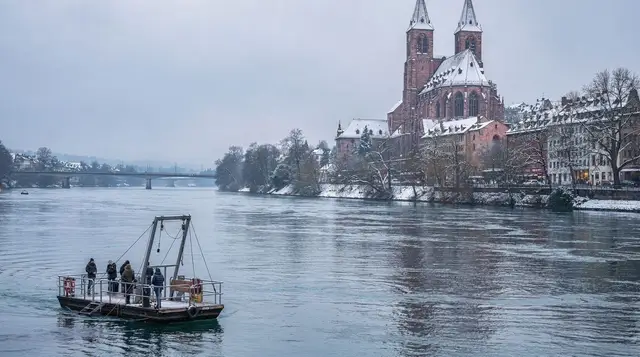
The Rhine is what makes Basel feel different from any other Swiss city on this itinerary — it’s a working, fast-flowing river running right through the centre, not a lake framed by mountains. Four small cable ferries (Fähre) cross it using nothing but the current and a guide cable, no motor. The Münster ferry, directly below the cathedral terrace, is the most central and the easiest to combine with the old town walk. A crossing costs CHF 1.80, paid in coins into an honesty box on board — no cards, so keep change on you.
In summer, roughly June to September depending on water levels, Basel residents swim in the river itself. The standard method is a Wickelfisch, a waterproof floating bag sold at kiosks along the bank, which holds a dry change of clothes and doubles as a float; you get in upstream, let the current carry you down, and climb out at one of the marked ladders. It’s genuinely popular and not a tourist gimmick, but the current is stronger than it looks from the bank, and it’s worth checking posted water conditions before getting in rather than assuming it’s always safe — cold snowmelt years and high water make it a bad idea regardless of the calendar.
Even without swimming, the riverside promenades on both banks — Kleinbasel on the right, Grossbasel on the left — make for an easy, flat walk with better views of the old town’s rooftops and the cathedral than you get from within the old town itself.
For a river day with more current and a genuine waterfall rather than a swim, the Rhine’s other set-piece is well outside Basel: see the Rhine Falls day trip guide for that separately, and note it doesn’t combine well with Basel in one day given the added travel time.
The three-country point
At the confluence of the Rhine and the smaller Wiese river, a 20-minute walk or a couple of tram stops north of the old town, Switzerland, France and Germany meet at a single marked point (the Dreiländereck). It’s not a viewpoint in any dramatic sense — flat, industrial surroundings, a modest marker and a small tower you can climb for a slightly better vantage — but it costs nothing and takes about ten minutes once you’re there. Worth the detour if you’re already in that part of town or curious about the geography; not worth a special trip on its own.
Basel’s position on this border also means genuine day trips into France (Alsace, roughly 30-40 minutes by car or train to Mulhouse) or Germany (the Black Forest edge, or Freiburg by train) are realistic from here in a way they aren’t from Lucerne — something to note if a Basel stay is being planned as its own base rather than a one-day trip.
a private day trip from Basel out to Europe’s largest waterfall covers the Rhine Falls with hotel pickup if the river theme is the draw and public transport timing feels like too much to coordinate on the day.
If you’d rather not plan the trains yourself
A private guided day trip from Basel removes the transfer planning if the goal is somewhere further out rather than the city itself — useful given how much of Basel’s day-trip potential sits over the German or French border, where public transport connections are less predictable than inside Switzerland. a private car trip pairing Zurich and the Rhine Falls covers two stops in one day with a driver, which is difficult to match on public transport without losing an hour to connections.
For something closer to Basel and lighter on the day, Rheinfelden — 20 minutes by train — is home to the Feldschlösschen brewery, one of Switzerland’s oldest. a guided tour of the Feldschlösschen brewery with a tasting is a straightforward half-day add-on if Basel itself only takes a morning and afternoon, or a standalone alternative if the museums aren’t the priority.
A realistic day plan
- 09:00 — Train from Lucerne, arriving Basel around 10:15
- 10:30 — Münster and the Pfalz terrace, then down through the old town to Marktplatz
- 12:00 — Lunch near the Rathaus or down by the river
- 13:00 — Kunstmuseum Basel (allow two hours) or the Fondation Beyeler if art over the Kunstmuseum’s older holdings appeals more
- 15:30 — Riverside walk, Münster ferry crossing, or a Rhine swim in summer
- 17:00 — Free time or the Tinguely Museum if there’s an hour left
- 18:30 — Train back to Lucerne
Anyone wanting both major art museums, or Vitra across the German border on top, is better off treating Basel as an overnight rather than forcing it into one day from Lucerne. For a broader sense of how Basel stacks up against other bases, the day trips from Lucerne guide covers the full set, and how many days in Lucerne is useful if Basel is one of several trips being weighed against each other.
Practical notes
Basel splits into Grossbasel (left bank, the historic centre) and Kleinbasel (right bank, more residential and increasingly where newer restaurants and bars sit). Trams run frequently and a single ticket bought from the machine covers a set time window rather than a single ride, which is worth knowing before over-buying tickets for a short hop.
Sundays hit Basel harder than most Swiss cities on the shopping front — nearly everything closes, museums included in some cases, so check specific opening hours if a Sunday is the only available day. For getting to and from the station generally, the Swiss trains explained guide and the getting around Lucerne guide cover ticketing basics that apply the same way in Basel.
If the day includes a Rhine swim, keep valuables in the Wickelfisch or leave them at the hotel — there’s nowhere secure to store a bag on the riverbank itself. And Basel’s compact size means a missed connection or a museum running late rarely threatens the return train the way it can on longer day trips from Lucerne to somewhere like Zermatt or Lugano — worst case, an hourly IC service means a one-hour delay rather than a missed evening.
FAQ: Basel as a day trip from Lucerne
How long does the train from Lucerne to Basel take?
About 1 hour 15 minutes on the direct IC train, which runs roughly twice an hour from Lucerne Bahnhof. A standard second-class return with the Half Fare Card costs around CHF 45-50; full fare is roughly double.
Which Basel museum is actually worth the ticket?
The Kunstmuseum Basel for the collection’s depth (Holbein, Böcklin, a serious 20th-century wing), or the Fondation Beyeler in Riehen if you’d rather see fewer, better works in a Renzo Piano building with a garden. Both charge CHF 25-38 depending on the exhibition; the Beyeler is a 20-minute tram ride from the centre.
Can you swim in the Rhine in Basel?
Yes, from roughly June to September when the water and weather allow it. Locals swim with a waterproof Wickelfisch bag to keep dry clothes with them and let the current carry them downstream, getting out at one of the marked ladders. Water quality is tested and posted; check the current speed before getting in, as it’s stronger than it looks.
What are the Rhine ferries and how much do they cost?
Four cable ferries (Fähre) cross the Rhine using only the current, no motor. A crossing costs CHF 1.80 in coins dropped in an honesty box on board; there’s no card payment. The Münster ferry, right below the cathedral, is the most central.
Where is the three-country border point?
At the confluence of the Rhine and the Wiese river, a 20-minute walk or short tram ride north of the old town, where Switzerland, France and Germany meet at a single marker. It’s a flat, unremarkable spot rather than a viewpoint, but it’s free and takes ten minutes to see.
Is one day enough for Basel, or should I stay overnight?
One day covers the old town, the Rhine, and one major museum comfortably. Trying to fit two of the big art museums plus the old town in a single day means rushing at least one of them; if museums are the priority, an overnight stay removes that trade-off.
Are Basel’s museums open on Mondays?
Most are closed on Mondays, including the Kunstmuseum and the Fondation Beyeler. Tuesday to Sunday is safe for museum visits; check the specific museum before travelling if a Monday trip is unavoidable.
Does the Swiss Travel Pass cover the train and Basel’s trams?
The Swiss Travel Pass covers the Lucerne-Basel train and Basel’s tram and bus network (BVB). It does not include museum entry as a blanket rule — some museums offer a discount to pass holders, most don’t, so check each one.
Best day trips from Lucerne on GetYourGuide
Verified deep-linked GetYourGuide tours. Book through these links and we earn a small commission at no cost to you.
GetYourGuide does not provide a product photo for this activity — the image shows the meeting point, photographed by us.