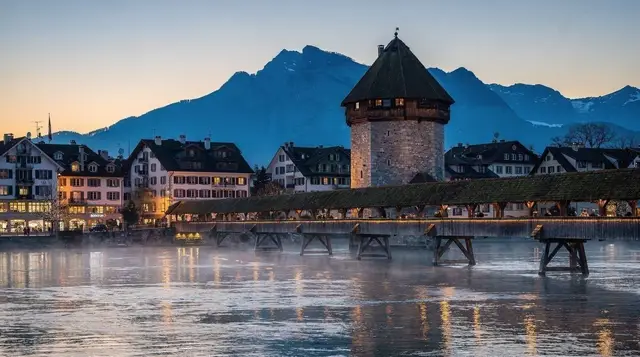
The Chapel Bridge and Water Tower: 1365 to the 1993 fire and back
What happened to the Chapel Bridge in 1993 and is it still original?
A fire on 18 August 1993, started by a cigarette on a moored boat, destroyed roughly two-thirds of the wooden bridge and around three-quarters of its painted roof panels. The bridge was rebuilt within about a year using the original 14th-century stone piers, but most of the panels you see today are 1990s copies, not the 17th-century originals.
What you are actually looking at on the water
The covered wooden bridge that crosses the Reuss between the old town and the Water Tower is called the Kapellbrücke in German and the Chapel Bridge in English, and it is the single most photographed structure in Lucerne. Most people cross it in under five minutes without realising that what they are walking on is largely a reconstruction finished in 1994, that the bridge is older than the tower it is often confused with, and that a fire on a single August night destroyed most of what had survived nearly six centuries. None of that makes the bridge less worth seeing. It does mean the popular claim that this is “the same bridge the Habsburgs saw” needs some qualifying.
This guide covers the 1365 construction, what the bridge and its painted panels were actually for, the night of the 1993 fire, what burned and what did not, and the separate and older Water Tower next to it, which is not open to the public no matter how many times you walk around it looking for a door.
Why Lucerne built a covered bridge in 1365
The Kapellbrücke was built in 1365 as part of Lucerne’s medieval fortifications, not as a tourist crossing. It linked the old town on the right bank of the Reuss to the newer settlement on the left bank and, more importantly, formed part of the city’s defensive perimeter alongside the Musegg city wall. A covered bridge with a roof kept the timber dry and extended its working life, and the diagonal position across the river, rather than a straight crossing, was a deliberate defensive choice: it made the bridge harder to attack in a straight line and let it double as a partial breakwater against floating debris and ice from the Reuss.
The bridge takes its English name from the nearby St Peter’s Chapel, one of the oldest chapel sites in the city, which stood close to the bridge’s approach. The stone piers driven into the riverbed date from that original 1365 construction and are the oldest verified part of the whole structure; a great deal of what sits on top of them is not.
At around 205 metres, the Chapel Bridge is usually described as the oldest surviving truss bridge in Europe. That claim rests on the substructure and the documented continuous use of the crossing since the fourteenth century, not on every plank being 660 years old. Wooden bridges need constant maintenance, and the Kapellbrücke had been repaired, replanked and partially rebuilt more than once even before 1993.
The painted panels: what they showed and why they were added later
The bridge’s roof line is filled with rows of triangular painted panels wedged into the truss framework, and these are what most visitors actually remember rather than the bridge itself. They were not part of the original 1365 build. The paintings were added roughly two and a half centuries later, around 1599 to 1614, commissioned as a cycle depicting the history of Lucerne and Switzerland alongside scenes from the lives of the city’s patron saints, Leodegar and Mauritius. The bridge originally carried around 158 of these panels.
The panels were not maintained as carefully as the bridge structure itself. By the time of the 1993 fire, decay, earlier partial losses and past restorations had already reduced the surviving count to roughly 111 panels, each identified by a number and inscription that most visitors walk past without reading.
They functioned as a kind of civic history lesson painted in wood and pigment, visible to anyone using a bridge that ordinary Lucerners crossed daily for shopping, commuting and moving goods between the two riverbanks. If you want the wider civic and religious history that the panels were drawing on, the private walking tour of Lucerne’s old town is the more efficient way to get it explained on the spot rather than pieced together from plaques.
The night of 18 August 1993
The fire that defines the bridge’s modern history started after dark on 18 August 1993. Investigators traced the cause to a discarded cigarette that ignited material on a small boat moored underneath the bridge. The bridge’s construction worked against it here: a long, narrow, covered wooden tunnel over open water, with dry centuries-old timber and a roof that trapped heat and drew flame along its length almost like a chimney. By the time the Lucerne fire brigade had it under control, roughly two-thirds of the bridge’s length had burned.
The damage to the painted panels was worse proportionally than the damage to the timber structure. Of the roughly 111 panels still in place that evening, around three-quarters were destroyed outright, leaving something in the region of 30 originals that survived, either because they hung in a section of the bridge the fire did not reach or because they were pulled clear during the response. It is one of the few Lucerne landmarks where the disaster itself, not just the structure, is now part of what people come to ask about.
What was rebuilt, and what stayed original
Reconstruction started quickly and finished fast by the standards of heritage restoration: the bridge reopened to the public in April 1994, under a year after the fire. That speed shaped what the rebuild actually is. The stone piers below the waterline were undamaged and needed no replacement, so the bridge’s oldest and most structurally important element from 1365 is still there and still original. Above the waterline, the timber trusses and roof are essentially a 1990s reconstruction built to the historic profile, using traditional carpentry methods but new wood.
The panels are the part visitors most often get wrong. A number of the destroyed paintings were recreated using historical photographs taken before the fire, so what hangs in those positions today are careful copies rather than the seventeenth-century originals. The panels that survived the fire are still in place among the copies, identifiable if you know which numbers to look for, though the bridge does not post an obvious guide to which is which. If distinguishing an original 1611 panel from a 1994 copy actually matters to you, that level of detail is exactly what the Lucerne History Museum and the guided old-town route cover and the bridge itself does not.
The Water Tower: older than the bridge, and not a chapel
The octagonal stone tower standing in the water at the bridge’s bend is the Wasserturm, or Water Tower, and it predates the Chapel Bridge by roughly three decades, built around 1300 as part of the same fortification system that the bridge would later connect into. It is not, despite how often the two names get merged into one attraction, part of the same 1365 construction, and it is not a water-related utility building in any functional sense — the name most likely comes from its position standing directly in the river.
Over the centuries the tower’s function changed repeatedly. Records point to it having served at various points as a prison and torture chamber, the city treasury and archive, and a watchtower and lookout post over the river approach to Lucerne. What it has never been is a chapel, a pumping station, or anything to do with water supply. Today it is used by a Lucerne shooting and civic guard association as a clubhouse and storage for historical material, and the interior is not open to visitors. You can walk the riverbank paths around its base and photograph it from the bridge, the Rathaus quay, or across the water near the lake outflow, but there is no ticket booth and no door to look for.
Seeing it well: timing, angles, and what to combine it with
The bridge and tower are free, unticketed, and open at all hours, which is also why they are busy at almost all hours. Coach groups and day-trip crowds from Zurich and the cruise-adjacent lake traffic fill the bridge from mid-morning through early evening for most of the year. The reliable quiet window is shortly after sunrise, generally before 8am between spring and autumn, when the panels are lit from a low angle and the crossing is close to empty.
For photographs, the classic angle is from the lakeside end near the private boat cruise departure point on Lake Lucerne, looking back along the bridge with the Water Tower framed against the old town rooftops. The opposite view, from the Rathaus quay looking toward the lake, catches both structures with the mountains behind on a clear day.
The crossing itself takes three to five minutes without stopping. Most visitors spend fifteen to twenty-five minutes if they pause to read a few panel inscriptions and shoot photos from both banks. It pairs naturally with a longer loop through the old town’s walking route, since the bridge sits directly between the two halves of the medieval centre and most self-guided routes cross it at least twice. If you are combining it with the city’s other fortification-era sights, the Musegg city wall and its towers were built as part of the same defensive system and are a fifteen to twenty minute walk uphill from the bridge’s old-town end.
The other bridge worth knowing about while you are on this stretch of river is the shorter, plainer Spreuerbrücke, which carries its own and grimmer painted cycle, the Dance of Death, and gets a fraction of the Chapel Bridge’s foot traffic because it is one block upstream and out of most people’s sightline. If panel paintings interest you specifically, seeing both bridges back to back is more useful than seeing the Kapellbrücke alone, since the contrast in condition and subject matter is more informative than either bridge on its own.
Getting a wider view of Lucerne from the water
Because the bridge and tower both sit directly on the Reuss where it leaves Lake Lucerne, the most complete view of how the two structures relate to each other and to the old town skyline comes from the water rather than from either bank. A short lake outing gives you the angle that no bridge-level photograph can, with the tower’s full height visible against the Musegg wall and the mountains behind.
The e-bike and boat combination covering the wider lake shoreline is one way to get that view alongside a longer look at the lake itself, and it also works as an efficient way to see the lake shoreline without committing to a full-day itinerary.
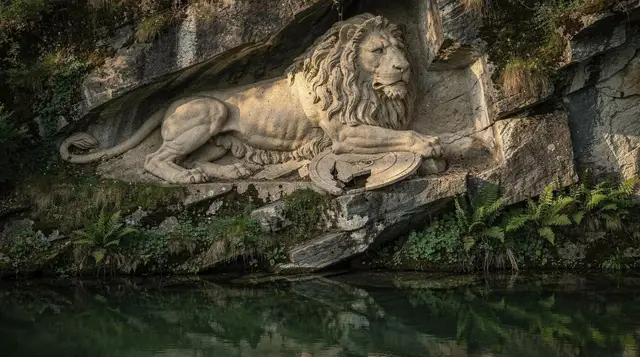
For visitors with only an hour or two in the city before a train connection, the e-tuktuk city tour loops past the bridge, the Water Tower, the Lion Monument and the old town in a fixed short window, which suits people arriving via Lucerne from Zurich airport with limited time rather than a full day free.
Museums and further reading nearby
If the 1993 fire and the panel losses are the part you actually want to understand properly, the bridge itself will not tell you much beyond the panel numbers. The city’s museums cover the fire and reconstruction in more depth than any signage on the bridge does, and the Rosengart Collection and Glacier Garden are both a short walk away if you are building out a half-day of old-town sights around the bridge rather than treating it as a five-minute stop.
For a first visit, most people are better off treating the Chapel Bridge and Water Tower as a fifteen-to-twenty-minute anchor within a longer old-town loop rather than a standalone destination, which is roughly how the one-day Lucerne itinerary and the standalone one-day guide both structure it. If you are staying longer, folding the bridge into an evening walk after the day-trip crowds thin out, then returning at sunrise for photographs, is the only realistic way to see it both properly lit and close to empty.
Practical basics for the crossing itself are listed below.
| Detail | Information |
|---|---|
| Cost to cross | Free, no ticket |
| Access hours | Open at all times, unstaffed |
| Crossing time | 3–5 minutes without stopping |
| Typical visit length | 15–25 minutes with photos |
| Quietest time | Before 8am, spring to autumn |
| Original construction | 1365 (stone piers original; timber and roof rebuilt 1993–1994) |
| Painted panels added | c. 1599–1614 |
| Panels before the fire | Around 111 (of an original c. 158) |
| Panels lost in the fire | Roughly three-quarters of those remaining in 1993 |
| Water Tower built | c. 1300, predates the bridge |
| Water Tower interior | Not open to the public |
Chapel Bridge and Water Tower: questions people actually ask
Is the Chapel Bridge the oldest wooden bridge in Europe?
It is usually described as the oldest surviving truss bridge in Europe, dating to 1365, though the phrase gets simplified in tourist material. The stone piers and foundations are original; a large share of the visible timber and roof panels are 1990s reconstruction after the 1993 fire.
How many of the painted panels survived the fire?
Of the roughly 111 panels still hanging in 1993 (the bridge originally held around 158, with losses over the centuries before that), the fire destroyed about three-quarters of them. Somewhere around 30 originals survived and a number of the destroyed panels were later recreated from historical photographs.
Can you go inside the Water Tower?
No. The Water Tower is used as a clubhouse and archive by a Lucerne shooting association and is not open to the public. You can walk around its base and view it from the bridge and the riverbank, but there is no public entrance.
What caused the 1993 fire?
Official investigations traced the fire to a discarded cigarette that ignited a boat moored under the bridge, which then set the dry wooden structure alight. It spread fast because the bridge’s covered roof and closely spaced timber trusses acted like a chimney along the water.
Is it free to walk across the Chapel Bridge?
Yes, there is no charge and no ticket. It is a public pedestrian bridge and one of the few sights in Lucerne that costs nothing, though it is also the most crowded stretch of the old town for most of the day.
How long does it take to walk the Chapel Bridge and see the Water Tower?
The crossing itself takes three to five minutes at a normal pace. Most visitors spend fifteen to twenty-five minutes if they stop to look at the panels and take photographs from both riverbanks.
What is the best time to photograph the Chapel Bridge without crowds?
Shortly after sunrise, generally before 8am from spring to autumn, is the only reliable quiet window. By mid-morning the bridge fills with coach groups and stays busy until early evening.
City sightseeing tours on GetYourGuide
Verified deep-linked GetYourGuide tours. Book through these links and we earn a small commission at no cost to you.
GetYourGuide does not provide a product photo for this activity — the image shows the meeting point, photographed by us.