Lucerne museums: what's worth visiting and what isn't
Which Lucerne museum should I actually visit?
The Swiss Museum of Transport is the one that justifies a half or full day for almost anyone, adults and kids alike. If you only have an hour, the Bourbaki Panorama or the Rosengart Collection both work as a single, focused stop in the old town.
Lucerne has more museums than most cities its size, and not all of them deserve equal billing. Some, like the Swiss Museum of Transport, are genuinely national-scale attractions that can absorb a full day. Others are a focused 45 minutes that fit neatly around lunch. This guide ranks them by what they actually offer, how long they take, and what they cost, so you can build a museum day that matches the time you have rather than the marketing copy on each museum’s own website.
Which Lucerne museum is actually worth your time
If you read nothing else on this page, read this table. It’s the shortlist against which every other museum in Lucerne gets measured.
| Museum | Time needed | Typical adult price (CHF) | Best for |
|---|---|---|---|
| Swiss Museum of Transport | 3–6 hours | 32 (exhibitions), 40+ with Planetarium/IMAX | Families, wet days, anyone into engineering |
| Rosengart Collection | 60–90 min | 18 | Picasso, Klee and Miró in one small building |
| Bourbaki Panorama | 45–60 min | 15 | A single striking artwork, quick city-centre stop |
| Richard Wagner Museum | 60–75 min | 10 | Wagner enthusiasts, lakeside setting |
| Natur-Museum Luzern | 60–90 min | 8 | Alpine geology and wildlife, good with kids |
| Historisches Museum Luzern | 60–90 min | 10 | Local history, armour, Swiss federal context |
| Glacier Garden | 90 min | 22 | Ice-age rock formations plus a mirror maze |
Prices change year to year, so treat these as a planning baseline rather than gospel, and check the current tariff before you set off. Most of these sites, with the exception of Planetarium and IMAX add-ons at the Museum of Transport, are covered by the Swiss Travel Pass.
Swiss Museum of Transport (Verkehrshaus)
This is Switzerland’s most visited museum, and on a lakeside city of 82,000 people, it dominates the museum conversation for good reason. The site sits about 3 km east of the old town on the lakeshore, reachable by VBL bus or, more pleasantly, by boat from the main pier in around 20 minutes.
The core exhibition halls cover road, rail, air and water transport, with full-size locomotives, aircraft you can walk through, and a hall dedicated to Switzerland’s road network and car history. A separate hall, the Swiss Chocolate Adventure, walks visitors through chocolate production with a small dark-ride element, which is popular with children but adds real time and cost if you include it. The site also has a Planetarium and a large-format Filmtheatre, both ticketed on top of general admission.
Entry to the exhibition halls alone runs around CHF 32 for an adult. Add the Planetarium, IMAX-style Filmtheatre and Chocolate Adventure and a full day easily passes CHF 40–45 per adult, which is why deciding in advance what you actually want to see matters here more than at any other Lucerne museum.
a full day pass covering the exhibition halls, Planetarium and Filmtheatre is the straightforward option if you’re planning to make a day of it, particularly with children in tow. If you only want the transport halls without the extras, a standard entrance ticket to the exhibition halls is the cheaper route and still covers three to four hours comfortably.
Arrive by 10:00 if you want to beat the school groups, which fill the halls on weekday mornings from around 09:30. The full site is set up for a genuinely accessible visit, with lifts and ramps throughout, though the outdoor aircraft and rail exhibits mean some walking between halls regardless of mobility.
For the full layout, hall-by-hall breakdown and current opening hours, see the Swiss Museum of Transport guide.
Rosengart Collection
The Rosengart Collection sits in a converted former bank building on Pilatusstrasse, a five-minute walk from the station, and it is the opposite of the Museum of Transport in every way: small, quiet, and finished in well under two hours.
The collection was assembled by Angela Rosengart, a Lucerne art dealer and personal friend of Pablo Picasso, and it shows. There are over 200 Picasso works across paintings, drawings and prints, plus a substantial holding of Paul Klee, alongside pieces by Miró, Matisse, Cézanne and Braque. The upper floor holds black-and-white photographic portraits of Picasso taken by Angela Rosengart’s own photographer father, which is a nice, unexpected addition if you’ve just walked through the paintings.
Adult entry is around CHF 18. The museum is compact enough that a focused visit takes 60 to 90 minutes, which makes it an easy midday stop between the old town and lunch, rather than something that needs a dedicated afternoon.
Full opening hours, ticket options and gallery-by-gallery detail are in the Rosengart Collection guide.
Bourbaki Panorama
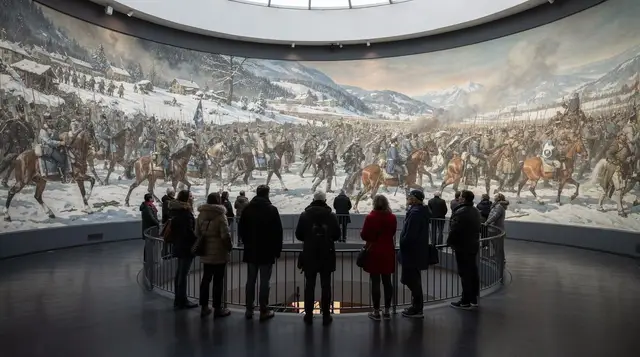
The Bourbaki Panorama is Lucerne’s most unusual museum experience: a single circular painting, 112 metres around and 10 metres high, depicting the internment of a defeated French army in Switzerland during the Franco-Prussian War in 1871. You stand in the centre of a rotunda a short walk from the old town, and the painting wraps entirely around you.
There isn’t much else to the site beyond the painting itself, a small exhibition space and an audio guide explaining the historical context, which is why a visit here rarely runs past an hour. Adult entry is around CHF 15. It works well paired with the old town walk, since the rotunda sits just off Löwenplatz, close to the Lion Monument.
More detail on the history behind the painting and visiting logistics is in the Bourbaki Panorama guide.
Richard Wagner Museum Tribschen
Richard Wagner lived in the Villa Tribschen, on a small peninsula on the lakeshore about 2 km southeast of the old town, from 1866 to 1872, and composed parts of several major works there, including sections of the Ring cycle and the Siegfried Idyll. The villa is now a small museum holding manuscripts, instruments and personal items, set in gardens that run down to the water.
It’s a niche stop compared with the other museums on this page, and it’s aimed squarely at people with some existing interest in Wagner or 19th-century music history rather than casual visitors. Adult entry is around CHF 10, and a visit takes about an hour including a walk through the lakeside gardens.
The museum runs a seasonal schedule and is typically closed over winter, so this is not a reliable November-to-March option. Check current dates before building a day around it. Getting there on foot from the old town takes about 25 minutes along the lakeshore, or the number 6 or 7 bus covers it in under 10.
Lucerne’s history and nature museums
Two smaller institutions round out Lucerne’s serious museum offer, and both are worth knowing about even though neither is a headline attraction.
The Historisches Museum Luzern, housed in a former armoury building near the Reuss, covers the canton’s history from its role in the founding of the Swiss Confederacy through to the 20th century, with a strong collection of historical weapons and armour. Adult entry is around CHF 10, and 60 to 90 minutes covers it thoroughly.
The Natur-Museum Luzern focuses on the natural history of central Switzerland: alpine geology, regional wildlife, and a hands-on section that works well for children. Adult entry is around CHF 8, with reduced or free entry on some days each month, which is worth checking if budget is tight. Between the two, the Natur-Museum is the better choice if you’re travelling with kids and want something educational without the scale of the Museum of Transport.
Neither museum requires advance booking outside special exhibition periods, and both sit within a 10-minute walk of the old town.
Glacier Garden: the museum that isn’t quite a museum
The Glacier Garden, on the hillside above the Lion Monument, is technically a museum but functions more like a hybrid site: a preserved field of glacial potholes carved into rock 20,000 years ago, a small geology exhibition, a 19th-century mirror maze, and a viewing tower over the old town. It’s a reasonable pairing with the Lion Monument since both sit within a few minutes’ walk of each other on Denkmalstrasse.
Adult entry runs around CHF 22, and a visit takes about 90 minutes if you cover the rock formations, exhibition and mirror maze. It’s a stronger choice for families than for anyone looking specifically for a fine-art or history museum. Full detail is in the separate Glacier Garden guide.
Planning a museum day in Lucerne
The mistake most visitors make is trying to combine the Swiss Museum of Transport with one or two smaller museums in the same day. The Museum of Transport alone fills three to six hours depending on how much of it you see, and it sits outside the old town, so tacking on a second museum usually means rushing both.
A workable split looks like this:
- Day with kids or a rainy forecast: the Swiss Museum of Transport, full day, nothing else scheduled.
- Half day in the old town: Bourbaki Panorama plus the Rosengart Collection, both within a 10-minute walk of each other and each other’s neighbourhood, finishing in under three hours including a coffee break.
- A quieter, slower day: Richard Wagner Museum in the morning (seasonal, check dates), a lakeside walk back into town, then the Historisches Museum or Natur-Museum in the afternoon.
If you’re combining museums with the rest of Lucerne’s sights, the Lucerne in one day guide and the how many days in Lucerne guide show where a museum visit fits against the Chapel Bridge, old town walls and lake. For a full multi-day plan that leaves room for one museum without crowding the schedule, the Lucerne 2-day itinerary is a reasonable template.
Travelling with the Swiss Travel Pass makes most of this simpler, since entry to the Museum of Transport, Rosengart Collection and Bourbaki Panorama is included; see the Swiss Travel Pass guide for what is and isn’t covered. Getting between sites is straightforward on the VBL bus network, covered in the getting around Lucerne guide.
Museums, food and a break from exhibits
If a museum morning leaves you wanting something less structured, Lucerne’s old town is close enough to most of these sites that a chocolate-focused break works as a natural follow-on rather than a separate outing. A guided chocolate bar-making session in Lucerne runs about two hours and pairs reasonably well after the Rosengart Collection or Bourbaki Panorama, both a short walk from the old town workshop locations.
For a different kind of break entirely, a private guided cliff path excursion above the lake gets you outdoors after an indoor museum morning, with views back over Lucerne and the lake that no museum window quite matches.
Museums vs. the old town: what to prioritise if time is short
For a first-time visitor with one day in Lucerne, the honest ranking is: the old town and Chapel Bridge first, one museum second. The Chapel Bridge and Water Tower guide, Musegg Wall and towers guide and Lion Monument guide cover Lucerne’s free, outdoor core, all of which take priority over any single museum on a tight schedule. If you have more than one day, the Lucerne old town walking guide ties the outdoor sights together, leaving a clear half or full day free for whichever museum matches your interest from the table above.
Travellers on a tighter budget should also check the Lucerne free things to do guide and the Lucerne on a budget guide before assuming a museum day is unavoidable — several of Lucerne’s best sights cost nothing at all. For families specifically weighing museum time against outdoor activities, the Lucerne with kids guide sets out how a museum morning balances against an afternoon on or near Lake Lucerne.
Questions about visiting Lucerne’s museums
Is the Swiss Museum of Transport worth the price?
Yes for a family or a rainy day, less so for a quick city break. A full day pass covering the Planetarium, Filmtheatre and Swiss Chocolate Adventure runs well past CHF 40 per adult once you add extras, so decide in advance how much of the site you actually want to see.
Are Lucerne’s museums covered by the Swiss Travel Pass?
Most of them are, including the Swiss Museum of Transport, the Rosengart Collection and the Bourbaki Panorama. The pass does not cover special exhibitions or the Planetarium and IMAX add-ons at the Museum of Transport, which are ticketed separately.
Which Lucerne museum is best for a rainy afternoon?
The Swiss Museum of Transport has the most indoor space to fill a wet afternoon, with hangars big enough that you are never queuing at the door. The Rosengart Collection and Bourbaki Panorama are smaller but entirely indoors and both take under 90 minutes.
Do I need to book Lucerne museum tickets in advance?
Not usually. Walk-up entry works for the Rosengart Collection, Bourbaki Panorama and Richard Wagner Museum outside peak summer weekends. The Swiss Museum of Transport gets busy with school groups on weekday mornings, so a mid-afternoon visit or a pre-booked full day pass avoids the worst of it.
Is the Richard Wagner Museum open all year?
No. It runs a seasonal schedule and typically closes over winter, so check the current opening dates before building a visit around it, especially if you are travelling between November and March.
Are there free museums in Lucerne?
The Natur-Museum Luzern and Historisches Museum both offer reduced or free entry on certain days each month, and several smaller collections around the old town are free year-round. None of the major sites, including the Swiss Museum of Transport and Rosengart, are free.
How much time should I set aside for Lucerne’s museums overall?
Budget a full day if you want to see the Swiss Museum of Transport properly, plus a separate half day for one or two of the smaller collections such as Rosengart or Bourbaki. Trying to fit all of Lucerne’s museums into one day means rushing every one of them.
Museum & art tours on GetYourGuide
Verified deep-linked GetYourGuide tours. Book through these links and we earn a small commission at no cost to you.
GetYourGuide does not provide a product photo for this activity — the image shows the meeting point, photographed by us.