Lucerne souvenirs: what's actually worth buying
What souvenirs are actually worth buying in Lucerne?
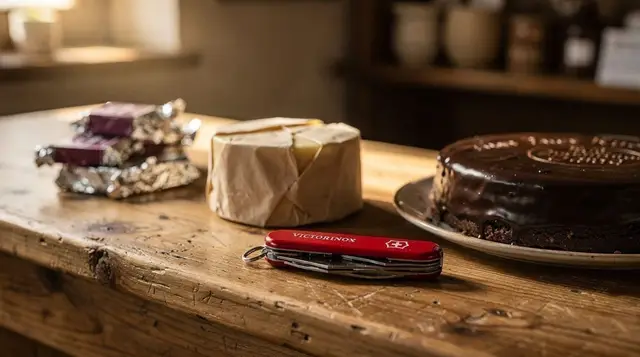
A genuine Victorinox Swiss Army knife (made in nearby Ibach), vacuum-packed Alpine cheese, Swiss chocolate bought at a supermarket rather than a tourist shop, and a Zuger Kirschtorte if you can eat it within a few days. Skip cuckoo clocks and anything with a Toblerone triangle printed on a T-shirt.
The short version: skip the cuckoo clock, buy the knife
Lucerne’s Old Town is dense with shops selling the same four things: Swiss Army knives, watches, chocolate and cuckoo clocks (which, for the record, are a Black Forest tradition, not a Swiss one — Switzerland has never really made them). Some of what’s on offer is genuinely good value and genuinely Swiss. Some of it is markup aimed at cruise-ship day-trippers who won’t be back to compare prices. This guide covers the four things actually worth the suitcase space — knife, cheese, chocolate, Zuger Kirschtorte — plus what customs and airport rules actually allow you to bring home, which trips up more people than the shopping itself.
If you want the wider picture of where to shop in Lucerne beyond souvenirs, the Lucerne shopping guide covers the department stores and Old Town streets. This page stays narrow: what’s worth buying, and what happens when you try to take it through an airport.
The Swiss Army knife: made 45 minutes from here
The Victorinox Swiss Army knife is one of the rare souvenirs in Lucerne that is exactly what the shop window claims. The company has manufactured the knives since 1884 in Ibach, a village in canton Schwyz roughly 45 minutes from Lucerne by car or a combination of train and bus, and production still happens there rather than being outsourced. The “Swiss Army” name is literal too — the original contract was to supply a folding knife to the Swiss military in 1891.
Prices in Lucerne’s Old Town run from around CHF 25 for a basic Classic SD (the small keyring model with scissors and a blade) up to CHF 200+ for larger multi-tool models with dozens of functions. The flagship Victorinox store is on Schwanenplatz, a short walk from the train station, and it’s not noticeably more expensive than the smaller shops nearby — unlike watches, knife pricing in Lucerne is fairly consistent because Victorinox controls retail pricing closely.
What actually varies is the shop’s willingness to engrave a name or date on the knife for free or for a small fee, which the flagship store does. If you’re buying as a gift, ask before you pay rather than after.
A note on airport rules: the knife has a blade, so it goes in checked luggage, never hand luggage. Every visitor to Lucerne who buys one and then tries to carry it onto a flight home finds this out the hard way at the security tray.
Cheese: buy it vacuum-packed, skip the soft ones
Hard and semi-hard Swiss cheeses travel well and are one of the better-value souvenirs in the country. Gruyère, Sbrinz and Appenzeller all hold up fine in a checked bag for a week or more without refrigeration once vacuum-packed, which any cheese shop or the cheese counter at a larger Coop or Migros will do on request, usually free or for a token fee.
Prices in Lucerne run roughly CHF 25-40 per kilo depending on the cheese and how long it’s aged — Swiss cheese is not cheap, and a shop selling it noticeably below that is probably selling a young, mild version rather than the aged one the price tag implies. Ask for a taste before you commit to a kilo.
Soft cheeses are the exception. Vacherin Mont-d’Or and other washed-rind soft cheeses are genuinely good but travel badly outside a cold chain — buy them to eat in Lucerne, not to bring home.
| Cheese | Typical price/kg | Travels well? |
|---|---|---|
| Sbrinz (hard, aged) | CHF 30-40 | Yes, weeks unrefrigerated |
| Gruyère | CHF 25-35 | Yes, well over a week |
| Appenzeller | CHF 25-32 | Yes, if vacuum-packed |
| Vacherin Mont-d’Or | CHF 20-28 | No — eat locally |
For the wider cheese picture — dairies you can actually visit rather than just shop at — see the Swiss cheese dairies day trip guide.
Chocolate: buy it at a supermarket, not a tourist shop
Swiss chocolate is genuinely good and genuinely a fair thing to bring home, but where you buy it matters more than what brand you buy. A bar of Lindt, Cailler or Frey costs CHF 3-6 at any Coop or Migros supermarket. The same bar, or a gift-wrapped version of it, in a souvenir shop on Kapellplatz or near Chapel Bridge, routinely costs two to three times that.
If you want something more specific than a supermarket shelf, Lucerne has a handful of proper chocolatiers worth the extra price — Confiserie Bachmann is the best-known local one, with several branches around the Old Town, and its pralines and truffles are made on-site rather than imported. Max Chocolatier, which has a shop near the station, does the same at a similar price point.
For a more hands-on version of the same interest, a chocolate-making session lets you see how the bars are actually put together rather than just buying the finished product —
a chocolate bar-making workshop runs through the process from tempering to moulding and you leave with what you made.
For the fuller list of where to taste and buy chocolate around the city, see Swiss chocolate experiences in Lucerne.
Zuger Kirschtorte: the cake that doesn’t travel far
Zuger Kirschtorte is a layered cake — almond meringue (Japonaise) and buttercream, soaked generously in kirsch, a clear cherry brandy — that comes from Zug, a town about 30 minutes from Lucerne by train and worth the trip on its own merits (see Zug). It is not subtle: the kirsch content is high enough that it’s genuinely an adult’s cake, and the layers are dyed pink specifically so bakers in the early 20th century could tell a properly made one from an imitation.
You don’t need to go to Zug to buy it. Confiserie Bachmann and other bakeries in Lucerne sell it, usually as a small whole cake rather than by the slice for takeaway. It keeps for 3-4 days unrefrigerated because of the alcohol content, which is long enough to get it home if you’re on a direct flight but not much longer — this is not a cake to buy on day one of a two-week trip.
Expect to pay roughly CHF 35-50 for a cake serving 6-8 people. It’s sold in a flat box designed for carrying, and bakeries will pack it for travel if you ask.
Watches: don’t assume Switzerland is automatically cheaper
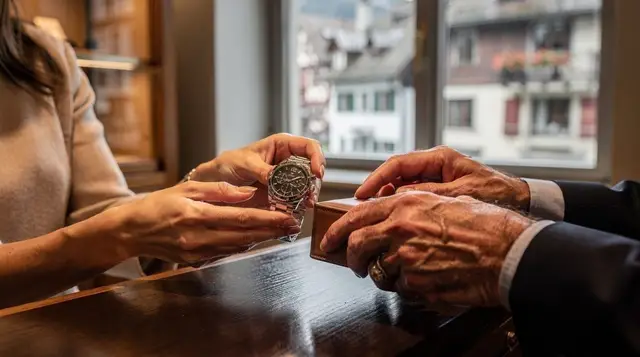
Lucerne’s Old Town has a dense concentration of watch shops, from Bucherer’s flagship on Schwanenplatz down to smaller independent dealers. The received wisdom that Switzerland is the cheap place to buy a Swiss watch isn’t automatically true — list prices are often set globally, and the saving (where there is one) comes mainly from the VAT refund rather than a lower sticker price. It’s easy to end up paying the same as, or more than, your home country once you account for the maths properly.
If a watch is genuinely on your list, do the comparison before you’re in the shop, not after — the full mechanics of the refund and how to check whether Lucerne is actually cheaper are in the Swiss watches buying guide.
Customs and duty-free: the part that actually catches people out
The security check when you leave Switzerland is not where souvenir shopping goes wrong — solid food, knives in checked bags and clothing all clear it fine. The part that trips people up is the customs value allowance at the other end.
| Destination | Duty-free allowance from Switzerland | Notes |
|---|---|---|
| EU countries | €430 (air/sea) or €300 (land) per person | Switzerland is outside the EU customs union |
| United Kingdom | £390 per person | Applies since Brexit; was previously £270 |
| United States | $800 per person | Higher allowance, rarely an issue for souvenir shopping |
Switzerland is in the Schengen area for passport-free travel but sits outside the EU, so goods bought here count as imports when you arrive in an EU country, the UK, or elsewhere — this is the same reason Swiss VAT refunds exist in the first place. A knife, a kilo of cheese and a few chocolate bars will not get near these thresholds; a watch or a lot of jewellery might.
Claiming the VAT refund
Switzerland’s VAT is 8.1% as of 2026. To claim it back, you need to spend at least CHF 300 in a single shop on a single day, ask for a Tax Free Form at the till, and get it stamped by Swiss customs when you leave the country with the goods still unused. Zurich and Basel airports both have customs desks for this; Lucerne itself doesn’t, so budget the extra time at the airport rather than assuming it’s quick. The refund typically comes back as cash at an airport counter or a credit to your card a few weeks later, minus a processing fee.
Where to actually shop in Lucerne
The Old Town streets around Kapellplatz and Hertensteinstrasse hold most of the souvenir shops, chocolatiers and the Victorinox flagship, all within a few minutes’ walk of Chapel Bridge. Pilatusstrasse, running south from the station, has the more everyday shopping — pharmacies, supermarkets, clothing — where chocolate and basics cost supermarket prices rather than tourist prices.
For a first orientation of the Old Town before you start comparing shop windows, the Lucerne old town walking guide covers the same streets from a sightseeing angle, and pairs well with either a self-guided route or a short guided one —
a private walking tour of the Old Town covers the same ground with someone who can point out which shops are locally run.
If you’d rather cover more ground with less walking and get a feel for where things are before committing to a shopping afternoon, a city tour by e-tuktuk loops through the Old Town and lakefront in under an hour.
Markets are worth timing around, too — the Lucerne markets and street food guide covers the weekly produce and general markets, which are a better source of small, genuinely local gifts than the souvenir shops.
What souvenir shopping actually costs
For context against the rest of a Lucerne trip, a modest souvenir haul — a small Victorinox knife, a vacuum-packed cheese, a couple of chocolate bars — runs roughly CHF 80-120 per person. That’s a meaningful add-on to a city that’s already expensive; see Lucerne travel costs for how it sits against accommodation and food, and Lucerne on a budget if you’re trying to keep the whole trip lean.
Worth knowing before you land at all: Switzerland’s Schengen membership means no passport check arriving from most of the EU, but the customs rules above still apply regardless — see Switzerland visa and ETIAS for the wider entry picture, and first-time mistakes in Lucerne for the other things that catch first visitors out, shopping-related and otherwise.
If you’re visiting in December, the shopping calculus shifts a little — mulled wine, ornaments and food gifts join the list at the Lucerne Christmas markets, often at fairer prices than the year-round Old Town shops.
Frequently asked questions about souvenir shopping in Lucerne
Is Victorinox actually Swiss-made, or is it a tourist brand?
It’s genuinely Swiss. Victorinox has made the knife since 1884 in Ibach, canton Schwyz, about 45 minutes from Lucerne, and still manufactures there. It’s one of the few souvenirs in Lucerne’s shop windows that is what it claims to be.
Can I bring Swiss cheese and chocolate through airport security and customs?
Cheese and chocolate are solid foods, so they’re fine in hand luggage and checked bags. The limit that matters is customs value allowance at your destination, not airport security. EU arrivals get €300-430 duty-free per person from Switzerland; UK arrivals get £390. Above that, declare it.
Where should I avoid buying souvenirs in Lucerne?
The shops immediately around Chapel Bridge and the Löwenplatz tram stop mark up watches, knives and chocolate against what you’ll pay a five-minute walk away on Hertensteinstrasse or in a Coop or Migros supermarket.
What is Zuger Kirschtorte and where do I buy it in Lucerne?
It’s a layered almond-meringue cake soaked in kirsch (cherry brandy) from the town of Zug, 30 minutes from Lucerne by train. Lucerne bakeries and Confiserie Bachmann sell it; it keeps 3-4 days unrefrigerated and doesn’t travel well beyond that.
Is a Swiss watch actually cheaper in Switzerland than at home?
Sometimes, after the VAT refund, but not reliably. Compare the exact reference number against your home-country retail price before assuming Switzerland is cheaper — see the separate watch-buying guide for how the refund maths actually works.
How do I claim the VAT refund on souvenirs bought in Lucerne?
You need a single receipt of at least CHF 300 from one shop on the same day, a Tax Free Form filled in at the till, and to get it stamped by Swiss customs when you leave the country with the goods unused. Airport counters at Zurich and Basel process refunds; Lucerne itself has no customs desk.
Can I buy vacuum-packed cheese that survives a flight home?
Yes. Cheese shops and larger supermarkets vacuum-pack hard and semi-hard cheeses (Gruyère, Sbrinz, Appenzeller) on request, which keeps them fine in a checked bag for well over a week without refrigeration. Soft cheeses like Vacherin travel worse and should be eaten in Switzerland.
Shopping & market tours on GetYourGuide
Verified deep-linked GetYourGuide tours. Book through these links and we earn a small commission at no cost to you.
GetYourGuide does not provide a product photo for this activity — the image shows the meeting point, photographed by us.