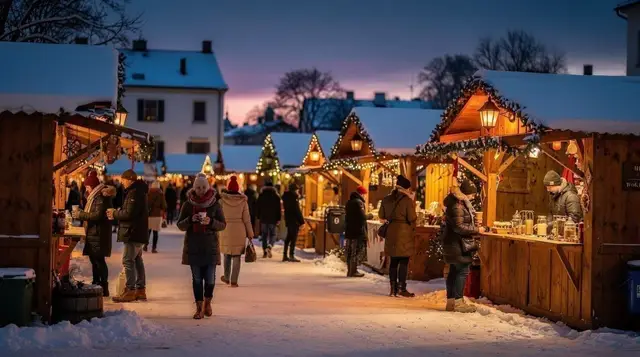
Lucerne's Christmas markets, mulled wine, and day trips to Zurich and Basel
When and where are Lucerne's Christmas markets?
The main Lozärner Wiehnachtsmärt runs at Franziskanerplatz from late November to 23 December, daily, with the smaller Hirschenplatz market a five-minute walk away. Both are free to enter; a mug of mulled wine runs roughly CHF 6-8. Zurich (45 minutes by train) and Basel (about 1 hour 15) have larger markets worth adding as a day trip.
Lucerne doesn’t try to compete with Zurich or Basel on size, and it shouldn’t. What it has is two small, walkable markets a few minutes from the station, wooden chalets selling mulled wine and raclette, and a location close enough to Switzerland’s two bigger markets that you can treat them as a half-day add-on rather than a separate trip. This guide covers what’s actually in Lucerne, what things cost, and when the extra train ride to Zurich or Basel is worth it.
Where Lucerne puts up its stalls
The main event is the Lozärner Wiehnachtsmärt, a covered row of wooden chalets on Franziskanerplatz, a five-to-ten-minute walk from Luzern Bahnhof along the river on the Old Town side. It’s the newer and larger of Lucerne’s two markets, strung with lights overhead so it stays dry even in rain, which matters more than it sounds - see our guide to Lucerne’s weather month by month for how often December brings rain rather than snow at lake level.
A short walk further into the lanes of the Old Town is the smaller Hirschenplatz market, one of the older Christmas markets in the region, tucked into a square surrounded by painted facades. It’s a fraction of the size of Franziskanerplatz - a dozen or so stalls rather than several dozen - but it’s quieter and better if you want a mug of Glühwein without queuing three deep. Both markets sit within easy reach of the Chapel Bridge, so a market visit pairs naturally with an evening walk past the bridge lit up for the season.
Neither market requires a ticket. You walk in, buy what you want, and walk back out - unlike some larger markets that fence off the whole area.
When the market runs, and what changes if you come early or late
Lucerne’s markets typically open in the last week of November and run daily through 23 December, closing before Christmas Eve itself. Exact dates move by a few days year to year, so treat “late November to 23 December” as the pattern rather than a fixed date, and check the current year’s dates shortly before you travel.
Weekday afternoons are noticeably calmer than weekend evenings. If you’re staying more than a night or two, a Tuesday or Wednesday visit around 17:00-19:00 avoids the crush that builds up on Friday and Saturday nights, when the stalls stay busy well past 20:00. Stalls generally open around 11:00 and run until 20:00 on weekdays, later at weekends - but individual vendors set their own hours, so don’t plan a visit around a single stall you saw online.
One thing that catches visitors out: Lucerne’s cable cars and cog railways up Pilatus and other peaks often close for autumn maintenance and don’t reopen for winter until mid-December at the earliest, weather depending. If your trip combines a market evening with a mountain excursion, check operating status before you build the day around it - our guide to Lucerne in winter covers which routes actually run in December.
What to drink: Glühwein, Punsch and the mug you keep
Every stall sells some version of mulled wine. The standard is Glühwein - red wine mulled with cinnamon, clove and orange - alongside a white-wine Punsch and a non-alcoholic fruit version for drivers and kids. A cup costs roughly CHF 6-8, and you’re usually charged a small deposit (CHF 3-5) for the mug, refunded if you hand it back or, more often, kept as a souvenir since the mugs change design each year.
There isn’t a single stall that stands out as “the best” - the wine itself is fairly uniform across vendors, mulled from the same basic recipe. The real variable is which mug design you end up with and how long the queue is. If a long line has formed at Franziskanerplatz, it’s usually faster to walk the few minutes to Hirschenplatz rather than wait.
What to eat: raclette, Magenbrot and Grittibänz
Food stalls lean on the same handful of Swiss winter staples you’ll find at every market in the country:
| Item | What it is | Typical price (CHF) |
|---|---|---|
| Raclette (bread + cheese) | Cheese scraped onto bread or potatoes | 8-12 |
| Bratwurst / Cervelat in a bun | Grilled sausage, mustard on request | 7-9 |
| Magenbrot | Spiced, glazed biscuit bites, sold by the bag | 5-7 |
| Grittibänz | Sweet bread shaped like a figure, seasonal | 4-6 |
| Roasted chestnuts | Sold hot in a paper cone | 5-7 |
| Vin chaud / Glühwein | Mulled red or white wine | 6-8 |
For a proper sit-down meal rather than market snacks, our guide to raclette and fondue in Lucerne covers restaurants that serve it year-round, and the guide to Lucerne’s markets and street food goes beyond the Christmas season. If chocolate is more your thing than cheese, a hands-on
chocolate-making workshop where you create your own baris an easy way to fill a cold afternoon before the market stalls get going in the evening, and it’s covered indoors regardless of weather.
Prices at the market, in francs
Switzerland is expensive, and the market doesn’t pretend otherwise. A realistic evening for two - two mulled wines, a raclette portion each, a bag of Magenbrot to share - runs roughly CHF 55-70. That’s before any souvenirs. For context on how that fits into a wider trip, see our guide to Lucerne travel costs, and for a lower-spend version of the same evening, the budget guide to Lucerne has specifics on where prices are lower.
Most stalls accept cards and TWINT (the Swiss mobile payment app) as well as cash, which is more forgiving than it was a few years ago - but a handful of the smaller stalls, especially at Hirschenplatz, are still cash-only. Carry at least CHF 30-40 in notes and coins to avoid a wasted walk to a cash machine mid-evening.
Getting from the market to everything else worth doing that day
Because both markets sit within ten minutes of Luzern Bahnhof, they slot easily into a day that starts elsewhere. If you’re staying near the lake, city buses run by VBL get you to the station in minutes, and Lucerne’s hotel guest card covers urban transport if you’re staying overnight - see where to stay in Lucerne for areas within easy walking distance of both markets.
If you want the lake itself rather than just the Old Town, a
private boat charter on Lake Lucerneruns through winter on a booked basis even though the scheduled paddle-steamer timetable thins out considerably in December - worth checking against our guide to Lake Lucerne’s paddle steamers if you specifically want one of the historic boats rather than a private charter.
For a mountain outing earlier in the day, Rigi sometimes runs its own small seasonal market at the top, and a
day trip to Rigi combining the cruise and cable carleaves you back in Lucerne with enough daylight left to walk the market before dinner. Full detail on the route and what’s actually open in winter is in our Rigi guide.
Zurich’s Christmas market: bigger, indoors, and 45 minutes away
Zurich’s best-known market, the Christkindlimarkt inside Zurich HB, is one of the largest covered Christmas markets in Europe, built around a Swarovski crystal-decorated tree in the middle of the station concourse. It’s indoors, which means it runs regardless of weather, and it’s directly on top of the train station, so there’s no walk involved when you arrive. Zurich also has a separate outdoor market and light installation along the Bahnhofstrasse, plus the Wienachtsdorf village at Sechseläutenplatz with its own food stalls and rink.
Trains from Luzern Bahnhof to Zurich HB run at least twice an hour and take 45 minutes to 1 hour depending on the service - see our guide to Swiss trains explained for how the timetable works and which trains need a reservation (none of the Lucerne-Zurich services do). That frequency and speed makes Zurich a genuinely easy half-day add-on: leave Lucerne mid-afternoon, spend two or three hours at the market and along the Bahnhofstrasse, and you’re back in Lucerne in time for a late dinner. Our Zurich day trip guide has a fuller itinerary for the rest of the day if you want to combine the market with sightseeing.
Basel’s Christmas market: the oldest and the biggest, at arm’s length
Basel’s market has a stronger claim to atmosphere: it’s regularly cited as one of the largest and oldest Christmas markets in Switzerland, spread across two connected old-town squares, Barfüsserplatz and Münsterplatz, with the cathedral as a backdrop on one side. It feels less like a market bolted onto a transit hub and more like the town itself has been decorated for the season, which is the trade Basel makes for being further away.
That distance is roughly 1 hour 15 minutes by direct train from Lucerne, against 45 minutes to an hour for Zurich - close enough for a day trip but with less slack in the evening if you want to be back at a reasonable hour. If Basel’s the one you pick, our Basel day trip guide lays out a realistic schedule that leaves proper time at the market rather than rushing it.
Comparing the three markets
| Lucerne | Zurich | Basel | |
|---|---|---|---|
| Setting | Two small squares, Old Town | Indoors at the main station, plus Bahnhofstrasse | Two connected old-town squares |
| Size | Small | Large | Large, arguably the largest in Switzerland |
| Travel from Lucerne | On foot from Luzern Bahnhof | 45 min-1 h by train | ~1 h 15 by train |
| Weather-proof | Franziskanerplatz is covered | Fully indoors at the station | Mostly outdoors |
| Best for | A short, low-effort evening | An easy half-day add-on | A full day trip, best atmosphere |
None of these is objectively “the best” - it depends on how much of your day you want to give up to travel. Lucerne alone is enough for an evening if that’s all the time you have; adding Zurich or Basel makes sense if you’re staying more than two or three nights and have a spare afternoon.
Weather, crowds and the mistakes that ruin the evening
The most common complaint about Lucerne’s market isn’t the market itself, it’s showing up unprepared for the cold. December evenings commonly sit at 0-5°C after dark, and standing outside with a hot drink for an hour cools you down fast if you’re not dressed for it. Proper boots and a real winter coat matter more than anything you buy at the stalls.
Rain, not snow, is the more likely weather event at lake level in early-to-mid December - snow tends to arrive later or stays confined to the surrounding peaks. Franziskanerplatz’s covered structure handles this fine; Hirschenplatz is more exposed. Check the forecast the day before rather than assuming a “winter” trip means snow on the ground in the Old Town.
Weekend evenings, especially the two weekends closest to Christmas, get genuinely crowded around the busiest stalls. If crowds bother you, aim for a weekday, or come earlier in the market’s run - the first week tends to be calmer than the final week before the 23rd. For families, our guide to Lucerne with kids has notes on which parts of the market work best with children in tow, and if snow activities are more the goal than mulled wine, sledding and snowshoeing near Lucerne covers where that’s realistic given how low the snowline usually sits in December.
If you’d rather build a full winter trip around Lucerne rather than a single evening, our five-day winter Lucerne itinerary works the market in alongside mountain excursions and one of the day trips above. And if you want to be walking rather than standing still for part of the visit, a
guided walk along Lucerne’s cliff pathearlier in the day gives you views over the lake before the light goes, which by mid-December is well before 17:00.
Questions about Lucerne’s Christmas markets
When do Lucerne’s Christmas markets open in 2026?
The Lozärner Wiehnachtsmärt at Franziskanerplatz typically opens in the last week of November and runs daily until 23 December, closing for Christmas Eve. Exact opening and closing dates shift by a few days each year, so check the current dates a week or two before you travel rather than assuming last year’s calendar.
Is there an entry fee for Lucerne’s Christmas markets?
No. Both the Franziskanerplatz market and the Hirschenplatz market are free to walk through at any time during opening hours. You only pay for what you eat and drink, and there’s no ticket or wristband system.
What’s the best mulled wine to try at the Lucerne market?
Most stalls serve a standard Glühwein (red wine, mulled with cinnamon and clove) alongside a white-wine Punsch and a non-alcoholic version for drivers and kids. There isn’t one standout stall; the difference is mostly in the mug you get to keep, which varies by year and stall.
Can I visit Zurich’s Christmas market as a day trip from Lucerne?
Yes. Trains run at least twice an hour and take 45 minutes to 1 hour, so you can be at Zurich HB’s Christkindlimarkt by mid-afternoon and back in Lucerne the same evening. It’s an easy add-on rather than an overnight trip.
Is Basel’s Christmas market worth the extra travel time?
If you only have time for one market outside Lucerne, Basel edges out Zurich for atmosphere: it’s older, larger, and spread across two connected old-town squares rather than concentrated indoors at a train station. The trade-off is roughly 1 hour 15 minutes each way on the train, against 45 minutes to 1 hour for Zurich.
What should I wear to an evening at the market?
Lucerne in December sits close to freezing after dark, often 0-5°C, and the market squares are unheated. Proper boots, a warm coat, gloves and a hat matter more than looking festive - you’ll be standing on cobblestones for an hour or two, mug in hand.
Where exactly is the Lozärner Wiehnachtsmärt?
It’s on Franziskanerplatz, a five-to-ten-minute walk from Luzern Bahnhof along the river, on the same side as the Old Town. The Hirschenplatz market is a short walk further into the Old Town’s lanes.
Skiing & winter experiences on GetYourGuide
Verified deep-linked GetYourGuide tours. Book through these links and we earn a small commission at no cost to you.
GetYourGuide does not provide a product photo for this activity — the image shows the meeting point, photographed by us.