Why bother with Zug
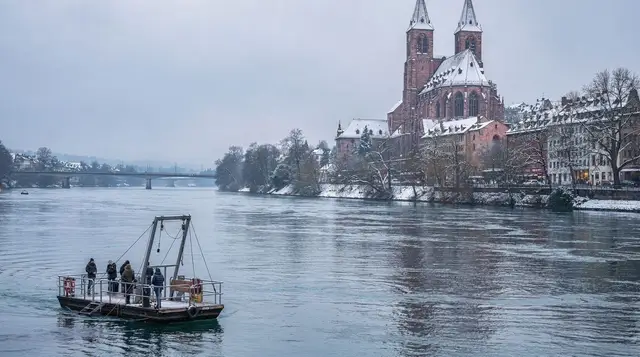
Zug rarely makes anyone’s first Switzerland list. It has no glacier, no Matterhorn view, no UNESCO plaque. What it has is a small, well-kept old town on the shore of a lake that is warmer than most, a clock tower that has been telling the town’s time since the 15th century, and the dubious distinction of being the richest canton in the country by a wide margin.
Low corporate tax rates pulled in commodity traders decades ago, then crypto and blockchain firms more recently — enough that the local press nicknamed the area Crypto Valley. None of that shows on the street. Zug looks like any other tidy lakeside Swiss town of 30,000 people, which is exactly why it is worth an afternoon: it is Switzerland with the tourist infrastructure switched off.
If you are staying in Lucerne, Zug sits on the direct rail line towards Zurich, which makes it an easy add-on rather than a special trip. Combine it with a Zugerberg funicular ride and you have used a day well without queuing for anything.
Getting there from Lucerne
Direct IR and S-Bahn trains connect Lucerne and Zug in 25 to 30 minutes, running roughly twice an hour throughout the day. There is no need to change trains and no need to reserve a seat. From Zurich HB the ride is even shorter, about 25 minutes on the same line, which is why Zug also works as a stop on the way between the two cities rather than a dead-end detour.
The station is a 10-minute walk from the old town and lakefront — flat, signposted, and walkable with luggage if you are passing through rather than basing yourself in Lucerne. Local buses run from the station forecourt if you would rather not walk, and the same ticket that gets you here on a Swiss Travel Pass or a Tell-Pass covers onward travel within the region; see the Swiss Travel Pass guide and the Tell-Pass guide for what each one actually includes before you buy.
| From | Journey time | Typical frequency |
|---|---|---|
| Lucerne | 25–30 min | 2x per hour |
| Zurich HB | 22–27 min | 2–3x per hour |
| Zurich Airport | 40–45 min | 1–2x per hour (change possible) |
| Schwyz | 30–40 min | Hourly, change at Arth-Goldau |
| Basel | 1 h 15–1 h 30 | Hourly, change at Zurich or Olten |
The old town, in the order it actually makes sense
Zug’s old town is small enough to see properly in two hours without rushing, which is part of its appeal after a busier stop like Lucerne or Zurich. Start at the station and walk straight down to the lakefront; from there the old town runs along a single spine of streets parallel to the water.
Kolinplatz is the working heart of the town — a fountain, a scattering of cafe terraces, and the market square feel that most Swiss old towns have lost to traffic. From here, Fischmarkt and the lanes running up towards Kirchenstrasse are lined with the painted facades and oriel windows typical of the region, less photographed than Chapel Bridge in Lucerne but with none of the crowds either.
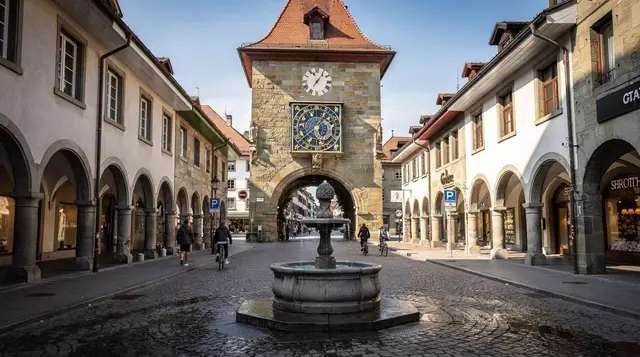
The unmissable landmark is the Zytturm, the town’s clock tower, which anchors the old town’s skyline with a blue-and-white clock face and a roof tiled in the colours of the eight original Swiss cantons. It dates to the 13th century as a fortification tower and only became a clock tower in the 15th, which is a common pattern across this part of Switzerland — defence first, timekeeping later. Local guides point out a hole in the roof tiling, said by legend to be from a cannonball fired during a shooting festival gone wrong; treat that as a good story rather than a documented fact, since the record is thin. You cannot climb the tower, but it is the natural photo point and meeting spot for the old town.
From the Zytturm, the lakeside promenade — Vorstadt and then out towards Landsgemeindeplatz — gives the best water-level view back at the town, with Mount Rigi and, on a clear day, Mount Pilatus visible across the water. This stretch is where locals actually spend their evenings, and it is free.
What to see, roughly in order
| Stop | What it is | Time to allow |
|---|---|---|
| Kolinplatz | Market square, cafes, fountain | 15 min |
| Zytturm | Clock tower, old town landmark | 10 min photo stop |
| Fischmarkt & Kirchenstrasse | Painted old-town facades | 20 min |
| Vorstadt lakeside promenade | Water-level walk, lake views | 30–40 min |
| Kunsthaus Zug | Municipal art museum | 45–60 min |
| Burg Zug | Medieval tower house, local history museum | 30–45 min |
The cake everyone should try once: Zuger Kirschtorte
Zug’s one genuine culinary claim to fame is the Zuger Kirschtorte, a round cake of meringue discs and buttercream soaked generously in kirsch — cherry brandy distilled from the region’s cherry orchards. It was created in 1915 by a local confectioner and has stayed a protected regional specialty since: the name is legally tied to bakeries following the original method, similar to how Champagne is tied to a region in France.
It is not subtle. The kirsch is not a background note, and a slice will taste noticeably alcoholic — worth knowing if you are ordering it for children or driving straight afterwards. Buy a slice rather than a whole cake unless you are catering a group; a full cake typically runs CHF 45–65 depending on size, while a single slice at a bakery cafe is CHF 6–9. The two names most associated with the original recipe are Treichler, baking in Zug since the 1920s, and Speck, both on or just off Kolinplatz. Either is a safer bet than a supermarket version, which tends to be sweeter and less kirsch-forward.
If chocolate rather than cake is more your interest, the wider region around Zug and Lucerne covers that too — see the Swiss chocolate experiences guide for factory visits and tastings, including one that runs directly from Zug:
a private half-day trip from the Zug/Zurich area to the Aeschbach chocolate factory, which is a reasonable way to fill an afternoon if the old town alone feels thin for a full day out.
The Zugerberg: the easy hill
The Zugerberg is the wooded hill directly above the town, reached by a funicular (Zugerbergbahn) running from Schönegg, a short walk or bus ride from the old town. The line dates to 1907, making it one of the older funiculars still running in Switzerland, and the ride itself takes about 8 minutes up a gentle gradient — nothing like the drama of the cog railways up Pilatus or Rigi.
At the top, the payoff is a wide view over the town, the lake, and on clear days a long stretch of the Alps including Pilatus and Rigi from a different angle than you get at lake level. There is a restaurant at the upper station, a short network of easy walking trails suitable for anyone reasonably fit, and in winter a toboggan run that is popular with local families rather than tourists. It is not a hike that needs planning — most visitors are up and back inside two hours including the restaurant stop.
For a longer, more serious day in the hills accessible from the Zug area rather than the summit itself, two guided options run directly from town:
a guided hike through the Mythen region with gondola rides included and a guided ridge walk above Stoos with transport arranged from Zug. Both suit hikers who want the logistics — transport, a guide, route-finding — handled rather than worked out from a timetable, which is otherwise straightforward but adds planning time. See the Stoos and Fronalpstock guide for what the region looks like without a guide, including the world’s steepest funicular.
Crypto Valley, without the hype
Zug’s other reputation is financial rather than scenic. Low cantonal tax rates have drawn commodity trading firms since the 1960s and 70s — Glencore’s roots are here — and more recently a cluster of blockchain and cryptocurrency companies, including the Ethereum Foundation, gave the area its Crypto Valley nickname. The canton was also, briefly, one of the first places in the world where a municipality accepted a cryptocurrency for a small range of official payments.
None of this is visible walking around. Zug does not look like a financial hub; it looks like a lakeside old town with an unusually high density of discreet company nameplates on unremarkable office buildings a few streets back from the water. If the subject interests you beyond a curiosity, a guided walk exists that ties the old town’s landmarks to this more recent history:
a walking tour through Zug’s old town covering the Crypto Valley story, with a Swiss aperitif included. It is a niche pick — skip it if finance and blockchain hold no interest — but it is one of the few structured ways to get context on why a town this size has this much money behind it.
Lake of Zug: swimming, boats, and the quiet shore
The Zugersee is smaller than Lake Lucerne and, in summer, noticeably warmer, which makes it a genuine swimming lake rather than just a scenic backdrop. The public lido (Strandbad Zug) has a lawn, changing facilities, and a snack kiosk, and is free to use outside a small seasonal entry fee at the main bathing area. Locals also swim informally off the Vorstadt promenade and around Landsgemeindeplatz, though the lido has the better facilities for a longer stay.
Passenger boats run on the lake in the warmer months, connecting Zug to smaller lakeside villages including Cham and Arth. It is a shorter, quieter network than the five historic paddle steamers on Lake Lucerne — see the Lake Lucerne paddle steamers guide for that larger network — and worth doing only if you have a full day rather than a quick stop, since the loops run to a leisurely timetable rather than a frequent shuttle service.
Where Zug fits against the rest of Central Switzerland
Zug is not a substitute for a bigger day trip; it is a smaller, lower-key one. If you are choosing where to spend a spare half-day from Lucerne, it helps to know what you are giving up by picking Zug over the more obvious options.
| Compared to | The honest difference |
|---|---|
| Zurich | Zurich has far more to see and do, but Zug is quieter, smaller, and faster to cover in half the time |
| Schwyz and Einsiedeln | Schwyz has the more significant history (the founding document of Switzerland); Zug has the better lakefront |
| Rigi | Rigi is the mountain day out; Zug is the town day out — do both only if you have two full days spare |
| Rapperswil | Rapperswil has a castle and a longer lake promenade; Zug has the cake and the funicular |
If you are building a longer stay rather than a single day trip, see how many days in Lucerne for where a Zug detour fits into a three- to five-day plan, and the day trips from Lucerne overview for how it compares to the region’s other options at a glance.
A private day trip that packages Zug with the surrounding lake villages exists if you would rather not manage the train timetable yourself:
a private day trip from Zurich covering Zug’s old town and Lake Ägeri. It runs from Zurich rather than Lucerne, so check the pickup point matches your base before booking.
Costs on the ground
Zug is not a budget destination, but it is cheaper than Lucerne’s most touristed streets simply because there is less markup aimed at visitors.
| Item | Typical price (CHF) |
|---|---|
| Coffee, sitting down | 4.50–5.50 |
| Slice of Zuger Kirschtorte | 6–9 |
| Lunch, casual restaurant | 22–35 |
| Zugerberg funicular, return | 12–16 |
| Museum entry (Kunsthaus or Burg Zug) | 8–15 |
| Beer, restaurant terrace | 6–8 |
A comfortable half-day covering the old town, a coffee stop, and a slice of Kirschtorte comes to roughly CHF 30–45 per person before transport. Add the Zugerberg funicular and a lunch and a full day sits closer to CHF 70–110, in line with the rest of the region — see Lucerne travel costs for how that compares to prices in Lucerne itself.
A sample half-day and full-day plan
Half day (from Lucerne, back for dinner): Morning train to Zug, old town walk from Kolinplatz to the Zytturm and along Vorstadt, coffee and a slice of Kirschtorte, early afternoon train back to Lucerne. Roughly four hours door to door including travel.
Full day: Same morning route, then the Zugerberg funicular after lunch, an hour or two on the hill with the restaurant stop, back down by mid-afternoon, and a return train that still gets you back to Lucerne in time for dinner. This is the version worth doing if Zug is your only stop that day rather than a stop en route to somewhere else.
Zug frequently asked questions
Is Zug worth visiting from Lucerne?
For a half-day yes, especially if you are already passing through on the Zurich line. It is not worth a special trip on its own if your time in the region is limited to two or three days, when Rigi, Pilatus or Lucerne’s own old town will make better use of the hours.
How do I get from Lucerne to Zug?
Direct trains run about twice an hour and take 25 to 30 minutes; no reservation or change is needed. The Zug train station is roughly a 10-minute walk from the old town and lakefront.
What is Zuger Kirschtorte and where should I try it?
It is a regional cake made from meringue and buttercream soaked in kirsch, cherry brandy distilled locally. Treichler and Speck, both near Kolinplatz, are the bakeries most associated with the original recipe; expect a noticeably alcoholic flavour rather than a mild one.
Why is Zug called Crypto Valley?
Low cantonal tax rates drew commodity trading firms from the 1960s onwards and, more recently, a cluster of blockchain companies including the Ethereum Foundation, giving the canton its nickname. It is a business story rather than a visible landmark — the old town shows no sign of it.
Can you swim in the lake at Zug?
Yes. The public lido, Strandbad Zug, has a lawn and changing facilities for a small seasonal fee, and locals also swim informally along the Vorstadt promenade in summer. The Zugersee runs noticeably warmer than Lake Lucerne.
Is the Zugerberg worth the funicular ride?
For an easy view and an hour or two outdoors, yes — the ride takes about 8 minutes and the gradient is gentle compared with Pilatus or Rigi. It is not a dramatic mountain excursion, more a pleasant local hill with a restaurant and short walking trails.
How much does a day in Zug cost?
Budget roughly CHF 30–45 for a half day covering the old town and a cafe stop, or CHF 70–110 for a full day including the Zugerberg funicular and lunch, broadly in line with other Central Switzerland day trips.
Should I combine Zug with another destination in one day?
It is possible given the short train times, but it makes for a rushed day. Zug pairs more comfortably with a relaxed half-day than as one stop among several, since its appeal is the unhurried pace rather than a checklist of sights.
faq:
- question: “Is Zug worth visiting from Lucerne?” answer: “For a half-day yes, especially if you are already passing through on the Zurich line. It is not worth a special trip on its own if your time in the region is limited to two or three days, when Rigi, Pilatus or Lucerne’s own old town will make better use of the hours.”
- question: “How do I get from Lucerne to Zug?” answer: “Direct trains run about twice an hour and take 25 to 30 minutes; no reservation or change is needed.
The Zug train station is roughly a 10-minute walk from the old town and lakefront.”
- question: “What is Zuger Kirschtorte and where should I try it?” answer: “It is a regional cake made from meringue and buttercream soaked in kirsch, cherry brandy distilled locally. Treichler and Speck, both near Kolinplatz, are the bakeries most associated with the original recipe; expect a noticeably alcoholic flavour rather than a mild one.”
- question: “Why is Zug called Crypto Valley?” answer: “Low cantonal tax rates drew commodity trading firms from the 1960s onwards and, more recently, a cluster of blockchain companies including the Ethereum Foundation, giving the canton its nickname.
It is a business story rather than a visible landmark, and the old town shows no sign of it.”
- question: “Can you swim in the lake at Zug?” answer: “Yes. The public lido, Strandbad Zug, has a lawn and changing facilities for a small seasonal fee, and locals also swim informally along the Vorstadt promenade in summer. The Zugersee runs noticeably warmer than Lake Lucerne.”
- question: “Is the Zugerberg worth the funicular ride?” answer: “For an easy view and an hour or two outdoors, yes: the ride takes about 8 minutes and the gradient is gentle compared with Pilatus or Rigi.
It is not a dramatic mountain excursion, more a pleasant local hill with a restaurant and short walking trails.”
- question: “How much does a day in Zug cost?” answer: “Budget roughly CHF 30 to 45 for a half day covering the old town and a cafe stop, or CHF 70 to 110 for a full day including the Zugerberg funicular and lunch, broadly in line with other Central Switzerland day trips.”
- question: “Should I combine Zug with another destination in one day?” answer: “It is possible given the short train times, but it makes for a rushed day. Zug pairs more comfortably with a relaxed half-day than as one stop among several, since its appeal is the unhurried pace rather than a checklist of sights.”