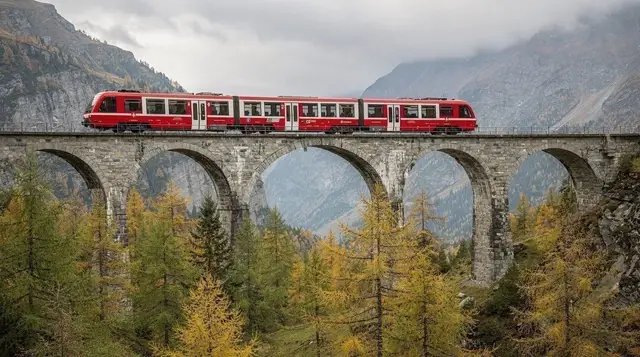
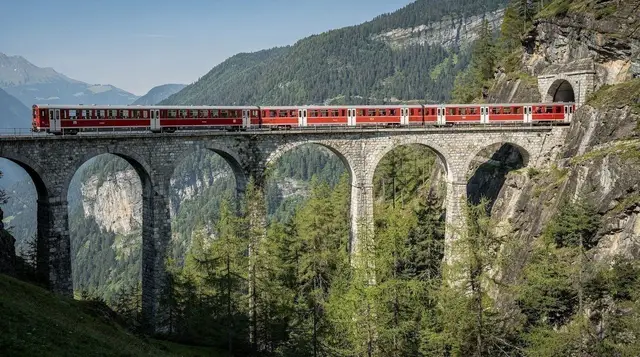
Why Swiss trains run on time
The first time I noticed it, I was standing on platform 3 at Luzern Bahnhof watching a woman finish a phone call, snap her suitcase shut, and step onto a train that pulled out ten seconds later. Not because she was lucky. Because the train was always going to leave at :04, and she knew it, the way you know your alarm goes off at seven.
The same minute, every hour, all year
Switzerland runs on what it calls the Taktfahrplan, a clockface timetable. If a train leaves Lucerne for Zurich at 09:04, it also leaves at 10:04, 11:04, and every hour after that, every day of the year bar a handful of engineering closures. You do not check a timetable app so much as memorise a single number. I have taken the 45-to-60-minute run to Zurich often enough that I know the departure minute better than my own train’s platform back home.
This is not an accident of scheduling software. It is the organising principle of the whole network, and it is worth reading how Swiss trains actually work before you build a trip around it, because the logic runs backwards from what most visitors expect: the timetable is fixed first, and the infrastructure is built to make it possible, not the other way round.
Connections are guaranteed, not hoped for
The part that actually changes a trip is the connection, not the train itself. Swiss planners build stations so that a train arriving at :56 meets its connection departing at :04, on the same platform or the platform directly opposite, giving you a genuine four to eight minutes rather than a sprint across a footbridge. At a junction like Arth-Goldau, changing for Rigi, or at Brunnen for the lake, this is engineered down to the minute, not left to chance.
It is why a Swiss Travel Pass or a Tell-Pass itinerary that looks absurdly tight on paper, a train, then a boat, then a cogwheel railway, all in one afternoon, works in practice. I have made a connection with 90 seconds spare at Vitznau, boat gangway to cogwheel carriage, and not once has that felt reckless. Read the Swiss Travel Pass guide before you plan a day like that, because the pass only pays off if you actually use the connections it is built around.
| Connection type | Typical scheduled gap | How tight it feels |
|---|---|---|
| Train to train, main hub (Lucerne, Zurich, Bern) | 4–8 minutes | Comfortable, same or opposite platform |
| Train to boat, lakeside station | 5–15 minutes | Easy, boat pier is usually steps away |
| Train to cogwheel railway (Rigi, Pilatus) | 6–20 minutes | Comfortable outside peak season |
| Regional branch line, off-peak | Up to 60 minutes if missed | The one to plan around |
What eight minutes actually buys you
On a trip to Interlaken last spring, I watched the return connection at Meiringen: a mountain train pulled in four minutes late, and the platform announcement calmly told the waiting service to hold. It did, for exactly as long as needed, no longer. That short hold is not generosity. SBB’s own punctuality reporting sits around 90 to 93 percent of trains within three minutes of schedule, and the whole system is tuned to protect the connection over the individual train’s arrival time.
For someone building a day trip from Lucerne, this changes what is actually feasible in a day. A loop that takes in the Luzern–Interlaken Express, a boat back across the lake, and dinner in the old town by seven is not an optimistic plan, it is a normal Tuesday.
The same logic underpins routes like the Glacier Express, the Gotthard Panorama Express, and the GoldenPass Line, each one is a chain of guaranteed connections dressed up as a single scenic journey. If you would rather have someone else manage the changeovers on the Glacier Express corridor, the day tour from Basel through the Alps to Lucerne runs the whole connection chain for you.
Where the system is weaker
It is not flawless everywhere. On single-track branch lines and the smaller mountain services, a missed connection has real consequences, sometimes a 30- to 60-minute wait rather than a four-minute one. Heavy snow, a signal fault near Basel, or engineering works on a weekend can ripple through the network faster than you would expect from a country with this reputation. I always check how the lake boat timetables interact with the trains before relying on a same-day return by the last sailing, because boats run less frequently than trains and the last one does not wait.
Cable cars and cogwheel railways add their own variable: they close for maintenance in spring and autumn, and if I am planning around Rigi or a Pilatus ascent, I check operating dates first, not the train timetable. A perfectly timed connection to a closed railway station buys you nothing.
Why it matters if you are staying in Lucerne
Lucerne sits close to the centre of this network, which is one of the quieter reasons it works so well as a base. Zurich is 45 minutes to an hour away, Bern about an hour, Basel around an hour and fifteen, Engelberg 45 minutes. None of these require a strategy, just a memorised departure minute and a coffee at the station.
Where the Taktfahrplan actually earns its keep is on the mountain days. A trip up Pilatus, whether on the cogwheel railway from Alpnachstad or the cable car from Kriens, or a cheese-and-glacier day near Titlis, depends on train, cable car and, sometimes, a boat all meeting within minutes of each other, more than once in a day.
If you would rather have a guide managing that chain, both the guided ascent of Mt Pilatus and the Titlis and Furenalp cheese-making day take that logistics problem off your hands entirely. For an afternoon that swaps trains for water, a private cruise on Lake Lucerne runs to its own schedule rather than the network’s, which is its own kind of relief after a few days of minute-counting.
None of this is charm for its own sake. It is what lets you fit a proper day trip, out and back, mountain or lake included, into the time most visitors would spend just getting somewhere and hoping the connection holds. Once you trust the minute on the board, you stop watching the clock and start watching the scenery.
Scenic train tours on GetYourGuide
Verified deep-linked GetYourGuide tours. Book through these links and we earn a small commission at no cost to you.
GetYourGuide does not provide a product photo for this activity — the image shows the meeting point, photographed by us.