Lake Lucerne boat timetables explained
How do Lake Lucerne boat timetables work?
The fleet runs a summer timetable (roughly April to October) with departures every 30-60 minutes on the main routes, and a much thinner winter timetable with a handful of daily crossings. The Swiss Travel Pass and Tell-Pass cover regular scheduled sailings; the Half Fare Card and Saver Day Pass cut the fare but don't make it free.
Lucerne’s boat timetable looks straightforward until you’re standing at the pier in November wondering why the next sailing isn’t for another hour and forty minutes. The Lake Lucerne fleet runs on a genuinely seasonal schedule, not a fixed year-round pattern, and the routes that connect to the mountains behave differently from the routes that just potter along the shore. This is what the timetable actually contains, how to read it, and which routes matter if you’re heading up Pilatus or Rigi rather than just going for a scenic cruise.
The two timetables: summer and winter
There isn’t one Lake Lucerne timetable, there are two, and the gap between them is large. From roughly April to October, the main routes run every 30 to 60 minutes through the day, with extra evening sailings in July and August. From November to March, most routes drop to two or three round trips a day, and some side branches stop running altogether until spring. The exact changeover dates shift by a couple of weeks each year depending on the operator’s published schedule, so the rule that matters is: check the current timetable before you plan a day around a specific departure, especially outside June to September.
This matters more on Lake Lucerne than on, say, Lake Zurich, because several of the lake’s must-do connections — the boat-to-cogwheel-railway link to Pilatus, the boat-to-cable-car link to Rigi — only work if a sailing lines up with the mountain departure. Miss the boat in winter and you might be looking at a two-hour wait, not a twenty-minute one.
The five paddle steamers, and why the boat type matters
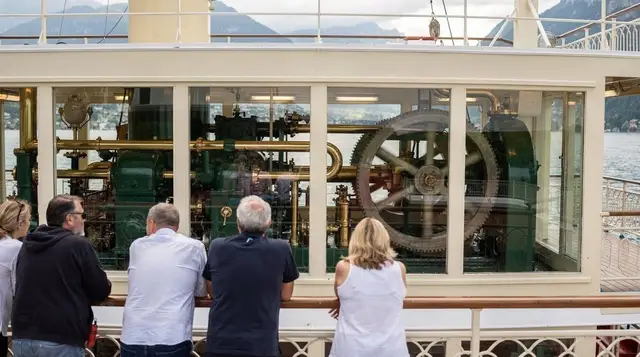
Five historic paddle steamers work the lake alongside a larger fleet of modern motor vessels. The paddle steamers are the ones on the postcards — coal or oil-fired originally, now oil-fired or converted, with the walking beam engine visible through a glass panel on deck — and they’re genuinely part of the experience, not just transport. They’re also slower than the motor vessels: a paddle steamer’s higher profile catches more wind, and the older machinery simply doesn’t move the boat as fast over the same stretch of water.
For a leisurely cruise this doesn’t matter. For catching a specific train at Brunnen or a specific cable car up at Vitznau, it can. The timetable usually shows which vessel is assigned to each sailing, so if a connection is tight, check whether you’ve been put on a paddle steamer before assuming the crossing time quoted for the route in general still applies.
Reading the route map
The lake has a rough Y-shape with three arms, and the timetable is built around a handful of core lines rather than one loop:
| Route | Typical crossing time | Why you’d take it |
|---|---|---|
| Lucerne — Weggis — Vitznau | 50-70 min to Vitznau | Rigi cogwheel railway (Vitznau) or cable car (Weggis) |
| Lucerne — Alpnachstad | around 90 min | Pilatus cogwheel railway |
| Lucerne — Brunnen — Flüelen | 2-3 hours to Flüelen | Rütli meadow, Tell country, the full length of the lake |
| Lucerne — Bürgenstock (Kehrsiten) | around 30 min | Bürgenstock resort and the Hammetschwand lift |
| Lucerne short round trips | 1-2 hours | No destination, just the lake |
The Vitznau/Weggis line is the busiest and most frequent because it’s the direct route to Rigi. The Alpnachstad line for Pilatus runs less often and is worth checking carefully in shoulder season. The full-length run to Flüelen is the scenic showpiece, past Bürgenstock, Brunnen and the Rütli meadow, but it’s a half-day commitment each way if you don’t plan a train back.
Connecting to the mountains
Boats and mountain railways on Lake Lucerne are designed to connect, but the connection is a timetable match, not an automatic transfer — you still need to be on the right sailing.
For Pilatus, the boat goes to Alpnachstad, where the pier sits close to the base station of the world’s steepest cogwheel railway, the one that climbs at up to 48%. That railway only runs from roughly May to November depending on snow, so a winter visit to Pilatus means going up by the Kriens cable car instead, which runs year-round; the boat-and-cogwheel combination — sometimes sold as the “Golden Round Trip” — only works outside the cogwheel’s closed season.
For Rigi, there are two approaches from the water: Vitznau, for the older and more famous cogwheel line, and Weggis, for the cable car up to Rigi Kaltbad. Both sit on the same eastern-shore route out of Lucerne, so the choice is really about which side of the mountain you want to come down.
Both mountain railways close for scheduled maintenance in spring and again in autumn, on top of any snow-related closures. That’s the detail that ruins the most days on this lake — someone plans a boat-and-mountain combination for a week in April or November without checking, and finds the railway shut. Always check the mountain’s own operating dates alongside the boat timetable before committing to a combined day.
Tickets and which pass actually covers the boat
This is where people overpay or, less often, get caught without a valid ticket.
- Swiss Travel Pass: covers regular scheduled sailings on the standard timetable, paddle steamers included. It does not cover special cruises — evening jazz sailings, dinner cruises, themed events — which are ticketed and often bookable separately.
- Half Fare Card: cuts the standard fare roughly in half; you still pay for the crossing.
- Saver Day Pass: a one-day ticket bought in advance at a lower price than buying on the day; works well if boats are the only thing on the agenda.
- Tell-Pass: the regional pass covering Central Switzerland — Lucerne, the lake, and the surrounding mountains including Pilatus and Rigi — bundles boats and mountain transport together for a set number of days, and is usually the better value if you’re doing both a boat and a cogwheel railway on the same trip.
- Lucerne guest card: covers city buses (VBL) in Lucerne itself, not the lake boats. Don’t assume it extends to the water; it doesn’t.
None of these passes need advance booking for the standard timetable — you board with a valid pass or buy a ticket at the pier kiosk or machine. Reservations only come into play for the special cruises, a private charter, or a table on a dinner sailing.
Building a day around the timetable, not against it
The mistake that costs people the most time isn’t picking the wrong route, it’s picking a departure without checking whether the season supports the frequency they’re assuming. A few working patterns:
Pilatus day, summer: an early boat to Alpnachstad, the cogwheel railway up, the cable car down to Kriens, bus back into town. This only works May to November while the cogwheel line is running; check dates before booking anything else around it.
Rigi day, any season: boat to Vitznau or Weggis, up by cogwheel or cable car, back the same way or via the other side and a bus. The cable car options here have more year-round resilience than the Pilatus cogwheel, which makes Rigi the steadier winter choice of the two.
Full-lake cruise: Lucerne to Flüelen and back, or one-way with a train back from Flüelen or Brunnen — check the return train timetable before boarding, since a late boat can miss the last convenient connection back to Lucerne.
Short evening loop: a one-hour round trip with no destination, useful when the weather’s good and you don’t want to commit half a day. These run most frequently in the peak summer timetable and barely exist in winter.
For a private version of any of these — no timetable at all, just your own schedule — a private luxury boat cruise on Lake Lucerne sidesteps the whole question, at a price that reflects it. There’s also a smaller private boat tour departing from Lucerne itself for a shorter, less expensive version of the same idea.
If the boats are one piece of a wider transport plan across the region, it’s worth working out the maths on a Swiss Travel Pass covering unlimited train, bus and boat travel before buying single tickets — see the Swiss Travel Pass guide and the Tell-Pass guide for the side-by-side numbers, since which one wins depends entirely on how many mountain trips are on the itinerary.
When the timetable isn’t the right tool
Not every way to see the lake needs a fixed departure time. An e-bike route around four lakes paired with a Lake Lucerne cruise replaces most of the boat legs with cycling and only uses the water for the parts worth sailing. It’s a different kind of day, and one where the seasonal boat schedule matters much less.
Practical notes for the pier
Boats board from the numbered piers along the Lucerne waterfront, next to the Bahnhof, and departure boards at each pier show the next few sailings with their destination and vessel type. Printed timetables are available at the ticket office and worth picking up if a day involves more than one connection, since checking a phone with patchy signal partway up a mountain is a poor substitute. Boats board a few minutes before departure and leave on time — Swiss punctuality applies on the water as much as on the trains — so treat the printed time as the moment the gangway lifts, not a rough guide.
For background on the fleet itself, including the individual paddle steamers and their history, see the Lake Lucerne paddle steamers guide and the broader Lucerne boat trips guide.
For the mountains at the other end of these routes, the Mount Pilatus guide, Mount Rigi guide and Pilatus vs Rigi vs Titlis comparison cover which one suits a given day better. Bürgenstock and the Hammetschwand lift and the best mountain excursions from Lucerne round out the options beyond the two headline peaks.
If two days in Lucerne need to fit in a lake crossing alongside the old town and a mountain, the two-day Lucerne itinerary sequences it sensibly. And for a sense of what an ordinary crossing actually feels like off-peak, a morning on the Rigi, riding the world’s steepest funicular and the quiet shore of Lake Lucerne are worth a read before you go.
Lake Lucerne boat timetable questions
Does the Swiss Travel Pass cover all Lake Lucerne boats?
It covers regular scheduled sailings on the standard routes, including the paddle steamers. It does not cover special evening cruises, dinner cruises, or chartered private boats, which are sold and ticketed separately.
Do I need to book Lake Lucerne boats in advance?
No booking is needed for the scheduled timetable services; you buy a ticket at the pier or use a valid pass and board directly. Reservations only apply to themed cruises, gala dinners, or a private charter.
How often do boats run in winter?
From November to March the timetable drops to a fraction of the summer frequency, often two or three round trips a day on the main line and none at all on some side routes. Always check the current published timetable before planning a winter day around a boat.
Which boat do I take for Mount Pilatus from Lucerne?
Take the boat to Alpnachstad, at the southern end of the lake, then connect directly onto the Pilatus cogwheel railway at the pier. The classic “Golden Round Trip” combines this outbound sailing with the cable car down through Kriens on the return.
Which boat do I take for Mount Rigi from Lucerne?
Sail to Vitznau for the Rigi cogwheel railway, or to Weggis for the cable car up to Rigi Kaltbad. Both piers sit on the same eastern-shore route and both connect to Rigi Kulm from different sides of the mountain.
Are the paddle steamers slower than the motor vessels?
Yes, noticeably. A paddle steamer crossing takes longer than the equivalent run on a modern motor vessel because of the older engines and a taller silhouette that catches more wind, so check which vessel type is running if a specific train or cable car connection is tight.
Can I just turn up at the pier without checking the timetable first?
In peak summer on the main Lucerne-Vitznau-Weggis line, yes, departures are frequent enough. On any other route, or outside June to September, turning up without checking is how people end up waiting 90 minutes on a cold pier.
Lake cruises & boat tours on GetYourGuide
Verified deep-linked GetYourGuide tours. Book through these links and we earn a small commission at no cost to you.
GetYourGuide does not provide a product photo for this activity — the image shows the meeting point, photographed by us.