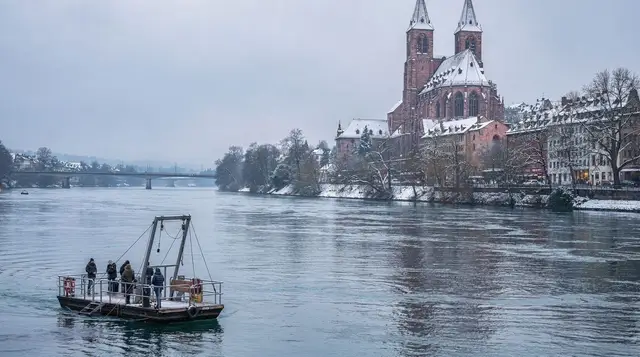
Most people who visit Winterthur do it by accident, on the way to somewhere else, and never get off the train. That is the town’s whole reputation problem: it sits twenty minutes past Zurich on lines heading to Schaffhausen, Romanshorn and St Gallen, close enough to feel like an afterthought and just far enough that almost nobody detours for it. It deserves better than that.
Winterthur was Switzerland’s industrial powerhouse for a century — the Sulzer engineering works built locomotives, diesel engines and textile machinery here that were shipped worldwide — and the money that industry generated bought some of the best privately assembled art in the country, most of it later given to the public. What is left is an unusual combination: a hands-on science centre that is the biggest of its kind in Switzerland, and art collections that punch well above what a town of 115,000 people has any right to hold.
This is not a lake, a mountain or a gorge, so it will not suit everyone doing a first trip through central Switzerland. It suits people whose interests run to science, engineering, painting or industrial history, and who are happy to spend a full day indoors regardless of the weather.
Why bother going past Zurich
The short answer is the Technorama and the Oskar Reinhart collections, neither of which has an equivalent in Zurich itself. Zurich has excellent museums — the Kunsthaus chief among them — but Winterthur’s Technorama is a different category of attraction: a genuine science centre built around several hundred hands-on experiments, not a collection of objects behind glass. And the two Oskar Reinhart houses hold works by Manet, Renoir, Cézanne, Van Gogh and Hodler that a private collector assembled over decades and then gave, complete, to the Swiss confederation and the city. You see them exactly as Reinhart hung them, in his own former home, rather than reorganised into a generic museum layout.
The trade-off is travel time. From Lucerne this is genuinely a long day: reckon on 1 h 10 to 1 h 25 each way once the change in Zurich is factored in, so 2 h 20–2 h 50 on trains alone. That is longer than the Rhine Falls or a straight Zurich day trip, both of which sit closer to Lucerne. Winterthur only earns that extra time if the Technorama or the art collections are actually things you want to see, not a box to tick.
Technorama: Switzerland’s largest science centre
The Technorama sits in the Grüze district, about a 15-minute walk or a short bus ride (line 3) from Winterthur station, in a large purpose-built hall. It is organised around themed areas — mechanics, electricity and magnetism, textiles, the human body, natural phenomena — and almost everything is designed to be touched, cranked, pumped or triggered rather than read about. Expect queues at the more theatrical stations (the giant soap-bubble frame, the tornado generator, the high-voltage demonstrations that run on a schedule through the day) but plenty of quieter corners where you can work through an exhibit at your own pace.
Adult entry runs around CHF 36, with reduced rates for young people and free entry for small children; a family ticket brings the per-person cost down noticeably if there are two adults and children in the group. Budget at least two and a half hours if you want to see more than a fraction of it — families with engaged children often spend the whole day. The high-voltage and physics demonstrations run at fixed times, posted at the entrance, and are worth planning your visit around rather than discovering by chance. The gift shop and café are unremarkable; eat in town rather than on-site if you have the choice.
a guided walk through the Sulzerareal district is a useful way to understand what the Technorama’s home city actually made before it made museums — the science centre itself sits close to where much of that engineering history played out.
The Oskar Reinhart collections and Kunstmuseum Winterthur
Oskar Reinhart, a Winterthur trader who inherited his family’s business, spent the first half of the twentieth century buying art with genuinely good judgement and no interest in showing off. He kept two separate collections.
The Sammlung Oskar Reinhart am Römerholz, in his former villa on the edge of town (a 15–20 minute walk or short bus ride from the station, up through vineyards), holds Old Masters alongside French Impressionists and Post-Impressionists — Cézanne, Renoir, Manet, Courbet, Van Gogh — hung in domestic rooms rather than a purpose-built gallery. The Museum Oskar Reinhart am Stadtgarten, in the town centre, is smaller and focused on Swiss and German-speaking art of the eighteenth to twentieth centuries, including a strong run of Hodler.
Several of Winterthur’s principal museums, including both Oskar Reinhart houses and the Kunstmuseum Winterthur, offer free entry to their permanent collections, with charges applying only to temporary exhibitions — a genuinely unusual arrangement in Switzerland and one that makes a museum-focused day here considerably cheaper than the same day in Zurich or Basel. The Kunstmuseum itself, split across two nearby buildings, covers a broader sweep of nineteenth- and twentieth-century art, including a well-regarded concrete and abstract art holding. The Fotomuseum Winterthur, a separate institution with a serious international reputation for photography, does charge for entry but is worth the detour for anyone with an interest in the medium.
Realistically, fitting both Oskar Reinhart houses and the Kunstmuseum into one day alongside the Technorama is too much. Most visitors pick either the science centre or the art (rarely both in full) and treat the other as a reason to come back.
The Sulzerareal: from steam engines to street life
Sulzer was, at its peak, one of the largest engineering employers in Switzerland, building steam and diesel engines, textile machinery and eventually aircraft engines from a sprawling works north of the old town. Production wound down through the late twentieth century, and the old halls have been repurposed rather than demolished — a rare example of a Swiss industrial site being adapted rather than flattened. The Lokstadt development, the Gaswerk theatre, Halle 53 and several converted engineering sheds now hold restaurants, a cinema, offices and event spaces, and you can walk the site freely to see how the conversion was done. It is not a museum and there is no single ticket or entrance; it rewards an unhurried walk more than a checklist.
a guided walk through Winterthur’s old town is a sensible way to link the Sulzerareal, the medieval core and the museum quarter into one route without doubling back, particularly on a first visit when the town’s layout is not obvious from the station forecourt.
The old town itself
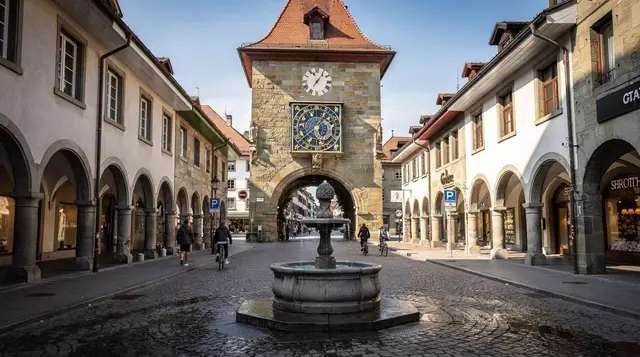
Winterthur’s Altstadt is small — you can walk its full length along Marktgasse and Obertor in under fifteen minutes — but well kept, with the oriel windows (Erker) on its patrician houses giving it a distinct look you will not see in Lucerne. The Stadtkirche’s twin towers dominate the skyline from most approaches. There is no lake, no covered bridge and no equivalent of the Musegg wall, so keep expectations realistic: this is a pleasant half-hour to an hour of wandering and a place to eat lunch, not a rival to Lucerne’s old town on its own terms.
Getting there from Lucerne
| Leg | Typical duration | Notes |
|---|---|---|
| Lucerne → Zurich HB | 45 min–1 h | Direct IC/IR services, roughly every 30 min |
| Zurich HB → Winterthur | 20–25 min | Frequent IC/S-Bahn connections, several per hour |
| Winterthur station → Technorama | 15 min walk or bus 3 | Signposted from the station |
| Winterthur station → Römerholz | 15–20 min walk or bus 2/5 | Uphill; bus is easier after a museum day |
A Swiss Travel Pass or Half Fare Card covers this route the same way it covers any other domestic rail journey — there is nothing Winterthur-specific to buy. If you are unsure which pass suits a trip like this one, the general Swiss Travel Pass guide and the broader explainer on how Swiss trains work cover the mechanics; getting around Lucerne itself is a separate, shorter question.
Anyone starting the trip straight from the airport rather than a Lucerne hotel should check the Zurich airport to Lucerne route first, since it shares the same Zurich HB interchange.
What a Winterthur day actually costs
| Item | Typical cost (CHF) |
|---|---|
| Return rail, Lucerne–Winterthur (no pass) | 90–110 |
| Technorama adult entry | ~36 |
| Oskar Reinhart houses, Kunstmuseum permanent collections | Free |
| Lunch, mid-range | 22–30 |
| Coffee and a snack | 8–12 |
| Local bus (single or day ticket) | 4–9 |
The free permanent-collection entry at the art museums is the one genuine bargain here; the Technorama is the one real expense, and it is worth it if hands-on science is why you are going in the first place.
A practical one-day plan
Take an early train so you are in Winterthur by mid-morning. Science-focused visitors should go straight to the Technorama and give it the whole morning and into early afternoon, then walk the old town and Sulzerareal on the way back to the station, stopping at the Kunstmuseum only if time allows. Art-focused visitors should start with the Museum Oskar Reinhart am Stadtgarten in the centre, walk or bus up to the Römerholz for early-to-mid afternoon, then loop back through the old town for a late lunch or coffee before the train home. Trying to do both the Technorama and both Oskar Reinhart houses properly in one day from Lucerne is not realistic once travel time is counted — pick a focus rather than rushing all of it.
Families travelling with children under about eight should weight the day heavily towards the Technorama; the art collections, while excellent, are quiet, contemplative spaces that do not hold younger children’s attention the way hands-on science does.
Where Winterthur fits against other day trips from Lucerne
Winterthur is not a substitute for the classic day trips from Lucerne — it does not compete with the Rhine Falls for scenery, or with St Gallen for a single outstanding sight you can see quickly. It is a longer, more specialised trip that suits repeat visitors to the region or travellers with a specific interest in science or art museums.
If you are choosing a single further excursion beyond the standard list of day trips from Lucerne, ask honestly whether the Technorama or the Oskar Reinhart paintings are things you would go out of your way for at home — if the answer is yes, the travel time is worth it; if not, put the day towards somewhere closer.
For a broader sense of how a Zurich-region base compares with staying in Lucerne, the Lucerne versus Zurich comparison covers the wider trade-offs, and travellers building a longer central-Switzerland itinerary can see where a day like this sits within a full three-day Lucerne itinerary.
Museum-focused travellers passing back through Zurich on the way home might also glance at the city’s own museums and art listings, or, for a lighter finish to the day before the train back, the wider day-trips category for what else sits within reach of Zurich HB — including a short stop for Rapperswil on the lake if you have energy left, or a look at Stein am Rhein’s painted old town, both of which pair more naturally with a shorter Zurich day than with Winterthur’s museums.
a guided bike tour of Zurich is worth considering if you build in an hour or two in Zurich itself either side of the Winterthur leg, rather than treating the interchange purely as a place to change platforms.