Lauterbrunnen's 72 waterfalls: Staubbach, Trümmelbach and when to see them
When do Lauterbrunnen's waterfalls run strongest?
Glacier-fed falls like Trümmelbach peak in July and August, when snowmelt is at its height and flow can be ten times what it is in winter. Staubbach, fed by rain and a small catchment above the cliff, is more erratic and can run dry in a hot, dry spell even in midsummer.
A glacial trench with water coming off every ledge
Lauterbrunnen sits in a U-shaped trough carved by glaciers, with near-vertical limestone walls rising 500 metres on either side of a flat, green valley floor. Every ledge and hanging side-valley on those walls sheds water somewhere, which is how the village ended up with its count of 72 waterfalls — some permanent and glacier-fed, most seasonal trickles that come and go with the weather. Two are worth planning a visit around: Staubbach Falls, which drops straight into the village, and Trümmelbach Falls, a series of ten waterfalls hidden inside the mountain a short way up the valley. They behave completely differently, and knowing why changes how you time the trip.
The village itself is straightforward to reach and easy to walk around in an afternoon; for the wider question of how to fit it into a Lucerne-based trip, see day trips from Lucerne or the dedicated Interlaken day trip guide, since most travellers approach the valley from there rather than from Lucerne direct.
Staubbach Falls: the one you see without leaving the village
Staubbach Falls drops 297 metres off the cliff directly above Lauterbrunnen’s main street, close enough that spray reaches the road on a windy day. It’s one of the highest freestanding waterfalls in Europe, and it’s free to view — you don’t need a ticket, a bus, or more than ten minutes’ walk from the train station.
The catch is that Staubbach isn’t glacier-fed. It’s a rain- and snowmelt-fed stream draining a relatively small catchment above the cliff edge, so its flow swings with recent weather rather than the season as a whole. After heavy rain or during the spring melt it’s a proper roaring curtain of water; in a dry, hot stretch of July it can thin to a wisp that barely reaches the ground, drifting sideways in the wind before it gets there — which is where the name comes from (“Staub” is German for dust). If you’re passing through on a clear, dry week, don’t be surprised if it’s underwhelming; check it again after the next rainy day and it can look completely different.
There’s a viewing platform partway up the cliff reached by a steep path and steps, giving a closer look and a view back down the valley, but most visitors are satisfied with the view from the village.
Trümmelbach Falls: ten waterfalls inside the mountain
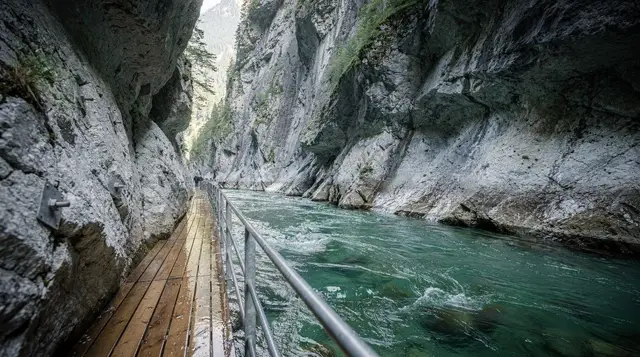
Trümmelbach Falls is the reason to actually plan a half-day around Lauterbrunnen’s water rather than just glancing up at Staubbach on the way through. It’s a series of ten glacier-fed waterfalls that carry meltwater from the Eiger, Mönch and Jungfrau down through a gorge cut inside the mountain, and a funicular lift takes visitors up through tunnels to a series of galleries and platforms beside the falls themselves. The largest chamber holds a genuinely loud, close-up waterfall — enough spray reaches the platform that a light jacket is worth having even on a warm day.
It’s a paid site, roughly CHF 14 for an adult ticket (check current pricing on-site, as it’s adjusted most seasons), and it’s only open from spring to autumn — typically April or May through late October or early November — because the tunnels and lift need to be shut down and re-checked over winter. Outside those months there’s no way in.
| Staubbach Falls | Trümmelbach Falls | |
|---|---|---|
| Cost | Free | Paid, around CHF 14 |
| Open | Year-round, always visible | April/May–October/November only |
| Water source | Rain and local snowmelt | Glacier meltwater (Eiger, Mönch, Jungfrau) |
| Visit length | 10–15 minutes | 45 minutes–1 hour |
| Access from village | On foot, 10 minutes | Bus or 45-minute walk further up the valley |
Because Trümmelbach draws on glacier ice rather than rainfall, it very rarely runs dry — even in a dry week its flow stays strong, which makes it the more reliable option if the weather has been unhelpful.
When the falls run strongest
Glacier-fed and rain-fed waterfalls peak at different times, which is worth knowing before you build a trip around them.
| Period | Trümmelbach (glacier-fed) | Staubbach (rain-fed) |
|---|---|---|
| April–May | Rising as snowmelt begins | Strong with spring snowmelt |
| June–July | Near peak, heavy glacier melt | Variable, depends on rainfall |
| August | Peak flow of the year | Variable, often thin in dry spells |
| September | Still strong, tapering | Picks up with autumn rain |
| October–November | Falling off, site closing for the season | Variable |
| Winter | Site closed | Can freeze into ice formations |
If the goal is to see Trümmelbach at its most dramatic, aim for late July or August. If Staubbach is the priority, watch the forecast rather than the calendar — a wet week in any season beats a dry one, and the valley gets noticeably quieter with fewer coach groups outside the July–August peak.
Other waterfalls in the valley worth a detour
Beyond the two headline falls, a walk up the valley floor passes several more worth a glance, even if none justifies its own separate trip the way Trümmelbach does.
Mürrenbach Falls, near the hamlet of Stechelberg at the head of the valley, is actually the highest single-drop waterfall in the valley at around 400 metres, fed by glacier meltwater off the Mürren side — it’s often overlooked because it’s further out and less publicised than Staubbach, but it’s visible from the road with no detour needed. Schmadribach Falls, higher up towards the Rottal glacier, is reachable only on foot and is for hikers already tackling routes toward Mürren and the Schilthorn rather than a casual visit.
For a wider view of the valley’s glacier-fed falls set against the peaks above, the cable car up to Schilthorn or the train toward Jungfraujoch both give a top-down perspective that puts the waterfalls in context — you can see exactly which glaciers and snowfields are feeding the falls you walked past at valley level.
Getting to the falls from Lucerne and Interlaken
Lauterbrunnen isn’t directly on the Lucerne–Interlaken line, so plan on a change at Interlaken Ost. From Lucerne, the Brünig line to Interlaken Ost takes around 1 hour 50 minutes; from there it’s a short connecting train of about 20 minutes further to Lauterbrunnen itself, so budget roughly 2 hours 15 minutes to 2 hours 30 minutes door to door, depending on the connection.
| From | To Lauterbrunnen | Notes |
|---|---|---|
| Lucerne | ~2h15–2h30 | Change at Interlaken Ost |
| Interlaken Ost | ~20 minutes | Direct train, frequent |
| Interlaken village (West) | ~25 minutes | Via Interlaken Ost |
Once in Lauterbrunnen, Staubbach Falls is a walk from the station. Trümmelbach Falls is about 3 kilometres further up the valley — reachable by local bus in around 10 minutes, or on foot along the flat valley floor in 45 minutes to an hour, which is a pleasant enough walk on a clear day with the cliffs on both sides.
The Swiss Travel Pass covers the train journey and the local valley bus, but not the Trümmelbach entrance fee, which is a separate ticket. If your visit is timed for winter, note that this is also ski country — see skiing day trips from Lucerne if you’re combining the valley with a snow trip, though Trümmelbach itself will be closed.
Walking the valley floor
The flat valley floor between Lauterbrunnen village and Stechelberg is one of the easier proper walks near Lucerne’s day-trip range, gaining almost no altitude while still delivering constant waterfall and cliff views.
| Section | Distance | Time (one way) | Terrain |
|---|---|---|---|
| Lauterbrunnen to Trümmelbach | ~3 km | 45–60 minutes | Flat, paved and gravel path |
| Trümmelbach to Stechelberg | ~2 km | 30–40 minutes | Flat, quiet road and path |
| Full valley floor return | ~10 km | 3–3.5 hours | Flat throughout |
For anyone wanting more elevation, cable cars from Stechelberg and Lauterbrunnen connect up to Mürren and Gimmelwald, both car-free villages perched on the opposite cliff edge; that’s covered in more detail under best hikes near Lucerne, which lists routes across the wider region rather than the valley floor alone.
Where a guided tour actually helps
None of this requires a guide — the valley floor is flat, well signed, and the bus to Trümmelbach is simple to use on your own. Where a tour earns its cost is combining the waterfalls with something you couldn’t easily arrange solo, or covering more ground in a single day if you’re based in Lucerne rather than Interlaken.
An e-bike route through the valley past its waterfalls covers more of the 72 falls in a morning than most people manage on foot, useful if time is tight. For a more active day, a guided hike from Lauterbrunnen to Mürren that includes the inside-the-mountain Trümmelbach visit bundles the valley floor, the cliff-top village and the falls into one itinerary without you having to work out bus times and lift connections yourself.
And for something well outside the usual waterfall-viewing routine, a paragliding flight that launches from above Mürren and lands on the valley floor gives a version of the top-down view that no cable car ticket matches.
Practical notes and common mistakes
Don’t assume Staubbach will look like the postcard. It’s the most photographed of the 72 falls precisely because it’s the one you see without trying, but it’s also the least reliable — check it in person before building expectations from a single photo taken after a rainy week.
Don’t skip Trümmelbach because of the entrance fee. It’s the one waterfall in the valley that’s genuinely different from what you’ll see anywhere else nearby — walking inside a mountain beside a roaring glacier waterfall isn’t something the free viewpoints replicate.
Don’t visit Trümmelbach outside its operating season expecting to get in. The lift and tunnels close for the winter, typically from early November to some point in April depending on the year, and there’s no way to check the falls from outside during that period — the entrance is entirely inside the rock.
Bring a light rain layer even on a sunny day if you’re going to Trümmelbach — the spray inside the galleries is real, and the temperature drops noticeably compared with the valley floor outside.
Finally, if the falls are the whole point of your day, build in flexibility around the weather rather than a fixed slot. Staubbach after a wet morning and Staubbach at the end of a dry week are two different waterfalls, and there’s no way to know which one you’ll get from a forecast alone.
Frequently asked questions about Lauterbrunnen’s waterfalls
How many waterfalls are actually in the Lauterbrunnen valley?
Locals count 72, though the number depends on how you define a waterfall — some are seasonal trickles that only run after rain or snowmelt, others are permanent glacier-fed falls visible year-round from the valley floor.
Is Staubbach Falls always flowing?
No. Staubbach is fed by a small stream and rainfall rather than a glacier, so it can slow to a thin veil or stop almost entirely during a dry summer week. It’s usually at its fullest after rain or in spring snowmelt.
Are Trümmelbach Falls open all year?
No, they close for winter. The site typically opens in April and runs through October or early November, weather and water levels depending; the falls are inside the mountain and reached by a funicular, so the operating months are fixed by the maintenance schedule rather than by weather on any given day.
Can you walk behind or into Trümmelbach Falls?
Yes — that’s the point of the site. A funicular lift and a series of tunnels and galleries take you inside the mountain to viewing platforms beside ten separate glacier waterfalls, including the largest, which you can stand close enough to for the spray to reach you.
Do you need a Swiss Travel Pass to visit the waterfalls?
The Swiss Travel Pass covers the train to Lauterbrunnen and the local bus, but Trümmelbach Falls charges its own separate entrance fee that isn’t included in rail passes. Staubbach Falls is free to view from the village at any time.
How long does it take to see both Staubbach and Trümmelbach?
Staubbach takes ten minutes from the village centre and is free. Trümmelbach is a short bus or 45-minute walk further up the valley, and the inside-the-mountain visit itself takes 45 minutes to an hour, so budget half a day for both without rushing.
Is Lauterbrunnen worth visiting if the waterfalls are running low?
Yes — Trümmelbach’s glacier-fed falls rarely drop to a trickle even in a dry spell, and the valley’s cliffs, meadows and the view up to the Jungfrau are worth the trip regardless of Staubbach’s mood on any given day.
Hiking & nature tours on GetYourGuide
Verified deep-linked GetYourGuide tours. Book through these links and we earn a small commission at no cost to you.
GetYourGuide does not provide a product photo for this activity — the image shows the meeting point, photographed by us.