Interlaken as a day trip from Lucerne
Is Interlaken worth a day trip from Lucerne?
Yes, but treat it as a gateway rather than a destination. The direct Brünig train takes around 1h50 to 2 hours, and most of what makes the day worthwhile — Jungfraujoch, the Schilthorn, Grindelwald, Lauterbrunnen's waterfalls — lies beyond Interlaken itself, reached by further connecting trains from its two stations.
What a day trip to Interlaken actually gets you
Interlaken sits between two lakes, at the foot of a valley that leads straight into the highest, most photographed part of the Bernese Oberland. That geography is the whole reason to go, and it’s also the reason a day trip needs some managing: the town itself is a small, pleasant, slightly touristy junction, not a destination that fills a day on its own. Book it as a springboard and you’ll have a good day. Book it expecting a Lucerne-sized old town and you’ll wonder what the fuss is about.
The direct Luzern-Interlaken Express runs roughly hourly and takes around 1h50 to 2 hours, crossing the Brünig Pass on a short rack section near Giswil before dropping down past Lake Brienz into Interlaken. No change of train is needed, which is unusual for a route that climbs a mountain pass along the way. That single fact makes Interlaken one of the more comfortable day trips from Lucerne, even though it isn’t the closest.
Getting there: the Brünig line
| Leg | Time | Typical fare (2nd class, full price) |
|---|---|---|
| Lucerne → Interlaken Ost | ~1h50-2h | CHF 39 one-way |
| Interlaken Ost → Interlaken West | 4 min | included on most through-tickets |
| Interlaken Ost → Grindelwald | ~35 min | CHF 11 |
| Interlaken Ost → Lauterbrunnen | ~20 min | CHF 8.60 |
| Interlaken Ost → Jungfraujoch (via Grindelwald or Wengen) | ~2h15-2h30 | from CHF 106 return with discount |
Fares move with the timetable and are lower with a Half Fare Card or the Swiss Travel Pass, which covers the Lucerne-Interlaken leg outright and cuts most onward mountain trains by half. Buy Jungfraujoch or Schilthorn tickets in advance in summer; queues at Interlaken Ost for the first departures of the day can run long in July and August.
The train itself is worth paying attention to rather than treating as dead time. The section past Lake Sarnen and Lake Lungern, then the drop through the Aare gorge towards Meiringen, is one of the better-looking regional routes in the country — sit on the right-hand side heading towards Interlaken for the lake views.
Interlaken town: an hour or two, not a full day
Höheweg, the long promenade between the two stations, gives an open view of the Jungfrau massif on a clear day and is where the paragliders from Beatenberg and Schynige Platte land, in a meadow right next to the road. It’s a genuinely good free spectacle if the weather’s cooperating. Beyond that, the old town has a few quiet lanes, a handful of decent cafés, and the Höhematte park, but there’s no equivalent of Lucerne’s Chapel Bridge or Musegg Wall — nothing that needs half a day of its own.
Most people who arrive in Interlaken are either changing trains within twenty minutes or using the town as an overnight base for the valleys around it. Both are reasonable. What doesn’t really work is arriving with the expectation of a full day of in-town sightseeing; you’ll run out of things to do by late morning.
Harder Kulm: the town’s own viewpoint
If you only have an hour and don’t want to commit to a longer excursion, the Harder Kulm funicular leaves from just behind Interlaken Ost and climbs to a ridge overlooking both Lake Thun and Lake Brienz simultaneously — a view few other points in the region offer without changing trains twice. It’s roughly ten minutes each way plus queuing time, and considerably cheaper than the big-name peaks further up the valley. It won’t replace Pilatus or the Schilthorn, but as a way to fill a gap between train connections it earns its place.
Using Interlaken as a springboard: where people actually go
This is the honest reason most visitors make the trip. Interlaken Ost is the junction for the Bernese Oberland’s headline excursions, and almost nobody stops at the town itself once a connecting train is available.
| Destination | Time from Interlaken Ost | What it is |
|---|---|---|
| Grindelwald | ~35 min | Village under the Eiger north face, gateway to First and Männlichen |
| Lauterbrunnen | ~20 min | Valley floor beneath 72 waterfalls, base for Mürren and Wengen |
| Wengen | ~50 min (via Lauterbrunnen) | Car-free village, Jungfraujoch access via Kleine Scheidegg |
| Mürren and the Schilthorn | ~1h (via Lauterbrunnen, cable car) | Cliff-edge village, Piz Gloria revolving restaurant |
| Jungfraujoch | ~2h15-2h30 | Europe’s highest railway station, 3,454m |
| Lake Thun shore towns | 20-40 min by boat or train | Spiez, Thun castle, vineyard slopes |
| Lake Brienz and Giessbach Falls | 40-60 min by boat | Turquoise water, historic paddle steamers |
Because so much of the value sits beyond Interlaken, the town works best as a hub you pass through rather than a stop you linger in. Deciding which one valley to commit to — Grindelwald, Lauterbrunnen, or the boats on the two lakes — matters more than what you do in Interlaken itself.
Jungfraujoch: possible, but a genuinely long day
Jungfraujoch is the excursion most people ask about, and it is doable from Lucerne in a single day, provided you’re honest about the schedule. Leaving Lucerne on the first realistic train around 06:30-07:00 gets you to Interlaken Ost by roughly 08:30, up to Jungfraujoch by around 11:00, and back down with enough daylight to also see Grindelwald or Lauterbrunnen on the way. Return to Lucerne is typically a 20:00-21:00 arrival.
It’s a full day, not a relaxed one, and cloud cover at the top — which happens often enough that it’s worth checking a live webcam before committing — can undercut the whole trip. Our Jungfraujoch day trip guide and this piece on what nobody tells you about Jungfraujoch go into the trade-offs in more detail, including the cheaper Eiger Express route via Grindelwald.
a full-day guided run through the Jungfrau region with a local guide, useful if you’d rather not plan train changes yourself covers the logistics for people who want the mountain without the timetable research.
The Schilthorn: less crowded, arguably better value
The Schilthorn cable car from Stechelberg, near Lauterbrunnen, reaches Piz Gloria at 2,970m — famous as a Bond film location and, more usefully, offering an unobstructed 360-degree panorama that includes the Eiger, Mönch and Jungfrau without standing among them. It’s markedly less crowded than Jungfraujoch and roughly a third cheaper. Our Schilthorn and Piz Gloria guide has the full route breakdown from Lucerne.
a small-group day trip to Mürren and the Schilthorn from Interlaken is a reasonable way to do this leg without juggling the Stechelberg cable car connections solo, particularly if the timetable coordination is what’s putting you off.
The lakes: an easier alternative to the mountains
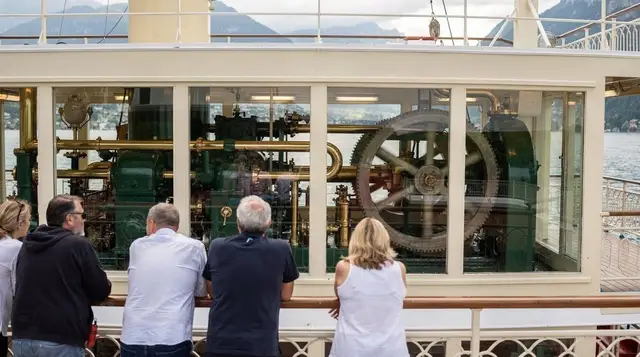
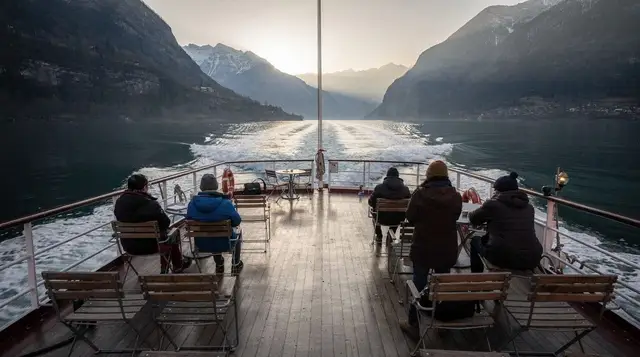
Not every day needs to end at 3,000 metres. Lake Brienz’s water is a genuinely striking turquoise, and the historic paddle steamers that cross it call at Giessbach, where a funicular built in 1879 still climbs to a set of waterfalls behind a grand old hotel. Our Lake Thun and Brienz cruises guide covers both lakes’ timetables, which run a reduced winter schedule and are worth checking before turning up at the pier — a point covered in general terms in our note on reading Lucerne’s own boat timetables, since the logic (seasonal frequency cuts, last-boat times that creep earlier from October) applies just as much here.
a boat trip to Giessbach Falls with a hike on to Iseltwald is a slower-paced option for a day when the weather isn’t cable-car clear but is fine for water and forest.
If you want altitude without the crowds: Glacier 3000
Glacier 3000, above Gstaad on the far side of the Bernese Oberland from Interlaken, is a longer detour and not something to tack onto an Interlaken day trip casually — but for travellers spending two days in the region rather than one, it’s worth knowing about as an alternative to the Jungfraujoch queues. a return cable car ticket to Glacier 3000 gets you onto a genuine glacier and a suspension bridge at altitude, with noticeably thinner crowds than the Jungfrau side of the valley.
Three ways to spend the day
If the weather is clear and you want one big mountain: train to Interlaken Ost, straight on to Lauterbrunnen and Stechelberg, cable car to the Schilthorn, back down via Mürren for lunch, return train from Interlaken Ost by early evening.
If you want variety over altitude: an hour in Interlaken along Höheweg, the Harder Kulm funicular for the twin-lake view, then a boat across Lake Brienz to Giessbach and back before the return train.
If Jungfraujoch is non-negotiable: commit to the early train from Lucerne, go straight through Interlaken Ost without stopping, and treat the town itself as something to see briefly on the way back, tired, in the evening light — which is honestly one of the nicer ways to see it anyway.
Practical notes
Left luggage lockers exist at both Interlaken stations, which matters if you’re doing Interlaken as a stop within a longer rail day rather than a there-and-back from Lucerne; see luggage and left-luggage in Lucerne for the equivalent setup at the Lucerne end. If you’re weighing whether this should be a day trip at all versus a full stop on a longer itinerary, our day trips from Lucerne overview compares Interlaken against the other realistic options, and how many days in Lucerne discusses where a Bernese Oberland excursion fits into a wider trip.
Lift and cable car maintenance closures happen most commonly in April-May and again in November, generally not overlapping across the whole region at once, but worth checking for whichever specific lift you’re planning to ride — a closed cable car discovered at the base station is the single most common way this day goes wrong.
Interlaken day trip FAQ
How long does the train from Lucerne to Interlaken take?
About 1h50 to 2 hours on the direct Luzern-Interlaken Express, which runs roughly hourly and terminates at Interlaken Ost. There’s no need to change trains on this leg, which is unusual for a route that crosses the Brünig Pass.
Is the Brünig line scenic or just a connection?
Both. It climbs over the Brünig Pass on a rack-and-pinion section near Giswil, then drops past Lake Sarnen, Lake Lungern and Meiringen. It’s genuinely one of the better-looking regional lines in Switzerland, not merely a way to get somewhere else.
Should I go to Interlaken Ost or Interlaken West?
Ost, almost always. It’s the terminus for trains from Lucerne and the departure point for the Jungfrau railway, the Brienz boats and most mountain connections. West is closer to the town centre’s shops and cafés but has fewer onward links.
Can I do Jungfraujoch as a day trip from Lucerne via Interlaken?
Yes, but it’s a long day: figure 13-14 hours door to door once you add the change at Interlaken Ost, the climb via Grindelwald or Wengen, and the return. Leave Lucerne by the first realistic train, around 06:30-07:00.
Is Interlaken town itself worth walking around?
For an hour or two, yes — Höheweg with the Jungfrau view, the old town lanes, the paragliders landing in the meadow. It’s not a full day’s sightseeing on its own; almost everyone visiting uses it as a base or a changeover point.
What’s the cheapest way to see the Bernese Oberland mountains from Lucerne?
Harder Kulm from Interlaken Ost is the budget option among the big viewpoints — a funicular ride rather than a multi-stage cable car and train combination, and it still delivers a proper panorama over both lakes.
Should I stay overnight in Interlaken instead of a day trip?
If you want to fit in Jungfraujoch or the Schilthorn without rushing, one night in Interlaken (or Grindelwald or Lauterbrunnen) removes the early alarm and the pressure of a last train back to Lucerne.
Does the Swiss Travel Pass cover the Brünig line and the mountain trains?
The pass covers the Lucerne-Interlaken train in full. It gives 50% off most of the private mountain railways beyond Interlaken — Jungfraujoch, the Schilthorn cable car, the Harder Kulm funicular — rather than free travel on them.
Lake cruises & boat tours on GetYourGuide
Verified deep-linked GetYourGuide tours. Book through these links and we earn a small commission at no cost to you.
GetYourGuide does not provide a product photo for this activity — the image shows the meeting point, photographed by us.