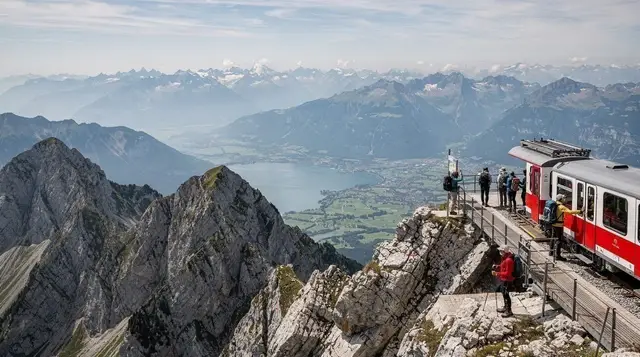
Jungfraujoch: the Top of Europe from Lucerne
Is Jungfraujoch worth doing as a day trip from Lucerne?
Yes, but budget a full day and a full wallet: the round trip from Lucerne takes 7-8 hours including roughly 2 hours 30 at the top, and a standard adult return costs around CHF 260-300 depending on route and season. Go only on a clear-weather day, since the Sphinx viewing terrace and the Aletsch Glacier view are the entire point.
Jungfraujoch calls itself the Top of Europe, and at 3,454 metres, with the highest railway station on the continent, it more or less earns the name. It is also the single most expensive and most heavily marketed excursion within reach of Lucerne, so it deserves a plain answer before you commit a full day and several hundred francs to it: it is genuinely worth doing once, on a clear day, and a waste of money on a cloudy one.
This guide covers the real logistics: how to actually get there from Lucerne, what the Eiger Express changed, what a ticket costs in each fare category, what’s waiting at the top, and the specific conditions that should make you postpone.
The route from Lucerne, leg by leg
There is no direct train. You are always changing at least twice, and the routing depends on whether you go via Lauterbrunnen or Grindelwald.
| Leg | Typical duration |
|---|---|
| Lucerne → Interlaken Ost (Brünig line) | ~1h 50 |
| Interlaken Ost → Grindelwald | ~35 min |
| Grindelwald Grund → Eigergletscher (Eiger Express) | ~15 min |
| Eigergletscher → Jungfraujoch (cogwheel train) | ~25 min |
Add it up and you’re looking at roughly 3 hours 5 minutes of pure travel time each way on the Grindelwald route, before connection waits. In practice, door to door from central Lucerne, plan on 3.5 to 4 hours. The alternative via Lauterbrunnen and Kleine Scheidegg is scenically the better ride — it’s the classic cogwheel approach past waterfalls and alpine meadows — but it takes slightly longer than the Eiger Express route and is worth choosing for the journey itself, not to save time.
Because of this, a Jungfraujoch day trip from Lucerne is a 7-8 hour round trip once you include roughly 2 hours 30 at the summit. Leave Lucerne on one of the early Brünig departures, ideally before 07:00, or you will be arriving at Jungfraujoch mid-afternoon with the light already flattening and the last comfortable connection home creeping up on you.
If train timetables and platform changes make you nervous, read how Swiss trains actually work before you go — the connections here are tight but they are built to be tight, and SBB’s real-time app will reroute you automatically if one leg runs late.
The Eiger Express and what it changed
Before December 2020, everyone climbed via the old Wengernalp cogwheel line through Kleine Scheidegg, a beautiful but slow ride. The Eiger Express is a tricable gondola running direct from Grindelwald Grund to Eigergletscher, carrying 26 passengers per cabin, running year-round regardless of snow, and cutting 30-45 minutes off the old route.
The trade-off is that the Eiger Express skips Kleine Scheidegg and the classic mountain-railway experience through the meadows. If you’ve got the extra half hour and want the more scenic ride, route via Lauterbrunnen and Kleine Scheidegg instead — you rejoin the same final cogwheel train up to Jungfraujoch either way.
Either route can be booked as a self-guided attraction ticket that bundles the whole chain of trains and the gondola into one QR code: a self-guided Jungfraujoch day ticket covers the full loop from Interlaken without you having to piece together separate legs at the counter.
What a ticket actually costs
This is the expensive part of your trip to Switzerland, and there’s no way around that. Prices below are round-trip, standard adult fares from Interlaken Ost, the fare point most people actually buy from since it’s shared by all approach routes.
| Fare type | Approximate return price (CHF) |
|---|---|
| Standard adult fare | 260-300 |
| Swiss Travel Pass discount (25% off) | 195-225 |
| Half Fare Card fare | 195-225 |
| ”Good Morning” ticket (first trains up, before ~08:00) | 175-210 |
| Children 6-15 with a Family Card | ~50% of adult fare |
These figures move with season and the specific promotion running, so check the official Jungfrau Railways fare page the week you travel rather than treating any number here as fixed. What doesn’t move is the pattern: nobody pays the standard fare if they can help it. If you’re already carrying a Swiss Travel Pass for the rest of your trip, the 25% Jungfraujoch discount is applied automatically at the ticket counter or online — it does not cover the ride itself, only the discount. A Half Fare Card gets you a similar reduction and pays for itself if you’re doing more than one or two long-distance excursions from Lucerne.
The early “Good Morning” ticket is worth planning around if your schedule allows it: it requires departing on one of the first trains from Interlaken and is the single easiest way to cut the price without sacrificing anything at the summit.
What’s waiting at the top
The station itself is a warren of tunnels carved into the rock, connecting several things worth allocating time for:
- The Sphinx Observatory, reached by a fast internal lift, with an open viewing terrace at 3,571 metres looking directly over the Aletsch Glacier — at 23 kilometres, the longest ice stream in the Alps. This terrace, on a clear day, is the actual reason to come.
- The Alpine Sensation and Ice Palace, a set of tunnels and sculpted ice chambers carved into the glacier itself — mildly touristy, genuinely cold, and a reasonable way to spend 20 minutes if the wind on the terrace has driven you back inside.
- Plateau walking trails onto the glacier snowfield, weather and season permitting, for those who want to actually stand on it rather than look at it through glass.
- A Lindt chocolate shop and Swiss watch outlets, because this is still a commercial operation at its core, not a research station with a gift shop attached.
Budget 2 hours 30 minutes to 3 hours at altitude to see all of it without rushing, plus lunch — the on-site restaurants are priced the way you’d expect for the highest railway station in Europe, so eating before you go up, or packing something, is the honest money-saving move.
When not to go
This is the part most guides skip. Jungfraujoch is entirely weather-dependent, and a cloudy or whited-out day there is close to a wasted day and a wasted few hundred francs. Before you commit:
- Check the live webcams on the official Jungfrau Railways website the morning of travel — not the forecast, the actual webcam. Alpine weather changes faster than forecasts update.
- Avoid days with a low cloud base over Interlaken. If Interlaken itself is grey and socked in, Jungfraujoch almost certainly is too, since the summit sits well above the valley cloud layer that causes the problem in the first place.
- Spring and autumn carry the added risk of maintenance closures on connecting lifts elsewhere in the region, the same pattern that affects Pilatus and Titlis — it’s rarer on the Jungfraujoch line itself, which runs close to year-round, but always confirm the full chain of connections is operating before you leave Lucerne.
- Midsummer brings crowds, not just clouds. July and August see the heaviest daily visitor caps reached earliest, which is the other reason to book a timed slot rather than turning up.
If the forecast is against you, this is a trip to move to a different day of your itinerary rather than push through. Nothing about the ice palace or the shop compensates for a Sphinx terrace wrapped in fog.
Two ways to do the trip
Self-guided, on your own schedule. Buy the train and gondola chain as one ticket, choose your own departure time from Lucerne, and set your own pace at the top. This suits anyone comfortable navigating Swiss train changes, which are announced clearly and rarely require more than following the platform screens.
Organised day tour from a closer base. If you’d rather not manage the connections yourself, tours running from Interlaken or Grindelwald cover Jungfraujoch alongside a guided introduction to the region — useful if English-language commentary or a fixed itinerary matters more to you than flexibility. An option like a guided day covering Grindelwald, Lauterbrunnen and Mürren works well if you want Jungfraujoch’s surrounding valleys explained rather than just transited through.
Neither approach changes the core numbers: the travel time from Lucerne and the ticket price stay the same regardless of who’s holding the itinerary.
If you’re staying closer to Grindelwald first
Some visitors base an entire day, or even a night, around Grindelwald rather than making the return trip from Lucerne in a single push. If that’s you, the Grindelwald First gondola and adventure activities make a reasonable lower-altitude add-on the same day, since First sits well below Jungfraujoch and rarely closes for the same weather that ruins the Sphinx terrace.
There’s also a route built specifically for people staying in Lucerne who want the whole loop handled in one booking: a combined Lucerne-to-Grindelwald top adventure package bundles the return journey and the mountain activity into a single ticket.
Alternatives if Jungfraujoch isn’t the right fit
Jungfraujoch is the highest and most famous option, but it isn’t the only way to get a big alpine view from this corner of Switzerland, and it isn’t always the best value one:
- Schilthorn (Piz Gloria), reached from Lauterbrunnen and Mürren, gives a wide panorama across the Eiger, Mönch and Jungfrau from the opposite side of the valley, at a noticeably lower price.
- Grindelwald First is closer, cheaper, and adds ridge walks and the First Flyer zipline, though at lower altitude and without the glacier.
- Mount Titlis near Engelberg is the closest true glacier experience to Lucerne itself, reachable in under an hour, with its own ice cave and revolving cable car.
- Mount Pilatus and Mount Rigi sit right on Lake Lucerne, need only half a day, and cost a fraction of a Jungfraujoch ticket — see the direct comparison in Pilatus vs Rigi vs Titlis and, for the higher-altitude question specifically, Jungfraujoch vs Schilthorn.
For a broader look at how this trip fits against the region’s other big excursions, the roundup of day trips from Lucerne puts Jungfraujoch alongside Zurich, Bern and the Rhine Falls by time and cost.
If you’re building a full day around the destination page for Grindelwald or want to compare it with basing yourself in Interlaken or Lauterbrunnen instead, those pages cover accommodation and shorter local excursions in more depth. And if a single overwhelming day feels wrong for your trip, an itinerary built around Lucerne can help you weigh whether this excursion belongs in your plan at all.
Jungfraujoch from Lucerne: the questions people actually ask
How long does it take to get from Lucerne to Jungfraujoch?
Around 3.5 to 4 hours each way. Lucerne to Interlaken Ost takes about 1 hour 50 minutes on the scenic Brünig line, then it’s roughly another 1 hour 40 minutes via Grindelwald or Lauterbrunnen, the Eiger Express, and the final cogwheel train up to the Jungfraujoch station.
How much does a Jungfraujoch ticket cost from Lucerne?
A standard adult return runs roughly CHF 260-300 depending on route. Swiss Travel Pass holders get a 25% discount, Half Fare Card holders also pay a reduced fare, and an early “Good Morning” ticket on the first trains up shaves a further chunk off the price.
What is the Eiger Express?
It’s the tricable gondola that opened in December 2020 between Grindelwald Grund and Eigergletscher, cutting about 30-45 minutes off the old cogwheel-only route via Kleine Scheidegg. It carries 26 people per cabin and runs year-round.
Is Jungfraujoch worth it if it’s cloudy?
No. The whole draw is the view over the Aletsch Glacier and the surrounding 4000-metre peaks from the Sphinx terrace, and that view disappears completely in cloud. Check the live webcams on the official Jungfrau Railways site the morning you travel and be ready to postpone.
Can I do Jungfraujoch and Grindelwald First on the same day?
Not comfortably. Each attraction on its own eats up most of a day once Lucerne travel time is factored in. Trying to combine them means rushing both, and Jungfraujoch’s opening hours and the last connecting train home from Interlaken Ost don’t leave much slack.
Do I need to book Jungfraujoch tickets in advance?
Yes, strongly recommended. Jungfrau Railways caps daily visitor numbers and popular slots, especially the first morning departures and midsummer, sell out. Booking a fixed time slot also means you’re not queuing at the Interlaken Ost ticket counter with everyone else who had the same idea.
Is there a cheaper way to see this part of the Alps without paying for Jungfraujoch?
Yes. The Schilthorn (Piz Gloria) and Grindelwald First both sit at lower altitude, cost less, and on a clear day give a comparable sense of scale over the Eiger, Mönch and Jungfrau without the Jungfraujoch price tag or the queues.
Mountain excursions on GetYourGuide
Verified deep-linked GetYourGuide tours. Book through these links and we earn a small commission at no cost to you.
GetYourGuide does not provide a product photo for this activity — the image shows the meeting point, photographed by us.