What nobody tells you about Jungfraujoch
I did the maths on the train home, which is the worst possible time to do it, because by then the money was already spent. Jungfraujoch had cost me, door to door, more than a decent hotel night in Lucerne, and I’d spent longer sitting on trains and queuing for lifts than actually standing at the top. I still think it’s one of the best days you can have from Lucerne. I also think almost nobody tells you what it actually costs, in money, time, and how your body feels at 3,454 metres.
The price nobody rounds down
The “Top of Europe” ticket from Lucerne is not a single fare, it’s a train-lift combination via Interlaken, and the full-price adult return sits in the CHF 200-260 range depending on the season and which route you take up. That is not a typo and it is not inflated for the story; it reflects what one of the most expensive railways on earth actually charges to reach a station carved into a glacier saddle.
| Discount | Roughly what you pay | Catch |
|---|---|---|
| Full fare, no card | ~CHF 240-270 return from Lucerne | Baseline, all trains |
| Swiss Travel Pass | ~50% off the mountain section | Pass itself still costs money; covers Lucerne-Interlaken free |
| Half Fare Card | ~50% off almost everything | Worth it if you’re doing 3+ mountain trips |
| ”Good Morning” early ticket | A further discount | Only on the first one or two trains up, so you’re leaving Lucerne before 6am |
Even with a Swiss Travel Pass covering the Lucerne-Interlaken leg outright, the Jungfraujoch section itself is billed separately and the discount there is real but not enormous. Budget CHF 130-150 per adult as a realistic “I have a pass and used the early train” figure, and closer to CHF 250 if you’re buying on the day at midday with no card. Check current fares before you book anything; they move most years and I’m not going to pretend a number from last winter is gospel.
The five hours you don’t picture when you look at a map
Lucerne to Interlaken Ost takes about 1 hour 50 minutes on the scenic Brünig line, which is a pleasant ride in its own right, lake and green hills the whole way. What people don’t picture is what comes after.
From Interlaken Ost you change onto the line up through Lauterbrunnen or Grindelwald, then change again at Kleine Scheidegg for the final cog railway that tunnels through the rock of the Eiger and Mönch to reach the station. Door to door, that mountain section alone, Interlaken up to the Joch and back down to Interlaken, eats close to five hours of train time once you count the connections and the wait for the next departure, which on a busy August day is not instant.
Add the Lucerne-Interlaken legs on both ends and you are looking at a genuine 11-to-12-hour day if you’re doing it independently from Lucerne, out the door before 7am and back after 7pm. That’s not a warning to skip it, it’s a warning to stop treating it like a half-day excursion.
If train transfers and timing aren’t something you want to manage on unfamiliar platforms, a guided full-day tour to Jungfraujoch that also stops at Bachalpsee takes the connection-planning off your hands, or a more direct day trip that goes straight from Lucerne up to Jungfraujoch without you having to work out which platform at Interlaken Ost you need.
What 3,454 metres actually does to you
Nobody at the ticket counter mentions this part. Jungfraujoch sits at 3,454 m, and if you’ve come straight up from Lucerne’s 436 m in under three hours, that’s a genuinely fast ascent for your body to process. The station itself pipes in supplemental oxygen in a couple of the enclosed areas, which tells you something. What you’ll likely feel: a mild headache, a slightly breathless feeling walking up the ramps and stairs inside the complex, and a general “slow motion” quality to moving around, especially if you go straight out onto the Sphinx viewing terrace and start climbing steps for photos.
It’s rarely dangerous for a healthy adult spending two or three hours there, but it’s real, and if you have a heart or lung condition it’s worth a word with your doctor before you book. Drink water on the way up, skip the alcohol at the summit restaurant no matter how tempting the “highest bar in Europe” line is, and don’t sprint for photo spots.
What you actually see, weather depending
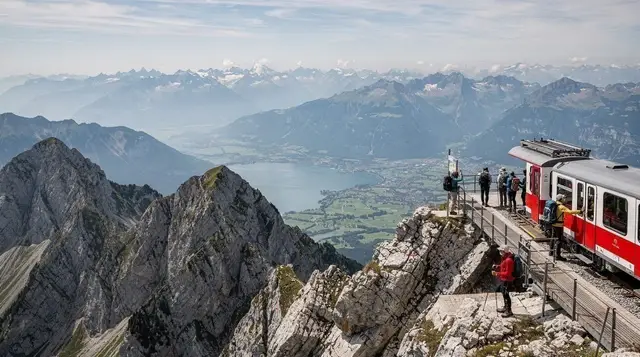
This is the part that decides whether your day was worth it, and it has nothing to do with how much you paid. If the sky is clear at altitude, and I mean clear at 3,454 m, not just blue in Lucerne, you get the Aletsch Glacier stretching out below in a long white river of ice, and close-up walls of the Eiger, Mönch and Jungfraujoch itself. It’s a genuinely different landscape from anything at valley level, more Arctic than Alpine.
If it’s socked in, and the Bernese Oberland clouds in more often than the forecasts down in Lucerne or Interlaken would suggest, you get grey wall in every direction, wind, and a long walk through an ice palace and gift shop to kill time before the train back. I’ve had both. The clear day was one of the best things I’ve done in Switzerland. The cloudy one was an expensive train ride to a gift shop.
Check the live Jungfraujoch webcam the morning of, not the night before, and be honest with yourself about switching the trip to a lower target like Schilthorn or postponing a day if the summit forecast is bad. Best time to visit Lucerne covers the wider seasonal pattern, but for Jungfraujoch specifically, early morning in high summer gives you the best odds before afternoon cloud builds.
Was it worth it
Yes, once, on a clear day, and I’d do it again. But I wouldn’t do it as a rushed add-on to a two-day Lucerne stay, and I wouldn’t do it without checking the summit forecast that morning. If your schedule is tight and flexible weather-chasing isn’t an option, the shorter Schilthorn trip via Wengen costs less, takes less of the day, and still delivers a genuine 360-degree Alpine panorama, arguably a better one for the price.
If you want the full Top of Europe experience and someone else handling the logistics, an overnight combination like the two-day Lucerne, Interlaken and Jungfraujoch tour spreads the long travel day over two days instead of cramming it into one.
For general planning, see day trips from Lucerne, Swiss trains explained, and the direct comparison at Jungfraujoch vs Schilthorn if you’re still deciding which summit earns your day and your francs.
Jungfraujoch questions answered honestly
How much does Jungfraujoch actually cost from Lucerne?
Expect roughly CHF 200-260 return for the full combined rail journey at full fare, less with a Swiss Travel Pass, Half Fare Card, or an early “Good Morning” ticket on the first trains up. Prices change with the season, so check the current fare before you commit.
How long does the round trip from Lucerne really take?
Lucerne to Interlaken Ost is about 1 hour 50 minutes each way. The mountain section from Interlaken up to Jungfraujoch and back, including the change at Kleine Scheidegg, is close to five hours of train time on its own. All in, a same-day trip from Lucerne runs 11-12 hours door to door.
Will I feel the altitude at Jungfraujoch?
Most healthy adults do, at least mildly: a headache, breathlessness on stairs, or general sluggishness, because the ascent from Lucerne’s low altitude happens in under three hours. It’s rarely dangerous but it’s real. Move slowly, drink water, and skip alcohol at the top.
What if it’s cloudy on the day?
You’ll see fog and white-out conditions with no glacier or peak views, which makes the ticket price hard to justify. Check the live summit webcam the morning of your trip rather than relying on the Lucerne or Interlaken forecast, and be ready to swap to a lower viewpoint like Schilthorn if the cloud base is low.
Is the Swiss Travel Pass worth it just for Jungfraujoch?
On its own, no, the pass costs more than the discount saves for a single trip. It becomes worthwhile if you’re also using it for unlimited trains, the Lucerne-Interlaken leg, and other mountain excursions like Rigi or Pilatus during the same trip.
Is Schilthorn a better choice than Jungfraujoch?
Schilthorn is lower, cheaper, and faster to reach, with a full 360-degree panorama that many visitors rate just as highly. Jungfraujoch offers the glacier and the higher altitude, plus the novelty of the highest railway station in Europe, but at a real premium in cost and time.
Can I do Jungfraujoch as a guided tour instead of booking trains myself?
Yes. Guided full-day options handle the train connections, timing, and often add a stop like Bachalpsee, which removes the platform-hopping stress at Interlaken Ost and Kleine Scheidegg.
Is one day enough, or should I stay overnight near Interlaken?
One day works if you start early and the weather cooperates, but it’s a long day. Splitting the trip with an overnight in the Interlaken or Lauterbrunnen area, or booking a two-day combined tour, turns a rushed slog into a more relaxed couple of days.
Mountain excursions on GetYourGuide
Verified deep-linked GetYourGuide tours. Book through these links and we earn a small commission at no cost to you.
GetYourGuide does not provide a product photo for this activity — the image shows the meeting point, photographed by us.