A city that trades mountains for museums
Basel does not try to compete with Lucerne on scenery. There is no lake framed by snow peaks, no paddle steamer, no cable car climbing a ridge. What Basel has instead is a concentration of serious museums that would be notable in a city three times its size, a compact old town built from the same red sandstone as its cathedral, and a river that runs straight through the middle of daily life rather than sitting decoratively at its edge. It sits at the corner where Switzerland, France and Germany meet, which shows up constantly in small ways: German across the border in Weil am Rhein, French in Saint-Louis, and Swiss German in between, on trams that cross all three without anyone thinking twice about it.
For a Lucerne-based trip, Basel makes sense as a full day out rather than an add-on. The direct train takes just over an hour, which is comparable to the run out to Interlaken or Zurich, but the day itself has a different rhythm: less walking between viewpoints, more time standing in front of things. If your Lucerne itinerary is already stacked with Pilatus and Rigi, Basel is the day you swap boots for a museum pass.
Fondation Beyeler, Tinguely and the Kunstmuseum
Three museums do most of the work of Basel’s reputation, and they are different enough from each other to justify visiting more than one.
Fondation Beyeler, in the suburb of Riehen, is the one people travel specifically for. Renzo Piano’s low glass-and-stone building sits in a park that blurs into the private garden behind it, and the permanent collection runs through Monet, Cézanne, Picasso, Rothko and Giacometti at a density most national galleries would envy. It is reached by tram 6 from the city centre, about 20 minutes, and the building itself is worth the trip even on an exhibition you do not care about. Expect CHF 35-40 for a standard adult ticket, more during a major temporary show.
The Museum Tinguely, on the riverbank a short walk or tram ride from the centre, is a one-artist museum built around Jean Tinguely’s kinetic sculptures, scrap-metal machines that clank, spin and occasionally spray water when a visitor presses a button. It reads as more playful than the Beyeler and takes less time, an hour to ninety minutes rather than half a day. Outside, Tinguely’s fountain sculptures animate a small square near the theatre in the old town, free to see any time.
The Kunstmuseum Basel, right in the centre near the Münster, is Switzerland’s oldest public art collection and one of its largest, spanning Holbein through to contemporary work across a main building and a newer extension across the street, linked by an underground passage. It rewards two or three focused hours rather than a rushed hour between trains.
| Museum | Location | Typical visit | Adult ticket |
|---|---|---|---|
| Fondation Beyeler | Riehen, tram 6 | 2-3 hours | CHF 35-40 |
| Museum Tinguely | Riverbank, walkable | 1-1.5 hours | CHF 18-20 |
| Kunstmuseum Basel | Old town centre | 2-3 hours | CHF 26-30 |
Trying to fit all three into one day is possible but rushed; most visitors do better picking two and giving the old town proper time as the third stop.
The old town and the Münster
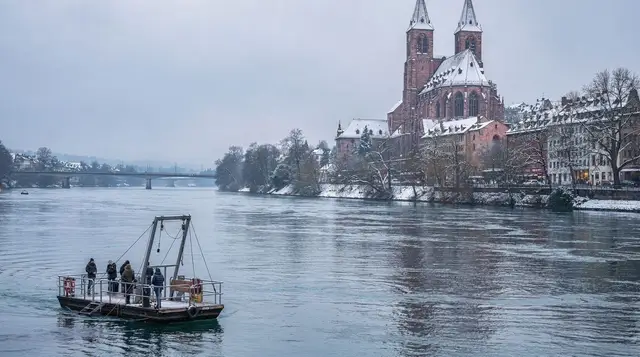
Basel’s old town climbs gently from the Rhine, its streets narrow and largely car-free, lined with the same rust-red sandstone that gives the Münster its colour. The cathedral itself is Romanesque and Gothic, its twin towers visible from most of the old town, and its terrace behind the building, the Pfalz, gives a free view over the Rhine and the industrial skyline beyond that costs nothing and takes five minutes to reach. Inside, the tomb of Erasmus and the painted tiled roof are the two details worth seeking out; climbing the tower for CHF 5 adds a higher, wider view for anyone who does not mind a tight spiral staircase.
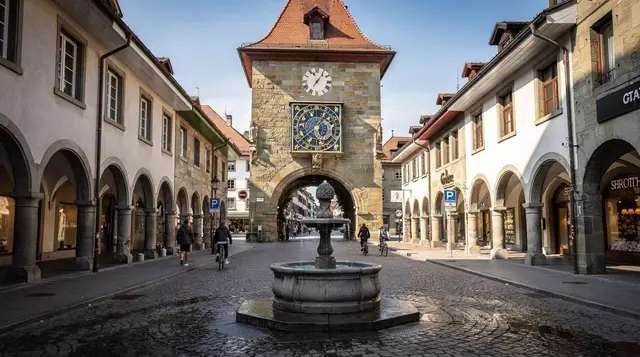
Marktplatz, a short walk downhill, is dominated by the red-and-gold Rathaus, Basel’s city hall, its courtyard open to walk through and its facade painted with frescoes that reward a slow look rather than a glance. The market itself still runs on weekday mornings, mostly produce and flowers rather than souvenirs. From there, the old town’s lanes lead back down toward the river, past guild houses and the kind of quiet residential streets that make Basel feel more lived-in than staged for visitors, unlike parts of central Lucerne in high season.
Compared with Lucerne’s old town, Basel’s is larger, flatter and less immediately photogenic, with fewer painted facades in a single concentrated stretch, but it has the advantage of the Münster terrace and the river below it, which Lucerne’s old town does not.
The Rhine: ferries, reaction ferries and river swimming
The Rhine is the actual centre of Basel’s identity, more than any single building. Four small cable ferries, known locally as Fähri, cross the river at fixed points using no motor: each boat is fixed to a cable strung high above the water, and the ferryman angles the rudder so the current itself pushes the boat across. A crossing costs around CHF 1.80 and takes a few minutes; doing it once, even without needing to be on the other side, is worth the small fare.
Swimming in the river is a genuine Basel habit rather than a tourist activity, from May through to September when the water is warm enough and the current predictable. Locals buy or rent a Wickelfisch, a fish-shaped waterproof bag that seals your clothes and phone inside and floats behind you as you swim, then walk upstream along the bank, get in, and let the current carry them back down past the old town to one of the marked exit points. It is faster than it sounds and calmer than it looks from the bank, though it is still a real river with a real current, not a swimming pool, and it is worth watching how locals enter and exit before doing it yourself.
For a lower-effort version of the same river, a short cruise or a walk along either bank covers the same views without getting wet: the Kleinbasel side, across from the old town, has a long promenade of cafés and bars built into the old city walls that fills up on any warm evening.
The Dreiländereck: where three countries meet
A few kilometres downstream from the old town, past the docks, a viewing tower marks the Dreiländereck, the point where the borders of Switzerland, France and Germany converge on the Rhine. It is reached by tram to the end of the line and a 15-20 minute walk along the riverside path, past working docks rather than anything scenic. The tower itself is a spiral ramp with a platform at the top, free to climb, giving a flat view over industrial Basel and the river bending north into Germany.
It is not, on its own, worth a special trip: the appeal is standing at a point where three national borders touch, and the mild novelty of technically being in three countries within a few strides. Combined with a walk along the Rhine promenade or as a stop on the way back from the Fondation Beyeler side of the city, it adds an hour without derailing the rest of the day.
Getting to Basel from Lucerne
Basel SBB is the main station, and the direct connection from Lucerne is straightforward enough that no advance planning beyond checking the timetable is really needed.
| From | To | Duration | Notes |
|---|---|---|---|
| Lucerne | Basel SBB | 1h05-1h15 | Direct IC/IR, roughly hourly |
| Basel SBB | Old town / Marktplatz | 10 min | Tram 8 or a 15-minute walk |
| Basel SBB | Fondation Beyeler (Riehen) | 20 min | Tram 6 to Riehen Grenze, then a short walk |
| Basel SBB | Dreiländereck | 30-35 min | Tram to the line’s end plus a riverside walk |
The Swiss Travel Pass covers the train and Basel’s trams; without it, a Half Fare Card cuts the point-to-point fare roughly in half. For a Lucerne base, this is one of the more efficient rail day trips, comparable in time to Zurich and shorter than Bern once you factor in Basel’s tighter walking distances once you arrive. See how Swiss trains work if this is your first trip using the network.
Basel also has its own airport, EuroAirport, shared with France and Germany and used mostly for budget connections rather than as a gateway for Lucerne-based trips; nearly everyone arriving from Lucerne comes by train.
Where a Basel day fits in a Lucerne trip
Basel is not a mountain excursion and does not compete with the tours that dominate a typical Lucerne stay, which is part of why it works well as a change of pace partway through a longer trip. Travellers building an itinerary around a week in Lucerne often use a Basel day as the museum-and-city counterweight to two or three days of cable cars and lake boats.
If you are combining the trip with wider Swiss travel rather than staying strictly Lucerne-based, several operators run day tours that start from Basel itself, useful if you are splitting nights between the two cities rather than doing Basel as a single return trip. A small-group day tour to Mount Pilatus and Lake Lucerne departing from Basel covers the mountain and boat side of a Lucerne visit in one outing, useful if your schedule only allows a single day away from Basel.
Travellers based in Basel who want the high Alps rather than Lucerne’s lower peaks can take a private day trip to the Jungfraujoch, a long day by any measure but one that removes the need to plan train changes yourself.
Basel is also within easy reach of Rheinfelden, a smaller riverside town upstream known for the Feldschlösschen brewery; a brewery visit with beer tasting at Feldschlösschen is a reasonable half-day add-on for anyone splitting time between Basel and the surrounding region rather than a Lucerne day-tripper on a tight schedule. For those staying longer in the Basel-Bern corridor, a day tour from Basel to Thun, the Beatus Caves and a lake cruise extends the trip into the Bernese Oberland without needing to plan the connections independently.
None of this replaces the direct Lucerne-Basel train for a straightforward day trip; the tours above are for travellers structuring a longer, multi-base itinerary around Basel and the northwest rather than a single day away from Lucerne.
Basel day trip costs
A realistic budget for a day trip from Lucerne, per person, assuming standard-fare train tickets rather than a rail pass:
| Item | Cost (CHF) |
|---|---|
| Return train, Lucerne-Basel | 70-90 (with Half Fare Card) |
| Two museum entries | 55-70 |
| Tram day ticket in Basel | 4.80 |
| Lunch and coffee | 30-45 |
| Reaction ferry crossing | 1.80 |
| Total | 160-210 |
A Swiss Travel Pass day used on this trip covers the train and trams, leaving museum entry and food as the only out-of-pocket costs, which brings the day closer to CHF 90-120. See the trip budget tool to weigh a Basel day against other options from Lucerne.
Mistakes to avoid
Trying to see Fondation Beyeler, the Kunstmuseum and Tinguely in one day, then also walk the full old town, is the most common overreach; pick two museums and treat the third as a “next time.” Arriving without checking which exhibition is currently on at the Beyeler is a smaller but frequent mistake, since prices and queues shift noticeably around a major show. Swimming in the Rhine without watching how locals enter and exit first is worth avoiding too, since the current is stronger than it looks from the bank and the marked exit points matter more than they seem to on a hot day. Finally, treating the Dreiländereck as a half-day destination rather than a one-hour stop tends to eat time better spent in the old town or a museum.
Frequently asked questions about visiting Basel
Is Basel worth visiting on a day trip from Lucerne?
Yes, if art and architecture are what you travel for. Basel has three genuinely strong museums, a well-preserved old town around the Münster, and river swimming in summer that Lucerne cannot match. It is a different kind of day out from the mountain excursions Lucerne usually sells.
How long does the train from Lucerne to Basel take?
Around 1h05 to 1h15 on a direct InterRegio or InterCity service, running roughly every hour from Lucerne station. No change of train is normally needed, and both the Swiss Travel Pass and Half Fare Card cover or discount the fare.
Can you actually swim in the Rhine in Basel?
Yes, and locals do it constantly in summer. The current is fast but manageable close to the banks; people use a Wickelfisch, a waterproof dry bag that floats and doubles as a buoy, to carry clothes and phones while they drift downstream from one bathing spot to the next.
What is the Dreiländereck and can you visit it in an afternoon?
It is the point where Switzerland, France and Germany meet on the Rhine, marked by a viewing tower a few kilometres north of Basel’s old town, reachable by tram and a short walk. It is a curiosity rather than a destination in itself, worth 30-45 minutes if you are already in the area.
Do you need to book Fondation Beyeler tickets in advance?
It is not usually required outside a blockbuster exhibition, but booking a timed slot online avoids queuing on weekends and saves a few francs compared with paying at the door. Check the current show before travelling, since ticket prices and hours shift with the exhibition.
Is the Basel old town walkable, or do you need public transport?
The old town, the Münster and the main museums within the centre are all within a 20-minute walk of each other. You only need Basel’s trams to reach Fondation Beyeler in Riehen, the Dreiländereck, or Tinguely’s fountains if you are short on time.
What is a Rhine reaction ferry (Fähre)?
It is a small wooden boat attached to a cable strung across the river, steered only by angling the rudder against the current, no motor involved. Basel has four of these ferries in daily use, each costing a small coin fare, and crossing on one is a five-minute ride worth doing at least once.
Is Basel more expensive than Lucerne?
Broadly similar, though museum entry adds up faster in Basel than sightseeing does in Lucerne. A restaurant lunch, a coffee, and a tram ticket cost about what they do in Lucerne; the difference is that Basel’s big draws are ticketed indoor spaces rather than free viewpoints and lake shores.