Stoos and the Fronalpstock ridge: the world's steepest funicular
Is Stoos worth visiting instead of Rigi or Pilatus?
Stoos is worth it for the funicular ride alone: four rotating cabins climb a 110% gradient from Schlattli to a car-free village in under four minutes. From there the Fronalpstock ridge walk to Chinzig Chulm gives wide views over Lake Lucerne, the Mythen peaks and the Alps with far fewer visitors than Rigi or Pilatus.
Not just a funicular ride
Stoos sits in the canton of Schwyz, on the far side of Lake Lucerne from the city, roughly an hour away by train and bus. Most day-trippers come for one reason: the Stoosbahn, the steepest funicular railway in the world, climbing a maximum gradient of 110 per cent — steeper than a black ski run — inside four barrel-shaped cabins that rotate on their own axis so the floor stays level all the way up. That alone is worth the trip. What keeps people longer is what’s at the top: a genuinely car-free village at 1,300 metres, and a ridge walk to the Fronalpstock summit that gets a fraction of the foot traffic of Mount Rigi or Pilatus, for views that are just as good.
This guide covers the funicular itself, the village, the Fronalpstock and Klingenstock ridge route, what it costs, and when the lift shuts for maintenance — which is the detail that ruins the most visits.
The steepest funicular in the world, explained
The Stoosbahn opened in December 2017, replacing a much older and slower funicular that had run the same route since 1933. It covers about 1.7 kilometres and 744 metres of vertical ascent in under four minutes, at a top gradient of 110 per cent, roughly 47.7 degrees — the section that earns it the “steepest in the world” title, verified by Guinness World Records.
The engineering trick is the rotating cabin. Each of the four barrel-shaped cars turns continuously on its own axis as it climbs the fixed incline, so passengers always stand on a level floor even while the track itself tilts to near-45 degrees underneath. It feels less like a train ride and more like standing inside a slow-turning drum with a window. Cabins run roughly every few minutes in high season and hold a few dozen standing passengers each — there’s no seating, and no real space for large luggage.
The base station is at Schlattli, just above Schwyz. The funicular is the only realistic way up to Stoos: there’s no public road, and the old road that once climbed the valley is now closed to general traffic.
Getting there from Lucerne
From Lucerne station, take the train towards Zug or Arth-Goldau and change for Schwyz, then a short postbus ride to Schlattli for the funicular base station. Door to door it’s about an hour to an hour and ten minutes each way, funicular included. Driving isn’t an option beyond Schlattli — this is one of the few excursions near Lucerne where the train genuinely is the faster and simpler choice, not just the greener one.
See getting around Lucerne for how the connections fit together, and the Swiss Travel Pass guide or the Tell-Pass guide if you’re weighing up regional passes — the Tell-Pass in particular covers Stoos along with Rigi and the Lake Lucerne boats, which matters if you’re stacking more than one mountain into a trip.
| From | Journey time | Change |
|---|---|---|
| Lucerne | 1h–1h10 | Schwyz, then postbus to Schlattli |
| Zug | 45–55 min | Arth-Goldau or Schwyz |
| Zurich | 1h15–1h30 | Arth-Goldau, then Schwyz |
| Schwyz town | 15 min | Postbus to Schlattli only |
Stoos village: car-free at 1,300 metres
Stoos itself is small — a scatter of chalet-style hotels, a couple of restaurants, a chapel, and open meadow that doubles as a sledging run in winter. There are no cars beyond the odd service vehicle, and no real “sights” as such; the point of the village is the setting, not the architecture. In summer it’s a base for the ridge walk described below. In winter it’s a modest, low-key ski area with a handful of lifts and one of the more reliably scenic sledge runs in central Switzerland, covered in more detail in Lucerne in winter.
If you’re only up for an hour, the short loop path around the meadow gives a first look at the Mythen twin peaks across the valley and, on a clear day, a slice of Lake Lucerne to the north-west. Most people move on quickly to Klingenstock.
The Fronalpstock ridge walk
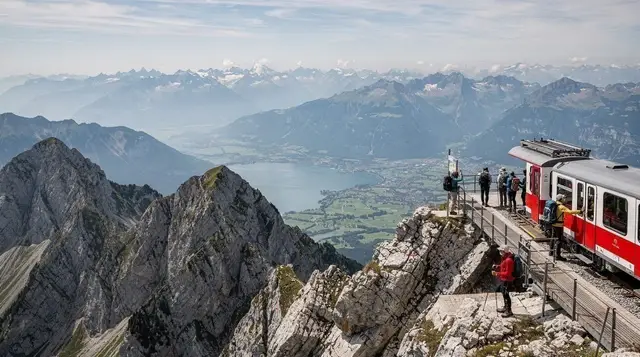
From the top of the village, a chairlift, or a roughly 45-minute uphill walk, reaches Klingenstock at 1,935 metres, the start of the ridge proper. From Klingenstock the path runs along an open, narrow crest — exposed in places but not technical — to Fronalpstock at 1,921 metres, then continues, for those with the legs and time, to Chinzig Chulm at 2,073 metres. The full ridge from Klingenstock to Chinzig Chulm and back is around three to four hours of walking, most of it above the treeline with uninterrupted views: Lake Lucerne and the Rigi massif to the north, the Mythen’s twin limestone horns close by to the east, and on a clear day a long stretch of the Alps to the south, from the Uri peaks towards the Bernese Oberland.
This is the ridge’s real selling point over Rigi: fewer people, a proper sense of exposure without actual difficulty, and views that don’t require sharing a summit platform with a tour bus’s worth of visitors. It’s not a hike for poor weather — the ridge offers no shelter and the path can be genuinely unpleasant, and occasionally unsafe, in wind or low cloud.
Check conditions before committing to the full route; the shorter Klingenstock–Fronalpstock leg alone, about 45 minutes each way, still delivers most of the view for a fraction of the commitment, and works well as a fallback. For route planning against the rest of the region, best hikes near Lucerne and best mountain excursions from Lucerne both cover where Stoos sits relative to Pilatus, Rigi and Titlis.
| Section | Distance/time | Difficulty |
|---|---|---|
| Stoos meadow loop | 20–30 min | Easy, flat |
| Stoos to Klingenstock (chairlift) | 8 min | None — lift |
| Stoos to Klingenstock (on foot) | ~45 min | Moderate, steady climb |
| Klingenstock to Fronalpstock | 45 min–1h each way | Moderate, exposed ridge |
| Fronalpstock to Chinzig Chulm | 1h–1h15 each way | Moderate-hard, sustained ridge |
Stoos, Rigi or Pilatus?
If you’ve already done Mount Rigi or Pilatus and want a third mountain that doesn’t feel repetitive, Stoos is the better pick over adding a second cog railway to the itinerary — the funicular experience is genuinely different, and the ridge walk is quieter than anything on Rigi’s more developed summit network.
If you’re choosing your one mountain excursion from Lucerne and have to pick just one, Rigi or Pilatus usually wins on convenience and view variety; Stoos is the one to add on a second visit, or if the “steepest in the world” novelty and a proper ridge hike matter more to you than an easy first-timer’s summit. The comparison is worked through properly in Pilatus vs Rigi vs Titlis.
Stoos also pairs naturally with the Mythen region and with Schwyz itself, a historic town worth an hour if you’re passing through anyway — it’s where the Swiss Confederation takes its name from. Nearby Brunnen and Lake Uri make a reasonable add-on if you’re driving or have a full day and want to combine the mountain with a lakeside stop.
Costs and what’s covered
Prices below are approximate return fares from Schlattli; check current tariffs before travelling, as Swiss mountain transport prices are revised most winters.
| Item | Adult return (CHF) | Notes |
|---|---|---|
| Stoosbahn funicular (Schlattli–Stoos) | ~34 | Swiss Travel Pass: 50% discount |
| Klingenstock chairlift (from Stoos) | ~24 combined with funicular | Half Fare Card: 50% discount |
| Tell-Pass | Covers Stoos, Rigi and Lake Lucerne boats | Worth it only over several days in the region |
| Postbus Schwyz–Schlattli | ~4–6 | Half Fare Card applies |
The Swiss Travel Pass gives 50 per cent off both the funicular and the Klingenstock chairlift rather than free travel, which surprises some first-time visitors expecting full coverage — it’s a private mountain railway, not part of the CFF/SBB network. The Tell-Pass, which bundles Stoos with Rigi and the Lake Lucerne paddle steamers, is the better value if Stoos is one stop among several in central Switzerland rather than a single outing.
When to go — and when the lift is shut
The Stoosbahn runs year-round, unlike some of the higher mountain railways in the region, but the Klingenstock chairlift and the ridge path itself close for maintenance for a period each spring, typically April, and sometimes briefly in autumn — check the operator’s site before planning around the ridge walk specifically, since the village and funicular can be open while the chairlift isn’t.
Summer, June to September, is the reliable window for the full ridge to Chinzig Chulm; winter turns Stoos into a modest ski and sledging base instead, with the ridge walk not realistically doable in snow without proper equipment. Best time to visit Lucerne covers the broader seasonal picture across the region if you’re planning around several excursions.
Families with younger children are usually better served by the meadow and the short Klingenstock lift-and-back than by the full ridge — see Rigi and Pilatus with kids for the comparable family-friendly version of this kind of mountain outing, since the exposed ridge itself isn’t recommended for small children.
Booking a guided hike or a transfer
If you’d rather not work out the train-bus-funicular chain yourself, or want a guide for the ridge, a few operators run the route from Lucerne, Zug and Zurich. A day trip from Lucerne to the steepest funicular and the Fronalpstock viewpoint handles the transfers and gives a fixed window at the top without the timetable-juggling.
From Zug, a guided ridge hike with transport included is a reasonable shortcut if you’d rather not navigate the Klingenstock-to-Fronalpstock route solo, particularly in shoulder season when conditions on the ridge can turn quickly. There’s also a day trip from Zurich combining the funicular with Rigi views, useful if you’re based there rather than in Lucerne and want both mountains in one outing.
None of these are necessary if you’re comfortable with Swiss public transport — the connections from Lucerne aren’t complicated — but they save time for a single free day and take the guesswork out of ridge conditions.
Making it a full day
Combined with an early start, Stoos and the Fronalpstock ridge fill a full day comfortably: funicular up by mid-morning, three to four hours on the ridge, and back in Lucerne for a late dinner. It slots well into a longer central Switzerland itinerary — see Lucerne, five days in the Alps for how it fits alongside Rigi, Pilatus and a lake cruise without repeating the same view twice. For a first impression of what the ride and the ridge actually feel like before you commit a full day to it, a morning on the Rigi covers the comparable experience one mountain over.
Stoos and Fronalpstock: frequently asked questions
How steep is the Stoos funicular exactly?
The Stoosbahn climbs a maximum gradient of 110 per cent, around 47.7 degrees, which is why it’s recognised as the steepest funicular railway in the world. Each of its four cabins rotates continuously on its own axis during the climb so the floor stays level despite the incline. The full ascent from Schlattli to Stoos covers about 1.7 kilometres and takes under four minutes.
How do I get to the Stoos funicular from Lucerne?
Take the train from Lucerne towards Arth-Goldau or Zug, change at Schwyz, then a short postbus ride to Schlattli, the funicular’s base station. Total journey time is around an hour to an hour and ten minutes each way. There’s no direct road to Stoos beyond Schlattli, so the train-bus-funicular combination is the only practical route.
Is Stoos car-free, and how do I get around once there?
Yes, Stoos has no general road access and no cars beyond service vehicles — it’s reached only by the funicular. The village itself is small enough to cross on foot in a few minutes; a chairlift from the top of the village handles the climb up to Klingenstock for the ridge walk.
How long is the Fronalpstock ridge hike from Stoos?
Klingenstock to Fronalpstock and back is about 45 minutes to an hour each way, suitable for most reasonably fit visitors. The full ridge extension to Chinzig Chulm adds another one to one and a quarter hours each way and involves sustained exposure on a narrow crest, better suited to hikers comfortable with heights and clear weather.
What does the Stoos funicular cost, and is it covered by the Swiss Travel Pass?
A return fare from Schlattli is roughly 34 Swiss francs for the funicular alone, with the Klingenstock chairlift priced separately or combined. The Swiss Travel Pass gives a 50 per cent discount rather than free travel, since Stoos is run by a private mountain railway company outside the SBB network. The regional Tell-Pass, which also covers Rigi and the Lake Lucerne boats, is better value for a multi-day central Switzerland trip.
When is the best time to visit Stoos and Fronalpstock?
June to September is the reliable window for the full ridge walk to Chinzig Chulm. The Klingenstock chairlift and the ridge path close for maintenance for a period most springs, typically in April, and sometimes briefly in autumn, so check current opening dates before planning a trip specifically around the hike. Winter turns Stoos into a small ski and sledging area instead.
Can I combine Stoos with Rigi or the Mythen in one day?
Combining Stoos with Rigi in the same day is possible but tight, given the transfer time between the two — it works better as a guided day trip with transport arranged than as a self-planned itinerary. The Mythen twin peaks are visible from the Fronalpstock ridge throughout the walk, so you get that view without a separate excursion; a dedicated Mythen hike from Zug is a separate outing best treated as its own day.
Is the Fronalpstock hike suitable for families or beginners?
The meadow loop around Stoos village and the Klingenstock chairlift with a short walk at the top are both easy and suitable for most families. The full ridge to Fronalpstock and beyond is exposed in places and better suited to older children and adults comfortable with heights, rather than young children or anyone uneasy on narrow paths with drop-offs on either side.
Mountain excursions on GetYourGuide
Verified deep-linked GetYourGuide tours. Book through these links and we earn a small commission at no cost to you.
GetYourGuide does not provide a product photo for this activity — the image shows the meeting point, photographed by us.