The Lion Monument: Lucerne's saddest stone
What is the Lion Monument in Lucerne and is it worth seeing?
The Lion Monument is a dying lion carved into a sandstone cliff face, commemorating the Swiss Guards killed defending Louis XVI in Paris in 1792. It is free, outdoors, and takes five minutes to see properly, but it draws large tour-bus crowds between roughly 09:30 and 15:00 — go earlier or later and pair it with the Glacier Garden next door.
A dying lion carved into a quarry wall
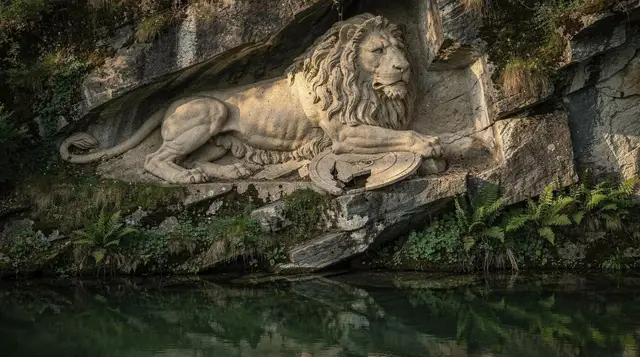
The Lion Monument, known locally as the Löwendenkmal, is a single relief carved directly into a sandstone cliff face on the northern edge of Lucerne’s old town. A lion, roughly 6 metres long and pierced by a broken spear, lies dying over a shield bearing the fleur-de-lis of the French royal house. Below it, a Latin inscription reads HELVETIORUM FIDEI AC VIRTUTI — “to the loyalty and bravery of the Swiss.” It is not a statue on a plinth; the whole thing is hewn out of the living rock of a former sandstone quarry, which is part of why it reads so differently from most war memorials. There is no marble grandeur here, just an animal expiring quietly in a wall.
The monument commemorates the Swiss Guards who died on 10 August 1792, when a mob stormed the Tuileries Palace in Paris during the French Revolution. Around 760 guards were killed in the fighting that day, and several hundred more died afterwards in prison or from their wounds — the total is usually put at somewhere close to 800.
Louis XVI had already fled the palace by the time the worst of the fighting broke out, and by some accounts he sent word ordering the guards to stand down. They largely held their position anyway, following the terms of their contract to the king rather than the political reality on the ground. That detail — soldiers dying for an order given by a king who had already run — is part of what makes the memorial land as tragedy rather than triumph.
The monument was commissioned by Karl Pfyffer von Altishofen, a former officer of the Swiss Guard who survived the Tuileries massacre because he happened to be in Lucerne on leave that day. He spent years raising funds across Switzerland and abroad. The design came from the Danish sculptor Bertel Thorvaldsen, one of the leading neoclassical artists of his generation, and the actual carving into the rock face was done by the local stonemason Lukas Ahorn between 1820 and 1821. The monument was unveiled on 10 August 1821, the 29th anniversary of the massacre.
Why Mark Twain called it the saddest stone in the world
Mark Twain visited Lucerne in 1880 and wrote about the Lion Monument in his travel book A Tramp Abroad. His actual line describes it as “the most mournful and moving piece of rock in the world” — the version that circulates on postcards and guidebooks around Löwenplatz today, “the saddest and most moving,” is a slight but persistent misquote of the same sentiment.
Either way, the point he was making has held up: the lion isn’t roaring or rearing, it’s dying, curled protectively around the shield even as the spear runs through it. Twain’s praise wasn’t really about the politics of 1792 — he was reacting to Thorvaldsen’s decision to carve grief rather than victory, at a moment when most monuments to fallen soldiers still went in for heroic defiance.
You don’t need to know any of this history to feel something looking at the carving, which is probably why it has stayed one of the most photographed single objects in Switzerland for two centuries. Knowing the history does change how long you spend standing at the railing rather than just snapping a photo and moving on.
Where it is and how to reach it
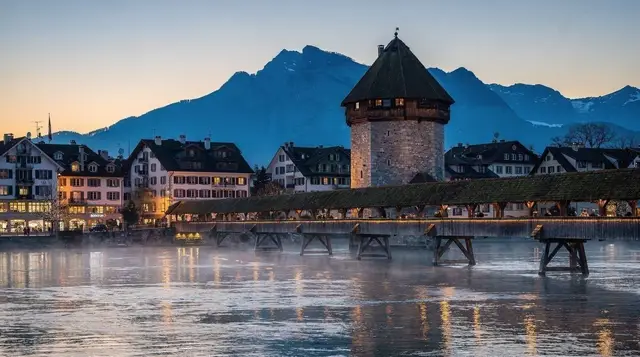
The Lion Monument sits just off Löwenplatz, on Denkmalstrasse, a short walk north of Lucerne’s old town. On foot from Luzern Bahnhof it’s about 15 to 20 minutes, mostly flat, and an easy add-on if you’re already doing the old town walking route past the Chapel Bridge and Water Tower. VBL city buses also stop at Löwenplatz, a couple of minutes’ walk from the site, which is worth using if you’re pressed for time or the weather has turned.
There’s no ticket, no gate and no fixed opening hours — the monument sits in a small public park with a viewing pond in front of the rock face, open around the clock. In practice most people visit during daylight, since the carving is unlit and hard to appreciate after dark. It genuinely takes only five to ten minutes to look at properly; the challenge isn’t time, it’s crowd density.
How to see it without the crowd
Löwenplatz is a fixed stop for a large share of the coach tours that pass through Lucerne on day trips from Zurich, Interlaken and beyond, and the viewing area in front of the pond is compact. Between roughly 09:30 and 15:00, expect several rows of people at the railing, tour guides talking over each other in different languages, and a queue for the classic photo angle. It clears out considerably before 09:00 and again after about 17:00, when you can often have the pond to yourself for a few minutes at a stretch — worthwhile if you actually want to read the inscription rather than just get a photo of having been there.
If mornings and evenings don’t fit your schedule, a guided walk that times its route around the coach schedule is the next best option. A local guide on a photography-focused walking tour will typically route past the monument outside the worst of the midday rush and can also help with the framing — the rock face is in partial shade for much of the day, which flattens photos taken straight-on.
The Glacier Garden, right next door
The Glacier Garden (Gletschergarten) sits directly next to the Lion Monument, close enough that most visitors do both in one stop. It’s built around a genuine geological accident: in 1872, quarry workers cutting sandstone at this exact spot uncovered a series of glacial potholes — smooth, cylindrical shafts drilled into the rock by swirling meltwater and grinding stones at the edge of a glacier roughly 20,000 years ago, during the last ice age. Some of the potholes are more than 9 metres deep. They were preserved in place rather than removed, and the museum has grown up around them since.
Beyond the potholes, the site includes a small museum on the history and geology of the area, a relief model of Switzerland, and a mirror maze built in 1896 in a Moorish revival style, which is more of a novelty add-on than a highlight. A rooftop platform gives a view back over the old town roofs.
As of recent seasons, adult admission runs around CHF 15-17, with reduced rates for children, students and families — check the current price on-site or on the Glacier Garden’s own website before you go, since Swiss museum pricing is revised most years. Opening hours are typically around 10:00-17:00 in winter and 09:00-18:00 in the summer months; the Glacier Garden, unlike the monument, does close on a schedule, so it’s worth checking hours if you’re arriving late in the day.
Whether the entry fee is worth it comes down to interest rather than budget. If glacial geology or 19th-century Swiss museum curiosities genuinely interest you, the potholes are a real, unusual thing to see up close, not a tourist-trap gimmick. If you’re mainly here for the Lion Monument itself, the Glacier Garden is an optional extra rather than an obligation.
Combining it with the rest of the old town
The Lion Monument works well as one stop on a longer loop rather than a destination in its own right, since the carving itself is quick to see. A natural half-day sequence starts at the Chapel Bridge and Water Tower, continues through the old town squares covered in the old town walking guide, climbs up to the Musegg Wall and its towers for a view over the rooftops, then finishes at Löwenplatz for the monument and Glacier Garden.
If you’d rather have someone else handle the route and the history along the way, a private guided walk through the old town typically covers the Chapel Bridge, the main old-town squares and the Lion Monument in a single loop of two to three hours, with the guide able to adjust the pace and timing around the coach-tour crowds. For a different angle on the same part of town, a sunset cycling tour covers more ground along the lakeshore and can swing past Löwenplatz in the quieter evening hours.
Museum-minded visitors sometimes fold in the Rosengart Collection or the Bourbaki Panorama, both a short walk from Löwenplatz and covered in the wider Lucerne museums guide. None of this needs booking in advance; the only site in this loop that has fixed hours and a ticket is the Glacier Garden.
What to look at once you are standing there
Most visitors photograph the lion and leave, but the carving rewards a slower look. Start with the face and the paw resting on the shield: the animal is not posed for the camera, and the sorrow is in the details rather than in any grand gesture. Then follow the line of the spear down to the wound, and let your eye travel to the fleur-de-lis on the shield, the one symbol that ties the scene back to the French crown and to the men who died serving it.
Next, read the Latin inscription beneath the lion. It is short, but it says what the whole monument is about: loyalty and bravery, offered by soldiers who had no say in the politics that doomed them. Taking a minute over those words is what turns a snapshot into a visit.
Finally, step back from the railing and look at the setting. The pond in front of the rock face is not decoration. It doubles the lion in the water on a still day and keeps visitors at a respectful distance, which is exactly why the viewing area fills so quickly when a coach party arrives. A calm morning, when the surface is flat, gives the best reflection and the quietest atmosphere.
Light, weather and photography
The rock face sits in partial shade for much of the day, so the carving can look flat in a straight-on photograph. Soft, even light from an overcast sky is often kinder to the relief than hard sun, and the wet stone after rain deepens its colour. If you want a clean image without other visitors in the frame, early morning is the realistic option, and it is also when the pond is most likely to be still.
Bring something for a drizzle, because the park is open-air and there is no shelter beside the pond. If the weather turns while you are in the area, the Glacier Garden next door is the natural indoor fallback, and the Lucerne museums guide lists further options within walking distance. For a wider view of when the city looks its best, the best time to visit Lucerne guide helps you choose a season.
Planning the visit around your day
Because the monument takes so little time, it fits almost anywhere in a schedule. Treat it as a pause rather than an outing: a short stop before breakfast, a quiet moment at the end of a day of sightseeing, or a gap between a museum and lunch. Arriving early or late keeps it peaceful, and neither option costs you anything extra.
If you are building a longer plan, the Lucerne old town walking guide shows how the monument links to the rest of the centre on foot, while the Lucerne in one day page and the two-day itinerary show where a stop like this sits alongside the lake and the mountains. Visitors on a strict budget will find the monument an easy win, since it costs nothing and can be fitted around paid activities.
Practical details at a glance
| Lion Monument | Glacier Garden | |
|---|---|---|
| Cost | Free | Around CHF 15-17 (adult) |
| Hours | Open access, daylight recommended | Roughly 10:00-17:00 winter, 09:00-18:00 summer |
| Time needed | 5-10 minutes | 45-90 minutes |
| Quietest times | Before 09:00, after 17:00 | First hour after opening |
| Access | 15-20 min walk from station, or VBL bus to Löwenplatz | Same location, next to the monument |
If you’re planning your first visit to Lucerne and want to know how the Lion Monument fits into a wider schedule, the how many days in Lucerne guide and the first-time mistakes in Lucerne guide both cover where a stop like this sits relative to the lake, the mountains and the rest of the old town. For a tight one-day visit, the monument slots neatly into the route laid out in the Lucerne in one day itinerary, and it’s one of the free stops listed in the Lucerne free things to do guide alongside other no-cost sights.
Visitors arriving from Zurich on a tight schedule sometimes see the Lion Monument as part of a guided day out — a half-day tour from Zurich with a local guide typically covers the old town and the monument in a single half-day loop, useful if Lucerne is a side trip rather than your base.
If you’re building your own view of the city from above afterwards, the Lucerne viewpoints guide covers the Musegg towers and other spots within walking distance of Löwenplatz, and families splitting the day between culture and hands-on exhibits sometimes add the Swiss Museum of Transport, a short tram ride further along the lakeshore.
The context that’s easy to miss
It’s worth remembering, standing at the railing with a phone out, that this is a war memorial for men who died in a foreign country serving a foreign king, commemorated by their own countrymen decades later once the fighting was long over. The site draws crowds because it’s genuinely striking and conveniently placed near the old town, not because most visitors arrive already knowing the 1792 backstory. Reading the Latin inscription and knowing roughly what it commemorates — rather than treating it purely as a photo backdrop — is really the only thing that separates a five-minute stop here from a five-minute stop anywhere else in the old town.
If you want a slower, quieter angle on the same square, arriving at opening hours for the Glacier Garden next door has the added benefit of getting you to the monument itself before the day’s coach parties do.
Leave yourself a few quiet minutes afterwards, too. Sitting on the edge of the park once the crowd has thinned, with the lion still in view, is a better way to take in the memorial than rushing to the next sight. If you have time, a stroll back toward the old town along the route you came by lets the story settle, and the contrast between the stillness of the carving and the bustle of the centre is part of what makes the stop memorable.
City sightseeing tours on GetYourGuide
Verified deep-linked GetYourGuide tours. Book through these links and we earn a small commission at no cost to you.
GetYourGuide does not provide a product photo for this activity — the image shows the meeting point, photographed by us.