Free things to do in Lucerne
What can you see in Lucerne without paying anything?
Lucerne's best sights cost nothing to see: the Chapel Bridge and Spreuer Bridge, the Musegg Wall towers, the Lion Monument, the Jesuit Church and Hofkirche interiors, and several kilometres of lake and river shore. Budget CHF 0 for sightseeing and spend instead on coffee, a museum or a boat ticket if you want one.
Switzerland has a reputation for being expensive, and Lucerne doesn’t do much to dispel it: a coffee runs CHF 4.50 to 6, a beer CHF 6 to 8, and a mountain excursion can easily clear CHF 100 once the return cable car or cogwheel train is added. Against that backdrop, it’s worth knowing that the sights most visitors remember longest — the covered bridges, the medieval wall, the lake — don’t charge admission at all.
This guide sticks to things that genuinely cost CHF 0: no “free with a City Pass” workarounds, no first-Sunday-of-the-month exceptions. If you want the fuller list of paid sights too, see the Lucerne in one day guide or how many days in Lucerne you actually need. If money is genuinely tight, the companion piece on Lucerne on a budget covers eating and sleeping cheaply too.
The Chapel Bridge and the water tower
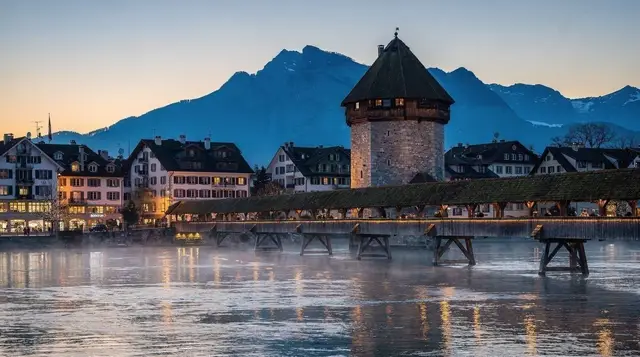
The Kapellbrücke, or Chapel Bridge, is Lucerne’s most photographed structure and its most misunderstood one. Most of what you’re looking at is a 1993 reconstruction: a fire in August 1993 destroyed roughly two-thirds of the wooden structure and about 80 of the 158 painted panels mounted under the roof trusses. The bridge was rebuilt within a year using the surviving timber as a template, and the panels that survived — depicting scenes from Swiss and Lucerne history — were restored and reinstalled alongside new copies.
It crosses the Reuss diagonally, connecting the right-bank old town to the left bank near the train station, and it’s open to pedestrians at all hours with no barrier or ticket booth. The octagonal Wasserturm, or water tower, stands beside it in the river and predates the bridge itself by several decades; it has served over the centuries as a treasury, an archive, a prison and a watchtower, and its interior is not open to the public, so don’t plan around going inside.
The best light for photos is early morning before the tour groups arrive, or blue hour just after sunset when the bridge is lit. For the full history of the panels and what each depicts, see the dedicated Chapel Bridge and water tower guide.
The Spreuer Bridge and the Dance of Death
A ten-minute walk downstream, the Spreuerbrücke gets a fraction of the Chapel Bridge’s visitors despite being the older of Lucerne’s two surviving wooden bridges in parts of its structure, and the only one that kept its original 17th-century panel cycle intact through the 1993 fire, since the fire didn’t reach it. The panels here, painted by Kaspar Meglinger in the 1630s, form a Totentanz, or Dance of Death — a series showing death as a skeletal figure interrupting people of every social rank, from pope to peasant, a common theme in post-plague European art.
It’s narrower, plainer and quieter than the Chapel Bridge, which is exactly its appeal if you’ve just fought through the crowds on the more famous one. The bridge sits near where the old grain market and mills once stood, hence the name — Spreuer refers to chaff, once thrown into the river here. Free, always open, no ticket.
Musegg Wall and its nine towers
Lucerne’s medieval fortifications are still largely intact along the north edge of the old town: a stretch of stone wall studded with nine towers, built mostly in the early 1400s. Several of the towers — typically including the Männliturm, Luegisland, Wachtturm and Zytturm — are open to climb for free during the open season, which runs roughly from April to early November depending on the year; they’re closed over winter and the exact opening dates move slightly year to year, so don’t build a January trip around them.
The Zytturm carries a clock that, by long-standing town privilege, is permitted to strike the hour a full minute before every other clock in Lucerne — a quirk locals will happily explain if you ask. Climbing the open towers gets you a rooftop view over the old town and the lake beyond, which is the free alternative to paying for a funicular ride if you just want elevation and a photo rather than alpine scenery; for higher, more dramatic viewpoints, see the separate Lucerne viewpoints guide.
Walking the full wall from end to end takes about 30 to 45 minutes if the towers are open and you climb a couple of them; allow closer to 20 minutes if you’re just walking past at ground level. Full details, including which towers are typically open in a given month, are in the Musegg Wall and towers guide.
The Lion Monument
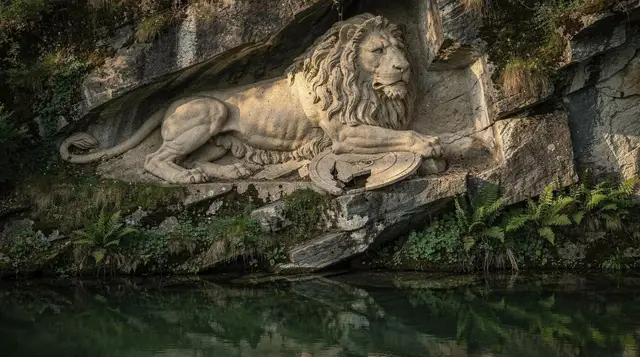
The Löwendenkmal is carved directly into a sandstone cliff face in a quiet park about a 15-minute walk from the old town, near the Glacier Garden. It commemorates the Swiss Guards killed defending King Louis XVI at the Tuileries Palace in Paris in August 1792 — roughly 760 of an 850-strong guard died in a single day. The design is by the Danish sculptor Bertel Thorvaldsen; the carving itself was done between 1820 and 1821 by the stonemason Lukas Ahorn.
Mark Twain called it “the most mournful and moving piece of rock in the world” after visiting in 1880, and the quote has stuck to the monument ever since — worth knowing before you arrive, since it sets expectations for what is, physically, a fairly small carved relief rather than a sprawling site. Give it five to ten minutes. It’s free, unenclosed and viewable at any hour, though it’s more atmospheric with fewer people around in early morning or early evening. The full Lion Monument guide covers the history in more depth if you want context before or after seeing it.
Walking the lake and river shores
Some of the best time in Lucerne costs nothing because it isn’t a sight at all — it’s the promenades. The Nationalquai and Schweizerhofquai run along the lakefront from near the train station and boat piers out past the grand 19th-century hotels toward the Swiss Museum of Transport, with benches, swans, and unobstructed views across Lake Lucerne toward Pilatus and the Rigi foothills. It’s flat, paved, and entirely walkable without a plan.
On the river side, both banks of the Reuss between the two bridges are lined with cafés, but you don’t need to sit down at one — walking the embankments past the old fishermen’s houses and the guild halls along Rathausquai and Unter der Egg gives you the same views as any paid river cruise, just from the bank instead of a boat. If you’d rather see it from the water, the Lucerne boat trips guide and the paddle steamer guide cover the paid options, and a private option is available too:
a private boat charter on Lake Lucerne if you want the lake to yourself rather than a scheduled public sailing.
For a longer free walk, the lakeside path continues well beyond the tourist core in both directions; a full route linking the old town’s free sights is sketched out in the old town walking guide.
The Jesuit Church
The twin green domes on the left bank of the Reuss belong to the Jesuitenkirche, built between 1666 and 1677 and generally credited as the first large Baroque church constructed north of the Alps. The interior is a full Baroque set piece — stucco, trompe-l’œil ceiling painting, and a pink-and-white colour scheme that’s warmer than the exterior suggests. Entry is free during opening hours, though the church closes to sightseers during Mass and other services, so a quick check of posted times avoids an awkward wait at the door.
It sits directly on the riverside promenade, so it’s easy to duck into on the way between the bridges and the station without a detour.
The Hofkirche and its organ recitals
The Hofkirche, or Church of St Leodegar, is the twin-spired church visible from much of the lakefront, a short uphill walk from the old town. The current building dates mostly from the mid-1600s after a fire destroyed most of an earlier Gothic church, though the two spires survived and are older than the rest. Entry is free, and the interior holds an elaborate late-Renaissance organ case and choir stalls worth the walk up alone.
Through the summer months, the church typically hosts free organ recitals on certain evenings — the exact days and dates vary by year and aren’t fixed far in advance, so treat this as something to confirm locally (a noticeboard at the church, or the parish’s own posted schedule) rather than something to build a fixed evening around before you arrive. If it lines up with your visit, it’s one of the better free things to do in Lucerne after dark, since the church has little other evening use for tourists.
Markets on the Reuss
Lucerne’s produce and flower market sets up along both embankments of the Reuss — Unter der Egg and the opposite bank — every Tuesday and Saturday morning, year-round, rain or shine. Stalls sell local cheese, bread, cured meats, flowers and seasonal produce; browsing is free and there’s no obligation to buy, though the food on offer is generally good value if you’re assembling a picnic for the lakeside promenade.
From spring through autumn, a flea market adds to the Saturday morning routine along the quay near Bürgenstrasse, worth a browse even if you’re not buying — it’s as much people-watching as shopping. Both markets wind down by early afternoon, so a Tuesday or Saturday morning is the window to catch them. More detail on where and what to buy is in the markets and street food guide.
Putting it together: a free half-day route
None of this needs a fixed order, but if you want a walkable loop starting and ending near the train station, this is roughly how the pieces connect:
| Stop | What it is | Time needed |
|---|---|---|
| Chapel Bridge and water tower | Covered bridge, painted panels | 15–20 min |
| Jesuit Church | Baroque riverside church interior | 10–15 min |
| Spreuer Bridge | Quieter bridge, Dance of Death panels | 10 min |
| Musegg Wall towers | Medieval wall, open towers, rooftop views | 30–45 min |
| Lion Monument | Rock-carved memorial | 5–10 min |
| Lakeside promenade | Nationalquai and Schweizerhofquai | 30–60 min |
| Hofkirche | Twin-spired church, free organ recitals in summer | 10–15 min |
Walked in that order, or reversed, the loop covers roughly 5 to 6 km and fits into three to four unhurried hours, longer if the markets are on or you climb every open tower. It threads through most of the old town, so it doubles as general orientation if this is your first day in Lucerne — see the Lucerne in one day guide for how to combine it with paid sights, or the 1-day itinerary for a fuller schedule.
If you’d rather not walk it yourself and want the layout explained as you go, a guided option covers the same ground with commentary:
a private walking tour of Lucerne’s old town is worth considering if you’d rather have the history narrated than read it off a plaque, and it can be timed around whichever of the free sights matter most to you.
What’s free versus what only looks free
A handful of Lucerne attractions get lumped in with the free sights in trip reports but actually charge admission, so it’s worth being clear about the boundary. The Glacier Garden, the Rosengart Collection and Lucerne’s other museums all charge entry — see the museums guide, the Glacier Garden guide and the Rosengart Collection guide for current prices.
Boat trips on the lake are paid unless you already hold a Swiss Travel Pass that covers regular navigation. Mountain excursions to Pilatus, Rigi and Titlis are all paid, often the single biggest line item in a Lucerne trip budget. None of that takes away from the free list above; it’s just worth knowing where the boundary actually sits before you plan a “free day” that quietly isn’t.
Getting around without spending on transport
Everything covered here sits within walking distance of the train station and the old town, so there’s no need to buy a bus ticket to see any of it. If your hotel is further out, the getting around Lucerne guide covers the VBL bus network and the hotel guest card that gives free local transport during your stay, which effectively makes even a peripheral hotel free to reach on top of everything above. For a broader look at what a Lucerne trip costs overall, including where these free sights fit against paid ones, see Lucerne travel costs and where to stay in Lucerne.
If you’d rather cover the ground faster than on foot, especially with limited mobility or limited time, a low-cost motorised option exists too:
a guided e-tuktuk tour around Lucerne’s old town hits most of these same landmarks in under an hour if you’re short on time or don’t want to walk the full loop.
Timing it around the calendar
A few of Lucerne’s free sights get considerably busier at certain times of year. Fasnacht, Lucerne’s carnival in February, fills the old town and its bridges with costumed crowds and brass bands — worth experiencing but not a quiet, contemplative version of any of the above; see the Fasnacht guide for what to expect. Summer weekends bring the heaviest bridge and lakefront crowds of the year, while a weekday morning outside July and August is close to the quietest this list gets. The events and festivals guide has the fuller calendar if you’re planning around a specific date.
City sightseeing tours on GetYourGuide
Verified deep-linked GetYourGuide tours. Book through these links and we earn a small commission at no cost to you.
GetYourGuide does not provide a product photo for this activity — the image shows the meeting point, photographed by us.