Lucerne in one day: the itinerary that avoids doubling back
What's the best order for a single day in Lucerne?
Start at Chapel Bridge before 8am while it is empty, then walk up to the Musegg Wall towers before the mid-morning queue forms. Cover the Old Town and lakefront through midday, eat lunch away from the bridge to avoid the markup, then spend the afternoon on a lake cruise or at the Lion Monument. This order means you cross the river once, not four times, which is the biggest time-waster for first-time visitors.
The order that saves you the most walking
Lucerne’s Old Town is small enough to see everything in a day, which is exactly why most visitors waste an hour of it. The station and the boat pier sit next to each other at the base of the river, and nearly every sight, the bridge, the wall, the museums and the lakefront, is within a 15-minute walk of that point. The mistake is treating the itinerary as a checklist instead of a loop: people photograph the bridge, walk to the wall, come back down for lunch near the bridge again, then walk back up to the lake. That is three crossings of the same river for things that sit on a single, sensible route.
The order below does it once: river first while it is quiet, uphill to the wall before the crowd builds, back down through the Old Town for lunch away from the tourist prices, then the lake or the Lion Monument in the afternoon depending on what you care about more. It assumes you arrive by train and start at Luzern Bahnhof, which is how most people reach the town given that Zurich Airport is under an hour away by direct train. For the full breakdown of what a longer stay adds on top of this, see how many days you actually need in Lucerne.
| Time | Stop | Why this order |
|---|---|---|
| 7.30–8.15am | Chapel Bridge and the Water Tower | Empty before tour groups arrive |
| 8.15–8.45am | Coffee near the Old Town, not on the bridge | Same coffee, half the price a street back |
| 8.45–10.15am | Musegg Wall and the open towers | Queue-free before mid-morning |
| 10.15–11.30am | Old Town streets, Kapellplatz, Weinmarkt | Shops open, light is even for photos |
| 11.30am–12.15pm | Lion Monument and the Glacier Garden area | Short walk from the Old Town, quieter at this hour |
| 12.15–1.15pm | Lunch away from the riverside terraces | Avoids the tourist-price zone |
| 1.30–4.30pm | Lake cruise, cycling loop, or a museum | Pick one, not all three |
| 4.30–5.30pm | Back along the lakefront promenade | Late-afternoon light on the water |
Before 8am: Chapel Bridge and the Water Tower to yourself
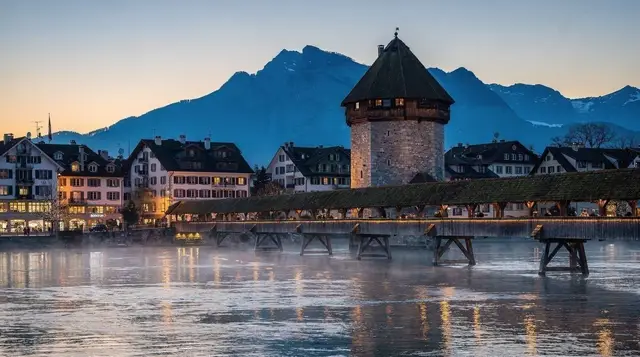
Chapel Bridge (Kapellbrücke) is the wooden covered bridge with the octagonal Water Tower at its bend, and it is the single most photographed thing in Lucerne, which means it is also the most crowded by mid-morning. A 1993 fire destroyed most of the original roof paintings; what you see now is largely a careful reconstruction, and the surviving panels are worth slowing down for rather than walking past.
Get there before 8am if you can. Cruise passengers and coach groups do not typically arrive until closer to 9.30 or 10am, so the window between sunrise and breakfast is the only reliable stretch when you can walk the bridge without weaving through people, or get a clean photograph down its length. If you are staying in the Old Town, this costs you nothing but an earlier alarm. The full history and a slower walking route through this stretch of riverfront is covered in the guide to Chapel Bridge and the Water Tower.
Walk both banks of the Reuss while you are here: the water plunges over a low weir just downstream of the bridge, and the Jesuit Church’s baroque towers are visible from the south bank without a detour.
Mid-morning: the Musegg Wall towers, before the queue
From the bridge, it is a 10 to 12 minute walk uphill to the Musegg Wall, the medieval fortification that still rings the north side of the Old Town. Nine towers survive; three, Männli, Zyt and Schirmer, are open to climb for free, typically from April to November depending on weather and maintenance, and the Zyt tower has a clock that has rung the hour a minute before every other clock in the city since the 1600s, a quirk locals still bring up unprompted.
This is the one part of the day where timing genuinely matters. Go before 10am and you will likely have a tower to yourself; go after 11am, especially in July or August, and the narrow spiral staircases create a real bottleneck. There is no ticket and no gate, so the only cost of getting this wrong is standing in a stone stairwell behind six other people. Full opening details and which towers give the best rooftop views are in the guide to the Musegg Wall and its towers.
If you would rather not manage the timing yourself, an guided e-tuktuk tour of the Old Town covers the wall’s viewpoints along with the bridge and Lion Monument in a fixed loop, which removes the planning at the cost of a set schedule.
Late morning: Old Town streets and the Lion Monument
Coming back down from the wall, the Old Town’s frescoed buildings around Hirschenplatz, Weinmarkt and Kornmarkt reward slow walking rather than a fixed route. These squares were the town’s medieval market centre, and several façades still carry 16th and 17th-century paintings that most visitors walk past without noticing because there is no signage pointing them out. A slower, guided version of this stretch, with the context that the plaques leave out, is in the Old Town walking guide.
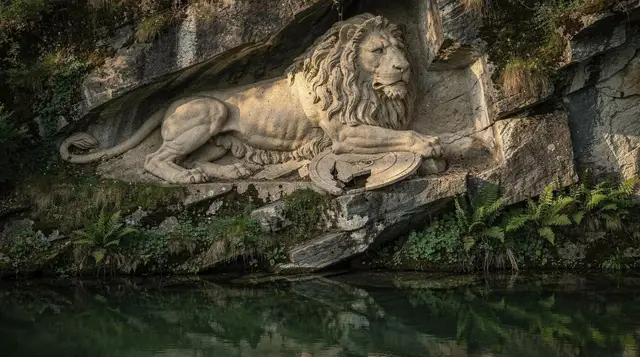
From here it is a 15-minute walk (or a short bus ride on VBL route 8) to the Lion Monument, the sandstone relief cut into a rock face commemorating the Swiss Guards killed defending the Tuileries Palace in 1792. Mark Twain called it the most mournful piece of stone in the world, and it is genuinely affecting in a way photographs of it undersell, but it is also small: budget 15 to 20 minutes, not more, and combine it with the nearby Glacier Garden if you have time and want a longer stop. The dedicated guide to the monument covers both in one visit.
For a slower alternative to walking, the private walking tour lets a local guide set the pace through this same stretch and adds context on the buildings that self-guided visitors typically miss.
Midday: where to eat without wrecking your budget
Switzerland is expensive and Lucerne’s riverside terraces price accordingly: a plate of rösti with a drink on the Reuss-facing terraces near the bridge commonly runs CHF 30 to 40. That is not a rip-off exactly, you are paying for the view, but it is avoidable if the budget matters to you.
| Where | What you get | Rough price |
|---|---|---|
| Terraces on the bridge/riverside | Rösti, schnitzel, view of the water | CHF 30–40 |
| Old Town side streets, one block back | Same dishes, no river view | CHF 20–28 |
| Migros or Coop restaurant near the station | Self-service hot meal, salad bar | CHF 15–22 |
| Bakery or Konditorei sandwich | Sandwich, pastry, coffee | CHF 10–15 |
A bakery lunch eaten on a bench by the lake is a completely normal way to do the midday break in Lucerne, and it buys you back 30 to 45 minutes compared with sitting for a full restaurant meal, time that is better spent on the lake in the afternoon. If chocolate is more your interest than lunch logistics, the chocolate-making tour doubles as a mid-afternoon activity rather than strictly a meal. For a broader sense of what a day of eating and moving around actually costs here, see the page on Lucerne travel costs.
Early afternoon: the lake, a boat, or a viewpoint
This is the one decision point in the day, and it is worth making before you arrive rather than standing at the pier working it out. Three reasonable options, and you should pick one, not attempt all three:
A short lake cruise. A return trip on one of the historic paddle steamers toward Weggis or Vitznau takes roughly 90 minutes round trip and gives you the Alpine backdrop, the Rigi and Pilatus foothills rising straight from the water, that the town itself does not offer. The Swiss Travel Pass covers regular scheduled sailings; without it, expect to pay for a return ticket at the pier. Full timetables and which route suits a short window are in the guide to Lucerne’s boat trips and the paddle steamer routes.
A cycling loop along the shore. The lakefront path toward Weggis is flat, well-surfaced and genuinely pleasant, and an e-bike loop covers considerably more shoreline than walking in the same window of time. If you would rather have someone else manage the route and the boat connection, the private boat cruise on the lake is the equivalent option without the pedalling.
One museum, chosen deliberately. The Swiss Museum of Transport is excellent but needs two to three hours minimum, which does not fit neatly into a single afternoon slot alongside everything else on this list; treat it as a reason to add a second day rather than squeeze it in. The Rosengart Collection, with its Picasso and Klee holdings, fits a one-hour window better if a museum is what you want. Neither replaces the lake for most first-time visitors, but both beat sitting in a café if the weather has turned.
If you’d rather trade the boat for something more active, the guided cliff path walk above the lake is a shorter, guide-led alternative that fits the same afternoon window and does not require a full mountain excursion day.
Getting around on foot vs the VBL buses
Everything in this itinerary sits inside a roughly 20-minute walking radius of the station, so a transport pass is not necessary for a Lucerne-only day. Walking is genuinely the fastest way to move between the bridge, the wall and the Old Town, since the streets are narrow, one-way for cars, and the bus routes loop rather than run in straight lines.
The exception is the Lion Monument in warm weather or if you are short on time: VBL bus 8 runs there directly from the station area, and a single ticket bought from the machine or the VBL app costs a few francs, cheaper than buying a day pass you will not otherwise use. If your day also includes a trip up Pilatus or Rigi, that changes the transport maths entirely, since both the Swiss Travel Pass and the regional Tell-Pass become worthwhile the moment a mountain excursion enters the plan; that is a separate day’s budgeting, covered in the comparison between the Swiss Travel Pass and the Tell-Pass. For a plain explanation of tickets, zones and where to buy them, see getting around Lucerne.
What to skip when you only have a day
A single day forces choices, and the itinerary above already assumes you are cutting some things. Specifically:
- Skip a mountain excursion. Pilatus, Rigi and Titlis each need the better part of a day on their own, counting the cogwheel train or cable car, the summit time, and the descent. Trying to add one to a town-focused day means rushing both. If a mountain matters to you, compare Pilatus, Rigi and Titlis and plan a second day around whichever fits your interests.
- Skip the full lake loop. A complete circuit of Lake Lucerne by boat takes most of a day by itself; the short return sailing described above gives you the same visual payoff in a fraction of the time.
- Be selective with museums. One museum, chosen deliberately, fits. Two does not, not without cutting the Musegg Wall or the lake, and those two are the parts of Lucerne that are hardest to replicate elsewhere.
- Don’t plan around Fasnacht or festival dates unless you’re chasing them. Lucerne’s carnival week reshapes the town’s rhythm entirely, closes some streets, and is worth experiencing on its own terms rather than as a backdrop to a standard sightseeing day.
If any of this pushes you toward staying longer, the two and three-day itineraries build directly on today’s route by adding a mountain and a slower half-day around the lake.
Practical notes before you go
Lucerne’s weather changes quickly given its lake and mountain setting, so check conditions the morning of your visit rather than relying on a forecast from days earlier; the monthly weather breakdown gives a realistic sense of what to expect by season. Water from any tap in the city is safe to drink, which is worth knowing if you want to skip buying bottled water between stops. Card payment is accepted almost everywhere, including small bakeries, but carrying CHF 20 to 30 in cash covers the rare machine-only ticket kiosk or market stall.
If your day in Lucerne is a stopover between the airport and somewhere else, the door-to-door route from Zurich Airport to Lucerne runs about an hour by direct train, which makes this itinerary realistic even as a single day sandwiched between flights.
Questions about spending one day in Lucerne
Is one day really enough to see Lucerne properly?
It is enough to see the compact Old Town, Chapel Bridge, the Musegg Wall, the Lion Monument and take one short boat trip, but not enough to also go up a mountain. If Pilatus, Rigi or Titlis are on your list, that needs its own day, so plan two days if a mountain excursion matters to you.
What time should I get to Chapel Bridge to photograph it without crowds?
Before 8am. By 9.30am tour groups and cruise-day visitors fill the covered walkway, and by midday it is difficult to get a clear shot down the length of the bridge. Early morning light also sits better on the Water Tower than the flat midday sun.
Are the Musegg Wall towers worth the climb?
Yes, and they are free. Three of the nine towers, Männli, Zyt and Schirmer, are open to climb (roughly April to November, weather dependent), and the platform views over the Old Town rooftops and lake are better than most viewpoints you would pay for.
Where can I eat lunch in Lucerne without overpaying?
Avoid the terraces directly on Kapellplatz and the riverside by the bridge, where a simple lunch runs CHF 30 to 40. A short walk to the Old Town’s back streets or the Migros or Coop restaurant near the station gets a filling lunch for CHF 15 to 22.
Is a lake cruise worth it if I only have a few hours?
A short return trip toward Weggis or Vitznau on a paddle steamer, about 90 minutes round trip, fits into an afternoon and gives you the Alpine backdrop that the town itself does not. A full loop of the lake takes most of a day and does not fit a one-day itinerary.
Do I need a transport pass for a single day in the Old Town?
No. Everything in this itinerary is within a 20 to 25 minute walk of the station, so a VBL bus ticket or a day pass is only worth buying if you are also going out to Verkehrshaus or up a mountain, since the Swiss Travel Pass and Tell-Pass are priced for multi-day use, not a single town-only day.
What should I cut if I am running short on time?
Cut the Rosengart Collection or the Bourbaki Panorama before you cut the Musegg Wall or the lake. The museums are good but replaceable on a return visit; the free outdoor sights are what makes Lucerne worth the stop in the first place.
City sightseeing tours on GetYourGuide
Verified deep-linked GetYourGuide tours. Book through these links and we earn a small commission at no cost to you.
GetYourGuide does not provide a product photo for this activity — the image shows the meeting point, photographed by us.