Where to see Lucerne and the lake from above
What is the best viewpoint in Lucerne?
The Männli tower on the Musegg Wall gives the closest rooftop view of the old town for free, but the Gütsch terrace and the KKL roof are better for a wide shot that includes the lake and Mount Pilatus. None of them beats Pilatus or Rigi for altitude — they are city viewpoints, not mountain ones.
Five ways to rise above the old town
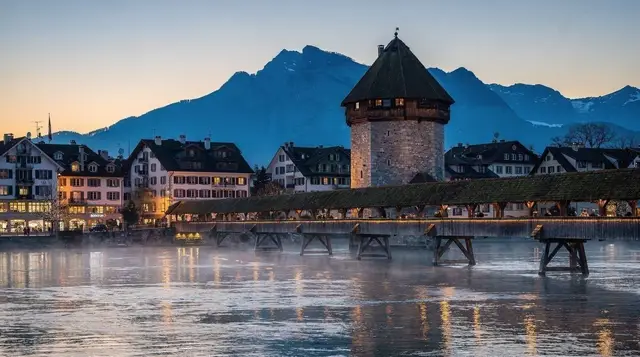
Lucerne doesn’t need a cable car to be photographed from above. The old town sits in a bowl between the Reuss river, the lake and a ring of low, wooded hills, and several of those hills — plus one tower and one concert hall roof — give a genuinely useful view without the time or expense of a mountain excursion.
None of the five below gets you above 700 metres; for that you want the mountain excursions from Lucerne, starting with Mount Pilatus or Mount Rigi. What follows is for the half-day or the hour before dinner, when what you want is the roofline of the old town, the Chapel Bridge from a distance, and the lake stretching off towards the Alps.
The Männli tower on the Musegg Wall
The Männliturm — the “little man tower,” named for the weathervane figure on its roof — is one of nine surviving towers on the Musegg Wall, the fortified perimeter that has ringed the north side of Lucerne’s old town since the 14th century. It’s the tower most visitors are actually allowed inside, and it gives the closest, most detailed view over the old town: red-tiled roofs, the twin spires of the Hofkirche, and the lake beyond.
Access is on foot from the old town, a ten-to-fifteen-minute walk uphill from the station or the Chapel Bridge, following signs for the Musegg Wall walk described in our wall and towers guide. The towers open seasonally, roughly from April to November depending on weather and maintenance work, and are free. There’s no lift and no barrier control — you simply climb the stone stairs — so it’s not a good choice for anyone with mobility issues or small children who don’t like heights. Go in the late morning or early afternoon for the clearest light on the roofs below; by evening the tower itself is in shadow.
Gütsch: a funicular and a hotel terrace
Gütsch is the small, tree-covered hill directly behind Lucerne station, topped by the turreted Hotel Château Gütsch and reached by the Gütschbahn, a short funicular that has run since 1884 from a modest station on Baselstrasse, a few minutes’ walk from the train station. The ride itself takes under two minutes; a single ticket costs a few francs and isn’t covered by the Swiss Travel Pass, though the walk up on the Gütschweg footpath is free and takes about 20 to 25 minutes at a steady pace.
The payoff at the top is a wide, open terrace looking straight down the length of the old town to the lake and Pilatus beyond — arguably the single best framed shot of the city, since you’re high enough to see the whole roofline but close enough that it doesn’t flatten into a postcard. The hotel restaurant terrace is open to non-guests for a coffee or a drink, which buys you time to sit rather than snap and leave. Go for the funicular if you’re short on time or the weather is uncertain; walk up if you’d rather see the residential streets on the way and don’t mind the climb.
Dietschiberg: the quiet side
Dietschiberg sits on the opposite bank of the Reuss from the old town, above the Utenberg district, and is the viewpoint locals actually use — mostly because tour groups don’t. From the top you look back across the river towards Pilatus and the old town roofline from a different angle than any of the others on this list, with the lake opening out to the southeast.
It’s reachable by city bus (VBL) from the station area to a stop within a 15-minute walk of the top, or on foot from the old town in about 45 minutes, gaining roughly 150 metres of elevation along wooded paths. There’s a restaurant near the summit with a terrace, useful for a lunch stop rather than a quick look. Because it’s a genuine walk with no funicular shortcut, it suits travellers who want hiking near Lucerne more than a five-minute photo stop — pair it with an early start if you’re also planning a boat trip or mountain excursion the same day.
Sonnenberg: the sun mountain
Sonnenberg, true to its name, catches the evening light later than almost anywhere else around the city. It rises above the lakeside district of Lucerne beyond the KKL, reached by the Sonnenbergbahn funicular from a station on Haldenstrasse, close to the lake promenade and a comfortable walk from the Lion Monument. The ride is short and inexpensive, and the residential hillside it climbs is quiet — mostly villas and gardens rather than anything geared to tourism, which is part of the appeal.
From the top, the view looks south and west down Lake Lucerne, with Pilatus dominating the far shore and, on a clear day, glimpses towards the Bernese Alps. There’s no restaurant terrace to speak of at the summit itself, so this is a viewpoint to visit rather than linger at — good for a sunset stop on the way back from a lakeside walk, less useful if you want somewhere to sit with a drink.
The KKL roof terrace
The KKL Luzern — the Culture and Convention Centre designed by Jean Nouvel, right beside the train station on the lakefront — isn’t a hill at all, but its cantilevered roof extends out over the lakeside square and gives a genuinely different kind of view: low, close to the water, looking straight down the lake rather than down onto the town. Standing under the vast steel canopy at dusk, watching the paddle steamers and the lake buses come in below, is one of the better free things to do in the city and is covered in our guide to free things to do in Lucerne.
It costs nothing, needs no ticket, and is accessible directly from the station forecourt — no climb, no funicular, no walk longer than five minutes. The trade-off is that it’s a view of the lake and the station square rather than of the old town roofs; for that, you want the Männliturm or Gütsch. It’s at its best in the last hour before sunset, when the light comes low across the water and the building’s steel roof picks up the colour.
Comparing the five
| Viewpoint | Elevation gain | How to get there | Cost | Best for |
|---|---|---|---|---|
| Männli tower (Musegg Wall) | ~40 m, on foot | 10–15 min walk from the old town | Free | Close-up over the old town roofs |
| Gütsch | ~90 m | Gütschbahn funicular (2 min) or 20–25 min walk | A few CHF for the funicular, free on foot | The single best framed shot of the city |
| Dietschiberg | ~150 m | VBL bus + short walk, or 45 min on foot | Free (bus fare if used) | A quiet, uncrowded angle across the river |
| Sonnenberg | ~200 m | Sonnenbergbahn funicular from Haldenstrasse | A few CHF for the funicular | Late light and a quick sunset stop |
| KKL roof terrace | None — lake level | On foot from the station, 2–5 min | Free | The lake itself, not the old town |
Timing and what gets missed
The single biggest mistake is treating one of these as a substitute for Pilatus or Rigi rather than a complement to them. At 700 metres or less, none of the five gets you above the tree line or gives the alpine panorama that the two mountains do; what they offer instead is a close, legible view of the city itself, which the mountains — 2,000 metres up and several kilometres away — actually lose.
If you only have one day in Lucerne, our one-day guide puts the Männliturm and the KKL terrace in the itinerary because they cost almost no time; Gütsch, Dietschiberg and Sonnenberg are better suited to a second or third day, covered in the multi-day itineraries.
Weather matters more than most visitors expect. Lucerne sits in a basin that traps low cloud and haze, especially in autumn and winter mornings; the Musegg towers and Gütsch can be genuinely socked in while the mountaintops above the cloud layer, on Pilatus or Rigi, are in full sun. Check the webcams before committing a morning to any of these five, and don’t assume a city viewpoint guarantees a view.
For a different, guided way to string several of these together — old town streets, riverside, and a stop at height — a private walking tour or an electric tuk-tuk tour of the city covers more ground in less time than doing it alone on foot, particularly useful if mobility or short daylight hours are a constraint.
Travellers who’d rather cover the lakeside hills by bike can book a guided sunset cycling tour along the lake timed to be at height when the light is best. If you’d rather go with someone who knows the routes and the timings, a private walking tour of Lucerne can be built around two or three of these viewpoints in a single outing.
None of these five is a hike in the mountain sense, but travellers who want more of a climb and a cliffside view rather than a hilltop one should look further afield, towards Bürgenstock and its cliff path above the lake — bookable as a private guided trip along the Bürgenstock cliff path — or take the view from the water itself on a private cruise on Lake Lucerne, which puts the hills, the old town and Pilatus all in the same frame from below rather than above.
Getting between them
None of these five viewpoints is directly connected to the others by a single ticket, and only Gütsch and Sonnenberg have their own funiculars — the Männliturm and the KKL terrace are reached on foot, and Dietschiberg needs a VBL bus or a proper walk. If you’re travelling with a Swiss Travel Pass or a Lucerne guest card, the city buses are covered, which takes care of Dietschiberg; the two funiculars are usually not included and are cheap enough to pay for on the spot. Full details on which pass covers what are in our Swiss Travel Pass guide and getting around Lucerne.
Families travelling with young children will find the Männliturm’s steep, unguarded stairs and Sonnenberg’s lack of amenities less practical than the flat, open KKL terrace or the Gütsch terrace with its café — see Lucerne with kids for a fuller rundown of which sights suit which ages. Anyone building a longer stay around the city’s museums and viewpoints together should also check the Lucerne museums guide — several, including the Bourbaki Panorama and the Rosengart Collection, sit within walking distance of the Musegg Wall route.
FAQ: choosing a Lucerne viewpoint
What is the best free viewpoint in Lucerne?
The Männli tower on the Musegg Wall is free, open in season, and gives the closest view over the old town’s red roofs. The Sonnenberg and Dietschiberg viewpoints are also free once you’ve walked or bussed up; only the Gütschbahn funicular charges a fare.
Do I need to pay to visit the Musegg Wall towers?
No. The Musegg Wall and its climbable towers, including the Männliturm, are free and open to the public during the season, roughly April to November, weather and maintenance permitting.
Is the Gütsch worth the funicular ride?
For most visitors, yes, if you want a sit-down terrace view without climbing. The Gütschbahn is a short, old-fashioned ride and the hilltop terrace by Hotel Château Gütsch looks straight down over the old town roofs to the lake and Pilatus.
Which Lucerne viewpoint is best at sunset?
The KKL terrace and lakeside promenade face west down the lake, so they catch the evening light well and cost nothing. Sonnenberg, whose name literally means sun mountain, also holds the light later than the old town streets below.
Can I walk to these viewpoints instead of taking transport?
The Männliturm and the KKL terrace are walkable from the station in under fifteen minutes. Gütsch, Dietschiberg and Sonnenberg all involve a real climb of 25 to 45 minutes on foot, or a short funicular, bus or cable car if you’d rather not.
Are these viewpoints better than Pilatus or Rigi?
No, and they’re not trying to be. Pilatus and Rigi put you above the treeline with alpine panoramas; the five viewpoints here are hills and towers around the city itself, useful for a half-day when a mountain trip doesn’t fit the schedule.
City sightseeing tours on GetYourGuide
Verified deep-linked GetYourGuide tours. Book through these links and we earn a small commission at no cost to you.
GetYourGuide does not provide a product photo for this activity — the image shows the meeting point, photographed by us.