The Rosengart Collection: Picasso and Klee in the heart of Lucerne
What is the Rosengart Collection in Lucerne and is it worth visiting?
The Rosengart Collection (Sammlung Rosengart) is a compact museum on Pilatusstrasse holding around 300 works, mostly Paul Klee and Pablo Picasso, assembled by art dealer Angela Rosengart, a personal friend of Picasso. It is worth a visit if you have 60-90 minutes and an interest in either artist; it is not a large day-filling museum like the Swiss Museum of Transport.
A dealer’s private collection, built on friendship
The Rosengart Collection is easy to underestimate from the outside. It occupies a former Swiss National Bank building on Pilatusstrasse, five minutes’ walk from Luzern Bahnhof, behind a plain neoclassical facade that gives no hint of what is inside: around 300 works by Paul Klee and Pablo Picasso, plus a handful of pieces by Cézanne, Miró, Matisse, Braque and others who passed through the same circles. What makes the collection unusual is not its size but its origin. This was not bought at auction by a museum board. It was assembled over decades by one woman, Angela Rosengart, who ran her family’s art dealership on the same street and who became a genuine friend of Picasso in his later years.
That friendship shows up literally on the walls. Several of the Picasso works here are portraits of Angela Rosengart herself, painted or drawn by Picasso during visits to his studio in the south of France. Seeing a painting of the collection’s own founder, hanging a few metres from the desk where she once sold Picasso prints to Lucerne’s wealthier residents, gives the museum a personal quality that larger, more anonymous Picasso collections in Paris or Barcelona do not have.
Who Angela Rosengart was
Angela Rosengart was born in Lucerne in 1932, the daughter of Siegfried Rosengart, an art dealer who had built relationships with Picasso and other major 20th-century artists from the 1930s onward. Angela took over the family gallery and continued the connection to Picasso directly, visiting him regularly at his home in Mougins in the years before his death in 1973. Picasso trusted her judgement enough that she handled sales of his work for collectors across Europe, and he painted her portrait more than once as their friendship developed.
The collection on display today is the private side of that career: works Rosengart kept for herself rather than sold on, built up over roughly 50 years of dealing. In 2002 she donated the entire collection, plus the building to house it, to a public foundation, which is why entry is ticketed like any museum rather than run as a commercial gallery.
What is actually in the collection
The core of the museum is two artists in roughly equal weight, which is unusual for a single-collector museum:
- Paul Klee — around 125 works spanning his career, including watercolours, drawings and oil paintings. Klee was Swiss-German and this is one of the largest concentrated Klee holdings anywhere, larger in depth than what you will see in a single room at most national galleries.
- Pablo Picasso — around 50 paintings, drawings and sculptures, plus a set of portrait photographs of Picasso and his family taken by the American photojournalist David Douglas Duncan, who had close access to Picasso’s household in the 1950s and 1960s.
- A smaller supporting group — works by Cézanne, Braque, Matisse and Miró, shown mainly to give context to Klee and Picasso rather than as a collection in their own right.
Because the collection is a single dealer’s personal taste rather than a curated historical survey, the hang feels different from a national gallery. You will not get a chronological march through Picasso’s Blue Period, Cubism and late work in strict order. Instead rooms group works by theme or by decade of Rosengart’s own acquisitions, and portraits of Rosengart herself are placed among the wider Picasso holdings rather than set apart as a curiosity.
The building, and the real size of the museum
Do not plan a half day around this. The Rosengart Collection is a former bank building with two main exhibition floors, and it takes most visitors 60 to 90 minutes to see properly, closer to two hours if you read every wall text and linger with the Klee watercolours, which reward slow looking more than a quick pass. Compare that with the Swiss Museum of Transport, a genuinely large day-out museum on the edge of town, and the contrast is stark — Rosengart is a concentrated, quiet visit, not a destination in itself for a full day.
The building’s former use as a bank is still visible in details like the vault-era proportions of some rooms and the restrained, formal facade. Inside, the galleries are well lit, air-conditioned and rarely crowded, which makes it one of the more comfortable indoor options in Lucerne on a hot or wet afternoon.
| What to expect | Detail |
|---|---|
| Floors | Two exhibition floors |
| Typical visit length | 60–90 minutes |
| Busiest works | Picasso portraits of Angela Rosengart, Klee watercolours |
| Photography | Not permitted in the galleries |
| Crowd level | Low to moderate, quieter than the old town sights |
Opening hours, prices and how long to allow
Hours vary slightly by season, so treat the following as a planning guide rather than a guarantee, and check the current schedule before you set off:
| Item | Approximate detail |
|---|---|
| Opening hours (April–October) | Daily, roughly 10:00–18:00 |
| Opening hours (November–March) | Daily, shorter hours, roughly 11:00–17:00 |
| Adult admission | Around CHF 18 |
| Concessions (students, seniors) | Around CHF 10 |
| Under 16 | Usually free with an accompanying adult |
| Swiss Museum Pass | Accepted |
| Last entry | Typically 30–45 minutes before closing |
Prices at Swiss museums are reviewed most years, and CHF 18 is not a small ask for a 60–90 minute visit, so it is worth deciding in advance whether Klee and Picasso are a priority for your trip rather than adding it on impulse. If your main interest in Lucerne is scenery and mountains rather than 20th-century painting, your money is probably better spent on a lake or mountain ticket instead.
Getting there
The museum sits on Pilatusstrasse, about 400 metres from Luzern Bahnhof and the lake promenade, which makes it one of the easiest sights in Lucerne to reach on foot — no bus or funicular required. If you are coming from the old town side of the river, it is a flat 10–12 minute walk across the Seebrücke or Kapellbrücke. Combine it naturally with a walk through the old town, or with the Chapel Bridge if you are working your way along the riverbank.
Rosengart against Lucerne’s other museums
Lucerne has more museum choice than its size suggests, and it helps to know where Rosengart sits among the options before deciding how to split a limited number of days. For a full rundown of every museum in town, see the Lucerne museums guide.
| Museum | Focus | Typical visit | Best for |
|---|---|---|---|
| Rosengart Collection | Picasso and Klee | 60–90 min | Modern art fans, quiet indoor time |
| Glacier Garden | Geology, ice-age potholes, mirror maze | 60–90 min | Families, quirky Lucerne history |
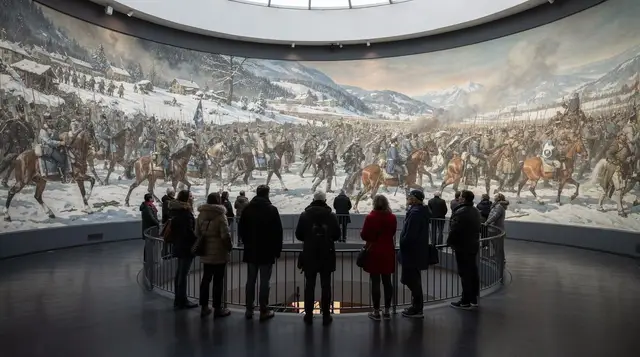
| Bourbaki Panorama | 1871 circular war panorama | 30–45 min | A single striking sight, quick stop |
| Swiss Museum of Transport | Trains, planes, cars, planetarium | Half day+ | Families, a full day out |
A separate Picasso Museum also exists in Lucerne’s old town, inside the Am-Rhyn-Haus, showing late-period Picasso drawings and Duncan photographs from Picasso’s final years. It is smaller again than Rosengart and sells its own ticket — worth knowing so you do not turn up expecting one collection and find a different one.
How to look at Klee and Picasso without rushing
Klee and Picasso ask for different kinds of attention, and the museum is small enough that you can give each of them what they need. Klee’s works on paper are intimate and often modest in scale, so the trick is to stand close, let your eyes adjust to the colour and the line, and resist the urge to move on after a few seconds. Picasso, by contrast, tends to announce himself from across the room. A good rhythm is to walk each floor once quickly to get your bearings, then go back to the three or four works that held your attention and spend your time there.
Do not feel obliged to read every label. A handful of well-chosen pauses beats a tired march past every frame. If you are not sure where to begin, start with the portraits of Angela Rosengart herself: they tie the building, the founder and the artist together, and they make the rest of the collection easier to follow. Visitors who arrive knowing little about either painter often leave remembering the portraits and the Klee watercolours best.
Before your first visit: practical tips
- Carry less. Galleries like these are more pleasant without a big rucksack. If you are arriving by train with bags, the luggage and left luggage guide explains where to leave them near the station, which is only a short walk away.
- Choose your slot. Weekday mornings are the quietest, as the quick answer above notes. If you are also visiting other sights that day, the Lucerne in one day plan shows where a museum stop fits.
- Check the discount at the desk. If you hold a rail or museum pass, the Swiss Travel Pass guide explains what such passes usually cover, and the desk can confirm what applies here.
- Mind the rules. Photography is not allowed in the galleries, so plan to look rather than shoot, and keep your phone in your pocket.
- Think about step-free access. If anyone in your group has limited mobility, the accessibility in Lucerne guide is a useful starting point, and it is worth asking the museum directly about the layout of its floors.
If you are weighing this museum against other ways to spend a limited trip budget, the Lucerne travel costs guide and the Lucerne on a budget guide help you decide where an entrance fee is worth it. And if you are still learning the town, the first-time mistakes in Lucerne guide is a short read that saves wasted hours.
A good museum for the wrong weather
Lucerne’s weather is changeable, and an art museum is one of the most reliable fallback plans when the clouds settle over the lake and the mountain views disappear. Rather than watching a cable car ticket go to waste under low cloud, many travellers swap in a quiet indoor morning and keep the mountain for a clearer day. The Lucerne weather month by month guide helps you see the pattern across the year, while the guides to Lucerne in winter and Lucerne in autumn suggest how indoor stops like this one balance outdoor plans in the colder, greyer months.
The same logic works in reverse on a hot summer afternoon, when a cool, calm gallery is a welcome break from the crowds along the waterfront. Pair it with a slow coffee and something sweet afterwards: the coffee and bakeries guide and the food tour guide point to places worth a stop on the walk back towards the old town.
Travelling with children or a mixed group
A museum of paintings is not every child’s idea of a good time, but a short visit can work if you set it up well. Give younger visitors a small mission, such as finding the most colourful picture or the portrait they like best, and keep the visit brief rather than testing their patience. The Lucerne with kids guide covers the places that suit families better, and the Swiss Museum of Transport guide describes the hands-on alternative if the group is split between art lovers and restless explorers.
Where Rosengart fits in a longer stay
On a short trip, Rosengart is a pleasant extra rather than a headline sight. On a longer stay it earns its place more easily, because there is time to spread out the indoor stops and avoid museum fatigue. The two-day Lucerne itinerary and the first-timer three-day itinerary both leave room for a slower cultural hour, and you can adapt either one by swapping a museum in or out depending on the weather and your energy.
Building it into a Lucerne day
Rosengart works best slotted into a walking day in the town centre rather than treated as a standalone outing, since it sits so close to the station and the river. A reasonable sequence for an art-and-old-town morning: start at Chapel Bridge and the Water Tower, walk the old town streets on the walking guide, see the Lion Monument, then finish at Rosengart before lunch, since it opens later and closes earlier than the outdoor sights. If you have energy left, the Musegg Wall towers are a short detour uphill with the best free view over the old town roofs.
For visitors balancing culture against Lucerne’s outdoor draws, the best free things to do guide and the Lucerne viewpoints guide both cover the no-cost alternatives if a CHF 18 ticket does not fit the budget that day. If you are still deciding how many days to give Lucerne overall, the how many days in Lucerne guide accounts for museum time like this alongside the mountains and lake.
Families splitting a day between culture and something more physical for children often pair a short Rosengart visit with the Swiss Museum of Transport later in the day — worth booking ahead with the Swiss Museum of Transport entrance ticket so the queue at the door doesn’t eat into the afternoon. If instead you’d rather spend the second half of the day outdoors after a morning of galleries, an easy contrast is a private sunset cycling tour along the lakeshore, which covers ground on wheels rather than on foot and works well once museum legs have had enough walking.
Travellers who want one more indoor-outdoor mix before the day ends sometimes add a guided walk along Lucerne’s cliff path for views over the lake that most day-trippers miss entirely. And for anyone travelling with children who found the galleries a hard sell, a hands-on chocolate bar-making tour from Lucerne is a reliable way to end the day on the kids’ terms rather than the parents’.
Where you stay affects how easy this all is logistically — see where to stay in Lucerne if you have not booked yet, and getting around Lucerne for how the VBL bus network and walking distances fit together. If shopping is also on the list for the same stretch of town, the Lucerne shopping guide covers the streets near Pilatusstrasse and the old town in the same walkable loop, and the destination overview for Lucerne ties all of this back to the wider city.
Museum & art tours on GetYourGuide
Verified deep-linked GetYourGuide tours. Book through these links and we earn a small commission at no cost to you.
GetYourGuide does not provide a product photo for this activity — the image shows the meeting point, photographed by us.