Lake Lucerne boat trips: paddle steamers, routes and tickets
What is the difference between a Lake Lucerne boat trip and the full crossing to Flüelen?
A short loop from the Lucerne pier runs about an hour and returns you to the same dock, costing around CHF 30-40 second class. The full run to Flüelen takes roughly three hours one way, covers the scenic southern arm of the lake past Rütli and Tellsplatte, and costs more unless it's already included in a Swiss Travel Pass or Tell-Pass.
Getting on the water at Lucerne
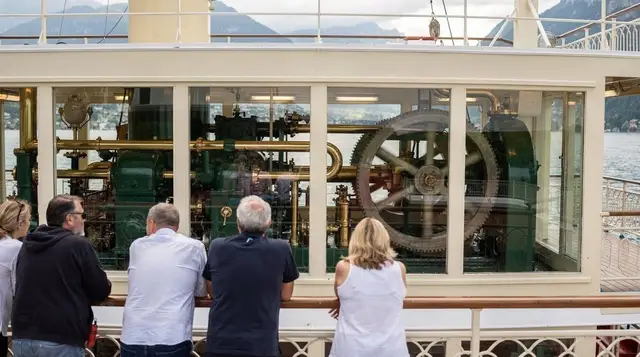
The main pier sits directly in front of Lucerne’s train station, on the lake side of the building, so there’s no separate trip to reach it. Boats depart from here on a fixed timetable operated by SGV (Schifffahrtsgesellschaft des Vierwaldstättersees), the company that has run scheduled services on Lake Lucerne since the 19th century and still uses steam-era paddle vessels alongside modern motor boats.
Lake Lucerne’s German name, Vierwaldstättersee, shows up on timetables and boat liveries, but everything in English-language signage and this guide uses Lake Lucerne. The lake is shaped like a cross with four irregular arms, which is why a short loop from the town centre and a full end-to-end crossing show you almost entirely different scenery.
The five paddle steamers
Five historic paddle steamers are still in scheduled service, which is unusual anywhere in Europe:
| Steamer | Built | Notes |
|---|---|---|
| Uri | 1901 | Oldest of the fleet, still coal- or oil-fired |
| Unterwalden | 1902 | Restored saloon interiors |
| Schiller | 1906 | Named for the playwright behind the William Tell legend |
| Gallia | 1913 | Largest capacity |
| Stadt Luzern | 1928 | Newest, Art Deco fittings |
They run mixed in with newer motor vessels through the day, and you don’t choose which boat you get when you buy a standard ticket — it depends on the timetable slot. If riding a genuine paddle steamer matters to you rather than any lake boat, check the vessel column on the SGV timetable (posted at the pier and in the SBB app) before boarding, since motor boats cover plenty of the same routes.
The short loop versus the Flüelen crossing
This is the real decision to make, and it changes both the price and the day.
The one-hour loop. Several short round trips leave from Lucerne, looping out past the lower slopes of the mountains and back to the same pier without landing anywhere. It’s a reasonable way to see the old town and the Chapel Bridge from the water, and works well if you have an hour to spare between other plans. It costs roughly CHF 30-40 second class without a pass, and it does not reach the narrower, steeper southern arm of the lake, which is where the scenery gets genuinely dramatic.
The full run to Flüelen. This is the length of the lake, roughly three hours one way on a paddle steamer (closer to two and a half on a faster motor boat), calling at Weggis and Vitznau, Brunnen, the Rütli meadow where the Swiss Confederation is said to have been founded, and Tellsplatte, before finishing at Flüelen.
From Flüelen a direct train gets you back to Lucerne in about 40 minutes, so a sensible plan is boat out, train back, rather than doing the full return crossing by water. A one-way second-class fare without a pass runs roughly CHF 40-80 depending on where you board and current SGV pricing; a same-day return by boat both ways costs more and eats most of a day.
Most first-time visitors are better served picking a middle distance — Vitznau or Brunnen — rather than committing to the full Flüelen run on a first trip. It gives you the scenic southern stretch without the full half-day commitment.
Choosing the right distance for your day
The simplest way to decide is to start from what else you want to do. If the morning is already taken by the old town or a museum, the short loop slots into a free hour without disturbing anything. If you have a full day and decent weather, a middle-distance trip to Vitznau, Weggis or Brunnen turns the boat into the main event, with time to step off, walk along the shore and take a later sailing back. The full Flüelen run suits travellers who like the journey itself and don’t mind spending most of a day on it.
Weather matters more than most people expect. On a clear day the southern arm is the reason to go further, because the mountains close in on both sides and the water turns a deeper colour. On a grey or hazy day, the extra hours on board give you less to look at, and a short outing or a different plan altogether may be the better choice. Look at the forecast the evening before, and keep the best time to visit Lucerne and the month-by-month weather guide in mind when you pick your dates.
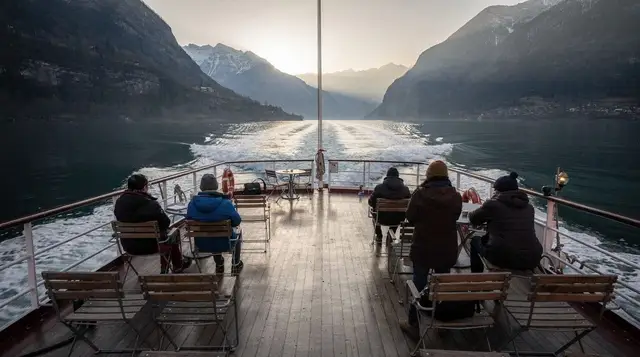
Another way to think about it is how you like to travel. Some visitors prefer to sit on the open deck from the first minute to the last. Others want a seat in the saloon with a coffee and the occasional trip outside when something worth photographing appears. Both styles work on the lake, and neither needs a different ticket. What changes is how long you want to be on board, and that is the only real decision.
What you see on the way
Leaving the Lucerne pier, the first impression is the city itself: the Chapel Bridge, the lakefront hotels and the towers of the Musegg wall on the hill behind. Further out the shoreline becomes greener and more wooded, with villas and small harbours, and the two big mountains take shape on either side. Pilatus rises on one side and Rigi on the other, and from the water you understand why each has its own railway and its own loyal following.
Beyond the landings at Weggis and Vitznau, the lake narrows and the character changes. The cliffs get steeper, the villages sit on small patches of flat land between mountain and water, and the boat spends more time in shadow on a bright day. This is the stretch that Lake Lucerne is known for, and it is the part you miss entirely on the short loop. The landings at Brunnen and later Flüelen are quieter than the Lucerne pier, and the announcements on board switch between several languages as the boat goes along.
For history, the Rütli meadow and Tellsplatte are the two places that explain why the lake matters to Swiss people. The first is tied to the founding story of the Confederation, the second to the legend of William Tell. The boat gives you a view of both from the water, and many visitors find that more atmospheric than reading about them. If the legend interests you, the Lion Monument in town and the paddle steamer named after Schiller complete the picture.
What tickets actually cost
Prices below are second class, adult, without any discount card, and are broadly representative rather than fixed — SGV adjusts fares by season and route length, so treat these as planning figures rather than a quote.
| Route | Approx. one-way | Approx. journey time |
|---|---|---|
| Lucerne short loop (return) | CHF 30-40 | ~1 hour |
| Lucerne to Weggis | CHF 20-28 | ~1 hour |
| Lucerne to Vitznau | CHF 22-30 | ~1 hour 15 |
| Lucerne to Brunnen | CHF 30-40 | ~2 hours |
| Lucerne to Flüelen | CHF 40-55 | ~3 hours (paddle steamer) |
Half Fare Card holders pay half these fares. First class typically adds a supplement of a few francs per route and gives access to the more comfortable upper-deck saloons on the paddle steamers, which matters more on the longer Flüelen run than on a short hop.
a private boat charter out of Lucerne is the alternative if you want your own schedule rather than the fixed timetable — useful for a small group, an anniversary, or simply avoiding the crowds on a summer scheduled sailing.
What the Swiss Travel Pass covers
The Swiss Travel Pass includes free travel on all scheduled SGV boats on Lake Lucerne — the short loop, the Weggis and Vitznau runs, and the full Flüelen crossing are all included with no supplement in first class if that’s your pass tier. This is one of the pass’s better-value inclusions given how expensive the longer routes are individually.
What it does not cover: private charters, dinner or evening cruises run as special sightseeing products rather than scheduled timetable services, and the funicular link up to Bürgenstock from the lake (that’s a separate operator). If you’re weighing up whether the pass makes sense for your trip at all, a Swiss Travel Pass covering train, bus and boat travel is worth pricing against your planned routes before buying, since it only pays off once your rail and boat total exceeds the pass price.
The regional Tell-Pass is the other option worth knowing about if you’re staying in central Switzerland specifically rather than travelling more widely: it bundles the Lake Lucerne boats with the region’s cable cars and cogwheel railways — Pilatus, Rigi, Stanserhorn and Titlis among them — for a fixed number of days, and can undercut the Swiss Travel Pass if mountains, not long-distance trains, are your priority.
Half Fare Card holders without the full Swiss Travel Pass still get 50% off standard boat fares, which is usually enough of a saving to be worth the card if you’re also using it on trains elsewhere in the country.
Combining a boat with a mountain
The most efficient way to use the lake is as one leg of a mountain day rather than a destination on its own. The boat from Lucerne to Alpnachstad connects with the Pilatus cogwheel railway, and the boat to Vitznau connects with the Rigi rack railway — both are built into the scheduled timetable with reasonable connection times, so you can go up one way and come down a different route (cable car from Pilatus to Kriens, or the Arth-Goldau railway off Rigi) without doubling back on yourself.
Check the last connecting boat or train down before you commit to a summit in the afternoon; mountain railways and lake boats both thin out their schedules after early evening, and missing the last connection from a mountain station means a longer, more expensive route back. Rack railways up Pilatus and Rigi also close for scheduled maintenance in spring and autumn depending on snow, so confirm the season is right before building a day around them.
If you’d rather stay on the water longer than a single crossing, an a private luxury boat cruise on Lake Lucerne lets you set your own route and stop where you like, which the scheduled timetable doesn’t allow.
Alternative ways onto the lake
Scheduled SGV boats aren’t the only way onto the water. An e-bike combined with a short lake crossing is one option for covering ground on both land and water in a single outing — a guided e-bike tour that includes a Lake Lucerne crossing links several lakes in the region rather than staying on Lake Lucerne alone. For something entirely different, kayaking and stand-up paddleboarding on the calmer stretches near the town shore are covered separately in the guide to Lake Lucerne watersports.
Reading the timetable and planning connections
The timetable is the most useful tool you have, and the Lucerne boat timetables explained guide walks through it in detail. The short version: pick your outbound boat first, then choose your return by train or by a later boat, and check that the last departure leaves you a comfortable margin. Boats in the early and late part of the season run less often than in high summer, so a plan that works in July may need adjusting in spring or autumn.
If you are collecting experiences rather than just ticking off a route, the paddle steamers guide explains which vessels are worth planning around. For travellers who want to compare lakes, the Lake Thun and Brienz cruises and the Lake Zurich boat trips offer a different mood, and the Rhine boat trips are another option if you extend your stay.
Where a boat trip fits in a longer stay
A boat trip sits easily in most plans. On a short stay it can be the one outing beyond the city, and the one day in Lucerne plan shows how to fit it around the main sights. On a longer stay, the two-day and three-day itineraries use the lake as a connector to the mountains, so you travel by water when the weather is good and keep museums for the wet afternoons. If you are staying a week or more, the boat becomes a convenient way to reach villages on the shore that make quiet bases, and the day trips from Lucerne guide lists what else is within easy reach.
Boats also help with the logistics of a mixed group. Older relatives, young children and people who dislike steep mountain railways can all enjoy the lake without effort, and the accessibility guide covers what to expect at piers and on board. If you are building a day around several moves, the getting around Lucerne guide shows how boats, trains and buses fit together.
Choosing between a scheduled boat and a private one
The scheduled boat is the right default. It is simple, it is covered by the passes, and the shared deck is part of the experience. A private boat makes sense when the group is small and wants control over the pace, when the occasion is special, or when the scheduled timetable simply doesn’t line up with the day you have. You choose where to stop, how long to stay and when to turn back. The trade-off is that you give up the paddle steamer atmosphere and the low cost of a ticket you may already hold on a pass, so it is worth deciding in advance which of the two matters more to you.
Practical notes
- Boarding. Arrive at the pier 10-15 minutes before departure in summer; the short loops and Vitznau/Weggis runs get busy on clear afternoons between June and September.
- Onboard food. Most paddle steamers and larger motor boats have an onboard restaurant or snack counter serving basic Swiss food and drink at prices similar to a mid-range Lucerne café — bring your own if you’d rather not pay boat prices.
- Weather. Services run in most conditions but can be shortened or cancelled in strong wind or fog; check the SGV status page or ask at the pier kiosk on a marginal-looking day.
- Photography. The open upper deck of the paddle steamers gives the best photo angles of the Bürgenstock cliff and the mountains; it’s exposed to sun and wind, so dress for the deck rather than the saloon.
- With children. The short loop and the Weggis or Vitznau runs work well for families; the full Flüelen crossing is long for younger children unless combined with a mountain stop partway. See the family day trips guide for age-appropriate combinations.
Boat trips on Lake Lucerne are one of the few genuinely well-organised parts of a Lucerne itinerary — the timetable connects cleanly with the mountain railways, the fleet is easy to use without advance booking, and the Swiss Travel Pass removes the fare question entirely if you already hold one. The only real decision is how far up the lake to go, and for most visitors that’s worth pushing past the short loop at least as far as Vitznau or Weggis.
Lake cruises & boat tours on GetYourGuide
Verified deep-linked GetYourGuide tours. Book through these links and we earn a small commission at no cost to you.
GetYourGuide does not provide a product photo for this activity — the image shows the meeting point, photographed by us.