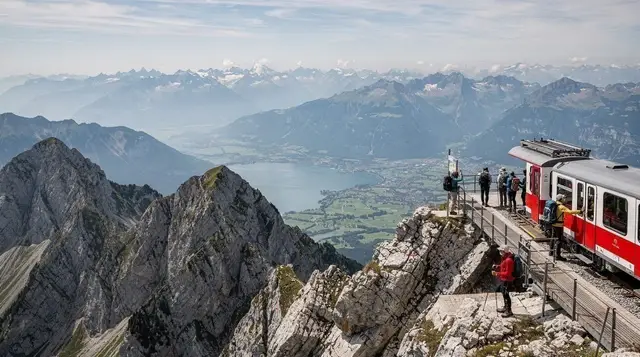
Mount Titlis: the Rotair, the glacier cave and the Cliff Walk
What's the best way to visit Mount Titlis from Lucerne?
Take the train from Lucerne to Engelberg (about 45 minutes), then the Titlis Rotair revolving cable car up to the summit in three stages. A return ticket runs to roughly CHF 96 for adults, and buying online a day ahead usually knocks off around 20%. Set aside a full day, and check the mountain's live status page before you leave — the top section closes in poor visibility and shuts entirely for a week or so each spring and autumn for maintenance.
Titlis is the one glacier you can reach from Lucerne without a mountaineering qualification, and it charges for the privilege. At 3,238 metres it’s the highest of the lake’s big peaks, and it’s the only one where you step out of a cable car onto real snow and ice in July as well as January. That’s the whole appeal, and it’s also why it costs more than Pilatus or Rigi and pulls a bigger crowd.
This is what’s actually up there, what it costs, and the two things that catch people out: altitude and the maintenance closures.
Getting to Titlis from Lucerne
The base station is in Engelberg, not Lucerne, so the day starts with a train. From Luzern Bahnhof it’s a direct regional train to Engelberg, roughly 45 minutes, running about twice an hour. There’s no need to book the train in advance.
From Engelberg station it’s a short walk (about 10 minutes) or a local bus to the Titlis Bahnen valley station. From there the ascent runs in three stages:
- Gondola, Engelberg to Trübsee (1,796 m) — an eight-seat gondola, about 6 minutes.
- Cable car, Trübsee to Stand (2,428 m) — a larger cabin, about 4 minutes.
- Rotair, Stand to Titlis (3,238 m) — the revolving cable car, about 5 minutes.
Including waiting time at each stage, plan on 60–90 minutes each way on a normal day, longer at midday in high season when queues build at Trübsee. If you’re combining Titlis with other stops, see our guide to best mountain excursions from Lucerne for how it fits against a full day versus a half day.
Self-drivers can park at Engelberg and skip the train; there’s no road up the mountain itself, so the cableway is the only way up regardless.
The Rotair: the world’s first revolving cable car
The Rotair is the reason Titlis gets photographed more than it needs to be. The cabin’s floor rotates a full 360 degrees during the five-minute run from Stand to the summit, so every passenger gets a turn facing the glacier, the crevasses below, and — on a clear day — south towards the Bernese Alps. It was the first cable car of its kind when it opened, and it’s still the main mechanical draw rather than a gimmick tacked on for tourists.
It’s an enclosed cabin, so there’s no wind or cold to worry about during the ride itself; the discomfort, such as it is, starts once you’re out at the top.
Inside the glacier cave
At the summit, a lift and a short walk lead down into the glacier itself: a man-made tunnel roughly 150 metres long, carved into real glacier ice and lit in blue and white. It’s included in the standard ticket, takes 10–15 minutes to walk through, and stays at a constant few degrees below freezing regardless of the season outside — bring a layer even if you were fine on the terrace.
The ice moves, so the tunnel is re-cut periodically; what you see is genuine glacier, not a fixed installation, which is worth knowing if a review from a few years back describes something slightly different.
The Cliff Walk: Europe’s highest suspension bridge
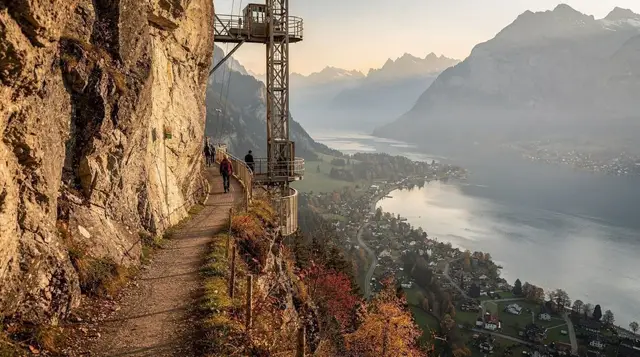
The Cliff Walk is a 100-metre steel suspension bridge fixed to the cliff face at 3,041 metres, built in 2012 and still billed as the highest of its kind in Europe. It’s a flat, boarded walkway with handrails on both sides — not a rope bridge and not an adrenaline activity in the technical sense — but it’s fully exposed to the wind and the drop is real, so it’s not for anyone with serious vertigo.
It’s included in the standard ticket. It closes in high wind or storm conditions, the same weather that also curtails the Rotair’s open views, so a bad-weather day can mean the bridge simply isn’t an option. Check the live status page on the operator’s site the morning you go, not the week before.
Trübsee: the lake halfway up
Trübsee, the middle station at 1,796 metres, is easy to treat as a transfer point and skip — that’s a mistake if the weather at the summit is marginal. It’s a genuine alpine lake with a flat lakeside path, several restaurants, and views that are often clearer than the summit’s when cloud sits on Titlis itself. In summer there’s a via ferrata and hiking trails from here into the Engelberg valley; in winter it’s a beginner ski and toboggan area with its own lift network, separate from the glacier runs higher up.
If you’re travelling with young children or anyone unsteady on cable cars, Trübsee alone — skipping the Stand and Rotair stages — is a legitimate half-day out at a fraction of the summit ticket price.
Altitude, thin air and how people feel it
3,238 metres is not extreme altitude, but it’s high enough that a fast, unacclimatised ascent by cable car can produce mild symptoms in a minority of visitors: headache, shortness of breath on exertion, or light dizziness. It tends to hit children, older travellers, and anyone with an existing heart or lung condition more than fit adults, and it’s rarely more than uncomfortable — it resolves within an hour or two back down at Trübsee or in Engelberg.
If you or anyone in your group has a known heart condition, it’s worth a word with a doctor before booking, the same caution that applies to Jungfraujoch, which sits higher still. For most visitors the practical fix is simple: don’t sprint between viewpoints at the top, drink water, and head down a stage if anyone feels off rather than pushing on.
Winter versus summer: what’s actually open
Titlis operates in both seasons, but the experience changes more than the marketing suggests.
| Winter (Dec–Apr) | Summer (Jun–Sep) | |
|---|---|---|
| Rotair, glacier cave, Cliff Walk | Open | Open |
| Skiing and snowboarding | Open, groomed glacier runs | Closed |
| Ice Flyer chairlift and snow park | Open | Closed or scaled back |
| Trübsee lakeside path, hiking trails | Under snow | Open |
| Via ferrata (Trübsee) | Closed | Open |
| Typical summit temperature | -10 to -2°C | -2 to 6°C |
For skiing specifically, see our roundup of skiing day trips from Lucerne; for a broader look at the region once the snow settles, Lucerne in winter covers what else changes.
The dates in between — roughly May and again in October to November — are when the cableway itself closes for a maintenance period of about a week, sometimes longer if repairs run over. This is the single biggest cause of ruined day plans: people book Engelberg accommodation or a Lucerne stopover around Titlis without checking, then arrive to a shut cableway. Always confirm current operating days on the official status page before you commit a date, especially if you’re travelling in the shoulder seasons — see best time to visit Lucerne for how that lines up with the rest of the region.
Prices and passes
Adult return tickets from Engelberg to Titlis run to roughly CHF 96 at full price, with online booking a day or more in advance typically cutting that by around 20%. Children pay less, and the Half Fare Card and Swiss Travel Pass both give a 50% reduction on the cableway rather than free passage — see our Swiss Travel Pass guide for what the pass does and doesn’t cover on this route.
| Fare | Approx. price (CHF) |
|---|---|
| Adult return, full price | ~96 |
| Adult return, online advance | ~77 |
| With Half Fare Card / Swiss Travel Pass | ~50% off |
| Child (6–15) | ~half adult fare |
| Trübsee only, adult return | ~35 |
Prices move year to year and with the exchange rate, so treat these as a planning guide rather than a quote — confirm on the operator’s site before you travel. For getting between stations in Lucerne itself before the trip out, see getting around Lucerne.
Tips for a day that’s worth the money
Go early. The first departures from Engelberg see noticeably shorter queues at Trübsee than anything after 10am, and cloud is statistically more likely to build over the glacier as the day warms.
Layer up regardless of season. The summit sits on permanent ice; even a warm Lucerne morning doesn’t mean a warm summit, and the glacier cave alone justifies a proper jacket.
Don’t buy the ticket blind if the forecast is bad. The website publishes live webcams and operating status for the Cliff Walk and Rotair rotation — a cloud-bound summit still lets you walk the glacier cave, but the photographs and the bridge views are the main draw, so a genuinely poor forecast is a reason to swap the day around rather than push through it.
Combine it sensibly. A full Titlis round trip from Lucerne with reasonable time at the top is a full day, not a half day — trying to fit in another mountain or town on the same date usually means shortchanging one of them. If you’d rather have the logistics handled, a guided day trip from Lucerne to Engelberg and Mount Titlis takes care of the train and cableway connections in one booking.
First-time winter visitors who want ski gear and lessons sorted in advance can look at a beginner ski experience on Mount Titlis, while anyone starting further out can join a day trip from Zurich covering Lucerne, Engelberg and Titlis in one loop.
If cable cars aren’t your thing but the region still appeals, a self-guided option like the self-guided Lucerne city and mountain experience lets you set your own pace, and thrill-seekers can add a tandem paragliding flight over Lake Lucerne or Engelberg onto the same trip.
Titlis versus the lake’s other mountains
Titlis isn’t a straight upgrade on Pilatus or Rigi — it’s a different kind of day. Pilatus has the world’s steepest cogwheel railway and is reachable from Lucerne in under an hour with no second cableway change. Rigi has the widest panoramic views over the lake itself and two separate approach routes. Titlis is the only one with a real glacier, and it’s also the priciest and most crowded, plus the only one requiring a change of town first.
Our comparison of Pilatus versus Rigi versus Titlis goes through the trade-offs in more detail, and families weighing which mountain suits younger children should see Rigi and Pilatus with kids — Titlis’s altitude and cave temperatures make it a slightly tougher day for very small children than either of those two.
If you’re building out a longer stay, how many days in Lucerne and our 3-day Lucerne itinerary both slot a Titlis day in against the city’s other essentials, and the wider day trips from Lucerne guide sets it against Pilatus, Rigi and the region’s other options side by side.
Mount Titlis: questions before you go
How high is Mount Titlis and how long does the journey up take?
The summit station sits at 3,238 metres. From Engelberg it’s three stages — gondola to Trübsee, cable car to Stand, then the revolving Rotair to the top — and the ride itself takes about 40 minutes if the connections line up. Add waiting time at busy stages and it’s closer to an hour door to door.
Is Mount Titlis worth it if I’ve already done Pilatus or Rigi?
Titlis is a genuine glacier, not just an alpine viewpoint, so the experience is different — you’re on snow and ice year-round, with a cable car, a suspension bridge and an ice cave that the other two peaks don’t have. It’s also the most expensive and the most crowded of the three, so it’s worth it for the glacier itself, not for solitude.
Can Mount Titlis cause altitude sickness?
At 3,238 metres it’s on the low edge of where altitude effects start, and the cable car gets you there with no acclimatisation at all. A minority of visitors feel a mild headache, breathlessness or dizziness, more often children, older travellers and anyone with a heart or lung condition. It resolves quickly back down at Trübsee or Engelberg and is rarely more than uncomfortable.
Is the Cliff Walk safe and is it included in the ticket?
The Cliff Walk is included in the standard Titlis ticket. It’s a fixed steel suspension bridge, not a rope activity, and is safe in normal conditions, but it closes in high wind or storms — the same conditions that also ground the Rotair’s open-air viewing, so check the status page rather than assuming it’ll be open.
What’s closed on Mount Titlis in winter versus summer?
In winter the glacier park’s snow tubing and the Ice Flyer chairlift run alongside skiing, while some warm-weather trails around Trübsee are under snow. In summer the glacier cave, Cliff Walk and Trübsee’s lakeside path are all open, but there’s no skiing and the glacier snow park is scaled back. The Rotair, glacier cave and Cliff Walk itself run in both seasons bar the spring and autumn maintenance closures.
Do I need special gear to visit Mount Titlis?
A warm jacket, gloves and sturdy shoes are enough for most visitors even in summer, since the summit sits on permanent snow and ice and the wind chill is real. You don’t need crampons or hiking boots to reach the viewing terraces, the glacier cave or the Cliff Walk — they’re all paved or boarded.
Does the Swiss Travel Pass cover Mount Titlis?
The Swiss Travel Pass covers the train to Engelberg in full but only gives 50% off the Titlis cableway itself, which still leaves a meaningful cost on top. The Half Fare Card gives the same 50% reduction on the cableway and is cheaper to buy if Titlis is the only excursion on your trip.
Mountain excursions on GetYourGuide
Verified deep-linked GetYourGuide tours. Book through these links and we earn a small commission at no cost to you.
GetYourGuide does not provide a product photo for this activity — the image shows the meeting point, photographed by us.