The quiet shore of Lake Lucerne
Why I keep going back to the shore without a railway
Most people who come to Lake Lucerne ride the boat to Weggis or Vitznau, on the north shore, because that’s where the railway is and where the cable cars up Rigi start. I understand why. It’s efficient, and the views back towards the city are genuinely good. But the shore I keep returning to is the other one: the south bank between Kehrsiten and Beckenried, where there has never been a railway line at all, because the rock comes down into the water almost vertically below Bürgenstock. No flat shelf, no track bed, no train. Just boats, and a handful of piers where the boat only stops if you ask it to.
That last part is what makes the south shore feel different from anywhere else on the lake. At Lucerne’s main quay, or at Weggis, boats run to a fixed timetable and stop regardless. Further along, past Kehrsiten, several piers switch to what the timetable prints as a request stop: the boat calls only if a passenger has told the crew they’re getting off there, or someone on the jetty presses a button or signals as the boat comes in. If nobody does either, the boat sails on. I found this out the slow way, standing on a nearly empty pier watching a boat continue past without slowing, before a local walking her dog told me about the button on the post I’d been standing next to.
Kehrsiten and the funicular nobody photographs
Kehrsiten is the main gateway to the south shore, and it works because it isn’t trying to be a destination itself — it’s a boat pier with a funicular station attached, nothing more. The funicular climbs from the lake straight up to the Bürgenstock plateau in a few minutes, gaining several hundred metres of height that would otherwise take the best part of an hour on foot. It runs year-round, though services thin out badly outside the main season, and I’d check the current timetable rather than assume an hourly service in November.
What struck me the first time was how few people got off with me. The boats stopping at Weggis or Vitznau empty out in a rush; at Kehrsiten it was four or five of us, most heading up to the resort for lunch rather than to explore. That thinness is the whole appeal of this shore. You’re not fighting anyone for a photograph.
Bürgenstock: the terrace, the cliff path, and the ferry that waits
Once up on the plateau, the obvious walk is the Felsenweg, the cliff path that runs along the ridge with the lake dropping away beneath it. It’s free to walk, open to day visitors and not just hotel guests, and takes under an hour if you don’t linger — though I lingered, because the angle down onto the water from up there is one I hadn’t seen from any other viewpoint around the lake, including the higher ones on Pilatus. The path narrows in a couple of sections and closes after heavy rain or ice, which is worth knowing if you’re visiting in shoulder season rather than midsummer.
For a slower, guided version of the same ground, with someone explaining what you’re looking at rather than working it out from a signboard, there’s an option to walk the Bürgenstock cliff path with a private guide, which suits a first visit better than it sounds like it should. If you’d rather stay on the water and see the same shoreline from below the cliffs instead of above them, a private cruise along Lake Lucerne gives you the option to slow down at Bürgenstock without worrying about the public timetable at all.
Beckenried and the piers where you have to wave
Further along, past Kehrsiten, the shore gets even quieter. Beckenried is the next proper stop, a plain village with a pebble beach and a cable car up to Klewenalp that most visitors to the lake have never heard of. It isn’t a destination I’d plan a whole day around, but as a pier to get off at when everyone else stays on the boat, it does the job. Between Beckenried and Brunnen, further round towards Küssnacht on the other side of the lake, several smaller landings work the same request-stop way, and the timetables printed at each pier tell you clearly which ones need a signal.
I’ll admit the first couple of times I found this faintly stressful — standing on an empty jetty, unsure whether I’d pressed the button correctly, watching a distant boat that may or may not be about to swing towards me. It always came. But it’s a different kind of travelling than the frictionless, everything-on-schedule Switzerland most visitors expect, and I think that’s exactly why this shore stays quiet: it asks something of you that the north shore doesn’t.
A morning I’d repeat
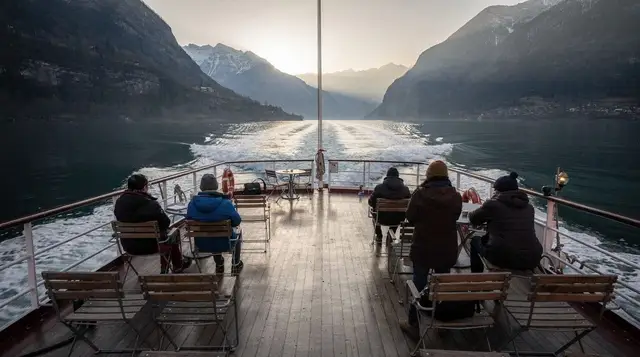
The best morning I had here started on an early boat out of Lucerne, past Weggis and across to Kehrsiten before nine, up the funicular while the terrace café at the top was still setting out chairs, along the cliff path with almost nobody else on it, and back down to a near-empty boat heading towards Beckenried. If you want to cover more of the shoreline in less time and don’t mind pedalling, an e-bike route combined with a lake cruise covers ground on both sides that a single boat trip won’t, including a stretch of this southern bank.
Practicalities: timetables, fares, and mistakes I made
| What | Detail |
|---|---|
| Boat coverage | Regular Lake Lucerne service, Swiss Travel Pass valid |
| Bürgenstock funicular | Separate fare, not covered by boat ticket alone |
| Request-stop piers | Press the button on the post, or signal clearly as the boat nears |
| Best months | May to October for full timetables; winter services are reduced |
| My mistake | Assuming a boat would stop without a signal — it didn’t |
Worth reading before you go: the boat timetables explained guide covers the request-stop system in more detail than I can here, and the Bürgenstock and Hammetschwand guide goes deeper on the funicular and the lift at the top of the ridge. For the wider paddle-steamer network, see Lake Lucerne’s paddle steamers, and for a broader view from the water generally, Lucerne boat trips is the place to start.
If hiking interests you more than boats, the best hikes near Lucerne guide includes routes that connect to this shore on foot rather than by water, and the Stanserhorn guide covers the CabriO cable car above Stans, a short hop inland from Beckenried.
For pass logistics, the Swiss Travel Pass guide explains what’s covered on the lake and what isn’t, and Lucerne’s viewpoints puts the Bürgenstock terrace in context against the others around the lake. Day-trip planning from the city is covered in day trips from Lucerne.
If you only have one boat trip in you on a visit to Lucerne, I’d still send you to Weggis or Vitznau — the connections onward to Rigi make more sense for a first visit, and there’s nothing wrong with going where everyone else goes. But if you’ve already done that, or you’d rather spend a morning somewhere that asks you to pay a little attention, the south shore is there, and mostly empty, whenever you’re ready for it.
FAQ: getting to the quiet shore of Lake Lucerne
What is the quiet shore of Lake Lucerne and how do you reach it?
It’s the south bank between Kehrsiten and Beckenried, which has no railway line, only boats and request-stop piers. You reach it on the regular Lake Lucerne boat service from Lucerne, Weggis, or Vitznau, and some piers only stop if you signal the crew or press a button at the jetty.
Why does the south shore of Lake Lucerne have no train?
The railway around the lake was built on the north shore, through Weggis and Vitznau, because the south bank rises almost straight out of the water below Bürgenstock. There was never a flat enough shelf for a line, so boats stayed the only public transport.
How do request-stop piers on Lake Lucerne actually work?
At smaller landing stages, the boat only calls if someone on board wants to get off there or someone on the pier signals to board, usually by pressing a button on a post or waving clearly as the boat approaches. If nobody signals, the captain sails straight past.
Is the Bürgenstock funicular from Kehrsiten still running?
Yes. The Bürgenstock funicular connects the Kehrsiten boat pier to the resort plateau in a few minutes and runs year-round, though timetables thin out in the low season, so it’s worth checking the current schedule before you plan a tight connection.
Can you walk the Bürgenstock cliff path without staying at the resort?
The Felsenweg cliff path along the Bürgenstock ridge is open to day visitors, not only hotel guests, and it’s free to walk once you’ve reached the plateau by funicular. It’s narrow in places and closed after heavy rain or ice, so check conditions if you’re going outside summer.
Is the Swiss Travel Pass valid on Lake Lucerne boats to the south shore?
Yes, the Swiss Travel Pass covers the regular Lake Lucerne boat network, including the request-stop piers on the south shore, the same as the busier routes to Weggis and Vitznau. The Bürgenstock funicular is a separate, additional fare.
What’s the best time of day to see the quiet shore?
Early morning, before about 10am, when the first boats of the day are half empty and the light comes low across the water from the Rigi side. Late afternoon on a clear day works too, once the tour groups have thinned out around Bürgenstock.
Is Beckenried worth stopping at on its own?
On its own, briefly. Beckenried is a plain lakeside village with a decent pebble beach and the cable car up to Klewenalp, but most people use its pier as a quieter alternative to Kehrsiten rather than a destination in itself.
Lake cruises & boat tours on GetYourGuide
Verified deep-linked GetYourGuide tours. Book through these links and we earn a small commission at no cost to you.
GetYourGuide does not provide a product photo for this activity — the image shows the meeting point, photographed by us.