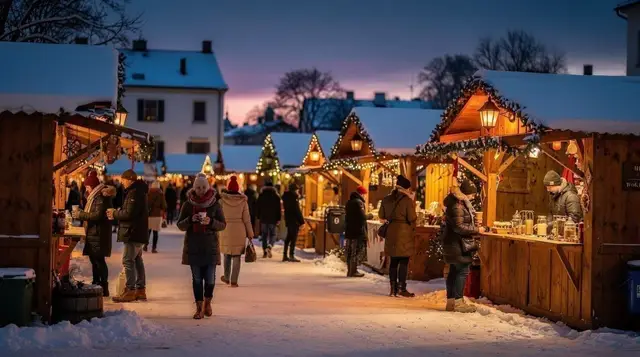
Lucerne Fasnacht: the loudest week of the year
When is Lucerne Fasnacht and what actually happens?
Lucerne Fasnacht runs from Schmutziger Donnerstag (Dirty Thursday) to Ash Wednesday, six days before the rest of Switzerland's Lent-linked carnivals end. It opens with the Urknall at exactly 5am, when brass-and-drum Guggenmusiken bands flood the old town, and closes with the Chesslete procession on Ash Wednesday morning. In 2027 the dates are 4 to 10 February.
What Fasnacht actually is, before you land in the middle of it
Fasnacht is the German-Swiss word for carnival, the pre-Lent stretch of organised chaos that Catholic and Protestant cantons mark on different calendars, in different styles, for different lengths of time. In Lucerne it is not a parade you watch from behind a barrier once and go home. It is six days during which the old town’s normal soundtrack — church bells, the odd busker, water lapping against the Chapel Bridge pylons — gets replaced by brass bands playing deliberately wrong notes at full volume, from five in the morning until well past midnight, in every square, tram stop, and bar doorway.
If you have only seen carnival in Rio or Venice, recalibrate. There are no elaborate floats and little in the way of choreography. Lucerne Fasnacht is closer to a city-wide, week-long street party organised around dozens of independent brass-and-drum bands (Guggenmusiken), a handful of set-piece processions, and a permission structure that, for six days, suspends most of the quiet Swiss city’s usual restraint. It is genuinely disorienting the first time, and genuinely one of the best free things happening anywhere in the country that week.
The Urknall: five o’clock on Schmutziger Donnerstag
Fasnacht opens with the Urknall — the “big bang” — a cannon shot fired at exactly 5am on Schmutziger Donnerstag (Dirty Thursday, the Thursday six days before Ash Wednesday) from the area around the Kapellbrücke. Within minutes, Guggenmusiken that have been assembling in side streets since before 4am strike up simultaneously across the old town. Locals who take Fasnacht seriously do not sleep that night; they go straight from the last bar to the Urknall and keep going.
For a visitor this means two realistic options. Either treat the Thursday as a very early, very loud alarm clock — worth setting for once, because the first hour of the Urknall, with brass bands converging from different directions through empty pre-dawn streets, is unlike anything else on the Lucerne calendar — or accept that the old town will not offer a quiet night’s sleep and book accommodation slightly outside the old town walking core for that specific night. There is no version of Fasnacht Thursday that is quiet near the station or the Musegg Wall side of town.
Schmutziger Donnerstag also traditionally marks the day schools and many businesses close early or not at all, and children in costume appear on the streets from mid-morning, well before the adult crowds intensify in the evening.
Guggenmusiken: the brass bands that define the week
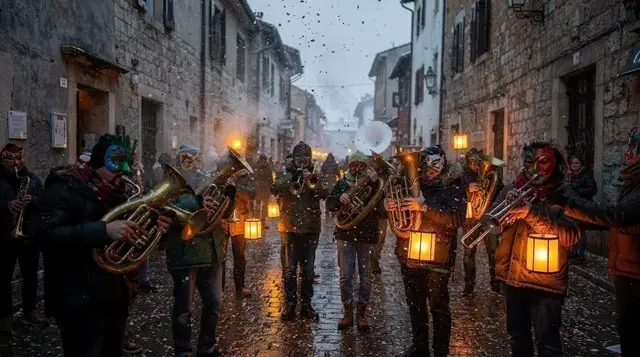
Guggenmusiken are the actual content of Lucerne Fasnacht — everything else is scaffolding around them. Each Guggenmusik is an independent club, typically 20 to 60 members, in matching themed costumes and painted or carved masks, playing brass and percussion arrangements of pop, rock, and folk songs deliberately off-key and syncopated. The effect, in the open air, from a band marching past at close range, is more physical than musical — it is loud in a way recorded audio does not capture.
Lucerne has several dozen registered Guggenmusiken, plus visiting groups from elsewhere in central Switzerland. During Fasnacht week they do not stick to a single stage; they parade through the old town on published routes, play unscheduled sets in the Bahnhofplatz and Weinmarkt squares, and turn up inside bars and restaurants that welcome them (a fair few do, since a Guggenmusik playing indoors for twenty minutes reliably fills the room). Evenings from Friday to Fasnacht Sunday are the densest for spontaneous street performances; weekday afternoons are calmer and better for anyone who wants to see a band up close without being packed shoulder to shoulder.
a guided photography walk through Lucerne’s old town outside Fasnacht week is a useful way to learn the same lanes and light before returning during carnival, when the crowds make it much harder to compose a shot slowly.
Fasnacht 2027 dates and the days that matter
Lucerne Fasnacht is tied to the Christian Lent calendar, so its dates move every year. The 2027 edition runs from Schmutziger Donnerstag on 4 February to Ash Wednesday on 10 February. Treat the table below as a guide to what each day is actually for — the published programme from Luzern Tourism, released a few weeks ahead, has the confirmed routes and stage times.
| Day | 2027 date | What happens |
|---|---|---|
| Schmutziger Donnerstag | 4 February | Urknall at 5am; Guggenmusiken parade all day and evening; schools close early |
| Fasnacht Friday | 5 February | Guggenmusik concerts continue; quieter than Thursday and Saturday |
| Fasnacht Saturday | 6 February | Major parades and stage performances in the old town squares |
| Fasnacht Sunday | 7 February | Children’s parade in the afternoon; family-friendly window before evening crowds build |
| Güdismontag (Fat Monday) | 8 February | One of the loudest nights; Guggenmusiken play late into bars and squares |
| Güdisziischtig (Fat Tuesday) | 9 February | Final full day of street Fasnacht; costumes and masks peak |
| Ash Wednesday | 10 February | Chesslete procession early morning; Fasnacht formally ends at midday |
The Chesslete on Ash Wednesday — a procession of Guggenmusiken and fife-and-drum groups through the old town in the early morning, ending with the symbolic close of Fasnacht around noon — is a genuinely different register from the rest of the week: quieter, more ceremonial, and worth catching if you are still in Lucerne on the final day.
Where to stand, what to expect, what it costs
Everything described above is free to watch. There is no ticketed Fasnacht event in the sense of a gate or entry fee; the parades and Guggenmusik performances happen in public squares and streets, and you simply turn up. The cost of Fasnacht week is what you spend on food, drink, and — the real expense — where you sleep.
Expect to pay Zurich-festival prices in Lucerne for those six nights: a simple hotel room that runs CHF 180 to 220 outside the season can climb to CHF 280 to 350 for Thursday through Saturday of Fasnacht week, when demand from day-trippers and overnight visitors across German-speaking Switzerland peaks. Bars in the old town do not raise drink prices specifically for Fasnacht, but they do stop taking reservations and often go standing-room-only from Friday evening.
Bring earplugs if a full night near a Guggenmusik route is not your idea of a good time, and expect confetti (Räppli) in your hair, pockets, and shoes for days afterwards — it gets everywhere and Lucerne does not fully clean it up until well after Ash Wednesday.
a guided pub crawl through Lucerne’s nightlife spots is a reasonable way to get a local’s sense of which bars are worth the queue on an ordinary weekend — useful groundwork before returning during Fasnacht, when the same bars operate on a completely different rhythm.
Where to sleep during Fasnacht week
Book earlier than you would for any other Lucerne visit. Central hotels and the better-located hostels near the station routinely sell out for the Thursday-to-Tuesday stretch by fewer than three months out, and prices rise well ahead of full availability disappearing. Our full where to stay in Lucerne guide covers neighbourhoods in normal conditions; for Fasnacht specifically, two adjustments matter.
First, staying slightly outside the old town — near the station, or a short bus ride out on a VBL route — buys real quiet at 2am without losing easy access to the parades, which is not true of anywhere inside the old town’s lanes during Fasnacht nights. Second, if central Lucerne is fully booked, Zug and towns reachable within thirty to forty minutes by train are workable bases; Swiss trains run reliably late enough on Fasnacht weekend nights to make a late return practical, though services do thin out after midnight and it is worth checking the last connection before committing to a distant base.
Basel’s Fasnacht is not the same event
Visitors sometimes assume all Swiss carnival is one calendar. It is not. Basel’s Fasnacht — the country’s largest and UNESCO-recognised — follows the Protestant civic calendar and starts a full week after Lucerne’s ends, opening with the Morgenstreich: all city lights extinguished at 4am while lantern-lit Cliques march through in total silence, the opposite mood of Lucerne’s brass-cannon Urknall. Some travellers do plan a February built around both, using the gap week to see Bern or Zurich in between, but treat them as two distinct festivals with distinct characters rather than one event with two dates.
What catches visitors out
The single most common mistake is arriving on Fasnacht Saturday or the Güdismontag evening expecting to walk straight into old-town restaurants without a reservation — nearly impossible that week, so book ahead or plan to eat standing at a Guggenmusik-adjacent bar instead. The second is underestimating how early the Thursday starts: if the Urknall at 5am is the point of the trip, staying anywhere more than a ten-minute walk from the old town means missing the first hour, which is the best hour.
The third mistake is assuming Fasnacht week is a good time for a first, orientation-focused visit to Lucerne. It is not. The old town’s key sights — Chapel Bridge, the Musegg Wall towers, the lakefront — are still there, but the crowds, noise, and closed or reservation-only restaurants make it a poor week for a slow first look at the city. If Fasnacht itself is not the draw, our first-time mistakes in Lucerne guide and best time to visit breakdown both suggest quieter alternatives.
Finally, February in Lucerne is genuinely cold and often damp — Fasnacht happens regardless of weather, and costumes are wool and layers rather than the light fabrics of Rio or Venice carnival for a reason. Dress for standing outside for hours, not for a mild evening.
A quieter alternative during the same week
Not every visitor wants six days of brass bands at close range, and Fasnacht’s crowds and noise are a legitimate reason to plan an escape hatch rather than force it. Daytime hours away from the parade routes stay genuinely calm — the lake itself does not celebrate Fasnacht.
a chocolate-making tour departing from Lucerne is a practical way to fill a Fasnacht afternoon somewhere quieter than the old town squares, and works well for families whose children have had enough confetti by mid-afternoon. For more on the rest of the year’s calendar, see our Lucerne events and festivals overview and Lucerne in winter guide, which covers the weeks either side of Fasnacht when the city is calm again and hotel prices return to normal.
Fasnacht questions people actually ask
When is Lucerne Fasnacht in 2027?
Lucerne Fasnacht 2027 runs from Schmutziger Donnerstag on 4 February to Ash Wednesday on 10 February. The Urknall starts the week at 5am on the Thursday; the Chesslete procession closes it on the Wednesday morning. Confirm the exact programme with Luzern Tourism close to the date, since Guggenmusik routes shift slightly year to year.
What is the Urknall?
The Urknall (literally “big bang”) is the cannon shot fired at exactly 5am on Schmutziger Donnerstag from the Kapellbrücke area that opens Lucerne Fasnacht. Within minutes the old town fills with Guggenmusiken playing at full volume, and it does not let up until well past midnight.
What are Guggenmusiken?
Guggenmusiken are brass-and-percussion carnival bands, usually 20 to 60 musicians in themed costume and painted masks, playing deliberately off-key, syncopated versions of pop and folk tunes. Lucerne has dozens of registered Guggen, and during Fasnacht week they parade through the old town and play impromptu sets in bars, squares, and train stations.
Is Lucerne Fasnacht free to watch?
Yes. The parades, the Urknall, and the Guggenmusik performances in the streets and squares are free and open to anyone. You pay only for what you choose to eat, drink, or where you sleep — and accommodation is the real cost of Fasnacht week.
Do I need to book accommodation early for Fasnacht?
Yes, several months ahead if you want anything central. Fasnacht is Lucerne’s busiest week outside Christmas markets, hotels near the old town and the station sell out, and prices rise noticeably for the Thursday-to-Tuesday stretch. Booking by autumn for a February Fasnacht is not excessive.
Is Lucerne Fasnacht suitable for children?
The daytime hours, roughly Schmutziger Donnerstag through Sunday afternoon, work well for families: parades, confetti, costumes, and Guggenmusik in the open squares. Weekend and Monday evenings turn into a loud, crowded, alcohol-heavy street party in the old town’s narrow lanes, which is less comfortable with small children.
How does Lucerne’s Fasnacht differ from Basel’s?
Lucerne is Catholic Fasnacht: loud, chaotic, and public from Thursday morning, with the Urknall as its signature start. Basel’s Fasnacht (Basler Fasnacht) is Protestant-calendar and begins a week later, at the Monday after Ash Wednesday, opening instead with the hushed, lights-out Morgenstreich at 4am. The two are genuinely different events, not the same carnival on different dates, and some visitors try to catch both in the same February.
Lucerne nightlife on GetYourGuide
Verified deep-linked GetYourGuide tours. Book through these links and we earn a small commission at no cost to you.
GetYourGuide does not provide a product photo for this activity — the image shows the meeting point, photographed by us.