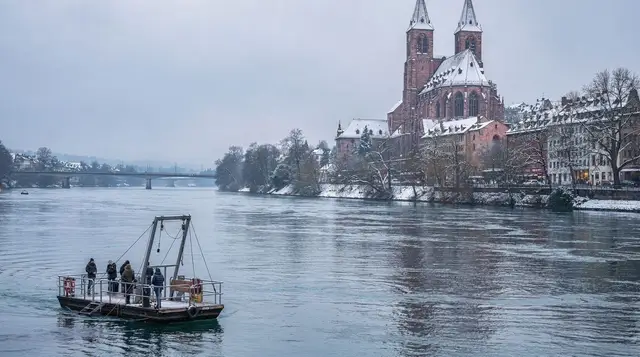
Bern doesn’t try particularly hard to impress you, which is part of why it works. It’s Switzerland’s federal capital, a UNESCO World Heritage old town since 1983, and it still runs on a scale you can cover on foot in an afternoon — no funicular required to see the centre, no queue to get into the main sights, and a river running straight through the middle of it that locals actually use rather than just photograph. Coming from Lucerne, it’s an easy direct train and one of the more efficient day trips in the country.
Getting there from Lucerne
Direct trains leave roughly every hour and take about an hour, arriving at Bern Hauptbahnhof, which sits at the western edge of the old town — you’re inside the UNESCO perimeter within five minutes of stepping off the platform. There’s no reservation system on this route; any valid ticket, Half Fare Card discount, or Swiss Travel Pass coverage applies to whichever train you catch. If you’re building a wider loop, Bern also connects onward to Basel (about 55 minutes), Interlaken (around an hour), and Zurich (about an hour), which makes it a workable stop on a longer central-Switzerland itinerary rather than only an out-and-back.
An early train — the first useful direct departure is generally just after 6am — buys you the old town before the day-trip crowds from other cities arrive, plus more daylight if you’re planning to add the Gurten or a swim.
The old town: Zytglogge, arcades and the Bundesplatz
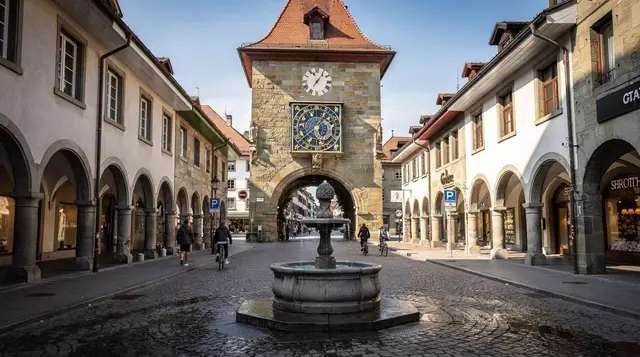
The historic centre sits on a peninsula formed by a loop in the Aare, which is most of why it survived largely intact — expansion was physically constrained, so instead of sprawling, Bern built up and along, giving it the roughly six kilometres of covered arcades (Lauben) that now shelter shops, cafés and the entrances to sandstone cellars along the main streets. Walking the full length of Kramgasse, Gerechtigkeitsgasse and Marktgasse under the arcades is the single best way to understand the city’s layout, and it costs nothing.
The Zytglogge, the medieval clock tower at the western gate, is the old town’s best-known landmark. Its astronomical clock and mechanical figures perform a brief sequence four minutes before each hour — worth a glance if you happen to be passing, not worth restructuring your day around, since the display lasts well under a minute and is easy to miss if you’re not looking directly at it. The tower itself, and its position as the former western boundary of the medieval city, matters more than the show.
Bundesplatz, the square in front of the Federal Palace (Bundeshaus), has 26 ground-level fountains that operate as a plaza-wide water feature in warmer months — popular with kids and worth timing a stop for on a hot afternoon. The Federal Palace itself offers free guided tours on weekdays when parliament isn’t in session; register in advance if you want a look inside rather than just the exterior.
| Sight | Cost | Time needed |
|---|---|---|
| Old town walk (arcades, Zytglogge, Kramgasse) | Free | 1.5–2 hours |
| Bundesplatz and Federal Palace exterior | Free | 20–30 minutes |
| Bear Park (Bärengraben) | Free to view | 10–15 minutes |
| Paul Klee Centre | CHF 20–25 | 1.5–2 hours |
| Rose Garden (Rosengarten) viewpoint | Free | 20–30 minutes |
| Gurten funicular + summit | CHF 8 return (funicular) | 2–3 hours |
The bear pit and the Rose Garden
The Bärengraben, Bern’s bear enclosure by the Nydeggbrücke, has kept bears since the 16th century — the animal that gives the city its name and its coat of arms. The current enclosure, opened in 2009, is a sloped, partly forested park along the Aare rather than a pit in the old sense, and it’s free to view from the bridge and riverside path. It’s a quick stop, honestly a bit sad if you dwell on the history of the older, smaller pits, but the current setup is a genuine improvement and worth the ten minutes on the way to or from the Rose Garden.
From the bear enclosure, a 15-minute uphill walk (or the same by bus) reaches the Rosengarten, a rose garden and terrace that gives the best single photograph of the old town’s sandstone roofline against the Aare loop and, on a clear day, the Bernese Alps behind it. It’s free, rarely crowded, and worth the climb specifically for that view.
Swimming in the Aare
This is the thing about Bern that photographs never quite explain: from around May to September, the Aare running below the old town is a genuine, actively used city swimming spot. Locals finish work and float the Marzili stretch below the Bundesterrasse in swimwear with a dry bag for their clothes, floating with the current rather than swimming against it.
The water is glacier-fed and cold even in summer, and the current is faster than it looks from the bank — check the posted flow rate and temperature (widely available online before you go) and don’t get in if the water is high or fast after rain or heavy snowmelt upstream. The Marzili outdoor pool complex next to the river gives a safer, supervised alternative if you’d rather not swim in open water, with changing rooms and a lawn for CHF 8.
Outside the May–September window the river is too cold and often too fast for casual swimming; admire it from the Nydeggbrücke or the Untertorbrücke instead.
Paul Klee Centre
The Zentrum Paul Klee, a curved building by Renzo Piano on the eastern edge of the city, holds the largest collection of Paul Klee’s work anywhere — around 4,000 pieces, rotated through temporary exhibitions since the full collection can’t be shown at once. It’s about a 20-minute bus ride (or taxi) from the old town, not walkable, and entry runs CHF 20–25. Worth the detour for genuine Klee admirers; skippable if modern art isn’t a priority and your day is already tight, since it’s the one sight on this list that requires a deliberate trip away from the centre rather than a stop along the way.
Gurten: Bern’s local hill
The Gurten is Bern’s answer to a city-adjacent viewpoint — not in the same league as Pilatus or Rigi above Lucerne in height or drama, but a genuinely pleasant half-day if you have the time. A tram from the station to Wabern, then a funicular ride of about six minutes, puts you on a low summit with walking paths, a playground, a small train for kids, and a restaurant with a view over the city and, on clear days, the Bernese Alps beyond.
A guided visit up the Gurten with a slide and a local cheese picnic is a reasonable way to combine the viewpoint with something more structured than a self-guided walk, particularly with children in tow. On a clear evening, the summit is also a workable, low-effort stargazing spot if you don’t want to travel further out; for something darker, the guided night hike into the Gantrisch Dark Sky Reserve south of the city gets well away from Bern’s light pollution.
Where Bern fits into a longer trip
Bern works cleanly as a standalone day trip from Lucerne, but it’s also a sensible link in a longer central-Switzerland loop. Travellers coming from Basel can pick up a private day trip into Bern with a cheese tasting rather than routing back through Lucerne first.
Those based further out in the Bernese Oberland sometimes combine Bern with the high mountains on the same pass — the small-group day trip to the Schilthorn and Mürren departing from Bern is one way to link the capital with the Jungfrau region without backtracking through Lucerne. If river time matters more than sightseeing, a private Aare rafting day trip from Zurich that finishes in Bern turns the swim into a guided activity rather than an unsupervised float.
None of these are necessary for a straightforward Lucerne–Bern day trip by train — the old town, bear pit and a summer swim cover the essentials on their own — but they’re worth knowing about if Bern is one stop on a wider Swiss itinerary rather than a single day out.
Practical notes
Bern’s train station has left-luggage lockers if you’re passing through with bags rather than staying. Public transport within the city (Bernmobil trams and buses) is not covered by the Swiss Travel Pass the way Lucerne’s VBL network sometimes is bundled with hotel guest cards — buy a single Bern city ticket or day pass if you’re using more than the old town on foot, though most of what’s described here is walkable from the station.
Weather matters more in Bern than in a mountain town, since there’s no cable car to retreat to if it rains — the old town’s arcades double as functional shelter, which is presumably part of why they were built six kilometres long. A wet day in Bern is still a reasonable day, just a slower one, with more time under cover on Kramgasse and Gerechtigkeitsgasse and less on the Rose Garden terrace.
For onward or return planning, see day trips from Lucerne for how Bern compares in time and cost to Zurich, Basel and Interlaken, and Lucerne travel costs for how a Bern day trip fits into an overall Switzerland budget.
If you’re deciding between capital cities on a short trip, see Lucerne vs Zurich for the broader comparison, since Bern often ends up as the deciding factor between a two-city and a three-city itinerary. Travellers building a full week around Lucerne can slot this in as one day of a 7-day itinerary, and the things to do — day trips hub lists Bern alongside the other realistic single-day options from the city.