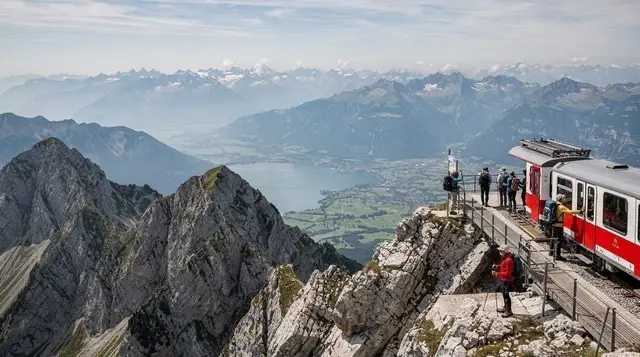
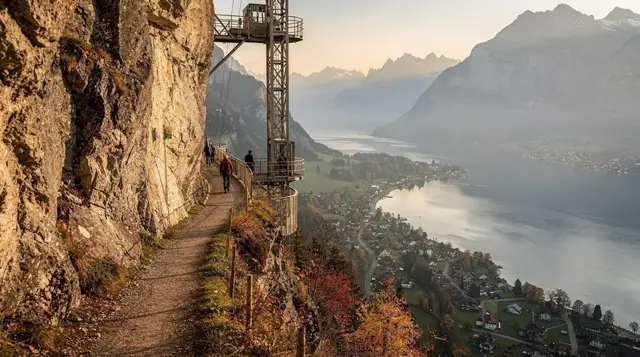
Rigi and Pilatus with kids
Should families with young children choose Mount Rigi or Mount Pilatus from Lucerne?
Rigi is the easier family day: the Vitznau or Arth-Goldau cogwheel train and the Weggis cable car are short, level rides with a gentle trail and picnic meadows at the top. Pilatus is more dramatic, with the world's steepest cogwheel railway and the Dragon Path playground, but the classic Golden Round Trip by boat and two cable cars makes for a long day with a toddler.
Two mountains, two very different family days
Both mountains sit either side of Lake Lucerne, both have a cogwheel railway or cable car climbing straight out of a lakeside village, and both are sold as the classic day trip from Lucerne. With young children the two days feel nothing alike. Rigi is short rides, flat paths and a family trail through alpine meadows. Pilatus is a steeper railway, rockier summit paths, and — if you take the full Golden Round Trip — a day that stitches together a boat, a cogwheel train and a cable car, which is a lot of transitions for a three-year-old.
This guide sticks to the practical questions a parent actually has: which route is shortest, where a pushchair works and where it doesn’t, what’s there to keep children occupied at the top, and roughly what it costs. For the wider comparison including Titlis, see Rigi vs Pilatus vs Titlis; for the general child-friendly rundown of Lucerne itself, see Lucerne with kids.
Mount Rigi with children
Rigi is reached three ways from the Lucerne side of the lake: the cogwheel railway from Vitznau (the world’s oldest mountain railway, running since 1871), the cable car from Weggis, or the cogwheel railway from Arth-Goldau on the Zug side. All three converge near Rigi Kaltbad, from where a shared cogwheel line continues to the summit, Rigi Kulm.
For families, Vitznau to Rigi Kulm is the classic route. The train ride takes about 30 minutes, is gentle by comparison with Pilatus, and has large windows at child height. From Lucerne, the connection is a boat or bus to Weggis or Vitznau, then the railway or cable car up.
At Rigi Kaltbad there’s a playground, a family-friendly restaurant terrace, and the start of the marked family trail that loops through meadows towards First, with information boards pitched at children about alpine farming and marmots. It’s flat enough for most all-terrain pushchairs, and short enough — about 45 minutes at a toddler’s pace — that it doesn’t turn into a forced march. Rigi Kulm itself, the true summit, has less to occupy small children beyond the view, though on a clear day the panorama over the Alps is worth the extra 10 minutes on the train.
a Rigi day card covering the cogwheel trains and cable car in one ticket is the simplest way to book the whole Rigi day without working out separate legs.
Full route detail, including which villages to combine it with, is in the Mount Rigi guide.
Mount Pilatus with children
Pilatus is the more theatrical mountain, and the more demanding day. The classic approach is the “Golden Round Trip”: boat from Lucerne to Alpnachstad, the world’s steepest cogwheel railway (up to 48 percent gradient) to Pilatus Kulm, then the Pilatus aerial cableway and the Kriens gondola down the other side, finishing with a bus back into Lucerne. It’s a spectacular sequence of transport, and also four separate changes with luggage, a pushchair and tired children by the third leg.
The cogwheel railway itself doesn’t feel alarming inside the carriage — seating and flooring are built level to the slope rather than tilted — but it runs only from roughly May to November, weather and snow permitting, and closes for scheduled revision work in spring and autumn each year, so check the Pilatus Bahnen status page before you plan around it. Outside that window, or if you’d rather skip the boat entirely, the Kriens gondola and the Pilatus aerial cableway run year-round and connect directly to a straightforward Pilatus roundtrip by cogwheel train from Alpnachstad if you’d rather do a simple there-and-back instead of the full loop.
At the top, the main child-focused feature is the Drachenweg — the Dragon Path — a short themed trail near Pilatus Kulm with dragon sculptures tied to the local legend of dragons living in the cliffs. It’s a 15 to 20 minute loop on mostly paved ground. Beyond that, summit paths at Pilatus are steeper and rockier than Rigi’s, with some sections on steps, so a baby carrier is more practical than a pushchair once you’re off the train.
For a shorter, calmer version of the day, some families do Pilatus via Mount Pilatus as a straight up-and-down from Alpnachstad, skip the Kriens gondola leg entirely, and save the Golden Round Trip for when the children are a little older. Full detail on both directions is in the Mount Pilatus guide.
Shortest routes up, side by side
| Route | Start point | Journey up | Gradient / character | Pushchair-friendly? |
|---|---|---|---|---|
| Rigi via Vitznau | Vitznau | Cogwheel train, ~30 min | Gentle, scenic | Yes, at the top |
| Rigi via Weggis | Weggis | Cable car, ~10 min | Smooth, fast | Yes, at the top |
| Rigi via Arth-Goldau | Arth-Goldau | Cogwheel train, ~40 min | Gentle | Yes, at the top |
| Pilatus via Alpnachstad | Alpnachstad | Cogwheel train, ~30 min | Steep, up to 48% | Limited, use a carrier |
| Pilatus via Kriens | Kriens | Gondola + cableway, ~40 min | Smooth, year-round | Limited, use a carrier |
What it costs a family
Mountain railway fares in Switzerland change annually, so treat the figures below as indicative rather than exact, and check the operator’s current family fares before booking. As a rule of thumb: children under 6 travel free on both Rigi and Pilatus lines, children aged 6 to 15 pay a reduced fare, and a Swiss Travel Pass or a Junior Travelcard attached to a paying adult’s ticket typically brings the children’s fare down to free or close to it on both mountains.
Full adult return fares from the lakeside starting points run roughly CHF 70 to 90 on Rigi depending on the starting station, and somewhat higher on Pilatus once the boat leg from Lucerne is added to the Golden Round Trip. For a family of four with two paying adults and two fare-paying children, Rigi is usually the cheaper day out simply because the direct routes are shorter and don’t stack a boat fare on top. If you already hold a Swiss Travel Pass it covers the boats and most of the mountain transport on both, which narrows the price gap considerably; the regional Tell-Pass does something similar for visitors based in central Switzerland for several days.
If you’re combining several mountains and boats over more than one day, a flexible multi-day pass covering trains, buses and boats can work out cheaper than buying each leg separately, especially with children in tow who need frequent stops and re-routes. Families who’d rather not manage tickets, timings and transfers at all sometimes book a guided day covering both Pilatus and Rigi with transport included, which removes the logistics but costs more than doing it independently.
Timing the day
Both mountains are best tackled in the morning. Cloud tends to build over the lake basin by early afternoon in summer, and a socked-in summit is a wasted train fare with children who won’t remember why the view mattered. Aim to be on the first or second departure from Vitznau, Weggis or Alpnachstad if you want a real chance of a clear summit.
With a toddler, budget half a day for either mountain as a there-and-back trip: three to four hours door to door from central Lucerne, including an hour at the top. The full Pilatus Golden Round Trip, or a Rigi day that adds the family trail plus lunch, is realistically a full day, roughly 8am to 4pm once you include the boat or bus connections from Lucerne itself.
Families who want a guided, less logistics-heavy version of Rigi specifically sometimes book a guided walk up Rigi from Goldau that includes a barbecue lunch, which turns the mountain into more of a planned outing than a self-navigated day.
Food, toilets and practicalities at altitude
Both summits have restaurants with children’s menus, though prices are altitude-inflated: expect to pay noticeably more for a plate of pasta or a hot dog at Rigi Kulm or Pilatus Kulm than in Lucerne itself. Bringing a packed lunch and eating at one of the meadow picnic spots on the Rigi family trail, or the benches near the Pilatus Dragon Path, is the honest way to keep costs down, and both areas allow it.
Toilets and baby-change facilities exist at the main stations on both mountains — Rigi Kaltbad and Rigi Kulm, Pilatus Kulm and the Kriens gondola base — but not at every intermediate stop, so plan around the main stations rather than assuming facilities everywhere. Temperatures at altitude run noticeably cooler and windier than lakeside Lucerne, often 8 to 10 degrees lower, so pack a layer for children even on a warm day in town.
Getting children ready before you go
A mountain day goes better when the children know what is coming. Show them the cogwheel train in a photo or a short video the evening before, tell them there will be a boat or a cable car, and let them choose the snack that rides in the backpack. Children who feel part of the plan tend to cope better with the changes of transport, and a child who has been promised a dragon trail will happily walk further than one who has simply been told it is a nice view.
Dress them in layers rather than one thick jacket. The lakeside can be warm and sunny while the summit is windy, and a thin fleece, a windproof layer, a hat and a pair of sturdy shoes with grip cover almost every situation. Sun cream matters more than parents expect at altitude, even on a hazy day, and so do sunglasses for small eyes when there is snow or bright cloud around. Pack a spare top for the youngest, because spilled hot chocolate at a cold summit is a very quick way to end a visit.
Keep the bag light and organised. A change of socks, wet wipes, a small first-aid kit, a water bottle each and something to nibble on the train will do more for morale than any amount of equipment. If you are travelling with a baby, a carrier leaves your hands free for railings and tickets, and it works on both mountains, which makes it the one piece of kit worth bringing even if you also take a pushchair. For more on the practical side of travelling with a pushchair and stairs, the accessibility in Lucerne guide is a useful companion.
Keeping children entertained on the way up
The journey is part of the day, and with children it is often the part they remember best. On Rigi, the large windows of the cogwheel train let small passengers watch the lake shrink beneath them, spot cows on the meadows and count the tunnels and little stations along the way. Turn it into a game: who sees the first cow, the first chalet, the first patch of cloud below you. On Pilatus, the steep climb is its own entertainment, and children usually enjoy noticing how the carriage floor stays level while the mountain tilts outside.
The boat from Lucerne is a bonus rather than a chore if you frame it that way. Children can lean at the rail, wave at the villages and watch the mountains grow closer, and it is a calm moment before the more active part of the day. If you want to understand how the lake services fit together before you commit to a boat leg, read lucerne boat trips and the page on the paddle steamers of Lake Lucerne, which will help you choose between a quick crossing and a slower, more atmospheric one.
Short rides are easier than long ones. If a child is already tired after the first leg, make the descent the simplest option available rather than insisting on a loop. A cable car down from a halfway station is not a failure; it is the plan that keeps everyone cheerful until the evening.
Pacing, naps and snacks
The biggest mistake families make on either mountain is trying to do too much. Children tire quickly at altitude, and the combination of fresh air, new surroundings and early starts can bring on a meltdown just when the view is at its best. Build in a long stop at the top, eat early rather than late, and treat the walking as optional rather than the goal. A picnic on a meadow with a view and an hour of free play is a perfectly good mountain day.
If your child usually naps, plan the descent around it. A sleeping toddler in a carrier on the train back down is a much easier trip than a fractious one at the summit, and the gentle rhythm of the cogwheel often does the work for you. Keep a small snack for each leg so that hunger never arrives unannounced, and keep the real lunch for somewhere you can sit comfortably.
For older children, give them a small job: carrying the map, watching the departure board, holding the tickets. It keeps them engaged and takes some of the pressure off you. If the family is combining the mountains with other days, the family itinerary for four days shows how to spread the effort so that a big mountain day is followed by something gentler.
When the weather does not cooperate
Mountain weather changes fast, and a plan with young children needs a fallback. If the forecast is poor, the summit can be fully hidden in cloud, which is disappointing for adults and baffling for a small child who was promised a view. Check the live webcams and the operator’s status page in the morning, and be ready to switch the day for something indoors in town. The Swiss Museum of Transport is the classic rainy-day answer for families, and the wider Lucerne with kids guide lists other options close to the lake.
If you are unsure whether to go at all, the weather month by month guide and the best time to visit Lucerne will help you judge which season suits your family, and Lucerne in summer describes what a typical warm-weather day looks like at lake level before you head up. A clear morning after a night of rain is often the best window, with sharp views and fewer crowds, but always keep the descent option in mind if cloud rolls in earlier than forecast.
Making it a story, not just a trip
Children remember stories more than timetables. On Pilatus, the dragon legend gives the day a ready-made plot, and on Rigi the idea of the oldest mountain railway in the world, or the queen of the mountains, can be enough to spark curiosity. Ask them to find clues, spot animals and take their own photos. At the end of the day, let each child pick a favourite moment, and you will usually find it is something small, like the bell of a cow or the taste of a snack on a bench, rather than the headline view.
If this trip leaves the family wanting more, the blog post on a morning on the Rigi captures the early-hours atmosphere, and the account of a day on Pilatus in November shows the quieter side of the other mountain. For choosing between the two with a broader view, the best mountain excursions from Lucerne and the family day trips guide put both in context. And if you want a gentler alternative with a view, Weggis and Vitznau and Lake Lucerne offer lakeside time without a single steep step.
Which one to actually pick
If this is your only mountain day and you have a child under about 5, pick Rigi. It’s shorter, flatter, has an actual trail designed with children in mind, and costs less. If your children are a bit older, sturdier on their feet, and you have a full day to give it, Pilatus’s steeper railway and Dragon Path make for a more memorable day, but go in expecting more walking on uneven ground and more transitions between transport modes.
Doing both in one trip is possible only for families with older children and a full, clear-weather day, ideally on separate visits rather than back to back. For the wider set of family days beyond these two mountains, see family day trips from Lucerne, and for general boat timing between the lakeside villages, Lucerne’s boat timetables explained is worth reading before you fix a schedule around young children’s naps.
Mountain excursions on GetYourGuide
Verified deep-linked GetYourGuide tours. Book through these links and we earn a small commission at no cost to you.
GetYourGuide does not provide a product photo for this activity — the image shows the meeting point, photographed by us.