Five days in Lucerne: winter skiing, the Rigi's sea of clouds and Christmas markets
This is a winter-specific version of a Lucerne base trip: five nights in the city, four days out. It’s built around cold-weather things that don’t work the rest of the year — skiing and sledging at Engelberg, a shot at the Rigi’s temperature-inversion “sea of clouds,” and, depending on your exact week, either Lucerne’s Christmas market or the noise and brass bands of Fasnacht.
One thing to settle before you book dates: you cannot get both the Christmas market and Fasnacht on a single five-day trip. The market runs from late November to 24 December. Fasnacht is tied to Ash Wednesday, which falls on 18 February in 2026, so the maddest days — Schmutziger Donnerstag through Fat Tuesday — land between 12 and 17 February. The two events sit roughly two months apart. This itinerary is written for a general December-to-March window and flags where each event slots in; adjust Day 1 and Day 5 to match whichever one you’re actually travelling for.
Winter in Lucerne: what to expect
Days are short — sunrise around 8am, sunset by 4:30–5pm in December and January, stretching out a little by March. Lucerne itself rarely gets heavy snow; it sits at 436 metres and winters are more grey-and-drizzly than white. The snow is up the mountains: Engelberg (1,000m) and Titlis (3,020m), Rigi Kulm (1,798m), and Stoos (1,300m) all hold snow reliably from December through March. Pack for both — city rain gear plus proper ski layers for the peaks.
Mountain lifts close for scheduled maintenance in spring and autumn, not in the depth of winter, so a December–March window is generally safe for Titlis, Rigi and Stoos. Still worth a same-week check on each operator’s site before you lock train times, since weather can also force short closures on the cable cars.
Day 1: Lucerne old town, and the market or the noise
Arrive into Lucerne — most likely via Zurich Airport, about an hour away by direct train, or Basel–Mulhouse, roughly an hour and a half. Drop bags and spend the afternoon on the compact old town walking route: Chapel Bridge and its octagonal Water Tower, the Musegg city wall towers, and the painted facades along Hirschenplatz and Weinmarkt.
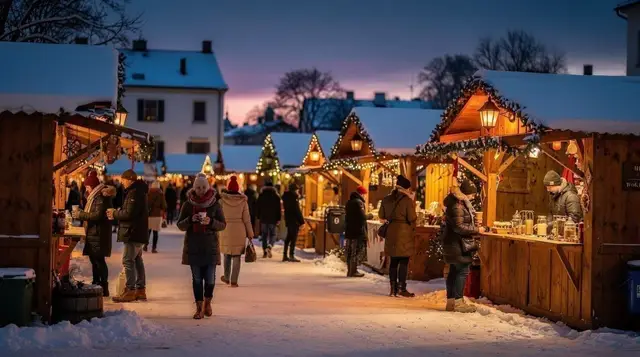
If you’re here in December: the Christmas market on Franziskanerplatz runs daily until 24 December, with mulled wine (Glühwein) at around CHF 6–7 a cup and wooden-stall crafts. It’s small compared to German markets — an hour covers it — but it’s genuinely local, not tourist-built.
If you’re here in mid-to-late February and the dates line up with Fasnacht: expect the Wey-Zunft’s cannon blast at 5am on the Thursday before Ash Wednesday, costumed Guuggenmusik brass bands in the streets through the following days, and most shops closing early. It’s loud and chaotic in a way the rest of the year isn’t — read the Fasnacht guide before you go if your trip overlaps.
Either way, book a lakefront or old-town hotel — you’ll be back here every evening.
Day 2: Engelberg and Mount Titlis
Engelberg is about 45 minutes from Lucerne by direct train, making it the closest proper ski resort to the city. From the valley station, the Titlis Xpress rotating cable car climbs in stages to Titlis at 3,020 metres, where there’s a glacier plateau, a glacier cave you can walk through, and the Cliff Walk suspension bridge (not for anyone uneasy with heights — it’s Europe’s highest suspension bridge, at over 3,000m).
For skiers and boarders, Engelberg-Titlis has terrain for most levels, though its reputation is built on the more demanding Laub and Steinberg off-piste-adjacent runs — a day pass runs roughly CHF 75–80 for an adult, with rental and a group lesson adding another CHF 100–150 on top if you need them. If you’d rather not ski, the lower Brunni side above Engelberg has marked sledging runs and easier snowshoe trails, and a first-timer package like a guided first-time ski experience on Titlis bundles the lift ticket, gear and instruction into one booking, which is worth it if you’ve never clipped into skis before.
If you’d rather have transport, the mountain and a guide handled without working out train connections yourself, a day tour from Lucerne covering Engelberg, Titlis and Brunni covers the whole loop from a Lucerne pickup.
Check skiing day trips from Lucerne and sledding and snowshoeing near Lucerne for the non-ski options in more detail, and the full Titlis guide for cable car timetables and current pricing.
Day 3: the Rigi and its sea of clouds
The Rigi is the reason this itinerary has a weather-dependent day built in. On a temperature-inversion morning — fog sitting over the lake and lowlands, clear sky above roughly 1,500m — the summit at Rigi Kulm (1,798m) pokes out above an unbroken white cloud layer with the Alps visible beyond it. It doesn’t happen every day, so check the mountain’s live webcams the evening before and take the first cogwheel train up if conditions look right.
Two cogwheel railways reach the top: from Vitznau (reached by boat or train from Lucerne) or from Arth-Goldau (direct train from Lucerne, about 40 minutes). A cable car from Weggis is the third route up. Return fare without a pass runs around CHF 78–90 depending on which station you start from; the Swiss Travel Pass and the regional Tell-Pass both cover the Rigi railways, which matters if you’re already carrying one for the rest of the trip — see the Swiss Travel Pass guide and the Tell-Pass guide to work out which one pays off over five days.
A classic Rigi round trip from Lucerne handles the boat-plus-cogwheel combination in one ticket if you’d rather not piece together connections yourself. For a slower, guided version that adds a walk and lunch at the top, a guided Rigi walk from Goldau with a barbecue lunch is the better fit if you want a few hours on foot rather than straight up and down.
Full detail, including which side has better inversion odds and how the three routes up compare, is in the Mount Rigi guide; if you’re weighing the Rigi against Titlis or Pilatus for time reasons, this comparison lays out the trade-offs.
Day 4: Stoos and the world’s steepest funicular
Stoos sits above Schwyz, reached by train from Lucerne to Schwyz (around 35–40 minutes) then a short bus to the Stoos valley station. The funicular itself is the draw: at a maximum gradient of 110%, it’s the steepest funicular railway in the world, and the barrel-shaped cars rotate to keep the floor level as the track climbs. The ride up takes about four minutes and covers what used to be a 45-minute walk.
At the top, Stoos and neighbouring Fronalpstock (reachable by a short chairlift from the Stoos plateau) have marked winter walking trails, a toboggan run, and views back down over Lake Lucerne and across to the Mythen peaks. It’s quieter than Titlis or the Rigi — worth building in if the previous two days felt crowded.
A day excursion from Lucerne to the Stoos funicular and Fronalpstock viewpoint covers the train and funicular legs together, useful if you don’t want to work out the Schwyz connection solo. Return fare on the funicular alone runs around CHF 33; check the operator’s site for any scheduled winter maintenance closures before you fix the date, and see the Stoos and Fronalpstock guide for the toboggan run details and trail lengths. If you have time on the way back, Schwyz’s old town — the canton’s namesake and the site of the 1291 federal charter — is worth an hour; more on that in the Stoos-Fronalpstock destination page.
Day 5: back in Lucerne — museums, markets, packing up
Keep the last day light and city-based. The Swiss Museum of Transport, on the lakeshore a short bus ride from the centre, is the obvious wet-weather option and genuinely holds up for a half-day even if you’re not especially into transport — there’s a planetarium and an aviation hall alongside the trains and cable cars. The Rosengart Collection (Picasso and Klee, among others) and the Bourbaki Panorama are smaller, faster alternatives if the transport museum feels like too much.
If you’re travelling in the Christmas window, this is a good morning to go back to the Franziskanerplatz market before an afternoon train out, or to walk the Chapel Bridge again without the midday cruise-ship crowds — early morning is noticeably quieter than 11am to 3pm. If your trip landed in Fasnacht week instead, expect the old town to still be recovering — cafés and shops sometimes open late after the parades — so build in flexibility rather than a tight museum schedule.
For onward travel, Zurich Airport is a direct hour by train with services roughly every half hour; Basel–Mulhouse is closer to ninety minutes with one change. Book the departure train the night before if you’re travelling on a Saturday, since winter weekend trains toward the airport can run close to full.
Getting around: which pass actually pays off
| Pass | Covers | Roughly worth it if |
|---|---|---|
| Swiss Travel Pass | Trains, buses, boats nationwide, and discounts on most mountain lifts | You’re also doing trips beyond this itinerary, or want boats included free |
| Tell-Pass | Central Switzerland only — Rigi, Stoos, Titlis, boats, regional trains | This exact itinerary and nothing further afield |
| Half Fare Card | 50% off most tickets, no free travel | You’re buying point-to-point tickets anyway and staying five days or fewer |
| Lucerne city Visitor Card | Free VBL city buses | You’re not walking everywhere in the old town (most people are) |
For a Lucerne-only, four-mountain trip like this one, the Tell-Pass usually comes out cheaper than the nationwide Swiss Travel Pass — work the actual numbers for your dates in the Tell-Pass guide against the Swiss Travel Pass guide before buying either. General orientation on tickets and connections is in getting around Lucerne.
Budget for five winter days
Rough total for two adults, mid-range hotels, excluding flights:
| Item | Estimate (CHF, for two) |
|---|---|
| Hotel, 5 nights, mid-range | 1,200–1,700 |
| Trains and regional pass | 220–320 |
| Titlis cable car + ski day (if skiing) | 300–500 |
| Rigi cogwheel round trip | 150–180 |
| Stoos funicular | 60–70 |
| Food, mid-range | 400–550 |
| Total | 2,300–3,300 |
Skiing is the biggest swing factor — cut it and substitute a sledging or snowshoe day at Brunni instead, and the total drops by CHF 200–350. Detailed day-by-day cost breakdowns, including what a coffee and a set lunch actually cost here, are in Lucerne travel costs and Lucerne on a budget.
Winter Lucerne itinerary FAQ
Is five days enough for a winter trip based in Lucerne?
Yes, for this route. None of the four stops is more than an hour and a half away by train, so you sleep in Lucerne every night and do single-day round trips. It’s tighter if you also want Pilatus or Interlaken — this itinerary deliberately leaves those out.
Can I see both the Lucerne Christmas markets and Fasnacht on the same trip?
No. The Christmas market on Franziskanerplatz runs from late November to 24 December, while Fasnacht follows Ash Wednesday, which falls on 18 February in 2026 — the loudest days run from the Thursday before (12 February) through Fat Tuesday (17 February). The two are about two months apart, so choose your week based on which one you want.
Do I need to book Engelberg-Titlis skiing in advance in winter?
Day lift passes are normally sold at the Engelberg valley station on the day, midweek. Weekends and the Christmas–New Year fortnight get busy enough that queues build by mid-morning, and ski school slots and equipment rental should be booked ahead if you want a lesson.
What if the Rigi doesn’t have a sea of clouds when I go up?
It’s weather-dependent — you need a temperature inversion, with fog sitting in the lowlands and clear air above around 1,500 to 1,800 metres. Check the Rigi’s live webcams the evening before and go up on the first train if the valley looks foggy; if the whole sky is grey there’s no inversion and you’ll just get grey at the top too.
How much should I budget for this five-day winter itinerary?
For two adults, mid-range hotels, the mountain excursions and train travel described here, plan on roughly CHF 2,400 to 3,200 total, excluding flights. Skiing adds the most variable cost — lift passes, rental and lessons can run CHF 150 to 250 per person for a full day at Titlis.
Is the Stoos funicular open all winter?
It runs year-round on a normal timetable, including through winter, but like most Swiss mountain lifts it can close for scheduled maintenance in shoulder seasons. Check the Stoos-Muotatal website for the specific week you’re travelling rather than assuming it’s running.
Skiing & winter experiences on GetYourGuide
Verified deep-linked GetYourGuide tours. Book through these links and we earn a small commission at no cost to you.
GetYourGuide does not provide a product photo for this activity — the image shows the meeting point, photographed by us.