Stanserhorn guide: funicular, CabriO and the summit
What is the Stanserhorn and how do you get there from Lucerne?
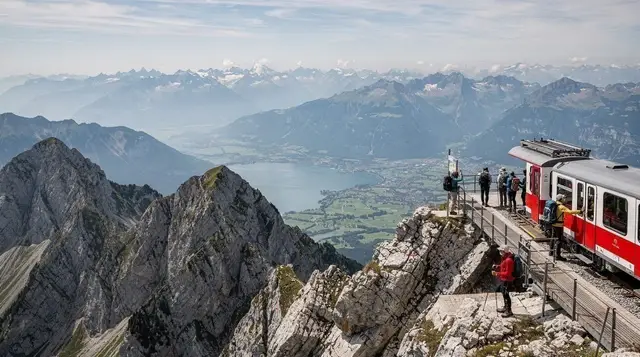
The Stanserhorn is a 1,898-metre peak reached by a heritage funicular from Stans and then the CabriO, an open-top double-decker cable car. From Lucerne it takes roughly 45 to 60 minutes door to door by train, funicular and cable car, and the mountain is closed outside its April-to-November operating season.
A funicular from 1893 and a cable car with no roof
Most mountains above Lake Lucerne send you up on a cogwheel train or a conventional cable car. The Stanserhorn does something odder: a wood-panelled funicular that dates back to 1893, followed by the CabriO, an open-top, double-decker cable car with no roof on its upper deck. It opened in 2012 as the first of its kind anywhere, and it’s still the reason people put this mountain ahead of its taller, busier neighbours.
The trade-off is scale. The Stanserhorn tops out at 1,898 metres, lower than Mount Pilatus or Mount Titlis, and the summit infrastructure is modest: one revolving restaurant, an observation deck, a short network of trails and a marmot colony. There’s no ridge walk to a second peak, no glacier, no cluster of restaurants. What you get instead is a quieter mountain, a genuinely distinctive ride, and views that stretch from the lake to the Bernese Alps on a clear day.
Getting there from Lucerne
The journey starts at Lucerne station, not at the mountain itself. Zentralbahn trains to Stans run roughly every 30 minutes and take 13 to 15 minutes. From Stans station it’s a five to seven minute walk, signposted, to the valley funicular station at the edge of town.
| Stage | Mode | Approx. duration |
|---|---|---|
| Lucerne station to Stans | Zentralbahn train | 13-15 min |
| Stans station to funicular base | Walk | 5-7 min |
| Funicular base to Kälti | Heritage funicular | 6-7 min |
| Kälti to summit | CabriO cable car | 6-7 min |
Add waiting time for connections and the whole trip from Lucerne to the summit usually runs 45 to 60 minutes each way. That’s slower than Mount Rigi via Vitznau but broadly comparable to getting up Pilatus. If you’re short on time and only doing one mountain from Lucerne, weigh this against the comparison of Pilatus, Rigi and Titlis before committing a full day to Stanserhorn specifically.
The funicular: the historic half of the trip
The lower section, from the valley station to Kälti, is the original 1893 line in spirit, though the rolling stock and technology have been rebuilt more than once since then, most substantially after a cable fire in 1970 that closed the mountain for years. What survives is the character: timber-lined cabins, a steep, direct climb through forest, and a noticeably slower, more mechanical feel than a modern gondola. It’s short, six to seven minutes, and mostly a warm-up for the CabriO above.
Kälti itself is just a mid-station, not a destination — there’s little reason to get off here unless you’re starting a hike back down later in the day.
The CabriO: standing in the open air at altitude
This is the part people come for. The CabriO is a double-decker cable car: an enclosed lower deck and an open-top upper deck with waist-high railings and no roof. Riders on top stand in the open air as the car climbs roughly 900 metres in about seven minutes, with the ground and then the whole Lake Lucerne basin dropping away beneath their feet.
It’s not a ride for anyone genuinely uneasy with heights or exposed to wind chill — even on a warm day at the valley station, the top of the CabriO can be noticeably cold and breezy, and rain turns the open deck unpleasant fast. Staff close the upper level in poor weather or high wind, at which point everyone rides in the enclosed lower cabin and the novelty largely disappears. Check conditions before you go if the open-top ride is the reason for the trip.
If you’d rather have someone explain the engineering and point out landmarks on the way up rather than work it out yourself, a private guided Stanserhorn mountain tour covers both the funicular and CabriO stages with commentary, which is worth it if this is your only central Switzerland mountain for the trip.
At the summit: Rondorama and the view
The summit building houses the Rondorama, a revolving restaurant that completes a full 360-degree rotation roughly every 43 minutes. Prices are what you’d expect for a mountain-top restaurant with a view — a main course generally runs CHF 28 to CHF 45, coffee and cake closer to CHF 12 to CHF 15 — and the food is solid rather than remarkable. The rotation is slow enough not to be gimmicky; most people don’t notice it moving unless they’re watching the horizon.
Outside, the observation terrace looks out over the Lake Lucerne basin towards Lucerne itself, and on a genuinely clear day the panorama extends to the Titlis massif, the Bernese Alps around the Eiger, Mönch and Jungfrau, and south towards the Uri Alps near Brunnen. Central Switzerland gets hazy summer afternoons more often than crisp ones, so mornings after a front has passed tend to give the clearest views — the same logic that applies to any of the lake’s viewpoints, covered in more detail in the Lucerne viewpoints guide.
A short, easy path circles part of the summit ridge, and just below it, in the open pasture, is the marmot colony that’s become one of the mountain’s better-known features. Marmots are most active and visible in early morning and early evening in summer; by midday, especially on a warm, busy day, they tend to retreat underground.
Prices and passes
Fares below are indicative for a standard adult return from Stans and should be checked against the current published tariff before you travel, since central Switzerland’s mountain railways typically revise prices each season.
| Ticket | Approx. price (CHF) |
|---|---|
| Adult return, Stans to summit | ~76 |
| Adult return with Half Fare Card | ~38 |
| Child return (6-15) | ~19 |
| Family surcharge (2 adults + kids) | varies, ask at counter |
The Swiss Travel Pass covers the Zentralbahn train from Lucerne to Stans in full and gives a 50 percent reduction on the funicular-and-CabriO combination rather than free travel, the same discount the Half Fare Card provides on its own. The regional Tell-Pass also includes reductions on the Stanserhorn as part of its central Switzerland network, which is worth checking against the Swiss Travel Pass vs Tell-Pass comparison if you’re deciding between the two for a longer stay.
For the return train, funicular and CabriO booked as a package with commentary included, the half-day trip from Lucerne to Stanserhorn bundles the logistics into one ticket, which removes the need to buy separate train and mountain tickets on the day.
When to go, and when it’s shut
The Stanserhorn has no winter operation. The lifts typically run from late April to late November, closing completely outside that window for maintenance — there’s no snow programme, no winter cable car service, unlike Rigi or the Kriens side of Pilatus. If you’re visiting Lucerne between December and April, the Stanserhorn simply isn’t an option; redirect that day to Mount Rigi or Mount Titlis instead, both of which run through winter.
Within the open season, July and August bring the most reliable weather but also the busiest CabriO queues, particularly late morning. May, June and September tend to have shorter queues and a reasonable chance of clear skies, though early and late season carries a higher risk of low cloud sitting on the summit. As with every mountain above Lucerne, check the live webcam or forecast before setting out — a hazy or cloud-bound summit is the single most common reason people regret the trip, and it applies just as much here as it does on the routes covered in the guide to Lucerne’s mountain excursions.
Walking the summit and down to Stans
There isn’t much of a hiking network at the top itself — a short loop path around the ridge is the extent of it — but a marked descent trail drops from the summit through pasture and then forest back towards Kälti or all the way to Stans. Depending on the exact route and pace, that descent takes roughly two and a half to three and a half hours, with a few hundred metres of steady downhill and reasonable footwear needed rather than technical gear. It’s a sensible way to turn a half-day mountain visit into a full day without paying for the ride down.
For anyone wanting more altitude than a summit walk, tandem paragliding launches operate from sites around Stans and the wider Nidwalden region on suitable weather days — the tandem paragliding flight from Stans is the way to see the same panorama from the air rather than the observation deck, weather and wind conditions permitting.
Stanserhorn vs Pilatus, Rigi and Titlis
Of the four mountains most visitors from Lucerne consider, Stanserhorn is the smallest in scale and the shortest on facilities, but it’s also the one with the most unusual ride. A rough comparison:
| Mountain | Signature feature | Altitude | Winter access |
|---|---|---|---|
| Stanserhorn | Open-top CabriO cable car | 1,898 m | Closed |
| Mount Pilatus | World’s steepest cogwheel railway (48%) | 2,132 m | Cable car year-round, cogwheel seasonal |
| Mount Rigi | Two historic cogwheel lines, ridge walks | 1,798 m | Year-round |
| Mount Titlis | Glacier, revolving cable car, year-round snow | 3,238 m | Year-round |
If you only have time for one mountain and want the most dramatic single experience, Titlis or Pilatus generally win on scale. If you want the mountain with the fewest crowds and the most memorable ascent, Stanserhorn is a reasonable case, provided your visit falls within its open season. The full breakdown is in the Pilatus vs Rigi vs Titlis comparison, and it’s also worth reading against the wider day trips from Lucerne if you’re planning more than one excursion.
Practical notes
- Photography: the open-top CabriO deck is the best spot for photos on the way up, but hold your phone or camera securely — there’s no glass between you and the drop, and the wind at altitude can be strong even on a calm valley day.
- What to wear: a layer for the summit even in summer, since it can be 10 to 15 degrees cooler than Lucerne, and closed shoes if you plan to walk any part of the descent trail.
- Combining with other stops: Stanserhorn pairs reasonably with a stop in Stans itself before or after, which has a small old town worth 30 to 45 minutes, or with a wider loop through Engelberg and Titlis if you’re making a full day of it and have a car or are comfortable with the connecting trains.
- Multi-day itineraries: travellers doing a longer Alpine circuit sometimes fold the Stanserhorn into a broader run of central Switzerland’s cable cars and cogwheel lines — the five-day Top of Europe tour including the Stanserhorn CabriO is one way to see it alongside Jungfraujoch and other high points without planning each leg separately.
- Getting around once back in Lucerne: for the wider transport picture beyond this one excursion, see getting around Lucerne and, if boats factor into your plans, how the lake’s boat timetables actually work.
Stanserhorn questions answered
How do you get from Lucerne to Stanserhorn?
Take a Zentralbahn train from Lucerne station to Stans, about 13 to 15 minutes, then walk five to seven minutes to the valley funicular station. The funicular climbs to Kälti in around seven minutes, and the CabriO cable car covers the final stretch to the summit in about the same time. Door to door, budget 45 to 60 minutes.
How long does the CabriO cable car take?
The CabriO section between Kälti and the Stanserhorn summit takes roughly seven minutes, gaining around 900 metres of altitude with no roof over the upper deck.
Is the Stanserhorn open in winter?
No. Unlike Pilatus or Rigi, the Stanserhorn has no winter operation and closes completely, typically from late November until late April, depending on maintenance and weather. Check the current season dates before travelling outside summer.
How much does the Stanserhorn cost?
A standard adult return from Stans to the summit runs to roughly CHF 76, with a Half Fare Card reducing that to around CHF 38. Adding the train fare from Lucerne to Stans brings a full round trip from Lucerne to somewhere around CHF 90 to CHF 100 at full price.
Is the Swiss Travel Pass valid on the Stanserhorn?
The Swiss Travel Pass covers the Zentralbahn train from Lucerne to Stans in full and gives a 50 percent discount on the funicular and CabriO combination, rather than a free ride. The Half Fare Card gives the same 50 percent reduction.
Can you walk down from the Stanserhorn?
Yes. Marked trails drop from the summit through pasture and forest back towards Kälti or Stans, taking roughly two and a half to three and a half hours depending on the route and how much you stop at the marmot colony near the top station.
Is Stanserhorn better than Pilatus or Rigi?
It depends on what you want. Stanserhorn has the most unusual ascent, thanks to the open-top CabriO, and a quieter summit with fewer facilities. Pilatus and Rigi offer more hiking options, more dining choices and, in Rigi’s case, year-round access.
Are there marmots on the Stanserhorn?
Yes, a colony lives in the pastures just below the summit and is one of the more reliable places in central Switzerland to see wild marmots at close range, particularly in the early morning or early evening in summer.
Mountain excursions on GetYourGuide
Verified deep-linked GetYourGuide tours. Book through these links and we earn a small commission at no cost to you.
GetYourGuide does not provide a product photo for this activity — the image shows the meeting point, photographed by us.