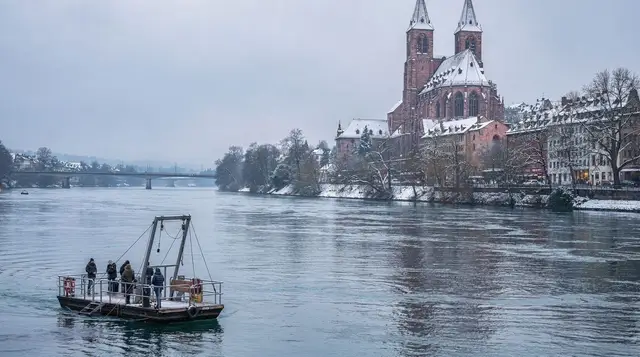
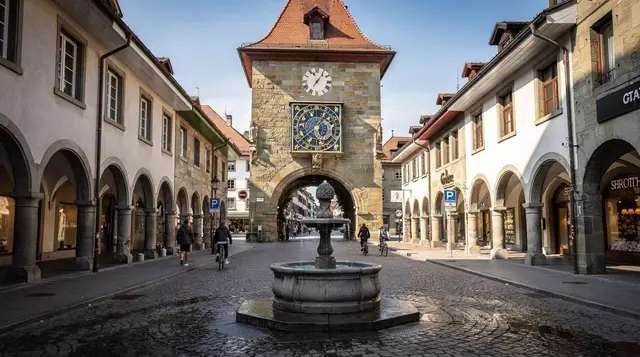
Stans does not get the same volume of day-trippers as Pilatus or Rigi, and that is more or less the point of going. The town itself is a proper Nidwalden county seat with a Baroque church and a war memorial worth ten minutes of attention, and above it sits a mountain reached by two lifts that between them cover more than 130 years of Swiss cable transport: a 1893 funicular that still climbs the original alignment, and the CabriO, a double-decker cable car with no roof on its upper deck.
It is a shorter, cheaper outing than Mount Pilatus or Mount Rigi, with a lower summit and a narrower view, and it earns its place on a Lucerne itinerary on the strength of the ride rather than the panorama.
Getting from Lucerne to Stans
The Zentralbahn line to Engelberg calls at Stans roughly every 15 to 30 minutes from Lucerne station, and the direct journey takes about 20 minutes. It’s an easy add-on to a Lucerne morning: leave after breakfast, be on the mountain by mid-morning, and be back in town for a late lunch if you want to keep it to a half day. Anyone building a longer loop can read up on the connections in Swiss trains explained before setting off, and the Swiss Travel Pass guide or the Tell-Pass guide is worth checking first, since both typically cover the Zentralbahn leg and give a discount on the mountain lifts themselves.
From Stans station, the funicular base at Kälti is a five-minute walk uphill, or a short hop on the local bus that meets most trains. There’s no need to book the train in advance; the funicular and CabriO tickets are bought at Kälti or online, and departures run at fixed intervals through the day rather than on demand.
Stans old town: Winkelried, the church and the Nidwalden Museum
Stans is compact enough to see properly in under an hour, which is exactly why it works well as a bookend to the mountain trip rather than a destination on its own. The centre of gravity is the Dorfplatz, where a bronze statue commemorates Arnold von Winkelried, the (probably legendary) Nidwalden soldier credited with breaking the Habsburg pike line at the Battle of Sempach in 1386 by gathering enemy spears into his own chest. Whether or not the story is literally true, Winkelried is the reason half the streets, inns and the local football club carry his name.
Behind the square, the parish church of St Peter and Paul is a full Baroque interior worth a quick look if it’s open, with a tower that’s older than the 18th-century nave around it. A few minutes’ walk away, the Nidwalden Museum occupies the Winkelriedhaus, a 17th-century patrician house, and covers the canton’s history from the Sempach battle through to the 19th-century tourism boom that eventually built the funicular up the mountain behind the town. It’s a small museum, realistically 45 minutes to an hour, and it’s the kind of stop that makes more sense of the funicular ride that follows. For a broader look at museum options around the region, see the Lucerne museums guide.
The 1893 funicular: Stans to Kälti and up to the middle station
The lower section from Kälti runs on the original 1893 alignment, making it one of the older funiculars still operating in Switzerland, though it has been rebuilt more than once since — most notably after a fire destroyed a carriage in 1970, which is also the disaster that eventually pushed the operator to replace the old summit gondola with something more modern decades later.
The carriages are a deep red, the gradient is steady rather than dramatic (nothing like the 48% of the Pilatus cogwheel or the 110% of the Stoos funicular), and the ride itself is short: a few minutes up through forest to the middle station, where the funicular ends and the CabriO takes over for the final climb to the summit.
The CabriO: the world’s first open-top cable car
This is the actual reason to make the trip. The CabriO opened in 2012 to replace the older enclosed gondola on the upper section, and its top deck has no roof at all — passengers ride standing, exposed to the wind and the view, while the enclosed lower deck carries anyone who’d rather not. It was the first cableway of its kind anywhere, and it remains a genuinely different sensation from every other lift in the region: no glass between you and the ridge, no reflections to shoot through if you’re photographing, and a level of exposure that a handful of visitors find more unsettling than scenic. It’s not a long ride, five to six minutes, but it’s the five minutes most people remember afterwards, more than the summit itself.
At the summit: Rondorama, the ridge walk and the marmots
Stanserhorn tops out at 1,898 metres, lower than Pilatus and higher than Rigi Kulm, with a view that leans towards Lake Lucerne’s Nidwalden shore and the peaks of the Bernese Oberland on a clear day rather than the wraparound sweep some visitors expect after the Pilatus or Rigi photos they’ve seen online.
The summit building, Rondorama, has a rotating restaurant — a reasonable, unhurried lunch spot rather than a destination meal, and priced accordingly for a mountain restaurant, which is to say not cheap. Outside, a short ridge path loops around the top, and a marmot colony lives on the slope just below the summit building; they’re genuinely wild, not fed on schedule, so sightings depend on the time of day and how much foot traffic has already gone past.
Anyone weighing this stop against the bigger-name mountains might find the comparison guide useful: Pilatus vs Rigi vs Titlis covers the trade-offs in more depth, though Stanserhorn itself sits a notch below all three in both height and name recognition — which is also why it’s quieter.
Prices and timings
| Item | Approximate price (CHF) | Notes |
|---|---|---|
| Train Lucerne–Stans return | 20–24 | Covered by Swiss Travel Pass and Tell-Pass |
| Funicular + CabriO, Stans–Stanserhorn return | 70–80 | Discounts with Half Fare Card, Swiss Travel Pass, Tell-Pass |
| Nidwalden Museum entry | 8–10 | Closed Mondays outside peak season |
| Lunch at Rondorama | 25–40 | Mountain-restaurant pricing |
| Total day budget, one adult | 90–140 | Excludes souvenirs or extra activities |
Book the lift tickets ahead of a summer weekend if you can, since the funicular’s small carriages mean queues build fast on clear days. A convenient way to lock in the ride is a Cabrio Cable Car half-day trip to Stanserhorn from Lucerne, which bundles the return journey without you having to work out ticketing at Kälti yourself.
Timing it around lift maintenance
Like most cable cars and funiculars around Lake Lucerne, the Stanserhorn lifts close for scheduled maintenance, usually for a stretch in spring and sometimes again in autumn. This is the detail that ruins the most day trips: someone builds an itinerary around Stanserhorn, arrives in Stans, and finds the base station shut for a fortnight of servicing. Check the current operating calendar before you commit a whole morning to it, particularly if you’re travelling in April, May, or late October to November.
Stanserhorn for a longer stay: paragliding and beyond
Stans is also a launch point for tandem paragliding, taking off from the upper slopes and landing back near the valley floor — a way to see the same ridge from a different angle if a five-minute CabriO ride isn’t enough exposure for one day. It’s bookable as a tandem paragliding flight over Stans and typically runs a couple of hours door to door including the drive up and the flight itself, weather permitting.
Travellers who’d rather have the mountain fairly to themselves, with a guide setting the pace instead of a fixed lift timetable, can also look at a private guided Stanserhorn mountain tour departing from Lucerne, which adds commentary and flexibility that the standard self-guided lift trip doesn’t.
Stanserhorn versus the bigger mountains
The honest comparison: Pilatus has the steepest cogwheel railway in the world and the option of a round trip via Kriens by cable car, giving it two very different approach routes and a genuinely dramatic gradient; Rigi has the widest, longest-established panorama and two separate approach lines from Vitznau and Arth-Goldau; Stanserhorn has neither the tallest summit nor the widest view, but it has the CabriO, which no other lift in the region replicates.
If time and budget only stretch to one mountain, most first-time visitors are better served by Pilatus or Rigi — see best mountain excursions from Lucerne for the full rundown. Stanserhorn earns its slot on a second visit, a quieter day, or specifically because the open-top ride itself is the attraction rather than the view from the top.
With kids, and without a car
The lifts are straightforward with children old enough to stand on the open CabriO deck comfortably; younger kids or anyone uneasy with heights can ride the enclosed lower deck instead, so it isn’t an all-or-nothing choice. For a wider set of options pitched at families, Rigi and Pilatus with kids and family day trips from Lucerne cover the alternatives, and general planning help sits in Lucerne with kids.
No car is needed for any part of this trip: train to Stans, a short walk or bus to Kälti, two lifts, and the same route back. Anyone wanting the wider transport picture before travelling can start with getting around Lucerne.
Stanserhorn on an itinerary
As a half-day add-on, Stanserhorn slots naturally into a two-day Lucerne itinerary alongside the old town and lake, or into a family-paced four-day family itinerary where a shorter, less crowded mountain outing is easier on younger legs than a full Pilatus or Rigi day. For more day-trip options from the same base, see day trips from Lucerne generally, or browse things to do: mountains and peaks for the full regional list.